Define Capital Loss: A Guide for Taxpayers & Businesses
Define capital loss and understand its tax implications. Our guide explains short vs. long-term losses, the $3,000 deduction, carryovers, and wash sale rules.

In this article
- Investing Isnt Always a Win What Happens When You Have a Loss
- Why business owners make this mistake
- What Is a Realized Capital Loss Really
- The formula that actually matters
- Adjusted basis isn't just what you paid
- A simple business-owner example
- The Two Types of Capital Losses Short-Term and Long-Term
- The dividing line
- Why the classification matters
- A practical comparison
- How to Calculate and Deduct Your Capital Losses
- The five-step sequence
- What this means in practice
- Where people blow this
- Individuals and corporations are not treated the same
- Capital Loss Scenarios for Taxpayers and Businesses
- Personal investor with a taxable brokerage account
- Sole proprietor selling business equipment
- S corporation or LLC owner dealing with pass-through reporting
- The practical takeaway from all three
- Common Mistakes and Special Tax Rules to Know
- Why wash sales create expensive problems
- The other mistake the IRS notices fast
- When to Call a Tax Attorney About Your Losses
- The situations that justify professional review
You sold stock from a side investment account for less than you paid. Or you unloaded an older business vehicle, computer, or piece of equipment and took a hit. Your first question is usually simple. Can I deduct that loss?
Sometimes yes. Often not the way people think.
Business owners get into trouble here because they treat a drop in value like a tax deduction. The IRS doesn't. A falling brokerage balance is not the same thing as a deductible loss. That mistake is common enough that over 15% of individual taxpayers incorrectly report unrealized losses as deductible capital losses annually, creating audit risk, according to CFI's capital loss overview.
If you're self-employed, run an LLC, or already have tax debt, this isn't a technical foot fault. It's the kind of reporting error that can compound other IRS problems. You need to know what counts, what doesn't, and where the traps are.
Investing Isnt Always a Win What Happens When You Have a Loss
A lot of taxpayers land here the same way. They sold something for less than they paid and assumed the tax result would be automatic.
A sole proprietor sells shares from a personal brokerage account after a rough year. An independent contractor replaces an older laptop setup and disposes of the old one at a loss. A small business owner gets rid of an asset that clearly didn't hold its value. They look at the numbers and think, "I lost money, so I should get a deduction."
That's not how the rule works.
The line that matters is whether the loss was realized, not whether the asset declined in value while you held it. That distinction trips people up constantly, especially taxpayers juggling business income, payroll obligations, estimated taxes, and personal investing on the side.
Why business owners make this mistake
Business owners are used to practical accounting. If money went out and value went down, they expect a tax consequence. Capital loss rules don't follow that instinct. They follow disposition, basis, classification, and reporting rules.
That means these assumptions often cause problems:
- A paper loss counts: It doesn't, unless the asset was sold or otherwise disposed of.
- Any asset sold at a loss creates the same tax result: It doesn't. The type of asset and how you used it matter.
- The deduction is immediate and unlimited: It isn't for individuals.
- If the numbers are close enough, the IRS won't care: It will if the return is wrong.
Practical rule: If you haven't sold the asset, don't claim a capital loss.
This matters even more if you're already trying to resolve tax debt. Inaccurate loss reporting can distort income, affect collection alternatives, and invite scrutiny right when you need your filings to be clean.
What Is a Realized Capital Loss Really
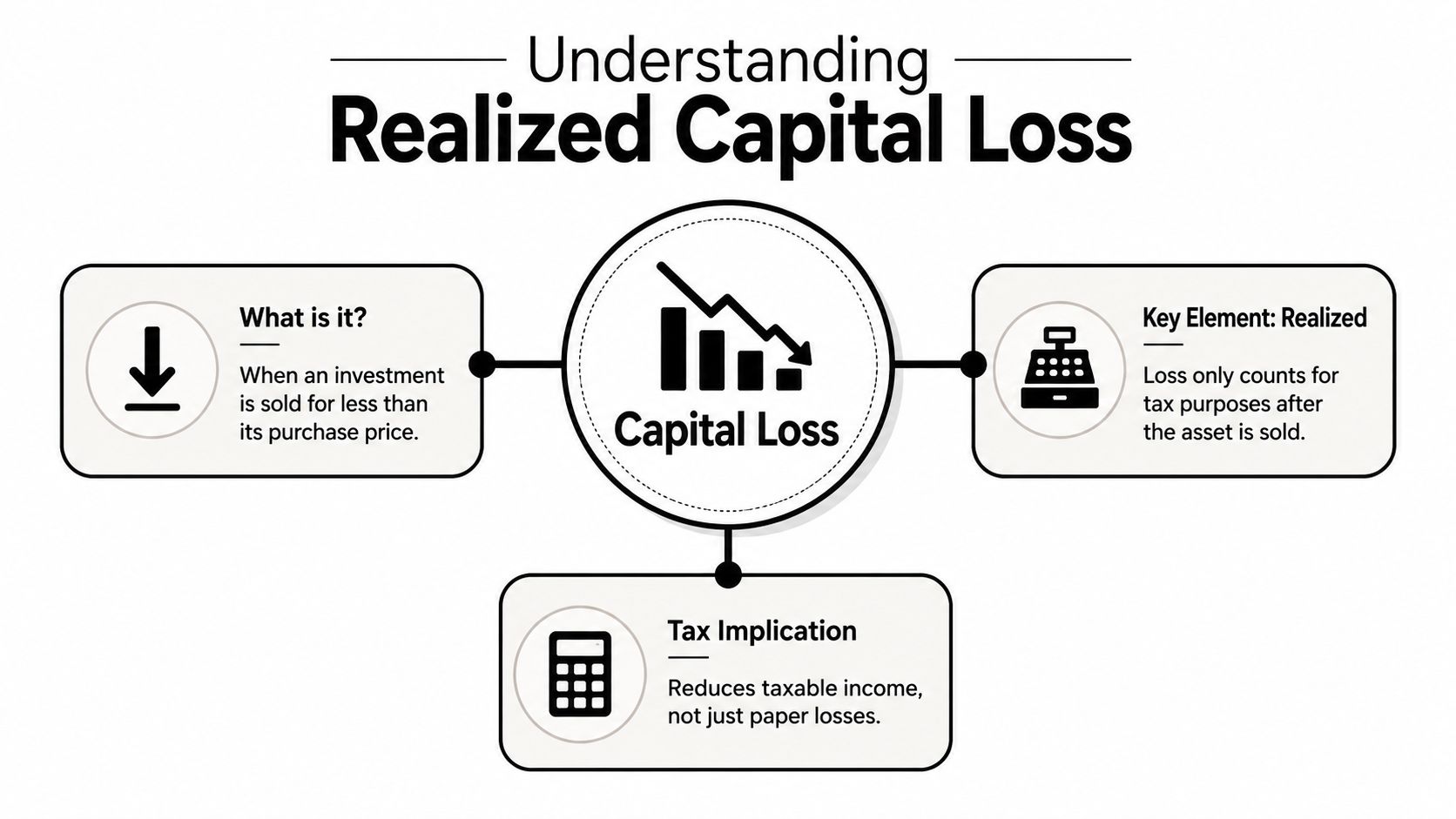
A capital loss exists when the amount you receive from selling a capital asset is less than your adjusted basis in that asset. For U.S. tax purposes, if the amount realized minus the adjusted basis is negative, you have a capital loss, and it becomes real for tax purposes only when the asset is sold, as explained in Study.com's lesson on calculating capital losses.
The formula that actually matters
Use this basic formula:
| Item | What it means |
|---|---|
| Amount realized | What you received on the sale or disposition |
| Adjusted basis | Your tax basis after required adjustments |
| Result | If amount realized is lower than adjusted basis, that's a capital loss |
If you're trying to define capital loss in plain English, here's the clean version. It's a tax loss you lock in when you sell a capital asset for less than its adjusted basis.
Adjusted basis isn't just what you paid
Many DIY filers get sloppy. They use the purchase price and stop there.
Your adjusted basis starts with what you paid, but it can change. It may include capitalized improvements, and it can be reduced by depreciation where applicable. If you don't calculate basis correctly, the loss number will be wrong before you even get to Schedule D.
For a basic grounding in what counts as a capital asset in the first place, BookkeepDIY's capital asset guide is a useful reference.
A market drop inside your account is not a tax event. A completed sale is.
A simple business-owner example
Suppose you bought company stock in a taxable brokerage account and later sold it for less than your adjusted basis. That sale creates a realized loss. The loss didn't exist for tax purposes the day the market fell. It existed the day you sold.
Now change the facts. You still hold the stock, and the value is down sharply. That's unpleasant, but it's still just an unrealized loss. The IRS treats it as tax-neutral until disposition.
That one distinction causes more filing mistakes than it should.
The Two Types of Capital Losses Short-Term and Long-Term
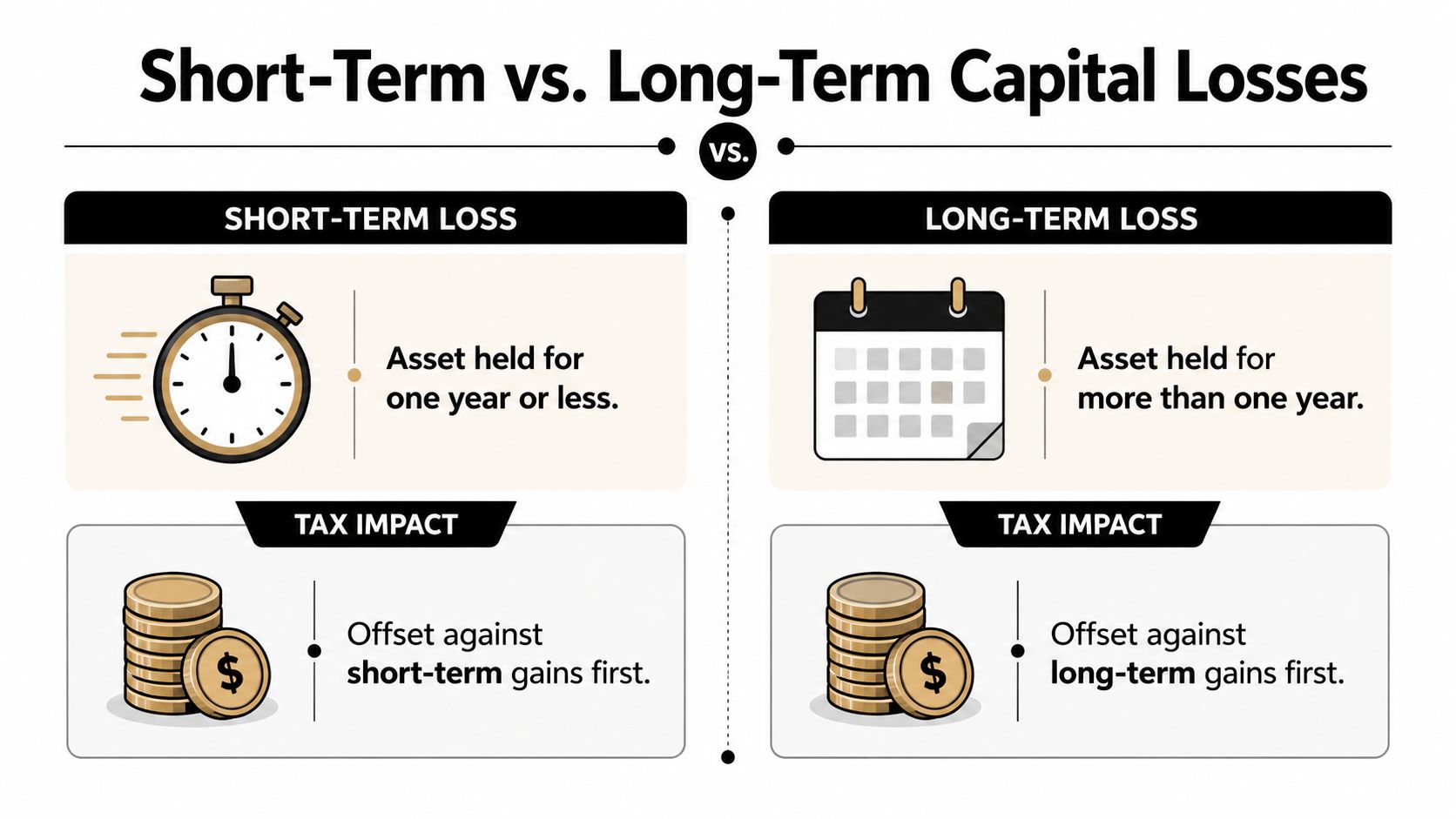
Once a loss is realized, the next question is classification. The IRS doesn't treat every capital loss the same. The holding period controls whether the loss is short-term or long-term, and that classification affects how the loss gets netted.
The dividing line
Here is the practical split:
| Type | Holding period | First use in netting |
|---|---|---|
| Short-term capital loss | Asset held for one year or less | Offsets short-term gains first |
| Long-term capital loss | Asset held for more than one year | Offsets long-term gains first |
That sounds minor. It isn't.
Why the classification matters
Business owners often focus only on whether a loss exists. The IRS also cares about what kind of loss it is.
If you sold one asset after a brief hold and another after holding it longer, those losses don't go into one generic bucket. They are netted in categories first. That affects how much gain they offset and how much net loss may remain after the process.
The mistake I see is assuming any loss is equally useful in any sequence. That's not how the forms work, and it's not how the return should be prepared.
A practical comparison
Short-term losses usually matter most when you also have short-term gains from active trading, frequent sales, or quick-turn investments. Long-term losses matter first against long-term gains from assets you held longer.
Keep this in mind:
- If you trade frequently, short-term classification can dominate your return.
- If you sell legacy investments, long-term classification may drive the result.
- If you have both, the order of netting matters, and your records have to be clean.
Don't guess at the holding period. Check trade confirmations, settlement records, and prior-year files.
This is one reason taxpayers get confused when software produces a result they didn't expect. The software may be right, but the user often doesn't understand that the code is sorting losses by holding period before applying them.
How to Calculate and Deduct Your Capital Losses
The deduction process is mechanical. If you skip steps, you'll get the wrong answer.
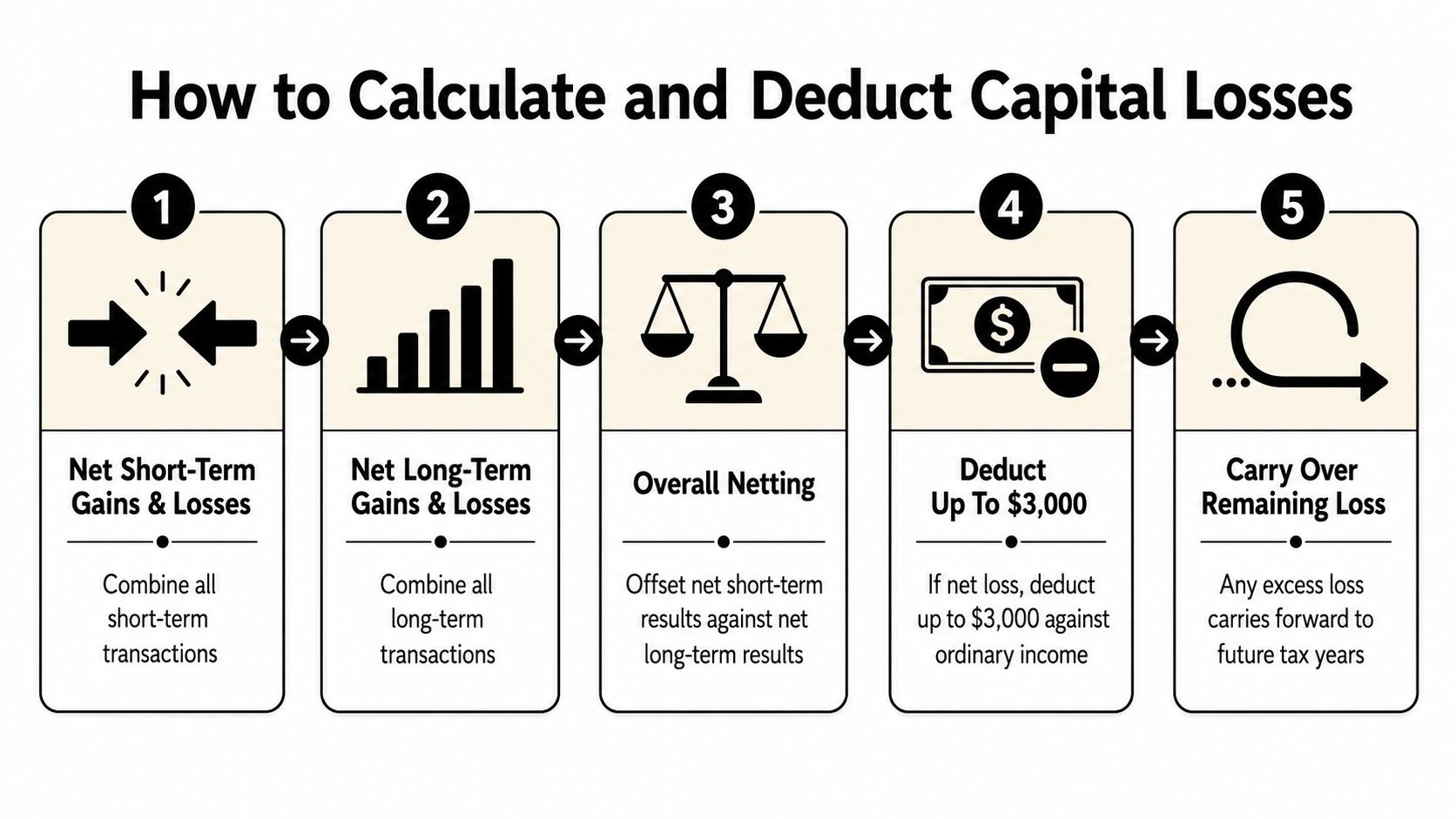
For individuals, net capital losses are deductible against ordinary income up to $3,000 annually, or $1,500 if married filing separately, and any excess can be carried forward indefinitely while keeping its short-term or long-term character, as noted in this capital loss deduction explanation.
The five-step sequence
Follow the order. Don't improvise.
Net your short-term transactions first
Combine all short-term gains and short-term losses.Net your long-term transactions next
Combine all long-term gains and long-term losses.Net the two results against each other
If one side is a gain and the other is a loss, they offset.Apply the ordinary income deduction if you still have a net loss
Individuals can deduct up to $3,000 against ordinary income, or $1,500 if married filing separately.Carry forward what's left
Unused loss doesn't disappear. It carries forward indefinitely and keeps its short-term or long-term classification.
What this means in practice
Most taxpayers don't lose the benefit of a large capital loss. They lose immediate access to the full benefit. That's a big difference.
If your net capital loss is larger than the annual deduction cap, the balance carries into future years. That's useful, but it also means recordkeeping matters. If you change preparers, switch software, or amend prior returns, sloppy carryover tracking creates avoidable problems.
If you're working through the details on federal reporting, the Schedule D instructions overview is worth reviewing before filing.
Where people blow this
The common mistakes are predictable:
- They skip the category netting. Short-term and long-term items have to be handled in order.
- They assume the whole loss offsets business income. For individuals, the annual ordinary income deduction is capped.
- They forget the carryover. That leaves money on the table in later years.
- They use bad basis numbers. The whole calculation then collapses.
Important: A large capital loss can be valuable, but only if it's reported correctly and tracked year to year.
Individuals and corporations are not treated the same
This is another trap. Individual taxpayers get the annual ordinary income deduction cap and indefinite carryforward treatment described above. Corporations are treated differently. If you're filing for a business entity, don't assume the individual rule applies just because you're the owner.
That's where many owner-managed businesses get confused. They mix entity-level rules with owner-level rules and end up reporting losses in the wrong place or expecting a deduction the return doesn't allow.
Capital Loss Scenarios for Taxpayers and Businesses
The rules make more sense when you put them into real situations. Here are three common ones.
Personal investor with a taxable brokerage account
A business owner sells several investments from a personal brokerage account. Some were held briefly. Others sat in the account much longer. One category produces gains, the other produces losses.
The first issue isn't emotion. It's classification. The return has to separate the short-term results from the long-term results, then net them in the proper order. If the taxpayer ends up with an overall net loss, the annual deduction limit applies and the rest carries forward.
Taxpayers often get frustrated. They expected the entire loss to wipe out other income immediately. It usually doesn't work that way.
Sole proprietor selling business equipment
A sole proprietor disposes of an older computer system or vehicle used in the business. They sold it for less than what they believe it was worth, so they assume they have a capital loss.
Maybe. Maybe not.
The tax treatment depends on the asset, its basis, how it was used, and what adjustments were made over time. This is exactly why business owners shouldn't casually label every loss on a sold business asset as a capital loss. Some losses belong in different categories and follow different rules.
If your broader goal is lowering overall exposure, this guide on ways to reduce tax liability is a useful companion read.
S corporation or LLC owner dealing with pass-through reporting
Owners of pass-through entities often think the entity-level transaction automatically gives them a personal deduction in the way they expect. That's too simplistic.
The pass-through structure means tax items move through the entity return and land on the owner's individual return according to the governing tax rules. The owner still has to classify and report the item correctly once it reaches the personal side. If there are basis limitations, prior-year carryovers, or mixed personal and business activity, the analysis gets more technical quickly.
The practical takeaway from all three
These examples all point to the same lesson. The phrase define capital loss sounds simple, but applying it correctly depends on the asset, the holding period, the basis, the owner type, and where the transaction belongs on the return.
Use this checklist before you claim any loss:
- Identify the asset clearly. Stock, partnership interest, vehicle, equipment, and real estate don't all behave the same way.
- Confirm who owned it. You personally, your LLC, and your S corporation are not interchangeable for tax reporting.
- Check the basis support. Purchase records, improvement records, and depreciation history matter.
- Match the loss to the right return. Entity return and individual return issues often get blurred.
- Review prior years. Carryovers and prior reporting choices can change the result.
If any one of those items is fuzzy, stop guessing.
Common Mistakes and Special Tax Rules to Know
You sell stock at a loss on Tuesday, buy it back before the month ends, and book the deduction anyway. That is the kind of shortcut that gets business owners into trouble.
The biggest trap is the wash sale rule. If you sell a security at a loss and buy the same security, or one the IRS treats as substantially identical, within the 30-day window before or after the sale, the loss is generally disallowed for now. This is a routine problem for owners who trade in personal accounts, retirement accounts, and business-related accounts without tracking all of them together.

As noted in Jackson Hewitt's discussion of capital gains and losses, wash sale mistakes regularly derail capital loss deductions and trigger IRS scrutiny, especially for self-employed filers and single-member LLC owners who repurchase too quickly.
Why wash sales create expensive problems
The rule exists to stop taxpayers from claiming a tax loss while keeping the same market position. If you never really stepped away from the investment, do not expect the IRS to reward the sale with an immediate deduction.
Business owners miss this because they focus on the trade, not the reporting. The IRS does the opposite.
A repurchase in another brokerage account can still cause a problem. So can automatic dividend reinvestments. So can a spouse's account in some situations. If you are harvesting losses, you need to review every related account before you sell, not after the 1099 arrives.
The other mistake the IRS notices fast
A drop in value is not a deductible capital loss by itself. Until you complete a taxable sale or other recognized disposition, you usually have a paper loss, not a tax loss.
That distinction matters even more if you already have tax debt or an installment agreement in place. Inflating losses, reporting unrealized declines, or forcing a deduction into the wrong year can damage your credibility with the IRS at the exact moment you need accurate filings most.
Watch for these red flags:
- Selling and rebuying inside the wash sale window: The loss may be disallowed.
- Ignoring linked accounts: Personal, joint, and sometimes retirement activity can affect the result.
- Reporting unrealized losses: A market drop without a sale is not a capital loss deduction.
- Relying on broker summaries without checking details: Dates, lot selection, and basis adjustments decide the tax result.
- Waiting to fix a bad filing: Delays turn a correctable reporting error into notices, penalties, and amended return work.
If you already filed and now see that a wash sale was missed or a paper loss was reported as real, read this guide on how to amend a tax return after a reporting error before the problem gets more expensive.
Assume the IRS will compare dates, accounts, and basis records. File that way.
When to Call a Tax Attorney About Your Losses
Some capital loss issues are routine. Others are not worth handling casually.
You should get legal tax help when the loss involves a complicated business asset, real estate, inherited property with an uncertain basis, pass-through entity reporting, prior-year carryovers that don't reconcile, or any situation where the IRS is already on your back. If you have tax debt, an installment agreement issue, an audit, payroll tax exposure, or possible Trust Fund Recovery Penalty concerns, accuracy isn't optional.
The situations that justify professional review
Call a tax attorney when:
- Your basis records are incomplete. If you can't prove basis, the IRS won't accept your preferred number just because it sounds reasonable.
- The asset came from a business structure. Entity-level transactions can create reporting issues owners routinely mishandle.
- You already filed something questionable. A bad capital loss entry is easier to correct early than after an IRS notice.
- You need the return to support a tax resolution strategy. Clean filings matter when you're negotiating with the IRS.
Form 8949 and Schedule D look manageable until they aren't. Once you add carryovers, pass-through items, basis adjustments, or wash sale problems, the return becomes less of a bookkeeping task and more of a risk-management exercise.
If your facts are messy, don't rely on instinct. Get the analysis done before you file, amend, or start moving assets around. If you're weighing whether the issue has crossed into legal-tax territory, this overview on when to hire a tax attorney will help you make that call.
If you're dealing with capital losses alongside IRS debt, audit pressure, payroll tax issues, or uncertain reporting, contact Attorney Stephen A Weisberg. He offers a free Tax Debt Analysis to determine whether he can help and what the best path looks like before you commit to representation.


