DC State Tax: A Complete Guide for 2026
Learn about DC state tax for individuals and businesses in 2026. Find rates, deductions, and filing tips in this comprehensive guide.

In this article
- Why DC State Tax Catches People Off Guard
- The part people miss
- How DC's Tax Burden Compares Nationally
- The revenue mix explains the pressure
- What that means in real life
- Why compliance risk is real
- Understanding DC Individual Income Tax Brackets
- Brackets that change the game
- Why planning has outsized value
- DC Sales and Use Tax Rules for Businesses
- Classification drives the actual trap
- Fix the system, not the invoice
- Business Tax Obligations and the Trust Fund Recovery Penalty
- Payroll withholding is where personal liability starts
- Nexus is broader than people expect
- DC Tax Audits Collections and Resolution Options
- What usually triggers trouble
- Your resolution choices
- Why the right help matters
- Who Really Bears the DC Tax Burden and What to Do Next
- Who should pay attention first
- What to do next
You moved to the District, hired a bookkeeper, and figured your taxes were simple because you're not running a giant corporation. Then the notice shows up, or your CPA says the return was filed in the wrong place, or your sales tax system has been charging the wrong rate for months. That's when you learn the hard way that DC state tax is really a full local tax regime, and the District does not treat confusion as a defense.
If you live here, work here, sell here, or own property here, you're inside a system that behaves like a state tax authority even though DC isn't a state. It reaches income tax, property tax, sales tax, payroll withholding, and business-level filing exposure, and the Office of Tax and Revenue tends to act fast when it thinks money is missing. The right move is to understand where the traps are before the District finds them for you.
Why DC State Tax Catches People Off Guard
A freelance designer moved to Shaw, started working for clients across the country, and assumed her filing life got easier because she didn't own a storefront. Then she realized her DC return wasn't just about income. Her rent didn't create a deduction by itself, her side business had separate filing questions, and one overlooked notice can snowball into enforcement if you let it sit.
That's the pattern I see over and over. People think DC is “just a city tax environment,” then discover it operates like a state tax jurisdiction for residents, businesses, and professionals. The District's own revenue mix tells you why the system is taken seriously, because in tax year 2023 the income tax supplied 36.1% of revenue, property tax contributed 25.7%, and sales, use, and excise taxes provided 17.4% of the District's $11.5 billion in total taxes and non-tax revenue, which the Office of Revenue Analysis said equaled 7.9% of the District's economy as measured by real GDP (DC Tax Facts Visual Guide 2024).
The part people miss
DC's burden isn't concentrated in one narrow filing. It's spread across the stuff ordinary taxpayers touch every day, which is why missing one return type doesn't stay small for long. A homeowner, a consultant, and a restaurant operator all face different taxes, but they're all inside the same local enforcement system.
Practical rule: if you owe tax, collect tax, or withhold tax in DC, treat the District like a real state tax authority, because that's how it will treat you.
One reason the issue gets messy is that a lot of taxpayers only discover the problem after a levy threat, not before. If you want a plain-English primer on how that collection pressure works, the explanation of a state tax levy is a useful starting point.
How DC's Tax Burden Compares Nationally
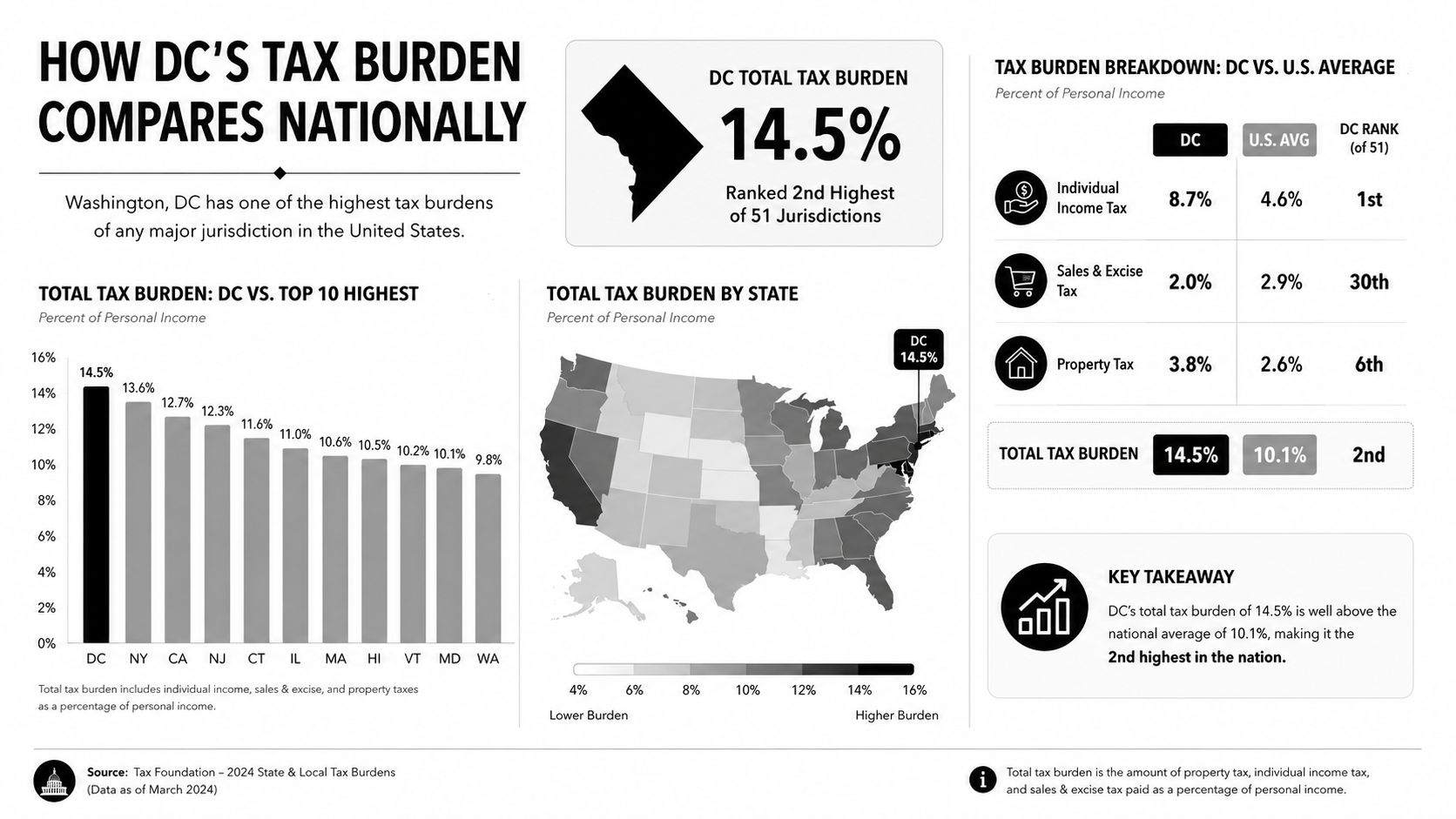
A business owner who assumes DC behaves like a low-friction local tax district is asking for trouble. The Tax Foundation ranks DC 48th overall in its 2025 State Tax Competitiveness Index, with weak marks in individual income taxes (47th) and property taxes (48th) (Tax Foundation DC index page). That ranking matters because it reflects a system built for collection, not for simplicity. If you file, collect, or hold property in the District, the rules are built to find mistakes.
The revenue mix explains the pressure
DC leans on the taxes taxpayers touch most often, income, property, and sales. That is why enforcement pressure lands on ordinary transactions instead of sitting in some narrow corner of the code. In the January 2026 trend report, the Office of Revenue Analysis said total tax collections were up 20.5% year over year, even as sales tax collections were down 2.8% in the same period. Per the same index, DC still sits near the bottom nationally, which tells you the District can keep pulling revenue even when one stream softens.
What that means in real life
For homeowners, DC property taxes sit inside a system with an effective property tax rate on owner-occupied housing of about 0.60%. For income earners, DC uses seven brackets with rates from 4.00% to 10.75%. For consumers and businesses, the general sales tax rate is 6.00%, and the trap is the special-rate structure around hospitality and parking, which creates room for misclassification and audit exposure.
If you are sorting out whether a deduction belongs on a federal itemized return or on the rental side of the ledger, the distinction in schedule A vs schedule E rules matters before you assume the federal treatment matches DC treatment.
Why compliance risk is real
DC is a revenue-heavy jurisdiction, so it does not ignore bad filings for long. When a return is wrong, the District has both the incentive and the administrative machinery to pursue it, and it uses that machinery hard. A sales tax error, a withholding failure, or a property classification mistake can turn into a collection problem before the taxpayer understands what went wrong.
For ongoing updates on state and local tax issues, the SALT newsletter archive is a useful reference point for taxpayers who need more than a rate chart.
Bottom line: DC's tax burden is high enough that small classification mistakes become expensive, and the District has every reason to keep chasing them.
Understanding DC Individual Income Tax Brackets
A DC return can look harmless until income crosses a bracket line. That is the part taxpayers miss. DC's individual income tax is progressive, and the key risk is bracket stacking, because a small increase in taxable income can push part of the return into a higher rate band. Under DC Official Code § 47-1806.03, taxable income runs through seven brackets, starting at 4.0% on the first $10,000 and rising to 10.75% above $1,000,000 (DC individual and fiduciary income tax rates). The rate schedule matters because the tax hit is tied to where the income lands, not just the total amount earned.
Brackets that change the game
The middle tiers do more damage than many taxpayers expect. Moving from $59,999 to $60,001 changes the marginal rate on the extra amount from 6.5% to 8.5%, and crossing $250,000, $500,000, and $1,000,000 each moves income into the next step of the rate schedule, as shown in the bracket table above. That is why I tell clients to stop thinking in a single blended number. DC taxes are driven by bracket placement, and bracket placement is what creates the surprise bill.
Here is the bracket structure in plain form:
| DC Individual Income Tax Brackets | Marginal Tax Rate |
|---|---|
| First $10,000 | 4.0% |
| Next bracket | 4.5% |
| Middle brackets | 6.0% to 8.95% |
| Upper brackets | 10.75% |
Why planning has outsized value
Year-end moves matter. Loss recognition, retirement-plan contributions, and entity classification planning can shift taxable income across thresholds instead of merely trimming one rate. A DC return with the same gross income can therefore produce very different results depending on timing and structure.
Practical rule: in DC, ask not just “how much income did I earn,” but “which bracket did I push it into.”
There is also a separate 8.25% tax on net income attributable to DC for certain business income, so entity-level sourcing and apportionment can change the total burden before you even reach the personal brackets (DC individual and fiduciary income tax rates). That point matters for pass-through owners who assume their entity setup will not affect the filing result.
Use the bracket table above, and model the return before you file it. Guessing is how people overpay or underreport.
DC Sales and Use Tax Rules for Businesses
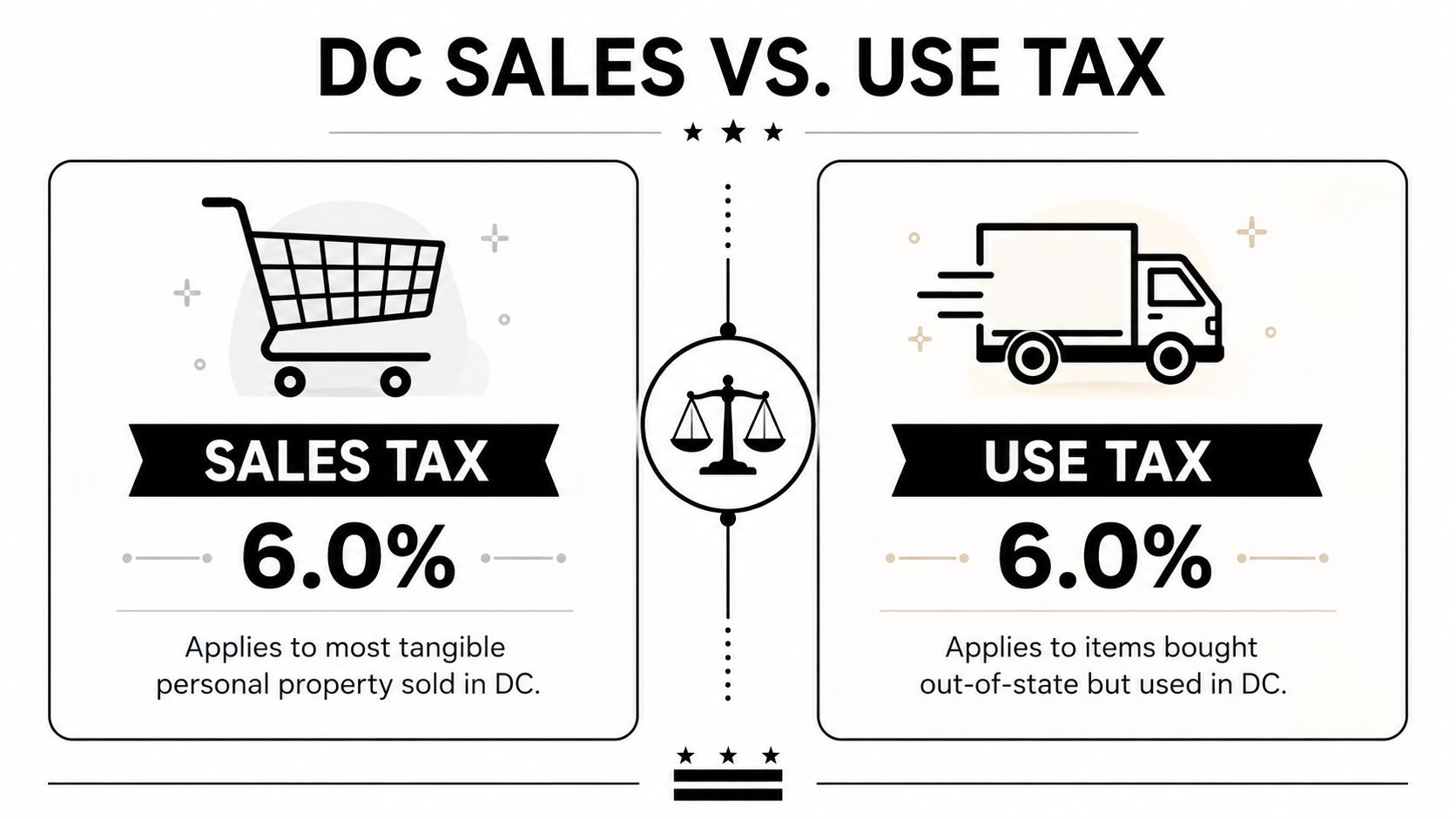
DC's sales tax system catches businesses off guard because the posted rate is only the first layer. The District applies a 6.0% general rate to tangible personal property and selected services, but it also taxes certain categories at much higher rates, including 10.0% for restaurant meals and liquor consumed on-premises, 10.25% for alcoholic beverages sold off-premises, 14.95% for hotels, and 18% for parking in commercial lots (DC sales and use tax).
Classification drives the actual trap
The tax result depends on what the transaction is, not just what the invoice says. One sale can be taxed at 6% while another lands at 14.95% if it is treated as transient lodging instead of a standard retail sale, as shown on the same OTR sales and use tax page. That is why DC under-collection problems usually start with misclassification, not with a missing line item.
Hospitality operators run into this first. Event venues, restaurants, bars, parking operators, and transportation-related businesses have to classify receipts carefully, because a wrong POS code does not stay isolated. It repeats on every return until someone fixes it.
Fix the system, not the invoice
The primary control point is the tax setup inside the billing system. If the code is wrong, every return built from that system carries the same error. That creates exposure across multiple filing periods, and the District does not need to show bad intent to assess the difference.
A clean internal process should include:
- Tax-code mapping: Confirm each item or service is assigned the correct DC rate in the POS or billing platform.
- Receipt review: Spot-check mixed transactions, especially where food, lodging, alcohol, or parking are involved.
- Exemption support: Keep documentation for exempt sales instead of assuming the customer's status is obvious.
If you run a small operation and have not built these controls yet, the small business tax checklist gives you a practical framework for getting the basics in order.
Practical rule: if your software cannot distinguish taxable categories correctly, your returns are not reliable.
DC's sales and use tax rules are detailed enough that many businesses need a monthly review, even when the volume is modest. That sounds tedious. It is still cheaper than rebuilding several quarters of returns after an audit notice.
Business Tax Obligations and the Trust Fund Recovery Penalty

A lot of DC law firms, consultancies, and pass-through businesses think the District's tax rules are mostly someone else's problem. That mindset is expensive. Once you add payroll withholding, business income sourcing, and filing footprint questions, even a small professional-services firm can create real exposure.
Payroll withholding is where personal liability starts
When a business withholds tax from wages and fails to remit it, the District can pursue the people responsible for the decision. That's where the Trust Fund Recovery Penalty comes in, and it's not limited to the owner in the corner office. Officers, managers, and in some cases even bookkeepers can be pulled into the issue if they controlled the withholding and payment process. If you want the formal mechanics, the Trust Fund Recovery Penalty overview is the right reference.
That's the part business owners hate hearing. They think the company is the taxpayer. Sometimes DC agrees, then turns around and asks who handled the money.
Nexus is broader than people expect
Remote and hybrid service providers create filing questions too. A business doesn't need a storefront in the District to trigger obligations. Employees, contractors, repeated client work, or other local contacts can create filing exposure, especially when the company is already touching DC customers or DC-based operations.
Professional-services firms get caught here because they don't think of themselves as “retail” or “tax heavy.” That's a mistake. Law firms, lobbyists, consultants, and other service businesses can still create filing and withholding problems if their structure, sourcing, or payroll handling is sloppy.
One option for owners who need a direct problem-solving path is Tax Attorney Stephen A Weisberg's tax debt analysis process, which is designed to identify whether a case can be resolved before money is spent on formal representation. That kind of triage matters when the issue is payroll, notice-driven, or tied to personal assessments.
Bottom line: if your business touches DC income, DC workers, or DC withholding, don't assume you're too small to matter.
The clean move is to review entity treatment, payroll procedures, and filing presence before the first notice arrives. After that, the options narrow fast.
DC Tax Audits Collections and Resolution Options
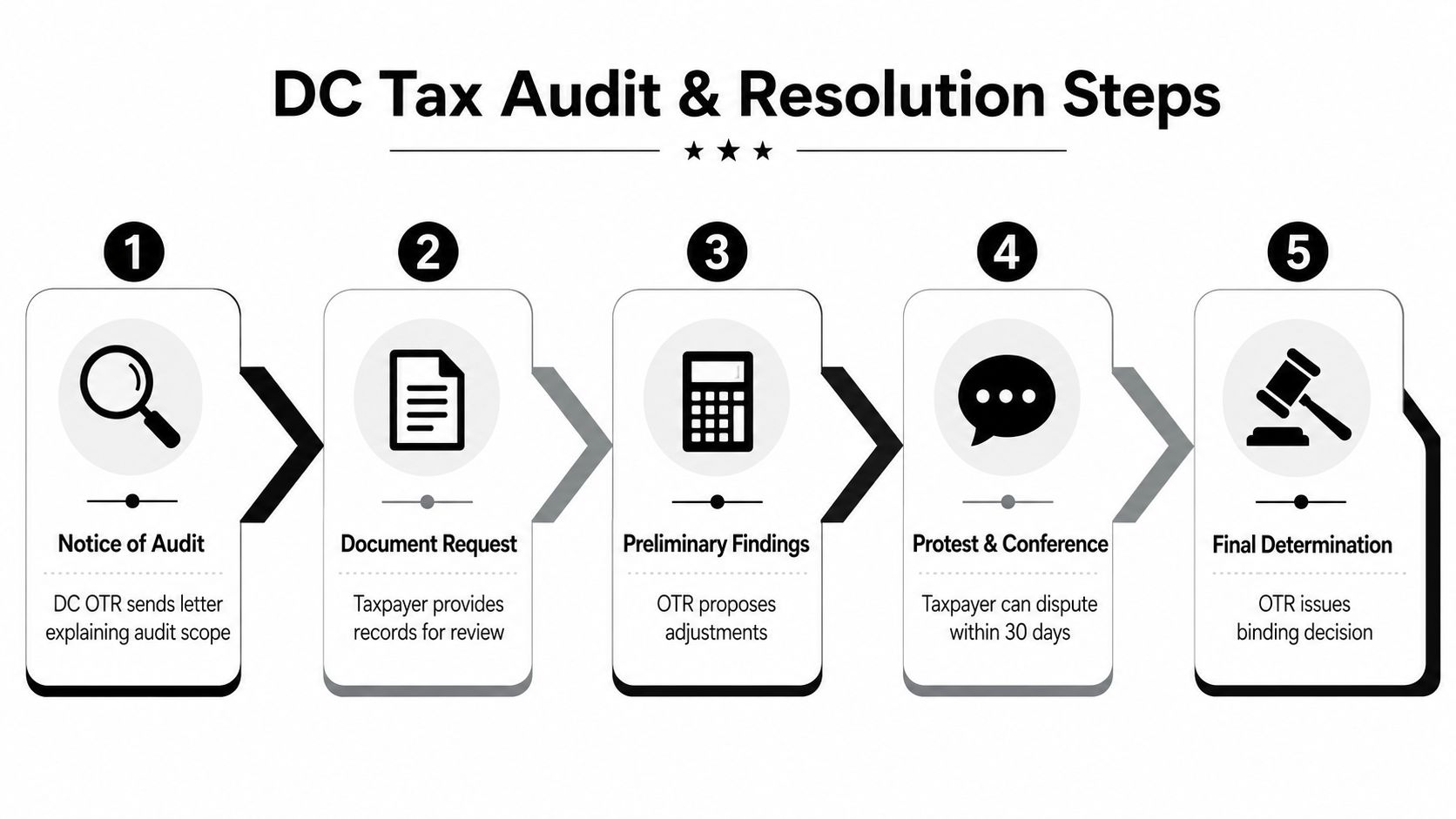
When the Office of Tax and Revenue starts asking questions, the worst response is silence. DC tax collections tend to escalate from letters to enforced action, and once a case gets moving, the agency is no longer interested in your theory that the mail got buried.
What usually triggers trouble
Audits often start with inconsistent returns, missing filings, payroll mismatches, or sales tax questions where the classification doesn't match the receipts. If the issue is a balance due, the collection path can move quickly into liens and levies if you ignore the notices. That's not drama, that's how enforcement works when an account stays open.
The better path is to answer the notice, preserve your records, and force the case into a review posture before the District makes it a collection file.
Your resolution choices
The practical options are straightforward, but only if you act early:
- Installment agreement. Useful when you can pay over time and want to stop the immediate pressure.
- Offer in compromise. Appropriate only when the facts support a settlement based on collectability or other qualifying grounds.
- Penalty abatement. Worth pursuing when the facts support reasonable cause or administrative relief.
- Currently not collectible status. This is for cases where payment would create immediate hardship and the file needs to pause.
The challenge is timing. If you wait until the collection stage is already active, you've usually lost negotiating power.
Why the right help matters
A CPA can prepare a return. An enrolled agent can handle many filings. But controversy work, collection defense, and personal-liability exposure call for a tax attorney who handles disputes. That's not a marketing line, it's a scope issue. The person who can file a return is not always the person who can stop a levy.
Practical rule: once DC starts collection activity, treat the case like a dispute, not a bookkeeping task.
If you want to understand how representation works in tax matters, the question is whether the person handling your file can negotiate, respond, and protect you when the District escalates. That's the difference between cleanup and damage control.
Who Really Bears the DC Tax Burden and What to Do Next
A lot of DC tax commentary stops at rate charts. That misses the issue. Policy analysis has pointed out that DC's system can produce lower effective tax rates for the top 1% than for middle-income residents because capital gains preferences and targeted property tax relief tilt benefits upward (DC Fiscal Policy Institute analysis). So yes, DC has progressive brackets. No, that does not mean the burden lands evenly.
Who should pay attention first
Homeowners with multiple properties, business owners with payroll exposure, and higher-income taxpayers with complicated sourcing should act now. Renters, wage earners, and low-complexity filers may still need to check their returns, but their risk profile is usually narrower. The bigger mistake is assuming that a progressive-rate jurisdiction automatically means a fair or simple one.
The District also has targeted property tax relief programs, but relief rules don't erase the underlying complexity. They change the outcome only if they're claimed correctly. That's why distributional fairness and filing compliance are related, not separate.
If you're comparing disclosure tools or intake systems for tax issues, a guided overview of Tally competitors can help if you need a better way to collect financial information before you hand it to counsel.
What to do next
Pull your last filed DC return, check your income sourcing, inspect any sales tax setup, and review payroll withholding if you run a business. If the numbers don't make sense, don't guess. Get the file reviewed before the District starts making assumptions for you.
Tax Attorney Stephen A Weisberg helps taxpayers and business owners deal with DC tax debt, audits, withholding problems, and collection notices in a direct, representation-focused way. If you're facing a DC tax issue and want a clear assessment before spending money on a full case, visit Tax Attorney Stephen A Weisberg to request a free Tax Debt Analysis and get a practical plan for your situation.


