IRS: currently not collectible status irs explained
Learn the currently not collectible status irs, who qualifies, how to apply, and how it pauses IRS collections on your tax debt.
In this article
- What is Currently Not Collectible (CNC) Status?
- Think of CNC as a "Pause Button"
- How the IRS Assesses Your Situation
- CNC Status At a Glance
- How to Qualify for IRS CNC Status
- The Core of Qualification: Allowable Living Expenses
- A Real-World Calculation Example
- Proving Your Financial Situation
- The Application and Documentation Process
- Gathering Your Essential Financial Documents
- Demystifying Form 433-F
- Setting Expectations for the IRS Review
- How CNC Status Affects IRS Collection Actions
- What Stops and What Continues
- The Unseen Growth of Your Tax Debt
- The Impact of a Federal Tax Lien
- Understanding the Ten-Year Collection Statute
- CNC Status Does Not Pause the CSED Clock
- Actions That Do Pause the Collection Clock
- Life After Being Approved for CNC Status
- The IRS Periodic Review Process
- Automated Income Monitoring
- Your Ongoing Responsibilities
- Common Questions About CNC Status
- Does CNC Status Forgive My Tax Debt?
- Can the IRS File a Tax Lien If I Am in CNC Status?
- How Often Does the IRS Review CNC Cases?
- What Happens If My Income Increases While in CNC?
When you owe the IRS money but genuinely can't afford to pay, it can feel like you're drowning. The IRS has a provision for this exact situation, and it's called Currently Not Collectible (CNC) status.
This isn't a get-out-of-jail-free card. Instead, think of it as a temporary pause on all aggressive collection activities from the IRS. It's an official acknowledgment that, right now, paying your tax debt would leave you without enough money for basic necessities like housing, food, and medical care.
What is Currently Not Collectible (CNC) Status?
Imagine you’re trying to keep your head above water financially, and the IRS keeps sending waves of collection notices your way. Securing CNC status is like the IRS agreeing to calm the waters for a while, giving you some much-needed breathing room to get back on your feet.
While you're in CNC status, the most stressful collection actions come to a halt. The IRS won't be able to:
- Garnish your wages, taking money directly from your paycheck.
- Levy your bank accounts, freezing and seizing your funds.
- Seize your personal assets, like your car or home.
The core idea behind CNC is simple: the IRS shouldn't push someone into destitution to collect a tax debt. It’s a practical and humane approach that creates a temporary financial truce.
Think of CNC as a "Pause Button"
A great way to understand CNC is to think of it as a pause button. Your tax debt is still there, and unfortunately, penalties and interest will continue to pile up in the background. But the immediate, high-stakes pressure is off.
This pause gives you a critical window to work on improving your financial situation without the constant threat of levies or garnishments. But remember, it's just a pause. The IRS will periodically review your financial situation to see if it's time to press "play" on collections again.
How the IRS Assesses Your Situation
Getting into CNC status isn't automatic. You have to prove to the IRS that you truly can't afford to pay. This means they will conduct a deep dive into your finances.
You'll need to provide comprehensive documentation by filling out specific forms. Most people will use Form 433-F (Collection Information Statement), but self-employed individuals might use Form 433-A, and businesses use Form 433-B. These forms paint a complete picture of your income, assets, and living expenses. The IRS uses this information to determine if you genuinely qualify for relief.
For a detailed look at the official guidelines, you can review the IRS's internal collection procedures manual.
To give you a quick overview, here's a simple breakdown of what CNC status entails.
CNC Status At a Glance
| Feature | Description |
|---|---|
| Primary Purpose | To temporarily stop IRS collection actions for taxpayers experiencing financial hardship. |
| What Stops? | IRS levies, wage garnishments, and property seizures. |
| What Continues? | The tax debt still exists, and penalties and interest continue to accrue. |
| Federal Tax Liens | The IRS can still file a Notice of Federal Tax Lien against your property. |
| Duration | Temporary. The IRS will periodically review your financial situation to see if you can resume payments. |
| Qualification | Based on a detailed financial review of your income, assets, and necessary living expenses. |
This status is a powerful tool, but it's crucial to understand it's a temporary solution designed to provide relief during tough times, not a permanent escape from the underlying tax obligation.
How to Qualify for IRS CNC Status
Getting the IRS to agree you can't pay your tax debt isn't a matter of just telling them you're broke. You have to formally prove it. This process, known as qualifying for Currently Not Collectible (CNC) status, involves opening up your financial life to the IRS to show that paying them would leave you without enough money for basic living necessities.
At its core, the IRS is trying to answer one simple question: after you pay for essential living costs, is there anything left over? If the answer is no, you're a good candidate for CNC. The IRS isn't in the business of making people homeless; their own internal rules are designed to prevent collection efforts that would cause a taxpayer genuine economic hardship.
The Core of Qualification: Allowable Living Expenses
So, how does the IRS decide what's "essential"? They don't just take your word for it. Instead, they use a set of standardized figures called Allowable Living Expenses. These aren't based on your lavish weekend getaways or daily gourmet coffee habit, but on what the government considers a reasonable amount for basic survival based on national and local data.
The main categories they look at are:
- Housing and Utilities: This covers your rent or mortgage, property taxes, insurance, and basic utilities like gas, water, and electricity. The amount you're "allowed" is based on the standards for your specific county and family size.
- Food, Clothing, and Miscellaneous: This is a flat national standard meant to cover groceries, clothes, personal care items, and other small daily costs.
- Transportation: The IRS allows for the costs of getting to work. This includes a car payment (up to a certain cap) plus a standard allowance for gas, insurance, and maintenance.
- Out-of-Pocket Health Care: This covers your medical costs not handled by insurance, like co-pays and prescriptions. While there's a national standard, you can often claim higher amounts if you can prove them with receipts and records.
The IRS will take your total monthly income and subtract the sum of these allowable expenses. Whatever is left over is considered your disposable income. If that number is zero or negative, you have a solid case for CNC.
This infographic lays out the simple yes/no logic the IRS uses to determine if you can afford your basic living costs.
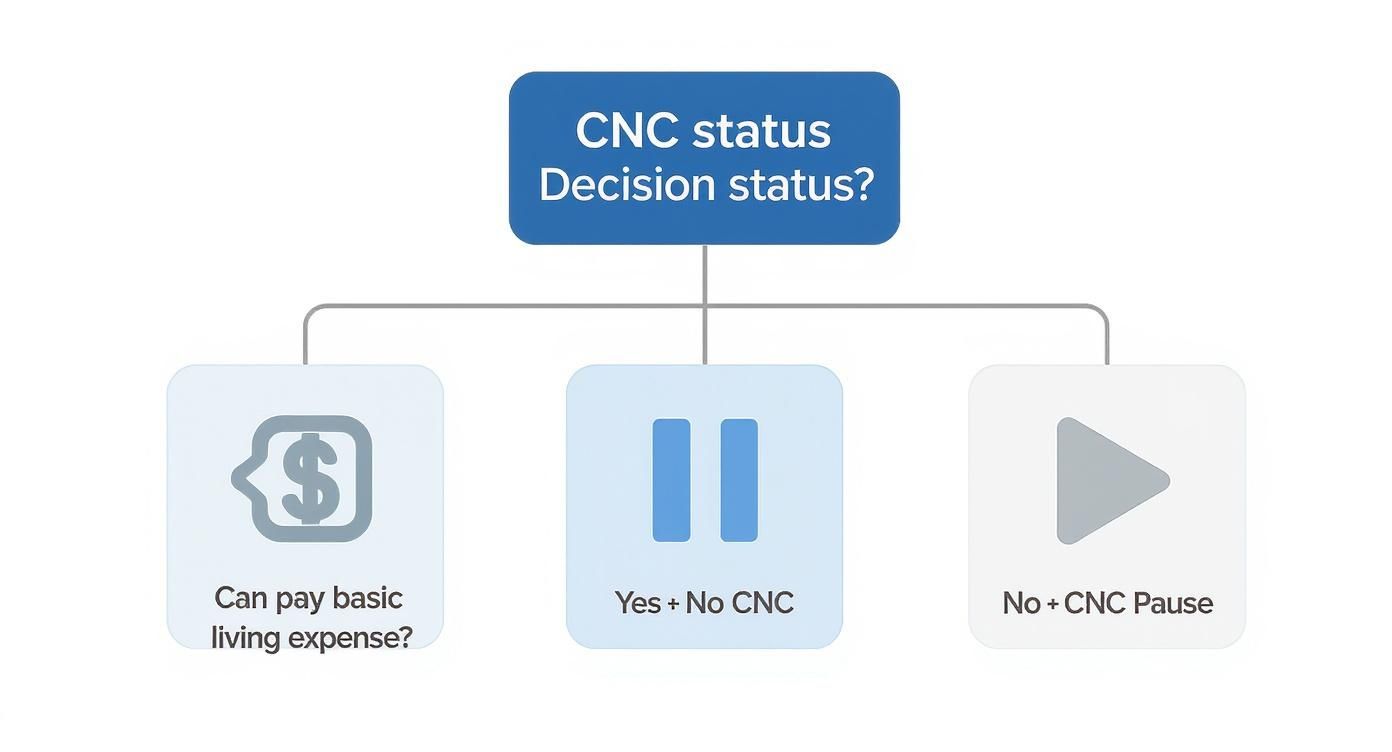
As you can see, the ability to cover those fundamental expenses is the clear dividing line between being put on a payment plan and being granted CNC status.
A Real-World Calculation Example
Let's walk through an example to see how this plays out. Meet Alex, a taxpayer who owes the IRS.
- Alex's Monthly Income: $4,000
- IRS Allowable Housing (Local Standard): $1,800
- IRS Allowable Food & Personal Items (National Standard): $1,200
- IRS Allowable Transportation (Local Standard): $600
- IRS Allowable Healthcare (National Standard): $150
First, we'll tally up Alex's total allowable monthly expenses:
$1,800 + $1,200 + $600 + $150 = $3,750
Next, we subtract those expenses from Alex's income:
$4,000 (Income) - $3,750 (Allowable Expenses) = $250 (Disposable Income)
In this case, the IRS sees that Alex has $250 left over each month. They would likely deny a CNC request and instead require Alex to set up a $250 per month Installment Agreement.
But what if Alex's income was only $3,500? The math changes completely:
$3,500 (Income) - $3,750 (Allowable Expenses) = -$250
This negative result is exactly what the IRS is looking for. It's the mathematical proof of financial hardship, making Alex a prime candidate for Currently Not Collectible status.
Proving Your Financial Situation
To get approved, you need to be an open book. This means filling out a Collection Information Statement (usually Form 433-F for individuals) and backing it up with hard proof—pay stubs, bank statements, bills, and receipts for major expenses. The IRS agent will comb through every detail to verify your claims.
Navigating these forms and standards can be tricky. Getting support from a tax professional can make all the difference in presenting your case clearly and correctly. An expert knows what the IRS looks for and can help you gather the right documentation. For a deeper dive into how the agency views these situations, check out our articles on the IRS definition of https://www.weisberg.tax/newsletter/tag/Financial+Hardship+IRS.
The Application and Documentation Process

Getting the IRS to agree to a currently not collectible status irs designation isn’t something that just happens. You have to take the lead and show them, in black and white, exactly why you can’t pay.
Think of it as building a case for financial hardship. Your paperwork is your evidence, and the IRS needs a complete, verifiable snapshot of your financial life before they'll even consider your request.
At the heart of this process is the Collection Information Statement. For most individual taxpayers, that means tackling Form 433-F. This is the official form where you lay out all your income, assets, and monthly expenses. It’s designed to give the IRS a clear picture of your financial reality.
Filling out this form isn't a casual exercise. You can't just guess your expenses; you need to back up every number with proof. This level of detail is absolutely critical and serves as the foundation for your entire CNC request.
Gathering Your Essential Financial Documents
Before you even look at the form, the first thing you should do is gather all your financial documents. Trust me, having everything organized beforehand will make the process infinitely smoother and your application far more credible. The IRS will be checking, so accuracy is everything.
Here’s a quick checklist of the core documents you’ll absolutely need:
- Proof of Income: Grab your most recent pay stubs (usually the last three months), W-2s, 1099s, and any proof of other income like Social Security or unemployment benefits.
- Bank Statements: You'll need statements for all your checking and savings accounts, typically for the past three to six months. The IRS will be combing through these for any hidden income or assets.
- Proof of Major Expenses: Collect recent bills for essential living costs—your mortgage or rent, utilities (gas, electric, water), car payments, and insurance policies.
- Asset Information: Pull together statements for any retirement accounts (like a 401(k) or IRA), investment accounts, and details on valuable property you own, like cars or real estate.
Having this stack of documents ready to go shows the IRS you're being cooperative and makes it much easier for the agent reviewing your case to verify your claim of hardship.
Demystifying Form 433-F
Form 433-F is the key that can unlock CNC status, but let's be honest—it can be an intimidating document. It demands a detailed breakdown of your entire financial world, from the cash in your bank account to the blue book value of your car. It's basically a balance sheet for your personal finances.
For a deeper dive, our comprehensive Form 433-F guide can help you navigate this critical document.
The form is structured to calculate your actual ability to pay. You list every source of income, then subtract your allowable living expenses. The catch? The IRS doesn't just take your word for it; they compare your expenses against their own national and local standards to see what they deem "reasonable."
The goal is to paint an accurate, evidence-backed picture of your financial reality. Any inconsistencies between your form and your supporting documents can lead to delays or an outright denial of your CNC request.
For example, if you claim high transportation costs but your bank statements show you barely spend anything on gas, that’s a red flag an agent will jump on. This is why being thorough and completely honest is your best strategy.
Setting Expectations for the IRS Review
Once you’ve submitted everything, the real review begins. This isn’t a rubber-stamp approval process. An IRS revenue officer or collection agent will be assigned to your case, and they will conduct a thorough analysis.
Be prepared for a phone call or even an interview. The agent will likely have questions to clarify the information you provided. They'll ask about your spending habits, question any large or unusual transactions, and try to get a full understanding of your financial situation.
This level of scrutiny is just part of the deal. The agent’s job is to verify that your request for currently not collectible status irs is legitimate. By providing clear, organized documents and being ready to answer questions honestly, you put yourself in the best possible position to build a successful case for the relief you need.
How CNC Status Affects IRS Collection Actions

Getting approved for Currently Not Collectible (CNC) status provides immediate and powerful relief, but it's vital to see it for what it is: a pause button, not a stop button. Think of it as the IRS agreeing to take its foot off the gas while you get your financial life back on track. For people drowning in tax debt, that breathing room can be a game-changer.
The biggest, most immediate win is the end of enforced collection actions. This means the IRS will back off from the aggressive tactics that can turn your daily life upside down, like wage garnishments, bank account levies, and seizing your personal property.
Suddenly, you can receive your full paycheck again and use your bank account without the constant fear that the funds will vanish overnight. To truly understand just how disruptive these actions can be, our guide to stopping IRS wage garnishments is a must-read. It’s this immediate protection that makes CNC such an essential lifeline for taxpayers in genuine financial distress.
What Stops and What Continues
A common misunderstanding is that CNC makes the entire tax problem go away. It doesn't. Instead, it draws a clear line in the sand, defining what the IRS will and won't do while your account is on hold. Knowing the difference is crucial for managing your expectations and planning your next move.
Here’s a simple breakdown of what changes:
Collections That STOP:
- Wage Garnishments: Your employer will no longer be forced to divert a chunk of your pay to the IRS.
- Bank Levies: The IRS won't touch the money in your checking or savings accounts.
- Property Seizures: Your major assets, like your home or car, are safe from being taken to pay off the debt.
Actions That CONTINUE:
- Interest and Penalties: Unfortunately, your tax bill keeps growing. Interest and penalties continue to rack up every single day.
- Tax Refund Offsets: If you’re due a tax refund in the future, don't expect to see it. The IRS will automatically intercept it and apply it to your outstanding balance.
- Notice of Federal Tax Lien: The IRS can still file a public lien against you. This lien can damage your credit and create headaches if you try to sell property.
The Unseen Growth of Your Tax Debt
While the relief from active collections feels great, the single biggest long-term catch with CNC status is the constant accumulation of penalties and interest. This is a detail that trips up many people. The debt doesn't freeze; it's quietly expanding in the background.
For example, a $20,000 tax debt could easily balloon by thousands of dollars over just a few years in CNC status. This means if your finances improve and the IRS puts your account back into active collection, you'll be staring down a much bigger number than before.
This reality highlights why CNC is a temporary fix for severe hardship, not a long-term strategy for resolving tax debt. The underlying bill remains your responsibility.
The Impact of a Federal Tax Lien
Even when the IRS has paused collections, they still have a powerful tool at their disposal: the Notice of Federal Tax Lien. A lien is a public legal claim against all your current and future property, essentially giving the government first dibs. It’s a public announcement to all other creditors that the IRS gets paid first.
This lien can create serious problems:
- Credit Damage: It shows up on your credit report, which can tank your score and make it incredibly difficult to get a loan, a credit card, or even a mortgage.
- Property Complications: The lien attaches to your real estate. This means you can't sell or refinance your home without paying off the IRS first.
Understanding these ongoing consequences gives you a clear-eyed, realistic view of what getting into Currently Not Collectible status actually means for your financial future.
Understanding the Ten-Year Collection Statute
One of the most powerful—and often misunderstood—aspects of dealing with the IRS is the ten-year collection clock. How this clock interacts with Currently Not Collectible (CNC) status is a critical piece of the puzzle, and getting it right can mean the difference between temporary relief and permanent resolution.
This all revolves around something called the Collection Statute Expiration Date (CSED). Think of it as a shot clock for the IRS. The moment a tax liability is officially assessed, a ten-year timer starts. The IRS has that decade to collect what you owe. If they don't, the debt is wiped out for good.
CNC Status Does Not Pause the CSED Clock
Here’s the most important thing to grasp: getting placed in CNC status does not stop that ten-year clock. This is huge. Even though the IRS has hit pause on active collections because of your financial hardship, the CSED timer keeps right on ticking.
For people facing long-term financial struggles, this can open up a unique path forward. If you remain in CNC status for several years, it’s entirely possible for the ten-year collection statute to expire while you’re unable to pay. The CNC status essentially acts as a bridge, running out the clock until the debt legally vanishes.
This is where strategy comes in. Understanding that the CSED is still running transforms CNC from a temporary bandage into a potential permanent solution—one where the debt disappears without you paying another dime.
The legal basis for this is solid. The Collection Statute of Limitations sets that firm ten-year window. Now, the IRS will check in on CNC accounts periodically—usually every 2 to 3 years as of 2025—to see if your financial situation has improved enough to restart collections. For more information, you can discover more insights about CNC guidelines on philalegal.org.
Actions That Do Pause the Collection Clock
While CNC status lets the clock run, other common tax resolution strategies will stop it cold. Knowing what "tolls" the statute—the technical term for pausing the clock—is crucial so you don't accidentally give the IRS more time to collect.
Watch out for these common clock-stoppers:
- Filing an Offer in Compromise (OIC): The CSED clock stops while the IRS reviews your offer and for 30 days after they make a decision.
- Requesting an Installment Agreement: The clock is paused while your request is pending.
- Filing for Bankruptcy: The CSED is suspended for the entire time you're in bankruptcy proceedings, plus an extra six months.
- Requesting a Collection Due Process (CDP) Hearing: The clock freezes from the moment you request the hearing until the appeal is finalized.
- Living Outside the United States: If you’re out of the country for at least six straight months, the collection clock is put on hold.
Understanding what pauses the clock and what doesn't is absolutely essential. To dive deeper into these rules, take a look at our guide to the IRS Collection Statute Expiration Date. Armed with this knowledge, you can make smarter strategic decisions and avoid unintentionally giving the IRS a longer runway to pursue your debt.
Life After Being Approved for CNC Status
Getting that CNC approval notice from the IRS is a huge relief, but it's important to know that this isn't the finish line. Think of it more like a pause button on aggressive collections, not a stop button on your tax debt. You’ve entered a quiet but crucial monitoring phase where the IRS steps back, but keeps an eye on things.
This status gives you the breathing room you need to get back on your feet. However, your responsibilities as a taxpayer don't disappear. In fact, this is when staying compliant matters most, as it's the key to keeping your account in CNC status and preventing the collection machine from starting up again.
The IRS Periodic Review Process
Once your account is marked as CNC, the IRS doesn’t just file it away and forget about it. They'll periodically check in to see if your financial situation has improved, usually every one to two years. This isn't a surprise audit—it's just standard procedure to make sure the status is still justified.
During a review, an agent is simply trying to figure out if your income has recovered enough to start making payments. You might receive a letter asking you to fill out a new financial statement, like an updated Form 433-F, to give them a fresh look at your current income and expenses.
A key thing to remember is that CNC status is dynamic, not permanent. It’s a snapshot of your financial reality today, and the IRS will re-evaluate that reality as your circumstances evolve.
This regular check-in is what makes the CNC program work. It ensures the status is reserved for people who are genuinely struggling.
Automated Income Monitoring
Beyond the manual reviews, the IRS also has a powerful automated system working behind the scenes. This system is designed to track the income you report on any new tax returns you file.
If you file a return showing a significant increase in income, it will automatically flag your account for review. This means you can't just fly under the radar. The system is built to catch cases where a taxpayer's finances have clearly turned a corner, prompting the IRS to take another look and decide if collection activities should resume.
Your Ongoing Responsibilities
Keeping your CNC status depends on you holding up your end of the deal. If you slip up, you can find yourself right back in the thick of active collections. There are two simple but non-negotiable rules.
- File All Future Tax Returns On Time: You have to stay current on all your tax filings. Missing a deadline is one of the quickest ways to lose your CNC status.
- Pay All New Taxes Owed: If a new tax return shows you owe money, you must pay that new tax bill in full and on time. CNC status only covers your old tax debt, not any new liabilities you rack up.
Think of it like this: the IRS has given you a break on your past-due debt. In return, you need to prove you can be a responsible taxpayer moving forward. By honoring these two simple terms, you protect your CNC status and give yourself the best chance to recover financially without the pressure of collections.
Common Questions About CNC Status
When you're dealing with the IRS, the term "Currently Not Collectible" can sound a bit confusing. It’s not quite a payment plan, and it's definitely not debt forgiveness, so what exactly is it? It's perfectly normal to have questions.
Let's walk through some of the most common ones that come up. Getting these answers straight will help you understand where you stand with the IRS and how to plan your next steps.
Does CNC Status Forgive My Tax Debt?
This is the big one, and the answer is a straightforward no. CNC status doesn't make your tax debt disappear. Think of it as the IRS hitting a temporary pause button on collections because they’ve officially recognized you don't have the money to pay them right now.
Your debt is still there, and unfortunately, it's still growing. Interest and penalties continue to rack up the entire time you're in CNC. The debt only truly goes away in one of three ways:
- You eventually find a way to pay it in full.
- You negotiate a different solution, like an Offer in Compromise.
- The clock runs out on the ten-year Collection Statute Expiration Date (CSED).
Can the IRS File a Tax Lien If I Am in CNC Status?
Yes, they absolutely can. Even though they’ve agreed to stop actively collecting from you, the IRS can still file a Notice of Federal Tax Lien. This is a public legal claim against your property—your house, your car, anything of value—to secure their interest in the debt you owe.
A lien doesn't mean they're taking your stuff tomorrow, but it has serious consequences. It puts a major dent in your credit score and can make it nearly impossible to sell property or get a loan until the tax bill is paid off.
How Often Does the IRS Review CNC Cases?
The IRS doesn't just put your file in a drawer and forget about it. They will check back in to see if your financial picture has changed. Typically, they review CNC cases every one to two years.
Their systems are also on autopilot. If you file a new tax return showing a sudden spike in income, that’s an instant red flag. It will automatically trigger a review of your CNC status, no matter when your last manual check-in was. This is a huge reason why you have to keep filing your taxes on time, every year.
A sudden increase in income is the fastest way to get your account moved out of CNC. The IRS's systems are specifically designed to flag these changes and restart the collection process.
What Happens If My Income Increases While in CNC?
If your income goes up enough that you can cover your essential living costs with some left over, the IRS will almost certainly take you out of CNC status. The good news is they won't just start garnishing your wages out of the blue.
Instead, they'll expect you to get in touch and arrange a formal payment plan, like an Installment Agreement. The key here is to be proactive. If you get a big raise or a new job, let them know. Ignoring it is a surefire way to find yourself right back in the middle of aggressive collections.
Navigating the complexities of IRS collections can be overwhelming, but you don't have to do it alone. Attorney Stephen A Weisberg offers a FREE Tax Debt Analysis to determine the best path forward for your specific situation. Visit the Weisberg Tax Law website to get the expert help you need.


