CT Estimated Tax Payments: CT Estimated Tax Payments: Your
Understand CT estimated tax payments for 2026. Follow our guide to ensure timely filing and avoid penalties. Get expert tips for Connecticut taxpayers.
In this article
- Your Guide to Connecticut Estimated Taxes
- Who Must Make CT Estimated Tax Payments
- The people most often affected
- The safe harbor rules that matter
- A fast reality check
- How to Calculate Your CT Estimated Tax Amount
- The regular installment approach
- The annualized income method for uneven income
- How annualization works in practice
- Due dates you should have on your calendar
- My recommendation
- Filing and Paying Your CT Estimated Taxes
- Use myconneCT first
- If you mail a payment
- A few execution mistakes to avoid
- Navigating Underpayment Penalties and Common Mistakes
- The big check mistake
- Uneven payments without the right election
- Ignoring other income sources
- Assuming an extension solves the payment issue
- Why the penalty problem snowballs
- My view as a resolution attorney
- Advanced Considerations for CT Business Owners
- Why the PE tax changes the analysis
- The common failure pattern
- Multi-member LLCs and S corporations need a coordinated plan
- Why tax debt cases get worse for pass-through owners
- When You Should Call a Tax Professional
- Call for help if any of these apply
- The business decision most people resist
You had a strong year. Money came in. Clients paid. Maybe your LLC finally started throwing off real profit, or your freelance work turned into a full-time business. Then April hit and Connecticut wanted its share all at once.
That’s how tax debt starts for a lot of otherwise responsible people. Not fraud. Not laziness. Just a bad system for anyone who doesn’t get enough tax withheld from a paycheck.
I deal with this from the back end, when the notices have already shown up and the penalties are already running. My advice is simple. Handle ct estimated tax payments before they turn into a resolution problem. If you’re self-employed, own a pass-through business, or your income jumps around during the year, this isn’t bookkeeping trivia. It’s damage prevention.
A lot of people wait too long because they think they’ll “catch up at filing time.” That’s the wrong move. Connecticut expects many taxpayers to pay during the year, not after the fact. If you get that right, you stay in control. If you get it wrong, the state starts adding cost and complexity that were avoidable.
Your Guide to Connecticut Estimated Taxes
If you’re getting paid without enough withholding, Connecticut may expect you to make quarterly payments during the year. That usually catches people off guard the first time. A consultant gets several large 1099 payments. A sole proprietor has a strong summer. An S corporation owner takes distributions and assumes the year-end return will sort it out. Then the tax bill lands, and the cash is already gone.
That’s the moment when people start looking for shortcuts. There usually aren’t any.
The practical fix is to build estimated payments into your operating routine. Treat them like rent, payroll, or insurance. They’re not optional if you meet the filing threshold, and pretending otherwise is how a profitable year turns into a debt problem.
Here’s the framework I use with business owners and freelancers:
- First, figure out whether Connecticut expects quarterly payments at all. The answer depends on what you’ll owe after withholding and credits.
- Next, choose the right calculation method. Equal payments work for stable income. They’re often a bad fit for seasonal or uneven revenue.
- Then, pay on time and keep proof. A missed payment isn’t a harmless oversight when penalties are in play.
- Finally, review midyear. Income changes. So should your estimates.
If you need a broader planning baseline for dates and timing, this estimated tax payment schedule overview is a useful starting point.
The main point is straightforward. Estimated taxes are cheaper to plan for than tax debt is to fix.
Who Must Make CT Estimated Tax Payments

Connecticut doesn’t require estimated payments from everyone. It does require them from people who are likely to owe enough tax that the state doesn’t want to wait until filing season to get paid.
The key threshold is clear. Connecticut requires quarterly estimated tax payments for individuals expecting to owe at least $1,000 in state income tax after withholdings and credits, and the general safe-harbor structure is paying 90% of the current year’s tax liability or 100% of the prior year’s tax to avoid underpayment penalties, which can accrue at 10% annually plus interest, according to the Connecticut income tax dashboard and DRS guidance summary.
The people most often affected
If you’re in one of these groups, assume this issue applies to you until you prove otherwise:
- Freelancers and independent contractors. If clients pay you on a 1099 and little or nothing is withheld, you’re the classic estimated tax payer.
- Sole proprietors and single-member LLC owners. Profit from the business flows onto your return. The state still wants tax paid during the year.
- S corporation owners. If income passes through to you personally, your personal estimate may still matter even when the business handles other tax obligations.
- Multi-member LLC members and partners. Pass-through income can create state tax liability even when cash distributions don’t line up neatly with that liability.
- People with investment or one-time income events. Capital gains, side income, or other non-wage income can push you over the threshold fast.
- Retirees with limited withholding. Pension, IRA, or other distribution income can leave a withholding gap.
The safe harbor rules that matter
The safe harbor rules are where people get sloppy. Don’t.
You generally stay out of trouble by paying enough during the year under one of these standards:
- Current-year approach. Pay 90% of the current year’s tax liability.
- Prior-year approach. Pay 100% of the prior year’s tax if you were a 12-month filer.
That doesn’t mean “send something in and hope for the best.” It means you need a real number and a real plan.
Practical rule: If your income is predictable, the prior-year method is often the simplest defensive move. If your income swings hard during the year, blind equal payments can create problems of their own.
A fast reality check
Ask yourself these questions:
- Did you have Connecticut tax withheld from all of your income?
- Are you making money outside a traditional W-2 paycheck?
- Did your income increase this year compared with last year?
- Do you own part of a pass-through business?
- Will you likely owe Connecticut at filing time?
If the answers are mostly yes, you probably need to address this now, not next spring.
For a practical self-employed perspective, this guide on self-employed quarterly taxes is worth reviewing.
How to Calculate Your CT Estimated Tax Amount
In this situation, people either prevent a problem or create one.
Most taxpayers use one of two approaches. They either make equal quarterly payments based on a reasonable projection, or they use annualization because their income is uneven. The right choice depends on how your money comes in, not on which worksheet looks easier.
The regular installment approach
If your income is steady, this method is usually fine.
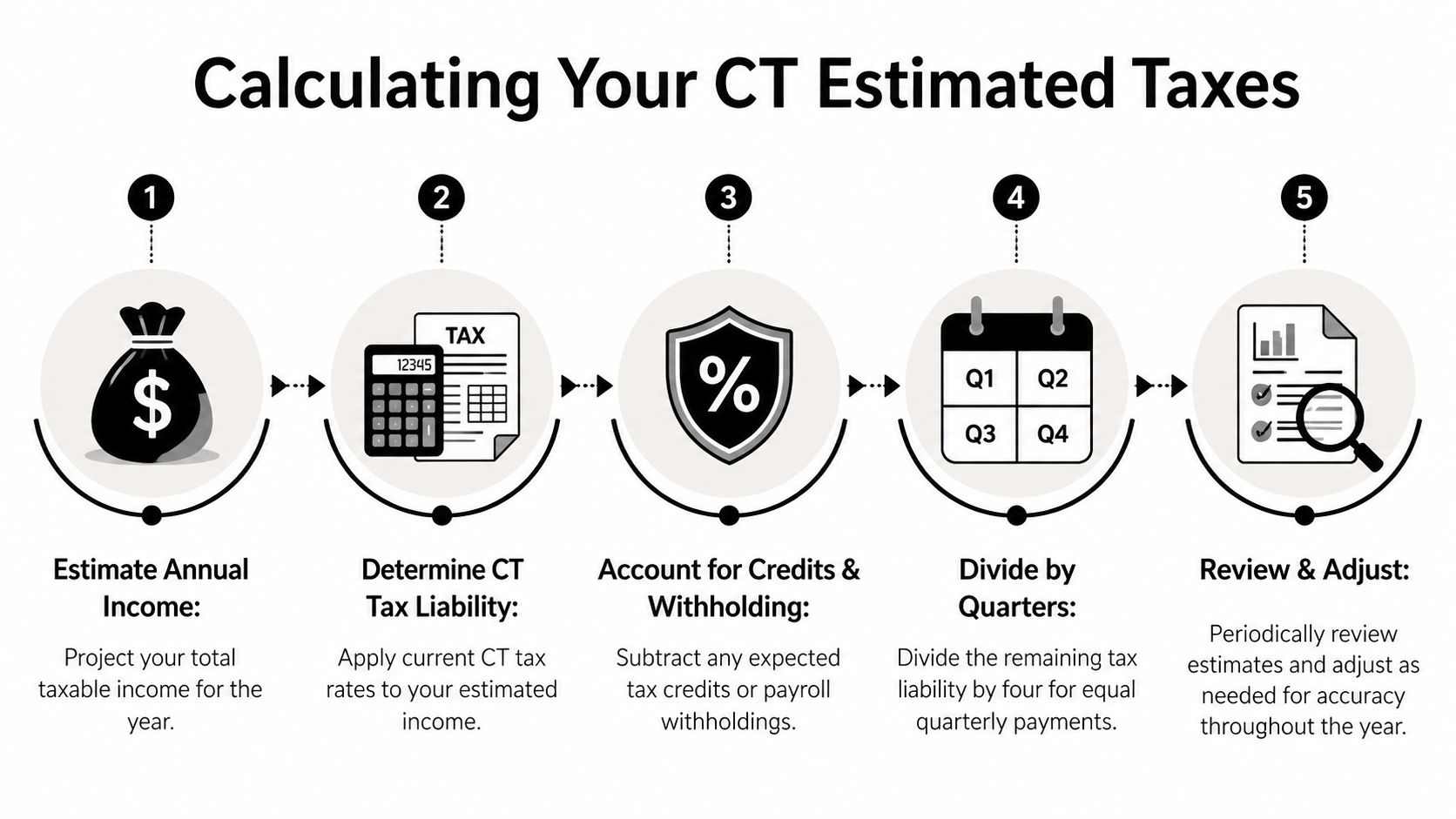
A straightforward process looks like this:
- Project your annual Connecticut taxable income.
- Estimate your Connecticut tax liability.
- Subtract expected withholding and credits.
- Use that remaining amount to plan your quarterly payments.
- Revisit the estimate if the year changes.
That’s the clean version. In practice, business owners often skip step five, and that’s where the trouble starts.
A useful mindset comes from accounting. If you want a plain-English explanation of how businesses think about setting aside money for expected tax exposure, this article on understanding the concept of a tax provision gives helpful context.
The annualized income method for uneven income
If your income is lumpy, seasonal, or back-loaded, the annualized income installment method matters. A lot.
For taxpayers with fluctuating income, the annualized income installment method using Form CT-1040 AES requires you to calculate year-to-date actual income at each quarter end, annualize it, and then determine the required installment as 22.5%, 45%, 67.5%, or 90% of the annualized tax. Correct use can achieve 90% penalty avoidance, but over 60% of small businesses still miss Q4 payments, according to this Connecticut estimated tax explanation focused on annualization.
That method exists for a reason. A wedding photographer, gardener, or consultant may have a weak first quarter and a strong third quarter. If that person forces equal estimated payments early in the year, cash gets squeezed when the business can least afford it. If that same person ignores quarter-to-quarter changes and underpays late in the year, the penalty issue starts.
How annualization works in practice
The broad process is mechanical:
- Measure actual income through each quarter. Don’t guess based on optimism.
- Annualize that year-to-date amount. The annualization factor changes by quarter.
- Compute the Connecticut tax on the annualized figure.
- Apply the required cumulative installment percentage.
- Subtract what you already paid.
- Pay the difference by the quarter’s deadline.
This method rewards accuracy. It also requires discipline.
If your income spikes late in the year, annualization can protect you from overpaying early and underpaying in the wrong quarter. But only if you actually update the numbers.
Due dates you should have on your calendar
Below is the basic due-date table many taxpayers use for planning.
| Payment Period | Due Date |
|---|---|
| 2026 CT Estimated Tax Payment Due Dates First Payment | April 15, 2026 |
| 2026 CT Estimated Tax Payment Due Dates Second Payment | June 15, 2026 |
| 2026 CT Estimated Tax Payment Due Dates Third Payment | September 15, 2026 |
| 2026 CT Estimated Tax Payment Due Dates Fourth Payment | January 15, 2027 |
The deadline isn’t the planning date. It’s the payment date. Build your review process before it.
My recommendation
Use the simple equal-payment method only if your income is genuinely stable. Not “probably stable.” Indeed stable.
If your income moves around, use current books, current bank data, and a current profit estimate each quarter. Don’t rely on what you earned last year, and don’t rely on memory. If you need help organizing the numbers before you compute the estimate, this step-by-step tax liability guide is a practical companion.
The mistake I see most often is not that people can’t do the math. It’s that they don’t respect how quickly a good quarter changes the tax picture.
Filing and Paying Your CT Estimated Taxes
Once you know the amount, pay it correctly. This is not the place for improvisation.
Connecticut wants the payment made through its systems, and the cleanest approach is electronic. Paper still exists, but online payment is easier to track and harder to mess up.
Use myconneCT first
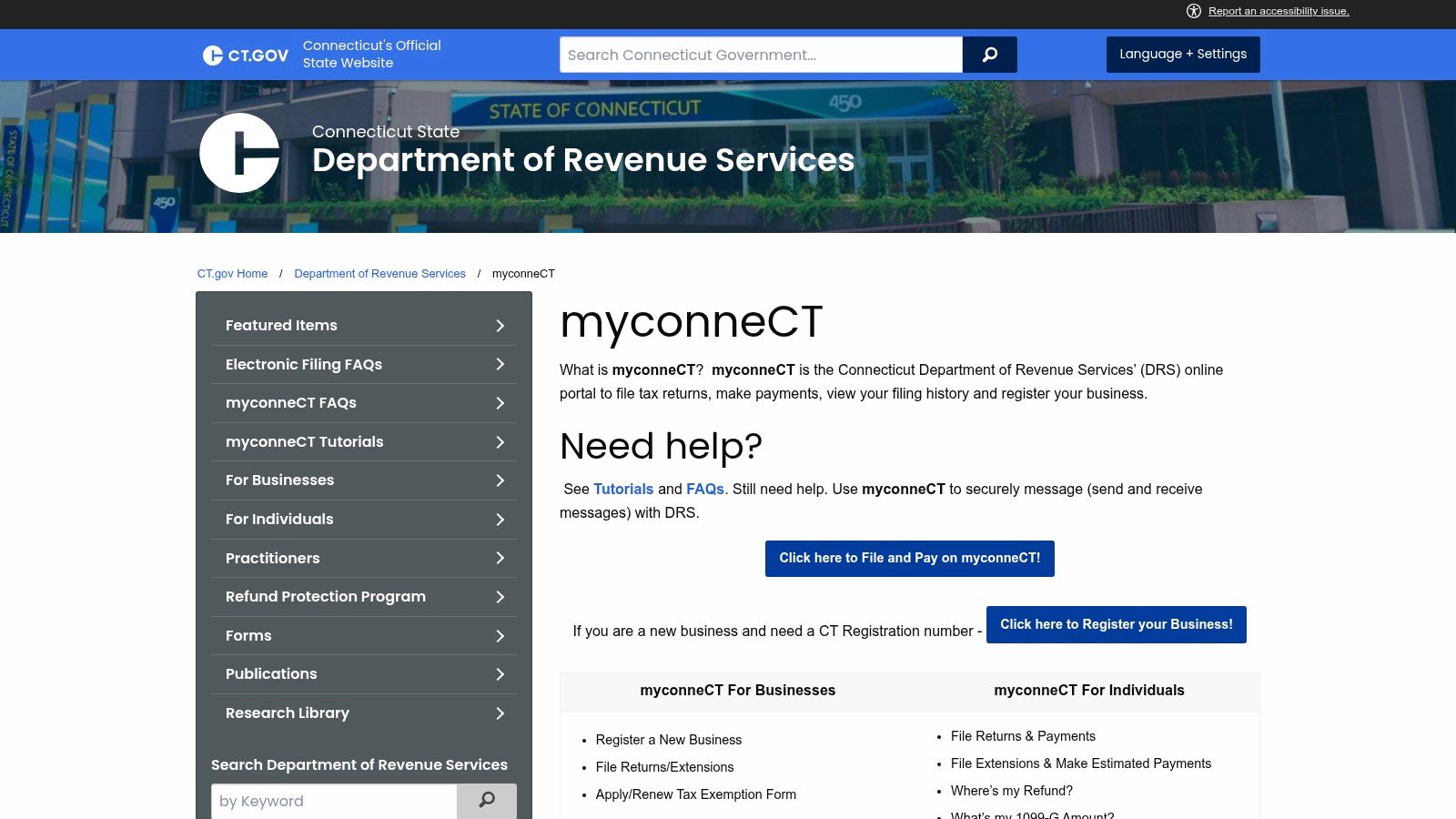
Paying through the state’s online portal is often the best approach. The value isn’t convenience alone. It’s documentation.
A solid online-payment routine looks like this:
- Create or access your myconneCT account. Use the taxpayer account that matches the return you’ll file.
- Select the income tax payment option. Make sure you’re applying the payment to the correct tax type and period.
- Choose bank draft or another available electronic method. Bank payment is usually the cleanest option for recordkeeping.
- Confirm the amount and date carefully. One wrong period selection can create a mess.
- Save the confirmation immediately. Download it, print it, and keep it with your tax file.
The confirmation matters because taxpayers often assume a payment “must have gone through.” That assumption becomes expensive when the state says otherwise.
If you mail a payment
Some people still prefer paper. If that’s you, be precise.
Use Form CT-1040ES and complete the voucher carefully. Match the payment to the correct tax year. Make sure the identifying information is exact. If you’re paying by check or money order, keep copies of everything that goes out.
Pay the state the way you’d send a contract or a lawsuit filing. Assume you may need to prove what you sent, when you sent it, and what it was for.
A few execution mistakes to avoid
- Wrong tax year. This is common and creates avoidable processing issues.
- Wrong taxpayer identifier. Payments posted to the wrong account can take time to unwind.
- No saved proof. If you can’t prove payment, you’ve made your life harder.
- Last-day scrambling. Waiting until the deadline invites banking, portal, or user errors.
The mechanics are simple. The consequences of sloppy execution are not.
Navigating Underpayment Penalties and Common Mistakes
Most tax debt problems don’t begin with one giant act of noncompliance. They start with ordinary bad assumptions.
Someone thinks they can wait until April and pay in one shot. Someone else sends uneven payments without using the annualized method. Another taxpayer forgets that pass-through income, investment income, or a year-end sale changed the entire estimate. Then the notice arrives, and they act surprised.
They shouldn’t be surprised.

The big check mistake
A lot of people think this way: “I’ll just hold the cash, earn on it, and pay everything when I file.”
That is not how estimated tax rules work.
Connecticut’s system is built around paying during the year when required. If you should have paid quarterly and didn’t, a full payment in April doesn’t erase the underpayment problem for the earlier periods.
Paying in full with the return doesn’t automatically fix missed estimated payments. It often just stops the problem from getting worse.
Uneven payments without the right election
This one hits business owners with irregular revenue.
They pay little or nothing early because cash is tight, then they make a big payment later after several strong months. They assume the later payment cures the earlier shortfall. It often doesn’t unless the return properly reflects the annualized income method.
If your income is uneven, your payment strategy must match that fact. Otherwise, you create a mismatch between how you earned the money and how the state measures timely payment.
Ignoring other income sources
Business owners focus on operating income and miss the extras that change the estimate:
- An asset sale. You sold something and triggered gain.
- Investment income. A gain event can create more state tax than expected.
- Pass-through allocations. The K-1 matters even when cash flow is inconsistent.
- Retirement or other distributions. These can increase tax due if withholding doesn’t cover the gap.
This is one reason year-end surprises happen. The return includes everything. Your quarterly planning often doesn’t.
Assuming an extension solves the payment issue
An extension to file is not the same thing as extra time to pay what should have been paid.
People confuse those two issues constantly. Filing paperwork later doesn’t erase the obligation to have paid enough during the year.
Hard truth: Extensions help with paperwork. They don’t fix underpayment.
Why the penalty problem snowballs
When taxpayers miss estimated payments, they usually also make one or more of these follow-up mistakes:
- They ignore the first notice. That removes options and shortens timelines.
- They stop opening state mail. That never helps.
- They mix current-year and prior-year problems together. Now accounting gets muddy.
- They keep underpaying in the next year. One bad year turns into a pattern.
That’s how a manageable issue becomes a real tax debt file.
If you’re already facing a penalty notice or you want to explore whether relief may be available in your situation, review the basics of Connecticut and IRS penalty abatement options.
My view as a resolution attorney
The people who avoid serious tax problems are not the people who never make mistakes. They’re the people who fix the mistake early.
If you missed a quarter, calculate the exposure immediately. If your income changed, adjust now. If you got a notice, respond while the issue is still small enough to control. Delay is what makes these cases ugly.
Advanced Considerations for CT Business Owners
If you own an S corporation or multi-member LLC, basic estimated tax advice often isn’t enough. Connecticut’s pass-through rules create moving parts that many owners misunderstand, especially when they try to coordinate the entity’s obligations with their personal return.
The biggest trouble spot is the Pass-Through Entity tax, often called the PE tax. If you get this wrong, you can overpay, underpay, or do both in the same year.
Why the PE tax changes the analysis
A major issue for business owners is that Connecticut Pass-Through Entities must pay estimated taxes quarterly based on 90% of the current year’s tax or 100% of the prior year’s, and the resulting owner credit on the personal return can reduce or eliminate the individual estimated tax requirement, as explained in this discussion of Connecticut Pass-Through Entity tax changes.
That matters because many owners still calculate their personal estimates as if the entity-level credit doesn’t exist. That’s a mistake. You can end up sending Connecticut money twice in two different channels.
The common failure pattern
Here’s what often happens:
- The entity pays. Or it should have paid, but the owners aren’t tracking it properly.
- The owner also pays personal estimates out of habit. No one adjusts for the expected PE credit.
- Books lag behind reality. By the time the K-1 information is clear, prior quarters are already gone.
- Cash flow suffers. The business sends money out, and the owner sends more out personally.
That kind of duplication isn’t a harmless clerical issue. It can stress payroll, vendor payments, and owner draws.
Multi-member LLCs and S corporations need a coordinated plan
Owners of pass-through businesses should stop treating quarterly payments as a single-return issue. They aren’t.
A better process includes:
- Entity-level review each quarter. Determine whether the business has its own estimated payment obligations and whether they’ve been funded.
- Owner-level review each quarter. Check whether the personal estimate should be reduced because of PE credits expected to flow through.
- K-1 projection discipline. Don’t wait until tax season to estimate pass-through income if the business is profitable.
- Distribution planning. A business can be profitable on paper while short on cash. Owners need enough liquidity to deal with tax obligations without raiding operations.
For broader small-business context, this general guide on quarterly estimated taxes for small businesses is a useful supplemental read, especially if you’re trying to align tax payments with cash flow discipline.
Why tax debt cases get worse for pass-through owners
Pass-through owners often have more than one exposure point.
The business may have unresolved tax issues. The owner may also have personal underpayment issues. In some cases, payroll tax trouble, old income tax balances, and current estimated tax failures all stack on top of one another. By the time someone asks for help, the problem is no longer “how much should I send this quarter?” It’s “which debt gets dealt with first, and how do we stop creating new debt while resolving the old debt?”
That’s why I push coordinated planning. Not perfect planning. Coordinated planning.
If your business is a pass-through entity, your estimated tax work should reflect the entity return, the owner return, expected credits, and expected income allocations. Anything less is guesswork with tax consequences.
When You Should Call a Tax Professional
Some taxpayers can handle their own estimated payments. Many can’t, and they shouldn’t pretend otherwise.
This gets especially risky once business entities, uneven revenue, prior tax debt, or multiple income streams enter the picture. At that point, DIY often means you’re doing incomplete work with full legal consequences.
Federal complexity matters here too. For S corporations and multi-member LLCs, federal rules often used in audit and penalty analysis require pass-through income projections on Form 2220, and ignoring allocable K-1 income from the start of the year causes 35% of underpayments for business owners, according to this analysis of estimated tax planning and Form 2220 issues.
Call for help if any of these apply
- You already owe back taxes. Adding a new estimated tax failure on top of old debt is how cases spiral.
- Your income is volatile. If your revenue swings by season, project, or commission cycle, annualization may matter.
- You own part of an S corporation or multi-member LLC. Pass-through income and entity-level tax issues need coordination.
- You’re dealing with the PE tax for the first time. Here, owners commonly miscalculate personal estimates.
- You received a Connecticut notice. Don’t wait to see if the next notice looks worse.
- Your income crosses state lines. Multi-state issues create another layer of planning and filing risk.
- You don’t trust your books. Bad bookkeeping produces bad tax estimates.
The business decision most people resist
A lot of owners think calling a tax professional means they failed. Wrong. It means they’re protecting cash flow, reducing risk, and preventing a manageable issue from turning into a collection problem.
The cheapest tax controversy matter is the one you prevent before the notice is issued.
That’s the standard I’d use. If the calculations are no longer simple, or the stakes are no longer small, get help while the problem is still fixable.
Attorney Stephen A. Weisberg helps individuals and business owners resolve IRS and state tax problems before they become unmanageable. If you’re dealing with estimated tax issues, existing tax debt, penalty notices, or pass-through entity complications, start with a FREE Tax Debt Analysis at Attorney Stephen A Weisberg.


