CPA And Tax Attorney Which Expert Do You Need for IRS Issues?
Struggling with the IRS? This guide compares a CPA and tax attorney to help you decide who to hire for audits, tax debt, and complex tax problems.

In this article
- Understanding The Core Roles Of A CPA And Tax Attorney
- CPA vs Tax Attorney: A Quick Comparison
- Primary Responsibilities And Expertise
- The Critical Role Of Legal Privilege
- Comparing Services Scope And Legal Protections
- A Deeper Look At Service Offerings
- The Decisive Factor: Attorney-Client Privilege
- Deciding Who To Hire For Real-World Tax Problems
- Scenario 1: IRS Audits
- Scenario 2: Significant Tax Debt
- Scenario 3: Complex Life And Business Events
- How CPAs And Tax Attorneys Work Together For The Best Outcome
- The Power Of A Unified Front
- A Practical Example: The Kovel Arrangement
- Why This Model Is More Relevant Than Ever
- How To Find And Vet The Right Tax Professional
- Your Initial Consultation Checklist
- How To Verify Credentials And Spot Red Flags
- Common Questions About Hiring a CPA vs. a Tax Attorney
- Can a CPA Represent Me in U.S. Tax Court?
- Is a Tax Attorney More Expensive Than a CPA?
- My CPA Found a Major Error on My Past Returns. What Should I Do?
- Can I Hire a Tax Attorney for Simple Tax Preparation?
- What Is a Kovel Letter and When Is It Used?
The fundamental difference between a CPA and a tax attorney boils down to this: a Certified Public Accountant (CPA) is your go-to expert for financial accuracy and tax compliance, while a tax attorney is your legal champion in disputes with the IRS.
It helps to think of it like this: your CPA is the architect who draws up your financial blueprint, making sure everything is structurally sound. The tax attorney is the litigator who defends that blueprint if it ever ends up in court.
Understanding The Core Roles Of A CPA And Tax Attorney

When you're facing a tax problem, the professional you hire can completely change the outcome. This isn't just about a job title; it's a difference in training, legal authority, and the kind of protection they can offer you.
A CPA is a licensed accounting pro who has passed the rigorous Uniform CPA Examination. Their world revolves around preparing precise tax returns, managing financial records, and offering solid advice on tax planning. They are absolutely essential for keeping your financial house in order and making sure your filings are up to snuff.
A tax attorney, on the other hand, is a lawyer who specializes in the complexities of tax law. After earning a Juris Doctor (J.D.) and passing the bar, they gain a deep, practical understanding of the U.S. Tax Code, legal procedures, and negotiation tactics.
To get a quick sense of the key differences, here's a high-level comparison.
CPA vs Tax Attorney: A Quick Comparison
| Comparison Point | Certified Public Accountant (CPA) | Tax Attorney |
|---|---|---|
| Primary Focus | Financial accuracy, reporting, and compliance | Legal interpretation, dispute resolution, and taxpayer rights |
| Core Services | Tax preparation, bookkeeping, audits, financial planning | IRS representation, tax court litigation, criminal tax defense |
| Key Strength | Proactive financial management and optimization | Reactive legal defense and advocacy |
| Legal Privilege | Limited; does not cover criminal proceedings | Absolute attorney-client privilege |
| Best For | Routine tax filing, financial planning, audit preparation | Tax audits, tax debt, potential criminal charges, legal disputes |
This table shows that while both are tax experts, their roles are designed for very different situations. Your choice depends entirely on the nature of your problem.
Primary Responsibilities And Expertise
Even though both roles deal with taxes, they serve fundamentally different functions. A CPA's job is primarily quantitative—they organize the numbers, keep you compliant, and optimize your finances before a problem ever starts. A tax attorney's job is protective and qualitative—they interpret dense legal code, defend your rights, and resolve conflicts after the IRS has taken action.
The numbers really tell the story here. According to the IRS's 2025 data, there are 850,152 active tax preparers. Of those, 208,488 are CPAs, but only 27,033 are attorneys. This means over 77% of credentialed preparers are accountants who can't practice law, which underscores just how specialized—and critical—a tax attorney's role is in a real IRS dispute. You can dig into the numbers yourself in the official federal tax return preparer statistics.
The Critical Role Of Legal Privilege
One of the most significant differences, and one that many people overlook, is attorney-client privilege. This is a powerful legal shield that protects all communications between you and your attorney from being disclosed. It’s nearly absolute, which creates a confidential space where you can discuss sensitive financial details, especially if you're worried about a potential criminal investigation.
While a limited accountant-client privilege does exist, it's fragile. Critically, it does not apply in criminal tax cases. This makes a tax attorney the only truly safe choice when you're facing potential allegations of tax evasion or fraud.
Understanding the benefits of hiring a tax attorney is vital because their authority goes far beyond what a CPA can offer. For instance, they can represent you in U.S. Tax Court, a venue where most CPAs are not allowed to practice. When the stakes get high, that legal shield is everything.
Comparing Services Scope And Legal Protections
When you get down to brass tacks, the real difference between a CPA and a tax attorney isn't just their titles—it's what they can do for you and, crucially, the legal protections they offer. While both can stand between you and the IRS in an audit, their roles diverge dramatically once things get serious and legal authority or confidentiality becomes the name of the game.
A CPA's world is built on financial accounting and tax compliance. They are the masters of the numbers, the ones who prepare meticulous returns, conduct financial audits, and give you smart advice on how to structure your finances to minimize taxes before a problem ever starts.
A tax attorney, on the other hand, lives in the world of legal interpretation and advocacy. Their expertise is in dissecting the U.S. Tax Code, fighting for a taxpayer's rights, and representing clients when a dispute lands in court. They're often the ones you call when a problem has already surfaced.
A Deeper Look At Service Offerings
Seeing what each professional does day-to-day really clears things up. Think of a CPA as your partner for maintaining ongoing financial health. The tax attorney is the defender you need when you're in a legal fight.
Typical CPA Services:
- Tax Preparation and Filing: Making sure your individual and business tax returns are accurate and filed on time.
- Bookkeeping and Financial Statement Audits: Keeping your financial records clean and verifying their accuracy for banks, lenders, or investors.
- Proactive Tax Planning: Building strategies to legally lower your tax bill in the years to come.
- Basic IRS Representation: Dealing with routine IRS letters, like CP2000 notices, and handling straightforward audits.
Typical Tax Attorney Services:
- Advanced IRS Representation: Managing high-stakes audits, filing appeals, and fighting aggressive collection actions like property liens and bank levies.
- U.S. Tax Court Litigation: Arguing your case in court when you legally challenge an IRS decision—a right reserved almost exclusively for attorneys.
- Criminal Tax Defense: Defending you against serious allegations like tax fraud or evasion.
- Complex Tax Debt Resolution: Negotiating sophisticated settlements, such as an Offer in Compromise (OIC), to resolve overwhelming tax debt.
This breakdown highlights a critical point. A CPA is perfect for helping you prepare for an audit. But if that audit uncovers something that could be interpreted as fraud or has criminal implications, a cpa and tax attorney team isn't just a good idea—it's essential.
The Decisive Factor: Attorney-Client Privilege
Here it is: the single most important difference between a CPA and a tax attorney is the level of confidentiality they provide. This isn't just some minor legal technicality; it’s a foundational protection that can make or break your case in a serious tax dispute.
A tax attorney offers attorney-client privilege. This is a powerful legal doctrine that keeps all communication between you and your lawyer strictly confidential. This protection is nearly bulletproof and is a cornerstone of our justice system. It means you can tell your lawyer everything—the good, the bad, and the ugly—without worrying that the IRS can force them to repeat it in court.
Key Takeaway: Attorney-client privilege shields all communications made for the purpose of getting legal advice. The IRS cannot break it, whether in a civil audit or a criminal investigation. This creates a safe harbor where you can build a real defense.
CPAs and other federally authorized tax practitioners operate under a different, more limited protection called the tax practitioner privilege. It's sometimes called the accountant-client privilege, and while it covers routine tax advice in non-criminal situations, it has some major weaknesses.
The limitations are stark:
- It Disappears in Criminal Cases: If a civil audit escalates into a criminal investigation, this privilege evaporates. The IRS can then subpoena your CPA, forcing them to testify against you and hand over every note, email, and conversation.
- It Doesn't Cover Tax Shelter Advice: Communications about promoting or investing in tax shelters are not protected.
- It’s Not Recognized by States: This is a federal privilege, so it might not protect you in tax disputes with state authorities.
For anyone in a situation with even a remote chance of criminal accusations—like years of unfiled returns, significant unreported income, or anything that could be labeled as fraud—relying on an accountant's limited privilege is a gamble you can't afford to take. A tax attorney is the only professional who can guarantee your conversations remain private.
If you ever find yourself wondering if the IRS can sue you, understanding your rights and the protections available is the first critical step. That legal shield is precisely why a tax attorney becomes indispensable when the stakes are high.
Deciding Who To Hire For Real-World Tax Problems
Knowing the difference between a CPA and a tax attorney is one thing, but figuring out who to call when you're in a tight spot is something else entirely. Making the right choice from the start saves you headaches and can dramatically change the outcome of your case.
So, let's walk through some common, real-world tax scenarios to see which professional fits the bill.
The decision really boils down to two things: how messy the numbers are and how serious the legal risk is. This simple flowchart gets to the heart of it.
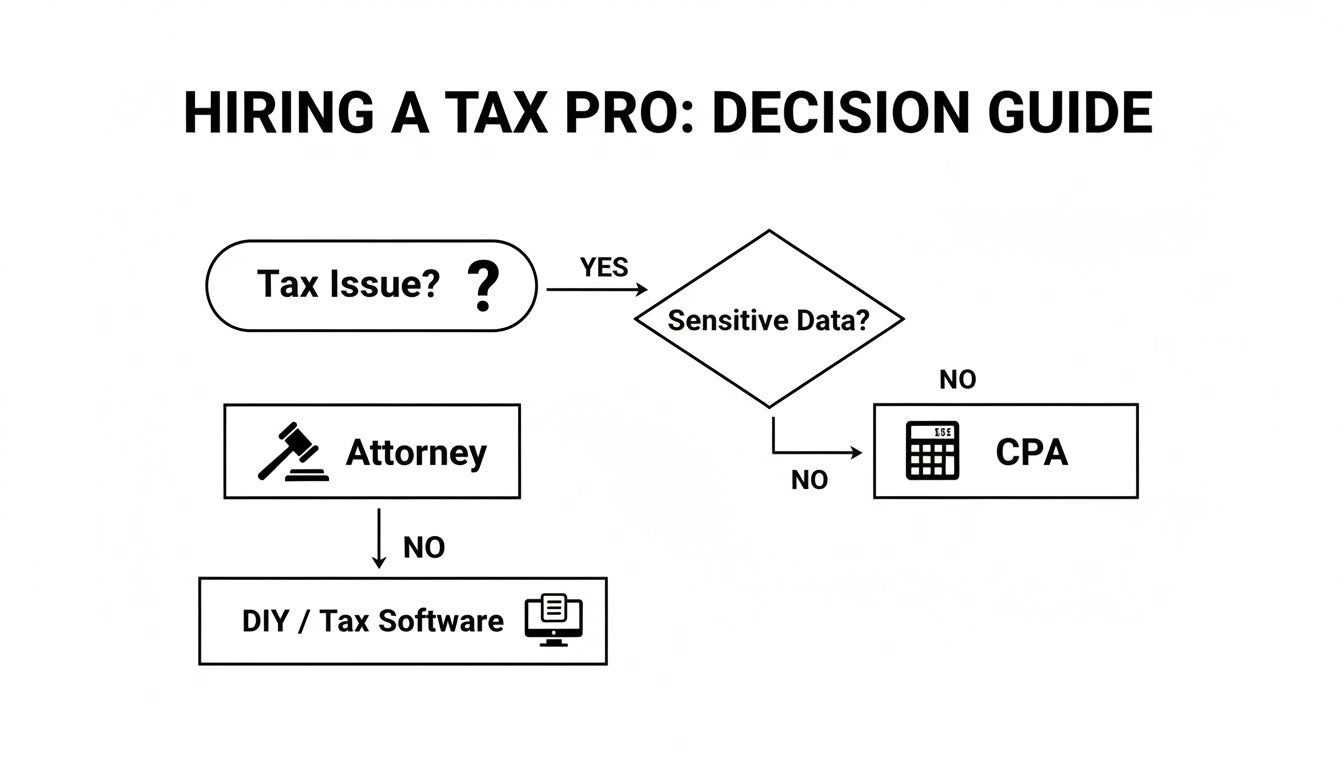
As you can see, the moment a tax issue involves sensitive information that could be used against you, a tax attorney's legal protection becomes non-negotiable.
Scenario 1: IRS Audits
Got a letter from the IRS for a routine correspondence or office audit? A CPA is usually your best bet. They are masters at organizing financial records, justifying every deduction, and speaking the IRS's technical language. Most audits are just about verifying information, and a good CPA can handle that efficiently.
But the game changes if the audit starts to heat up. If the IRS revenue agent begins asking pointed questions about potential fraud, unreported income, or willfulness, it’s time to bring in a tax attorney. Immediately. An attorney can step in, take over all communications, and shield you under attorney-client privilege. This stops you from accidentally saying something that could incriminate you. Understanding your rights with an IRS audit representative is the first, crucial step in protecting yourself.
Scenario 2: Significant Tax Debt
When you owe the IRS a substantial amount of money, the goal is no longer just compliance—it's negotiation. A CPA can certainly help you set up a basic installment agreement, but for more complex debt resolution, a tax attorney has the clear upper hand.
This is especially true when you're aiming for an Offer in Compromise (OIC), which is a request for the IRS to settle your debt for less than you owe. An OIC isn't just a financial form; it's a legal settlement. An attorney’s training in negotiation, presenting evidence, and navigating administrative law is invaluable here.
A tax attorney can build a compelling legal argument for why accepting your offer is in the government's best interest, often leading to a more favorable outcome than a numbers-only approach might achieve.
And if you’re a business owner facing payroll tax debt? A tax attorney is an absolute must. The IRS can hold you personally liable for these debts through the Trust Fund Recovery Penalty (TFRP), and an attorney is best equipped to defend you against this aggressive collection tactic.
Scenario 3: Complex Life And Business Events
Some situations are inherently legal from day one and demand a tax attorney's guidance. Trying to navigate these without proper legal counsel can lead to severe and lasting financial pain.
- Tax Issues in Divorce: Splitting assets like retirement accounts involves tricky tax laws. A CPA can run the numbers, but only a tax attorney can ensure legal documents like a Qualified Domestic Relations Order (QDRO) are drafted correctly to protect you from unexpected tax bombs.
- Bankruptcy and Tax Debt: Figuring out which tax debts can be discharged in bankruptcy is a purely legal question. You need a tax attorney who specializes in both tax and bankruptcy law to get this right.
- Business Formation and Transactions: When dealing with business tax matters, like figuring out how to retrieve an EIN number, both professionals can offer help. However, for legally structuring the business or managing the tax implications of a sale, an attorney's input is critical.
The sheer availability of these specialists also plays a role. In the United States, there are over 478,783 employed CPAs, but only about 27,310 tax attorneys holding active PTINs. This massive gap underscores how challenging it can be for people and small businesses to find specialized legal help for thorny issues like payroll tax debt or trust fund recovery penalties.
This numbers game means that finding the right cpa and tax attorney team requires careful vetting, since truly specialized legal tax expertise is much harder to come by. Your choice should always be guided by the specific legal risks and financial complexities you're facing.
How CPAs And Tax Attorneys Work Together For The Best Outcome

Choosing between a CPA and a tax attorney isn't always an either/or decision. For the most complicated tax problems, the best results come from putting them on the same team. Instead of picking one, think of them as two specialists working together, each bringing a critical and distinct skill set to the table.
This kind of collaboration creates a powerful synergy. The CPA masters the financial details and crunches the numbers, while the tax attorney builds a protective legal strategy around those facts.
The Power Of A Unified Front
When you’re facing a serious tax dispute, the division of labor is actually quite clear. A CPA is the expert with the numbers. They’re the one who will meticulously reconstruct your financial records, prepare precise amended returns, and pinpoint the exact origin and scope of your tax liability. Their work creates the factual foundation for your entire case.
Once that financial picture is crystal clear, the tax attorney takes the lead. They use the CPA’s clean data to build the legal case and handle all communication with the IRS. By funneling everything through the attorney's office, every conversation, email, and document is shielded by attorney-client privilege.
This two-pronged approach ensures your case is both financially accurate and legally protected. The CPA gets the numbers right, and the attorney makes sure your rights are defended.
A Practical Example: The Kovel Arrangement
This collaborative model is so well-established it even has its own legal precedent. It's called a "Kovel arrangement," named after a 1961 court case that set the standard. It allows an attorney to formally hire an accountant as part of the legal team.
Under this structure, the accountant's work—their analysis, communications, and findings—are all covered by the attorney-client privilege. Why? Because their financial expertise is deemed essential for the attorney to provide proper legal advice.
What this means in practice: You can have your trusted CPA sort out the complex accounting without worrying that their notes or findings could be used against you by the IRS. The tax attorney essentially extends their legal shield over the entire team's work.
This setup truly offers the best of both worlds. It’s the gold standard for navigating serious tax issues where you can’t afford to compromise on either financial expertise or legal protection.
Why This Model Is More Relevant Than Ever
The accounting world is changing. CPA firms are seeing massive growth—national annual revenue jumped by 11.4% in 2022, and client advisory services (CAS) practices reported a median growth rate of 17% in 2023. You can find more details on this growth on cpa.com.
This trend shows that CPAs are increasingly focusing on high-value advisory work. High-stakes IRS disputes, however, remain a specialized legal field. As CPAs lean into their advisory roles, this partnership model becomes even more important. A CPA can spot a serious tax problem and then bring in a tax attorney to manage the legal fight, offering a complete solution to the client.
A cpa and tax attorney team isn’t redundant; it's smart. Each professional sticks to what they do best. The CPA delivers financial clarity, and the attorney brings the legal firepower, creating a formidable front when it's time to face the IRS.
How To Find And Vet The Right Tax Professional
Choosing between a CPA and a tax attorney isn't just about credentials; it's about finding the right expert for your specific problem. The key is to approach your search with a clear plan, asking sharp questions that cut through the sales pitch and get to the core of their experience.
Think of your first consultation as an interview. You’re hiring a specialist for a high-stakes job, and you need to feel confident they can handle it. A true professional will respect your diligence and answer your questions directly.
Your Initial Consultation Checklist
Before you even think about signing an engagement letter, get these questions answered. Your goal is to understand their real-world experience, their process, and exactly how they bill for their time. While every situation is unique, understanding why hiring a Certified Public Accountant can be a game-changer is a good starting point for many business needs.
Here are the non-negotiable questions to ask any tax pro you're considering:
- Relevant Experience: Don't settle for a vague "we handle tax debt." Ask, "How many cases exactly like mine have you handled in the past year?" If you're facing a Trust Fund Recovery Penalty, you need someone who lives and breathes those cases, not a generalist.
- Your Point of Contact: Ask, "Who will actually be handling my case and be my main point of contact?" It's common to meet with a senior partner who then passes your file to a junior associate. You need to know who you'll be communicating with day-to-day.
- Realistic Timeline: A good question is, "What are the first few steps, and what's a realistic timeline for this initial phase?" An honest professional will tell you that IRS matters are a marathon, not a sprint. They'll manage your expectations instead of promising a quick fix.
- Fee Structure: Get specific. "Can you give me a clear breakdown of your fees? Is it a flat fee, hourly, or a retainer model?" Follow up by asking what services are included and, just as importantly, what might trigger extra charges down the line.
A huge green flag is a professional who offers a no-pressure initial analysis of your situation. Be very wary of high-pressure sales tactics or demands for a large payment before they’ve even reviewed your documents. That's a classic red flag in the tax resolution world.
How To Verify Credentials And Spot Red Flags
After you've narrowed down your list, it's time for some quick due diligence. Never just take someone's word for it. A few minutes of research can save you a world of trouble.
For Tax Attorneys:
- Check the State Bar Association: Every attorney must be licensed to practice. Go to your state bar's website and look them up. You can confirm they're in good standing and see if there are any public disciplinary actions against them.
- Verify Specializations: If an attorney calls themself a "tax specialist," see if that's a formal certification offered by their state bar. Not all states have this, but it’s a mark of advanced expertise where they do.
For CPAs:
- Confirm with the State Board of Accountancy: Just like lawyers, CPAs are licensed and regulated by a state board. A quick search on the board's website will verify their license status and any disciplinary history.
- Use the IRS Directory: The IRS has a public directory where you can look up federal tax preparers and confirm their qualifications.
Finally, trust your gut. If a firm's website screams "settle your debt for pennies on the dollar!" before they know a single thing about your finances, run. Real pros—whether you need a cpa and tax attorney working together or just one—build their strategy on the facts of your case, not on flashy, empty promises. Our guide on finding a good tax attorney offers even more tips on what to look for.
Common Questions About Hiring a CPA vs. a Tax Attorney
When you're dealing with tax problems, a lot of questions pop up. It can be tough to figure out who you need in your corner. Let's clear the air and tackle some of the most common things people ask when deciding between a CPA and a tax attorney.
Can a CPA Represent Me in U.S. Tax Court?
Almost never. U.S. Tax Court is a formal legal venue, and representing someone there is considered practicing law. That privilege is reserved for attorneys who are admitted to the Tax Court bar.
While there's a very narrow exception for non-attorneys who pass an incredibly difficult exam, it's extremely rare. If your dispute has even a small chance of ending up in court, you need a tax attorney. They are the only professionals who can file motions, follow courtroom procedures, and argue your case before a judge.
Is a Tax Attorney More Expensive Than a CPA?
On an hourly basis, yes, a tax attorney will typically charge more than a CPA. That higher rate reflects years of legal training, a law degree, and the powerful legal protections they bring to the table. But looking only at the hourly rate is a classic case of missing the forest for the trees.
Think about the total cost. For a serious issue—a large tax debt, a criminal investigation, or a high-stakes audit—an attorney's real value is in changing the outcome. They might negotiate an Offer in Compromise that saves you tens of thousands of dollars or get penalties completely waived. The upfront investment in legal counsel can easily save you a fortune down the road.
Key Insight: A tax attorney's higher fee is directly tied to their unique ability to manage your legal risk. The cost of not having that protection when you truly need it is almost always far greater than the attorney's bill.
My CPA Found a Major Error on My Past Returns. What Should I Do?
Stop talking to your CPA immediately and call a tax attorney. This is a critical moment. Anything you say to your CPA from this point forward is not protected by attorney-client privilege and could be used against you by the IRS.
A tax attorney can immediately put a shield around your conversations. Under the absolute protection of attorney-client privilege, they can analyze the situation and map out the safest legal strategy to fix the error, like a voluntary disclosure. The attorney might even hire your CPA under a Kovel letter to get their financial expertise without exposing you to risk.
Can I Hire a Tax Attorney for Simple Tax Preparation?
You could, but it would be like hiring a brain surgeon to put a bandage on a scraped knee—overkill and not at all cost-effective. CPAs are the specialists for routine tax preparation and filing; that's their bread and butter.
A tax attorney's skills really shine when you're facing a legal battle, a complex negotiation, or a situation with serious legal consequences. Here’s a good way to think about it: you hire a CPA to make sure your financial house is built to code, but you call a tax attorney when the inspector is threatening to condemn it.
What Is a Kovel Letter and When Is It Used?
A Kovel letter is a powerful legal tool. It’s an agreement where an attorney hires an accountant on behalf of a client to help with a case. This arrangement effectively extends the attorney-client privilege to the accountant's communications and work product.
This is a game-changer in cases that need both sophisticated financial analysis and airtight legal protection. In a tax fraud investigation, for instance, an attorney would use a Kovel letter to bring in a forensic accountant. The accountant can then dig into the numbers without fear that their findings will be subpoenaed by the IRS. A cpa and tax attorney team working this way gives you the best of both worlds: top-tier financial insight and ironclad legal security.
When facing the IRS, you don't have to go it alone. Attorney Stephen A Weisberg starts every case with a FREE Tax Debt Analysis to determine the best path forward for your specific situation. Find out how we can help before you commit by visiting https://weisberg.tax today.