Collection Information Statement: Your IRS Form 433 Guide
Facing an IRS Collection Information Statement (Form 433)? Our guide explains why it's required, how to complete it, and how to avoid common costly errors.
In this article
- You Received an IRS Notice Now What
- Why the request feels worse than it is
- What to do first
- What Is a Collection Information Statement
- The two questions the IRS is really asking
- Why every line matters
- The strategic mindset
- The Different Versions of Form 433
- Form 433-F
- Form 433-A
- Form 433-B
- Side by side comparison
- How to think about the difference
- A Section by Section Breakdown of the Form
- Income and cash flow
- Monthly living expenses
- Why Section H matters so much
- Assets and equity
- Debts and liabilities
- Business information when applicable
- Common Mistakes and How to Avoid Them
- The errors that hurt most
- Accuracy is not the same as strategy
- A short review checklist
- How the CIS Drives Your Resolution Options
- How the outcome usually flows from the data
- The practical takeaway
- When to Call a Tax Attorney for Help
The envelope looks official. The language feels sharp. The deadline jumps off the page. Individuals contacting a tax attorney at this stage are not confused about one thing: the IRS wants money. What they are confused about is why the IRS is asking for pay stubs, bank balances, car values, rent, utilities, and even details about accounts they barely use.
That request usually means you're being pushed into the world of the collection information statement. It feels intrusive, but it isn't random. The IRS is trying to decide what it thinks you can pay, and every answer you give helps shape that decision.
If you understand how the form works, the process becomes much less mysterious. What's more, you stop treating the form like paperwork and start treating it like what it really is: a financial case presentation.
You Received an IRS Notice Now What
A common scenario goes like this. Someone has a tax balance they haven't been able to clear. They may have tried calling the IRS already, asked for time, or ignored a few notices hoping their finances would improve. Then a new letter arrives asking for financial information. That letter changes the tone. It no longer feels like a billing issue. It feels personal.
The first thing to know is that this request usually means the IRS is deciding whether you qualify for a collection alternative. The Collection Information Statement is often the financial gateway to options such as an Offer in Compromise, a Partial Pay Installment Agreement, or Currently Not Collectible status, because the IRS generally requires that disclosure before it will review ability to pay, as explained in this discussion of IRS collection information statement forms.
That matters because the form is not a punishment. It's a gatekeeper.
Why the request feels worse than it is
Most taxpayers read the notice as a threat. In practice, it often means the IRS is willing to consider a structured resolution instead of just demanding immediate full payment. The agency wants a financial snapshot before it decides which path fits your case.
Practical rule: If the IRS asks for a collection information statement, assume every line item will be used to measure your ability to pay. Answer it like you're building a case, not filling empty boxes.
That doesn't mean you should shade facts, omit accounts, or soften numbers. It means you should slow down, gather records, and understand the consequence of each entry.
What to do first
Before sending anything back, take these steps:
- Read the notice carefully: Confirm what form the IRS wants, where it should be sent, and when it's due.
- Collect records before you start: Pay stubs, bank statements, loan statements, lease agreements, utility bills, and asset information make the form far more accurate.
- Keep your response organized: If you're submitting supporting documents electronically, secure tools for digital signatures for tax forms can help keep approvals and submissions cleaner.
- Respond, don't freeze: If you need context on the letter itself, this guide on responding to IRS letters is a good starting point.
A bad response creates two risks at once. The IRS may conclude you can pay more than you really can, and it may keep collection pressure in place while the issue drags on.
What Is a Collection Information Statement
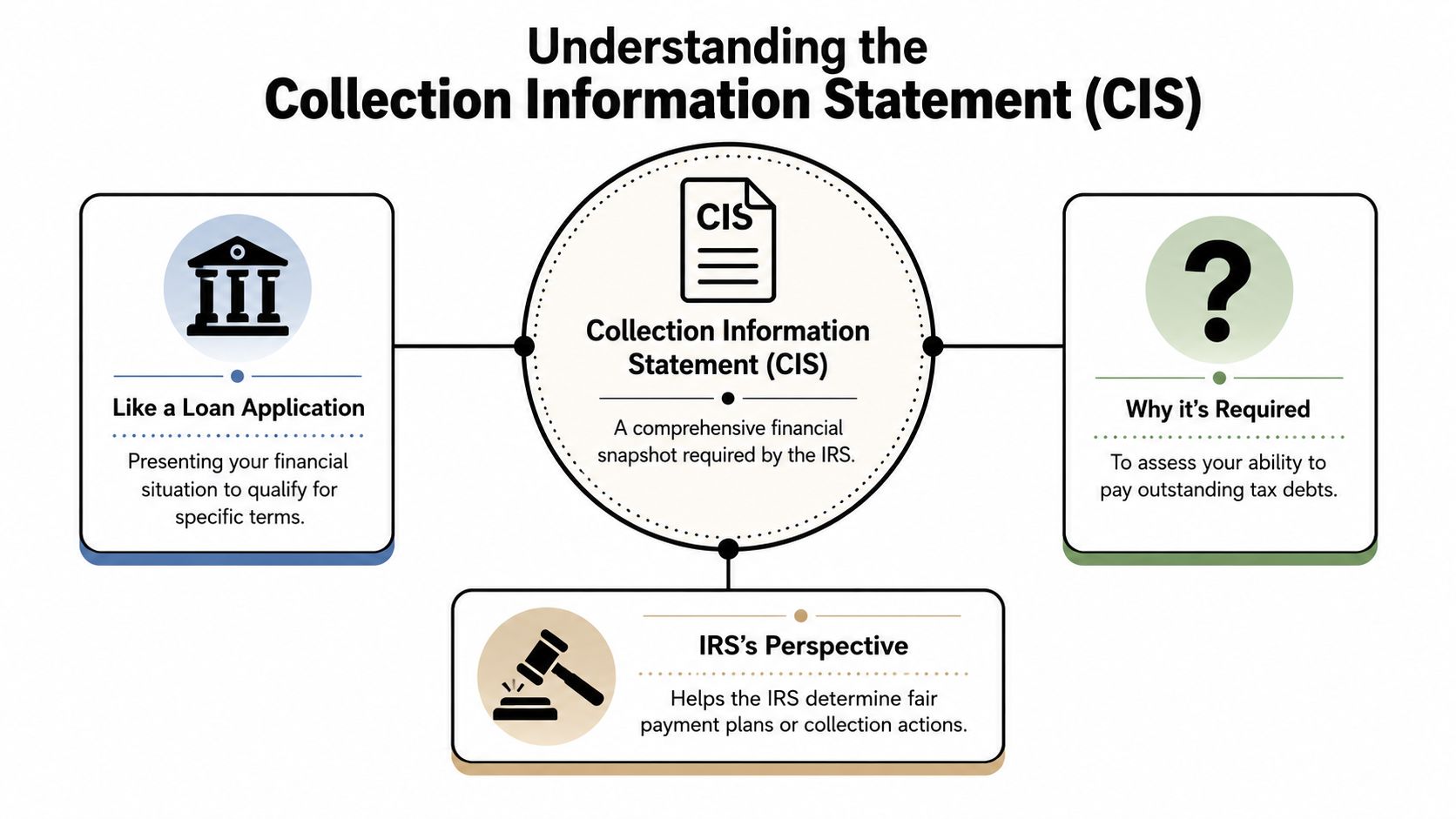
You open the IRS letter, see a request for financial information, and assume the next step is to list your accounts, income, and bills. That is only part of the job. A collection information statement is the document the IRS uses to decide how hard it can push, what resolution programs stay available, and how much it believes you should pay.
A collection information statement is the IRS's financial disclosure form for collection cases. It works like an underwriting file. The difference is that the IRS is not deciding whether to lend money. It is deciding whether to accept a payment plan, classify your account as currently not collectible, pursue an offer in compromise, or keep enforced collection on the table.
On Form 433-F, the IRS uses the numbers you provide to estimate your ability to pay now and over time. If you want a closer explanation of how that form fits into a collection case, this guide to Form 433-F in IRS collection matters gives helpful background.
The two questions the IRS is really asking
The form covers wages, bank accounts, property, loans, living expenses, and other details. Underneath all of that, the IRS is trying to answer two practical questions:
- What assets could be used to pay this debt?
- What monthly income is available after allowable expenses?
Those answers shape the case. Equity in a home, vehicle, investment account, or other asset can increase the amount the IRS expects to collect. Positive monthly cash flow can support an installment agreement or raise the amount the IRS demands in a negotiation.
That is why this form matters so much.
Why every line matters
Clients often ask why the IRS needs details like account balances, loan payoffs, vehicle values, or retirement accounts. The answer is simple. Each field helps the agency test three things: equity, liquidity, and credibility.
If the numbers show assets that could be borrowed against, sold, or reached through collection action, the IRS may count them against you. If the expenses look high but are not supported or are above what the IRS allows, the agency may reduce them and treat the difference as money available for payment. If the entries conflict with tax returns, pay stubs, or bank records, the review gets harder and slower.
The form is not just a snapshot. It is the starting point for the IRS's collection strategy.
The strategic mindset
Taxpayers often get into trouble by treating the collection information statement like an administrative form, when it is really a negotiation document backed by records.
A good submission does more than answer the questions. It presents your finances in a way that is accurate, documented, and framed around the resolution you are trying to reach. If income recently dropped, the file should show that clearly. If an expense is necessary but unusual, it should be explained and supported. If an asset has little reachable equity, that should be established with current balances and proof, not guesswork.
In my practice, the trade-off is usually between speed and precision. A fast submission may stop the immediate scramble, but a careless one can make the IRS overstate your ability to pay. Taking extra time to document the right numbers often puts you in a much better position.
A strong collection information statement usually does three things:
- Matches the records: income, balances, debts, and expenses should tie to documents the IRS can verify.
- Reflects current conditions: use present facts, especially if your finances recently changed.
- Supports the outcome you want: the information should be complete, but it should also be organized with the likely resolution in mind.
That approach gives the IRS fewer reasons to make assumptions that work against you.
The Different Versions of Form 433
Not every taxpayer deals with the same collection information statement. That causes a lot of confusion, especially with online references to Form 433-F, Form 433-A, and Form 433-B often being treated as interchangeable. They aren't.
The IRS uses different versions depending on who you are, how complex your finances are, and how your case is being handled.
Form 433-F
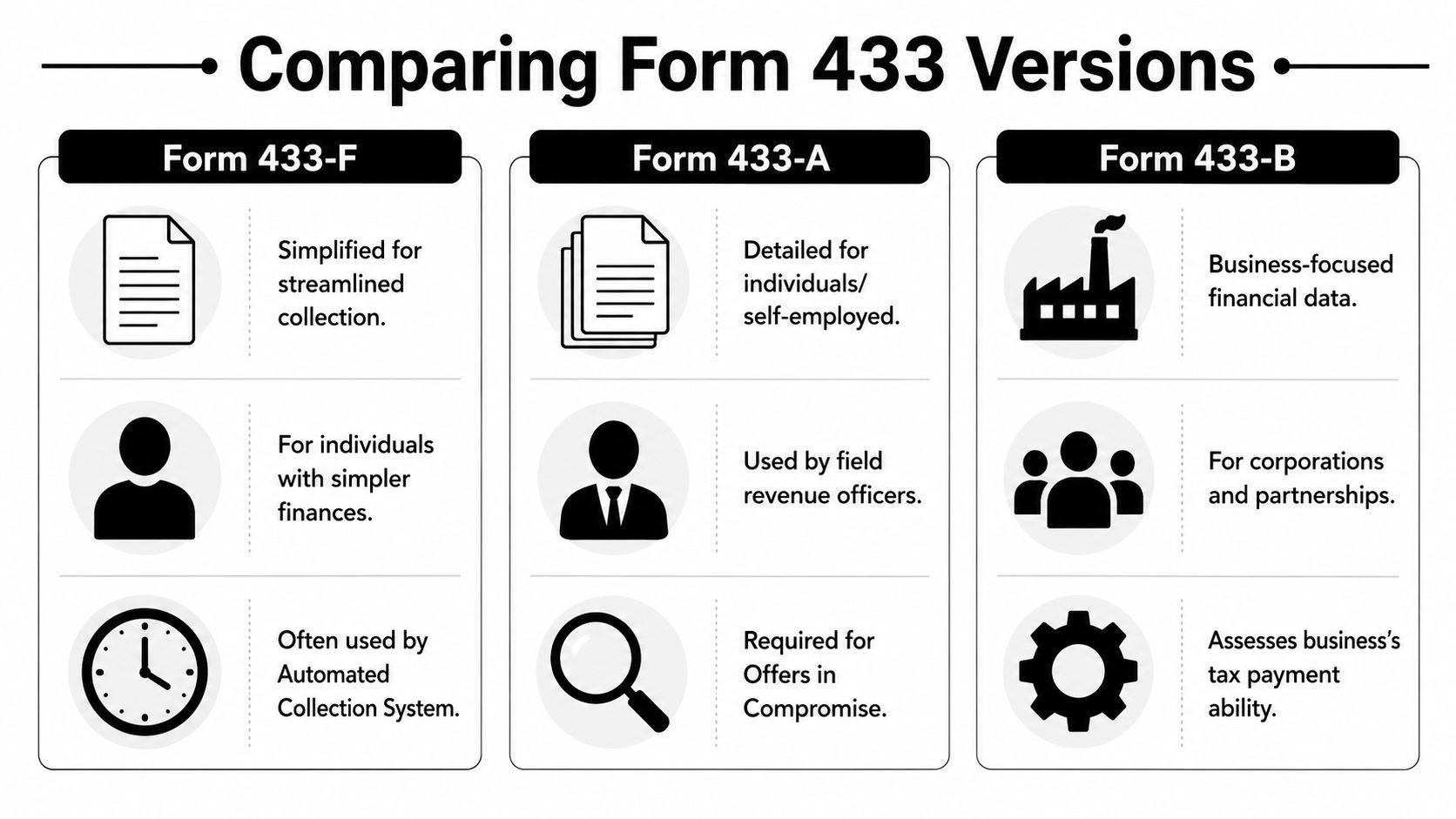
Form 433-F is the simplified version. It is officially a Collection Information Statement and serves as the foundational financial disclosure document the IRS uses to determine Reasonable Collection Potential. It is a two-page form used when the outstanding IRS balance is less than $250,000 and the case has not been assigned to a Revenue Officer, which distinguishes it from more involved forms such as 433-A for larger liabilities or field-assigned cases, according to this Form 433-F guide for IRS collection cases.
In practice, 433-F often shows up in Automated Collection System cases. The form is shorter, but don't mistake shorter for casual. The IRS can still make major decisions from it.
Form 433-A
Form 433-A is the more detailed version for individuals, including self-employed taxpayers in situations that require deeper review. If your finances are layered, if business and personal money overlap, or if a Revenue Officer is involved, expect more scrutiny and more documentation.
This is usually where self-employed people run into trouble. Their real financial picture often doesn't fit neatly into a simple monthly wage model. Gross receipts, business expenses, irregular draws, and personal payments of business costs all need to be presented carefully.
Form 433-B
Form 433-B is the business version. If a corporation, partnership, or other business entity owes payroll taxes or business taxes, the IRS wants the business's own financial disclosure. That includes operational information and business assets, not just the owner's household finances.
For many small business owners, this creates a double exposure. The business may need its own form, while the owner may also need to disclose personal finances depending on the issue.
Side by side comparison
| Form | Typical user | General use |
|---|---|---|
| 433-F | Individuals with simpler collection cases | Streamlined financial disclosure |
| 433-A | Individuals and self-employed taxpayers with more complexity | Detailed personal financial analysis |
| 433-B | Businesses | Business-focused collection review |
How to think about the difference
The best way to look at the forms is by the level of examination:
- 433-F means simplified intake, not relaxed review
- 433-A means a deeper look into personal and self-employment finances
- 433-B means the IRS is evaluating the business as its own payment source
A taxpayer who sends the right numbers on the wrong form still has a problem.
If the IRS asked for one version and you respond with another, you may delay review or look unprepared. If you're unsure which version applies, resolve that question first. The form type tells you how the IRS has already classified the seriousness and structure of your case.
A Section by Section Breakdown of the Form
A Collection Information Statement is more than a worksheet. It is the file the IRS uses to decide whether you can full-pay, qualify for a lower monthly payment, or justify a harder-to-collect resolution. Every line serves one of two purposes. It either measures monthly payment ability or identifies assets the IRS may expect you to borrow against, liquidate, or account for.
Using Form 433-F as the model, the practical question in each section is simple: how will the IRS use this number against you, or in your favor?
Income and cash flow
The IRS starts with current income because that figure drives the first draft of what it believes you can pay each month. Wages are only part of the picture. Self-employment income, rental income, pension income, support payments, and other recurring inflows all matter if they are available to cover living expenses or tax debt.
For self-employed taxpayers, this section often determines the entire tone of the case. The IRS does not accept a gross revenue number and move on. It looks at whether claimed business expenses are ordinary, necessary, and tied to producing income. Personal spending run through a business account can raise monthly disposable income in the IRS calculation, which usually means a higher proposed payment.
Use recent records and a time period that reflects present reality. If income dropped, show why with bank statements, profit and loss reports, or pay records. If income fluctuates, careless averaging can hurt you. A high month chosen out of context can overstate your ability to pay for the rest of the year.
Three points matter here:
- Report all recurring income sources
- Separate personal and business activity clearly
- Use current records that match your real financial condition
Monthly living expenses
Expense reporting is where many cases are won or lost. Taxpayers often assume the IRS cares about what they spend. In practice, the IRS cares about what it considers allowable. Those are not always the same number.
The form asks for housing, utilities, food, clothing, transportation, health care, and other regular expenses. Every figure needs to be converted to a reliable monthly amount. Weekly, quarterly, and annual bills have to be translated correctly or the whole budget becomes distorted. A taxpayer who overstates accidentally can lose credibility. A taxpayer who understates can end up agreeing to a payment that is unrealistic.
The strategic issue is allowance, not just arithmetic.
Why Section H matters so much
Section H is where the IRS compares your claimed necessary living expenses to its Collection Financial Standards. If your actual spending is higher than the standard, the excess may be allowed only if you can document why it is necessary and reasonable. A higher housing cost because there is no cheaper available option may be defensible. A higher housing cost because the home is expensive usually is not.
That difference changes outcomes. If the IRS disallows part of your expenses, the disallowed amount often gets added back into your monthly ability to pay. A case that looked like hardship on paper can become a payment plan case after the standards are applied.
Key point: An expense can be real, recurring, and fully paid, yet still be excluded from the IRS calculation unless you show why the higher amount should count.
Common trouble spots include:
- Mortgage and rent entered in the wrong category
- Housing or utility amounts above the standards without supporting documents
- Irregular bills converted to monthly numbers incorrectly
- Childcare, medical, or other necessary costs listed without records to support them
This is one area where presentation matters. The right documents and explanation can preserve allowable expenses that would otherwise be cut.
Assets and equity
The asset section answers a different question: if monthly cash flow is limited, what value is still available to satisfy the tax debt?
The IRS reviews bank accounts, investments, retirement funds, vehicles, real estate, and other property to estimate realizable equity. Ownership alone is not the issue. The actual issue is how much net value exists after loans, selling costs, or withdrawal limitations are considered. That number can affect whether the IRS expects a lump-sum payment, borrowing against an asset, or a larger offer in compromise.
Accuracy matters more than optimism. Inflated loan balances, outdated property values, or omitted accounts can undermine the entire submission. Digital assets belong here too. Cryptocurrency, online payment balances, and investment apps are still assets, even if taxpayers think of them as informal or temporary holdings.
Debts and liabilities
Liabilities matter because they can reduce equity and help explain monthly obligations. They also show whether another creditor already has a stronger claim on the same asset. A vehicle with a large loan balance presents a different collection picture than a vehicle owned free and clear.
Completeness matters here. List secured debts, credit cards, personal loans, and other liabilities accurately. Leaving out an account can make the form look selective, which invites closer scrutiny. The IRS does not treat omissions as harmless bookkeeping errors when it is evaluating collection alternatives.
Business information when applicable
If the form calls for business information, the IRS is trying to determine whether the business is a real source of payment apart from the owner's household budget. That includes business cash on hand, accounts receivable, payroll obligations, and operating expenses.
For owners, this is often where strategy matters most. A profitable business with strong receivables may weaken a hardship argument even if the owner feels cash-poor week to week. On the other hand, a business with inconsistent collections, necessary payroll, and tight operating margins can support a more restrained payment proposal if the numbers are documented clearly.
The goal is not to make the business look worse than it is. The goal is to show the IRS what cash is available after legitimate operating demands are accounted for. That distinction often shapes whether the IRS sees the account as collectible now, collectible over time, or a candidate for a more flexible resolution.
Common Mistakes and How to Avoid Them
Most collection information statement problems don't come from one dramatic lie. They come from small, careless choices that distort the financial picture. A missed account here, a guessed asset value there, an expense entered in the wrong category. The IRS adds those mistakes together and your case gets more expensive.

The errors that hurt most
Some mistakes make you look less credible. Others directly inflate what the IRS thinks you can pay.
- Forgetting digital assets or side accounts: PayPal, investment apps, and cryptocurrency still count. If the IRS sees transfers on statements that don't match the form, trust drops fast.
- Guessing at values: A car, home, or account balance shouldn't be estimated from memory if a statement or market reference is available.
- Using the wrong time frame: Weekly, quarterly, or annual bills entered as monthly figures can badly distort disposable income.
- Listing expenses the IRS won't allow: If you submit actual spending without considering IRS standards, your payment ability may be calculated on a harsher number than you expected.
Accuracy is not the same as strategy
Some taxpayers think strategy means minimizing everything. It doesn't. Strategy means presenting complete, supportable information in a way that matches the rules the IRS will apply.
A few practical examples:
- If rent is high, don't just enter the number and hope. Include the lease if support is likely needed.
- If income has dropped, don't rely on last year's return to tell today's story. Use current records.
- If an account balance changes daily, use a current statement rather than a rough figure from memory.
The IRS is often less troubled by a difficult fact than by an unexplained one.
A short review checklist
Before submitting the form, review it like an examiner would:
| Check | Why it matters |
|---|---|
| All accounts listed | Hidden or forgotten accounts create credibility issues |
| Asset values supported | Unsupported numbers invite adjustment |
| Expenses converted to monthly figures | Bad math distorts ability to pay |
| Documents ready for higher expenses | Unsupported over-standard expenses may be disallowed |
One more point matters. Incomplete forms don't just slow down review. They can leave collection action on the table. If the IRS decides the disclosure isn't reliable, it may deny the relief you were seeking and continue with levies, garnishment, or other pressure.
How the CIS Drives Your Resolution Options
Once the IRS reviews your collection information statement, the form stops being paperwork and becomes a decision tool. The agency uses the financial picture you provided to decide what kind of resolution it will even consider.
If the numbers show monthly disposable income after allowable expenses, the IRS will usually push toward an installment arrangement. If the numbers show that your income is fully consumed by necessary living expenses, Currently Not Collectible status may be on the table. If the picture shows limited ability to pay over time but some equity in assets, compromise discussions may become more relevant.
How the outcome usually flows from the data
- Installment Agreement: More likely when the IRS sees room in the monthly budget.
- Currently Not Collectible: More likely when necessary expenses consume available income.
- Partial Pay or compromise analysis: More likely when income is tight but the IRS still sees collection potential from assets or reduced monthly cash flow.
The hard part for taxpayers is that the form often predicts the answer before the negotiation starts. That's why pre-submission analysis matters. If you're considering settlement, it helps to understand what an Offer in Compromise is before you frame your financial disclosure.
The practical takeaway
A collection information statement doesn't guarantee a result, but it does shape the range of realistic outcomes. If the numbers are incomplete, unsupported, or poorly categorized, the IRS may calculate an ability to pay that doesn't match your real life. Once that happens, reversing the impression takes work.
When to Call a Tax Attorney for Help
Some collection cases are manageable with careful documentation. Others are not. If a Revenue Officer is involved, if business taxes or payroll taxes are in play, if you have rental property or other layered assets, or if the financial story is complicated, professional help often makes a real difference.

The value isn't just form completion. It's issue spotting. A tax attorney can identify when an asset is being overstated, when an expense needs support, when business records create risk, and when the presentation of the numbers should be tightened before the IRS locks onto a payment figure.
If you're deciding whether your situation has crossed that line, this article on when to hire a tax attorney is a useful benchmark.
The biggest mistake I see is waiting until after a bad disclosure has already shaped the case. It's much easier to build the right record on the front end than to unwind a damaging one later.
If you're dealing with IRS collection pressure and need a clear read on your options, Attorney Stephen A Weisberg offers a FREE Tax Debt Analysis to evaluate whether he can help and what path makes the most sense before you commit to representation.


