Collection Appeal Request Form 9423 Your Expert Guide
Learn how to use the Collection Appeal Request Form 9423. This expert guide covers eligibility, deadlines, and how to file for an IRS collection appeal.

In this article
- An IRS Notice Arrived What Is Form 9423
- What the form does
- Who should pay attention to it
- Why Form 9423 changes the case
- Deciding Between CAP and CDP Appeals
- The practical difference
- CAP Form 9423 vs CDP Form 12153 at a glance
- When CAP is usually the better move
- When CDP may be the stronger choice
- The mistake I see most often
- The Complete Collection Appeal Request Workflow
- Start by defining the decision you want changed
- The process usually starts with the IRS employee and that employee's manager
- Use the manager conference to build the record
- A workflow that gives Appeals something it can act on
- What a strong filing package usually includes
- Revenue officer cases require tighter execution
- What realistic outcomes look like
- Where these cases usually break down
- A Field-by-Field Guide to Completing Form 9423
- Basic identification fields
- Block 14 and choosing the action being appealed
- Block 15 is where the case is won or lost
- What arguments usually work better
- Attachments should support the story
- Tone matters more than many people think
- Critical Mistakes That Will Jeopardize Your Appeal
- Missing the deadline
- Arguing about the tax bill instead of the collection action
- Sending disorganized proof
- Asking Appeals to "fix it" without offering a workable result
- Letting emotion run the form
- After You File What Happens Next and What If You Lose
- What happens during review
- If the appeal is denied
- The right next step after a loss
- What a denied appeal still gives you
- Expert Answers to Your Top Form 9423 Questions
- Can I use Form 9423 if my installment agreement was rejected or terminated
- Do I always need a manager conference first
- Can Form 9423 help me argue that the tax assessment is wrong
- What if the IRS already assigned a revenue officer
- Does Form 9423 matter in Trust Fund Recovery Penalty situations
- What are the actual odds of success
- What if Appeals denies the request
- When should I get professional help
The envelope usually lands on the kitchen counter, a receptionist’s desk, or a bookkeeper’s inbox. Then the questions start fast. Is the IRS about to levy the bank account? Can payroll clear? Is this the moment a filed lien wrecks a refinance, a sale, or a divorce settlement?
When the problem is the IRS’s collection action, not the amount of tax itself, collection appeal request form 9423 can be one of the fastest tools available. It isn’t a cure-all. It won’t erase a valid tax debt. But in the right case, it can stop momentum, force review, and create room to present a better path.
That’s why Form 9423 matters so much in practice. It gives taxpayers, business owners, and the professionals advising them a structured way to challenge how the IRS is proceeding before the situation gets worse.
An IRS Notice Arrived What Is Form 9423
A revenue officer calls on Tuesday. By Friday, the client is worried about a bank levy, a payroll miss, or a lien that could derail a closing. At that point, the immediate question is not whether the tax can be paid in full today. The issue is whether the IRS is using the right collection tool, in the right way, at the right time.
That is where Form 9423 enters the picture. It is the Collection Appeal Request, used to ask the IRS Independent Office of Appeals to review certain collection actions under the Collection Appeals Program, or CAP.

What the form does
Form 9423 is used to challenge specific collection decisions, including proposed or actual levies, lien filings, seizures, and some installment agreement actions. The fight here is procedural and practical. The question is whether the IRS should be collecting this way, right now, given the facts in front of it.
That distinction matters. A good CAP case argues that the collection action is premature, unnecessarily harmful, based on incomplete financial information, or inconsistent with a workable resolution already on the table.
The form will not decide whether the underlying tax was assessed correctly. If the core dispute is liability, this is the wrong vehicle.
Who should pay attention to it
I see Form 9423 come up most in a few recurring situations:
- Business owners with payroll or income tax debt who need to avoid a collection step that could disrupt operations.
- Self-employed taxpayers and independent contractors who receive levy notices before a realistic payment proposal has been considered.
- Taxpayers in the middle of a sale, refinance, or licensing issue where a filed lien changes the economics fast.
- CPAs, EAs, and attorneys outside controversy work who need a focused way to challenge collection procedure without turning the matter into a full liability dispute.
For firms that do not handle these cases regularly, a directory of experienced Tax Accountants can help when the client needs financial statements, delinquent return cleanup, or organized support on short notice.
Why Form 9423 changes the case
Form 9423 matters because it forces a review of the collection action after the required discussion with Collection. That alone can change the posture of the case. It creates a record. It also gives you a chance to present a concrete alternative, such as a reinstated installment agreement, a delayed levy, or a less disruptive collection path.
Results depend heavily on the quality of the facts presented. Weak filings fail for predictable reasons: no timeline, no supporting records, no explanation of immediate harm, and no practical alternative for the IRS to accept. Strong filings do more than object. They show why the current action is unreasonable and what should happen instead.
That is also a practical trade-off to keep in mind. CAP can move quickly, which is a significant advantage when time matters. But speed does not fix a poorly developed record, and an unfavorable CAP decision leaves fewer options than many taxpayers expect. For a broader explanation of how these rights fit into the notice sequence, see this overview of IRS notices and collection appeal rights.
Used well, Form 9423 is not a protest form. It is an early opportunity to frame the case, protect the client from avoidable damage, and set up the next step if Appeals does not agree.
Deciding Between CAP and CDP Appeals
A lot of taxpayers hear “appeal” and assume there’s only one kind. There isn’t. In collection cases, the strategic choice is often between CAP using Form 9423 and a Collection Due Process hearing using Form 12153.
That choice should be deliberate. The faster option isn’t the better option. The option with court review isn’t available when you need immediate relief.
The practical difference
The Collection Appeals Program is designed to move quickly. CAP decisions are rendered in days or weeks, while CDP is a months-long process, as described in this overview of CAP versus CDP.
That speed matters when a bank levy, payroll disruption, or pending lien filing threatens immediate damage.
But CAP comes with a hard trade-off. You cannot dispute the underlying tax liability in CAP, and there’s no judicial review if the Independent Office of Appeals rules against you. CDP is slower, but it carries broader rights in the right case.
CAP Form 9423 vs CDP Form 12153 at a glance
| Feature | Collection Appeals Program (CAP) | Collection Due Process (CDP) |
|---|---|---|
| Form used | Form 9423 | Form 12153 |
| Speed | Usually faster | Usually slower |
| When it applies | Broader collection situations, including before or after certain actions | Tied to specific IRS notices |
| Can challenge the tax liability | No | Yes, in appropriate circumstances |
| Court review after appeal decision | No | Yes, subject to CDP rules |
| Main strategic use | Stop or challenge collection action quickly | Preserve broader review rights |
When CAP is usually the better move
CAP tends to make sense when the taxpayer’s problem is immediate and operational.
Examples include:
- A proposed levy is about to hit cash flow
- An installment agreement was rejected, modified, or terminated
- A lien or seizure dispute needs fast review
- The taxpayer can present a concrete alternative the IRS should have considered
In those situations, speed often outweighs the downside of finality.
When CDP may be the stronger choice
CDP is more valuable when the taxpayer needs a larger platform.
That usually means:
- There is a genuine dispute about the underlying liability
- Preserving court review matters
- The taxpayer received the kind of notice that triggers CDP rights
- The case needs a broader legal record, not just a quick review of collection action
CAP is the emergency brake. CDP is the fuller litigation-oriented process.
The mistake I see most often
Taxpayers and even experienced advisors sometimes choose based on the form they found first, not the remedy they need. That’s backwards.
The right question is not, “Which form is easier?” It’s, “What result are we trying to preserve?”
If the priority is speed, narrower review may be acceptable. If the priority is challenging the debt itself or preserving court rights, speed may not be enough.
For professionals sorting out the appeal path in a live collection file, this resource on IRS tax appeals is useful: https://www.weisberg.tax/irs-tax-appeals
The Complete Collection Appeal Request Workflow
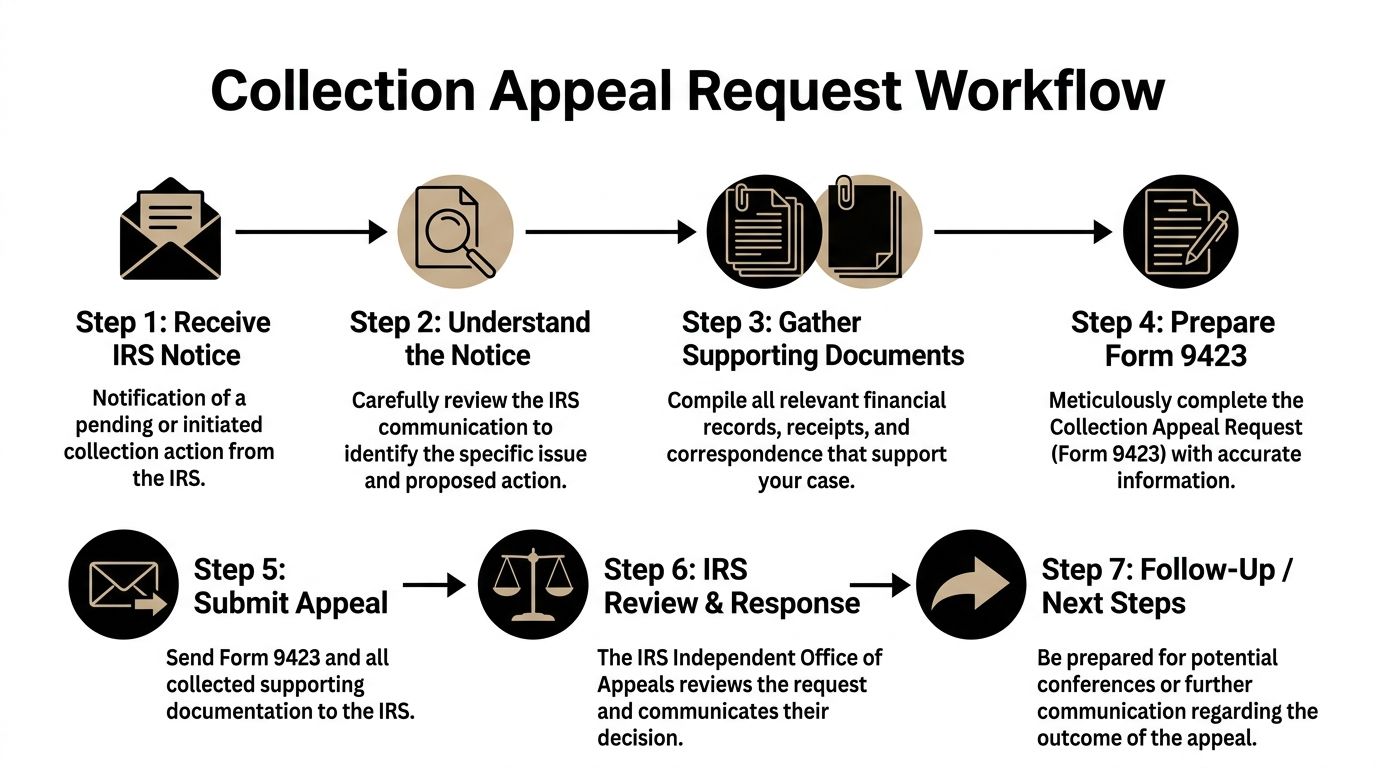
A common CAP file starts the same way. The taxpayer gets a call from a revenue officer, learns a levy is about to issue, scrambles to gather records, and then loses time arguing facts before pinning down the collection action under review.
Form 9423 does not fix a disorganized file. It gives you a short window to present a clean, supportable dispute through the right sequence.
Start by defining the decision you want changed
Identify the exact collection action first. Appeals can work with a specific dispute. Appeals cannot do much with a generalized complaint that the IRS is being aggressive.
A workable issue statement sounds like this: the revenue officer proposed a levy after receiving updated financial information and before considering a pending installment agreement proposal. That gives Appeals something concrete to review and a remedy to consider.
Pull the core documents before any conference or filing:
- The IRS notice, letter, or case history entry tied to the action
- Prior communications with the assigned employee, ACS unit, or manager
- Financial records that support your position
- A specific alternative such as an installment agreement, hold, release, or correction of factual error
The process usually starts with the IRS employee and that employee's manager
CAP is a procedural appeal. If you skip steps, the case can stall before anyone reaches the merits.
The IRS instructions for Form 9423 explain that the taxpayer generally must first try to resolve the disagreement with the collection employee, then request a conference with that employee's manager, then timely submit the appeal after the conference. See the IRS page for Form 9423 and collection appeal rights.
In practice, the deadline problem is what hurts taxpayers. The time to act is measured in business days, not weeks. Once the manager conference ends, treat the notice of intent to appeal and the form itself as immediate tasks.
Use the manager conference to build the record
The manager conference is often the last chance to correct the file before it goes to Appeals. A loose phone call wastes that opportunity.
State three things clearly:
- What action is being challenged
- Why the action is wrong, premature, or unsupported
- What specific result should replace it
Good notes matter. Record the date, the participants, the documents discussed, and the exact relief requested. If the manager says the IRS considered a financial statement, but the file shows the statement was never reviewed, that point belongs in your appeal package.
A workflow that gives Appeals something it can act on
This is the sequence I want followed in a live collection file:
- Review the collection notice and case posture immediately Confirm whether the dispute involves a levy, lien, seizure, or installment agreement action.
- Contact the assigned IRS employee right away Delay rarely helps in CAP matters, especially when collection action is already queued.
- Request the managerial conference For many CAP issues, this is part of preserving the appeal.
- Prepare for that conference like a short evidentiary presentation Have the timeline, financial records, and proposed resolution ready.
- Notify the manager that you intend to appeal Do it promptly after the conference.
- Submit Form 9423 with supporting documents The form should match the issue raised in the conference and ask for a defined remedy.
- Keep proof of delivery Certified mail, fax confirmation, or other reliable transmission proof can matter if timeliness becomes disputed.
What a strong filing package usually includes
Form 9423 by itself is not persuasive. The stronger packages are focused and readable.
Include the documents that support the requested outcome:
- The notice or letter at issue
- A short timeline of events
- Financial information relevant to collectibility or alternatives
- Prior correspondence with the IRS
- Form 2848, if a representative is involved
- A concise statement of the proposed resolution
That last point gets overlooked. Appeals officers are more likely to engage productively when the taxpayer presents a practical alternative, not a complaint.
Revenue officer cases require tighter execution
Cases assigned to a field revenue officer tend to move faster and involve more direct factual disputes than automated collection files. That affects how you prepare the appeal and how quickly you need to act.
For background on how those cases are usually developed, this explanation of the IRS revenue officer process is useful.
What realistic outcomes look like
A good CAP filing can stop or change the immediate collection action. It can also fail, even where the taxpayer has a fair point, if the record is thin or the requested relief is unrealistic.
That trade-off matters. CAP is often worth using because it is fast, but speed cuts both ways. You may get review quickly, and you may also get a quick denial if the file does not show a concrete alternative or a procedural problem the IRS should correct.
Used well, Form 9423 is not a protest form. It is an early opportunity to frame the case, protect the client from avoidable damage, and set up the next step if Appeals does not agree.
Where these cases usually break down
The weak files tend to have the same defects:
- No clear statement of the collection action under appeal
- The manager conference was skipped or poorly documented
- The filing does not match the issue discussed with the IRS
- Attachments are voluminous but do not prove the key point
- There is no proof the appeal was submitted on time
Those mistakes are fixable. The best approach is simple. Build the record early, ask for a specific result, and file as if you may need to explain later why the appeal should have been granted.
A Field-by-Field Guide to Completing Form 9423
A clean Form 9423 is not enough. The form needs to do persuasive work. Most of the boxes are straightforward, but a few fields carry almost all of the strategic value.
That’s where taxpayers either give Appeals a reason to act, or hand over a vague complaint with no path to relief.

Basic identification fields
Start with the obvious items and get them right.
That includes the taxpayer’s name, address, identifying number, and the tax periods involved. Business cases need extra care here. An EIN error, wrong period, or mismatch between the notice and the form can create confusion that slows everything down.
If a representative is acting for the taxpayer, include the proper authorization. In practice, that means Form 2848.
Block 14 and choosing the action being appealed
This section is more important than it looks. Check the box that matches the exact collection action.
Don’t overstate the dispute. If the issue is the termination of an installment agreement, don’t make it sound like an all-purpose challenge to every collection step the IRS has taken. Narrow issues are easier to analyze and easier to fix.
Block 15 is where the case is won or lost
The heart of collection appeal request form 9423 is the explanation of disagreement. In this section, many filings become too emotional, too broad, or too unfocused.
A strong Block 15 covers:
- What happened
- Why the IRS action is wrong, premature, or unreasonable
- What evidence supports that position
- What result you want instead
Here is the difference between weak and strong framing.
Weak explanation “The levy will cause hardship and the IRS is being unfair.”
Stronger explanation “The proposed levy should not proceed because the taxpayer provided updated financial records showing current operating obligations and proposed a revised payment arrangement that was not meaningfully considered. The file also reflects ongoing cooperation and current compliance.”
The second version gives Appeals something to evaluate.
Don’t write Block 15 as a complaint. Write it as a focused argument tied to facts and a requested result.
What arguments usually work better
CAP cases are strongest when they focus on collection process, not outrage.
Better arguments involve:
- Procedural error The IRS moved ahead without following the proper sequence.
- Bad facts The collection action was based on incomplete, outdated, or misunderstood information.
- Reasonable alternative ignored The taxpayer proposed something viable, and the IRS failed to weigh it fairly.
Poorer arguments sound like this:
- “I can’t believe they did this.”
- “I don’t agree with taxes.”
- “I shouldn’t have to pay.”
- “I want Appeals to reduce what I owe.”
Those points either aren’t relevant to CAP or aren’t persuasive.
Attachments should support the story
The best attachments are not the largest stack. They are the records that prove the point raised in Block 15.
Useful exhibits may include:
| Attachment | Why it matters |
|---|---|
| IRS notice | Identifies the exact action under appeal |
| Financial records | Supports hardship, feasibility, or factual correction |
| Prior correspondence | Shows cooperation and what the IRS was told |
| Proposed alternative | Gives Appeals a practical path to approve |
Label attachments clearly. If there are multiple exhibits, add simple exhibit names so someone reviewing the file can follow the argument without guessing.
Tone matters more than many people think
Form 9423 is not the place to punish the IRS for being difficult. It is the place to show that the proposed action should change.
That means the writing should be:
- Concise
- Fact-based
- Specific
- Solution-oriented
When a filing says, in substance, “Here is the exact action, here is why it should not stand, and here is the workable alternative,” Appeals has something useful to work with.
Critical Mistakes That Will Jeopardize Your Appeal
A common CAP loss starts the same way. The taxpayer has a significant problem with the proposed levy or lien action, but the Form 9423 file does not give Appeals a clean reason to intervene. The deadline was missed, the issue is framed as a dispute over the tax balance, or the attachments do not prove the point that matters.
That is why weak filings fail even when the underlying facts are sympathetic. CAP can stop collection pressure for a short period, but it does not rescue a poorly framed case.
Missing the deadline
Timing errors end good cases.
CAP deadlines are short, and the IRS does not usually forgive a late request because the taxpayer was busy, frustrated, or still gathering records. If the form is not submitted on time, collection can resume and the chance to get Appeals review may be gone. I see this most often after a levy warning, when a taxpayer spends days arguing with Revenue Officer staff instead of getting the appeal on file.
If the threatened action involves levying funds, review the practical consequences of an IRS bank account levy and how it unfolds. It underscores why delay is expensive.
Arguing about the tax bill instead of the collection action
Form 9423 is about collection conduct. It is not the forum for relitigating whether the tax is owed.
That mistake shows up in appeals that say, in substance, "the assessment is wrong, so stop collection." Appeals may treat that as beside the point if the issue under CAP is whether the IRS acted reasonably in filing a lien, rejecting an installment agreement, or moving too quickly toward levy. A better approach is to identify the collection decision, explain why it was improper or premature, and tie that explanation to documents already in the IRS file or attached to the request.
Sending disorganized proof
Evidence wins these cases only if the reviewer can follow it.
Some taxpayers submit a stack of bank statements, medical bills, emails, and payment screenshots with no index and no explanation. That hurts more than it helps. Appeals should not have to guess which page shows hardship, which email contains the ignored proposal, or which statement proves current ability to pay.
Good appeal prep looks more like file-building than document dumping. Group records by issue. Label them. If the case turns on changed financial circumstances, lead with current numbers and a brief explanation of what changed. For a useful non-tax parallel on record discipline, this article on how to improve data quality makes the same point from another field.
A file that is easy to review is easier to credit.

Asking Appeals to "fix it" without offering a workable result
Appeals is far more likely to engage with a concrete proposal than a general complaint.
Useful requests ask for one identifiable outcome, such as reinstating an installment agreement, delaying levy action while updated financials are reviewed, correcting a factual error in the collection file, or accepting a specific alternative proposed to Collections. Vague requests waste the opportunity. "Please stop all enforcement" does not tell Appeals what should replace the IRS action or why that replacement is justified.
There is a trade-off here. A narrow request can feel less satisfying than attacking everything at once, but narrow requests are easier to prove and easier for Appeals to grant.
Letting emotion run the form
Strong CAP filings are disciplined.
Anger, accusations, and long narratives about unfair treatment often obscure the one issue that could win relief. Appeals officers read a lot of these forms. The submissions that get traction usually do three things well: they identify the action, show the error, and propose a practical correction. If the facts are good, calm writing gives those facts room to work.
After You File What Happens Next and What If You Lose
You file Form 9423 to stop a levy or fight a collection decision, then the waiting starts. What matters in that gap is not just whether Appeals agrees with you. It is whether you are using the pause to prepare the next step before enforcement starts again.
What happens during review
CAP moves faster than a CDP hearing, which is one reason practitioners use it when timing matters. In many cases, collection activity is suspended while Appeals reviews the dispute. Appeals may examine the collection history, speak with the revenue officer or ACS employee, and ask for clarification or updated documents.
That pause is helpful, but it is short-term relief, not a final solution.
A good representative uses that time to tighten the record, correct any factual gaps, and test whether the proposed resolution still holds up if Appeals pushes back. If your case depends on updated financials, missing compliance, or a replacement installment agreement, get that work done before the decision comes out.
If the appeal is denied
A CAP denial is final within the CAP process. There is no further administrative appeal of that decision. Once the case closes, the IRS can resume collection action, sometimes quickly.
That is the practical difference clients need to understand. CAP can stop immediate action and sometimes reverse a bad collection decision, but it does not give you a second layer of review if Appeals sides with Collections.
The right next step after a loss
The next move depends on why Appeals said no.
If the file was weak because there was no clear collection alternative, build one. If the problem was proof, fix the proof. If Appeals agreed with the IRS on procedure but your client still cannot pay, shift to the resolution path that fits the facts.
Common next steps include:
- Submitting or revising an installment agreement proposal
- Evaluating whether an Offer in Compromise is realistic
- Requesting currently not collectible status based on hardship
- Preparing for renewed levy action and protecting exposed funds
- Correcting compliance issues before making the next request
Bank levy risk deserves special attention. If payroll, rent, or operating cash is sitting in an account that the IRS already identified, review how the process works before the hold on collection ends. This guide to IRS bank levies and frozen account timing is a useful starting point.
What a denied appeal still gives you
Even a loss can improve the case if you use it correctly. A well-prepared Form 9423 forces the dispute into a clear record. You learn which facts Appeals accepted, which arguments failed, and whether the underlying problem is procedure, financial disclosure, or the absence of a workable proposal.
I tell clients that CAP is partly a decision process and partly a pressure test. If the appeal fails, the file shows what has to change next. That may mean a cleaner financial package, a narrower request, or a different resolution altogether.
Do not let that record go stale. Use it immediately while the facts, contacts, and deadlines are still clear.
Expert Answers to Your Top Form 9423 Questions
A common scenario looks like this. The IRS rejects an installment agreement, levies are back on the table, and the taxpayer wants to know whether Form 9423 will change the outcome or just burn time. The right answer depends on what is being challenged, how clean the record is, and whether there is a realistic backup plan if Appeals says no.
Can I use Form 9423 if my installment agreement was rejected or terminated
Yes, if the dispute involves the rejection, termination, or proposed modification of an installment agreement. That is one of the clearer uses of Form 9423, and it is often the best path when the primary problem is the collection decision rather than the amount of tax due.
The deadline matters. In installment agreement cases, the window is longer than it is for many levy disputes. Miss it, and the taxpayer usually loses a fast administrative review that could have bought time or reversed a bad call.
Do I always need a manager conference first
For many levy, lien, and seizure disputes, start with the collection employee and then ask for a manager conference before filing. That step is often where the record gets made. If the manager discussion is skipped where the IRS expects it, the appeal can become harder to position.
Still, I want the file to show that the taxpayer tried to resolve the issue first, identified the exact decision being challenged, and stated what result would fix it.
Can Form 9423 help me argue that the tax assessment is wrong
No. Form 9423 is aimed at the collection action. It is not the place to relitigate the underlying tax liability.
That distinction matters in practice. Taxpayers often file a strong factual statement about why the tax is wrong and a weak statement about why the levy, lien, or payment decision is unreasonable. Appeals will usually focus on the collection issue in front of it.
What if the IRS already assigned a revenue officer
Then precision matters more.
Revenue officer cases tend to move faster, and the case history is usually more detailed than an automated collection file. Match the appeal to the exact action taken. Identify dates, conversations, documents provided, compliance status, and the practical harm the action will cause. Vague fairness arguments rarely carry these cases.
Does Form 9423 matter in Trust Fund Recovery Penalty situations
Yes, sometimes. It can help if the dispute is about a collection action tied to payroll tax exposure, especially where the IRS is pushing enforcement before the business or owner has a workable resolution in place.
These cases are harder than standard individual collection matters. The IRS may be looking at multiple periods, multiple entities, responsible person issues, and ongoing deposit compliance at the same time. A weak Form 9423 filing will not fix a broken payroll tax case. A focused one can still slow down a damaging collection move and force a more disciplined review.
What are the actual odds of success
Form 9423 is not a magic form. Some cases get significant relief. Others produce a quick denial because the taxpayer filed too late, challenged the wrong issue, or offered no practical alternative.
The better question is whether the appeal gives Appeals a reason to change course. Cases tend to perform better when the taxpayer can show one of three things: the IRS did not follow procedure, the proposed collection action is more aggressive than the facts justify, or a specific alternative is ready to approve. Cases tend to perform worse when the taxpayer is out of compliance, missing financial information, or using CAP to argue points that belong in a different process.
What if Appeals denies the request
Then treat the denial as a decision point, not the end of the matter.
A denial usually tells you where the case failed. Maybe the financials were incomplete. Maybe the proposal was not credible. Maybe the dispute belonged in CDP, audit reconsideration, penalty relief, or a fresh installment agreement request instead of CAP. Use that feedback immediately while the file is still active and the collection history is fresh.
In many cases, the next best move is not another appeal. It is a stronger resolution package.
When should I get professional help
Get help early if the case involves an active levy threat, a revenue officer, payroll tax issues, a terminated installment agreement, or a business with multiple related liabilities. Those are the files where strategy matters most and small mistakes cost time you do not get back.
If you’re dealing with an IRS collection action and need straight answers before spending money on the wrong strategy, Attorney Stephen A Weisberg offers a FREE Tax Debt Analysis at Weisberg.tax. He has over 10 years of experience representing individuals, businesses, and business owners in IRS and state tax matters, and his help-first approach is built around determining whether he can help, and how, before asking anyone to commit to full representation.


