Closing a Business IRS
Our guide helps with closing a business irs, covering final returns, payroll taxes, and debt resolution. Get your 2026 checklist to shut down correctly.

In this article
- The End of a Chapter Navigating Your Business Closure
- The Official IRS Final Filing Checklist
- File the final returns correctly
- Don't treat the EIN as the first step
- Keep records after the business is gone
- The State Dissolution vs Federal Closure Pitfall
- Why the mismatch causes trouble
- What works and what doesn't
- The Payroll Tax Trap Understanding Personal Liability
- What the Trust Fund Recovery Penalty means
- Who can be at risk
- Why owners make the wrong call
- How to Resolve Outstanding IRS Tax Liabilities
- Comparing the main paths
- What usually works in practice
- Strategy matters more than form names
- Your Step-by-Step Closure Action Plan
- A practical order of operations
- Red flags that should stop a DIY approach
- What a clean closure looks like
- Secure Your Financial Future Beyond the Business
You may be at the point where the business is already quiet. Payroll has stopped. Vendors have been told. The lease is ending, or you're negotiating the last month. And then the next thought hits: what does the IRS need from me, and what can still come back on me personally if I miss something?
That mix of relief and dread is normal. Owners often spend years making decisions under pressure, but closing a business can feel different because the operational work is ending while the legal and tax risk is still very much alive.
The usual checklists help, but they often leave out the two issues that create the most trouble in practice. First, the timing mismatch between state dissolution and federal closure. Second, the reality that unpaid payroll taxes can follow a responsible person personally, even after the company is gone. If you're dealing with equipment, inventory, or a full shutdown of a location, practical cleanup resources matter too. Businesses handling physical wind-downs often look for help for IT directors closing facilities while they sort out the tax side. For legal and tax-focused updates on shutdown issues, this business closure resource collection is also useful.
The End of a Chapter Navigating Your Business Closure
Closing a business rarely feels tidy, even when it's the right decision. A retiring owner may feel peace about stepping away and still lose sleep over final payroll forms. A founder closing after a hard year may be more worried about tax notices than the shutdown itself. Both reactions make sense.
What matters now is sequence and judgment. The IRS side of a closure isn't just about checking boxes. It's about making sure the government sees the same ending date that you think you've already reached.
Closing the doors and closing the tax account are related steps, but they are not the same step.
I've seen owners handle the customer-facing side of a shutdown carefully and still leave the tax side half-finished because no one explained where the significant traps are. They assumed the state filing ended everything. Or they assumed a dissolved company couldn't produce any more personal risk. Those assumptions cause expensive problems.
A calm approach works better. Gather the entity documents, identify the actual last day of operations, confirm whether wages were paid, and map the filings in order. Once you do that, the process becomes manageable. Serious, yes. Undefined, no.
The Official IRS Final Filing Checklist
Before getting into strategy, start with the baseline IRS requirements. These are the required steps that apply when the business has stopped operating and needs to close its federal tax footprint properly.
File the final returns correctly
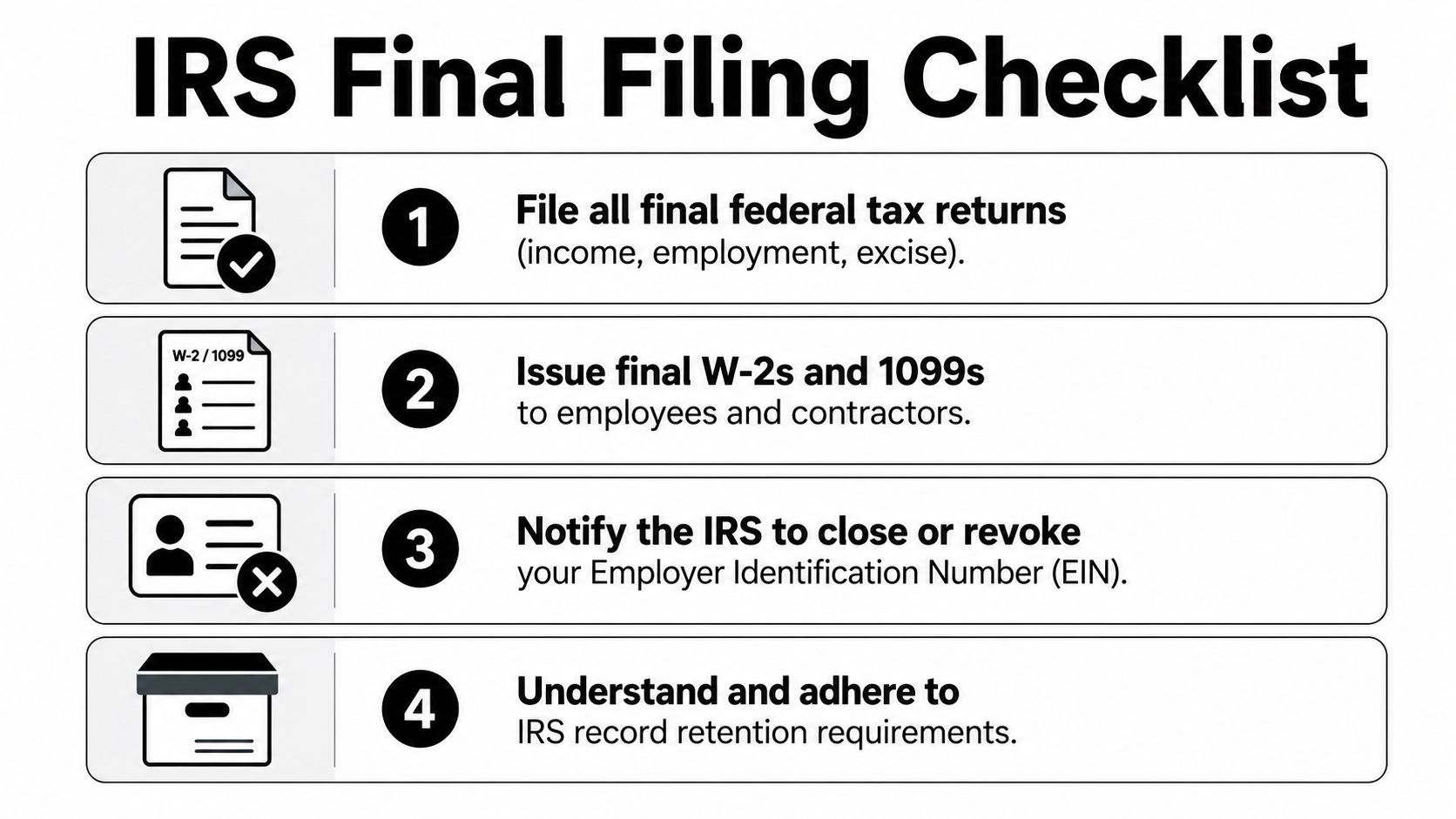
The IRS says a business closing down must file a final return, pay all tax owed, report contractor payments of at least $600 with Form 1099-NEC, and cancel the EIN after all other steps are done. The same IRS guidance also states that corporations must file Form 966 within 30 days of adopting a dissolution plan, and payroll filers must submit a final Form 941 for the last quarter in which wages were paid. It also states that employment tax records should be kept for a minimum of four years. That guidance appears in the IRS page on closing a business.
For many owners, the practical problem isn't learning that a final return exists. It's understanding that the return must clearly communicate that the entity is done. If the return isn't marked as final where required, the IRS may continue expecting future filings.
A good working checklist looks like this:
- Income tax return: File the last federal return for the entity and mark it as final where the form requires it.
- Payroll returns: If you had employees, file the final employment tax return for the last period wages were paid.
- Contractor reporting: If you paid nonemployees enough to trigger reporting, issue the final information returns that still apply.
- Tax payment: Pay outstanding federal tax due if the business can do so.
- EIN closure step: Notify the IRS to close the EIN account only after the filing work is finished.
Don't treat the EIN as the first step
Owners often focus on “canceling the EIN” because it sounds like the clean ending. It isn't the first move. It's the last administrative move after the tax filings and account closures are handled.
If you want a simple explanation of how an EIN is created and why it continues to matter during closure, this overview of Form SS-4 for law firms gives useful context on the role the EIN plays, even though the underlying form applies more broadly than law practice entities.
Practical rule: If the tax returns aren't finished, you are not ready to close the EIN account.
Keep records after the business is gone
Owners understandably want to purge files and move on. Resist that impulse. The IRS guidance above specifically says employment tax records should be kept for a minimum of four years. In practice, record retention after closure is part of risk control, not clutter.
For a broader operating checklist that helps owners organize year-end and entity-level tax tasks before the final shutdown filing, this small business tax checklist is a useful companion.
The State Dissolution vs Federal Closure Pitfall
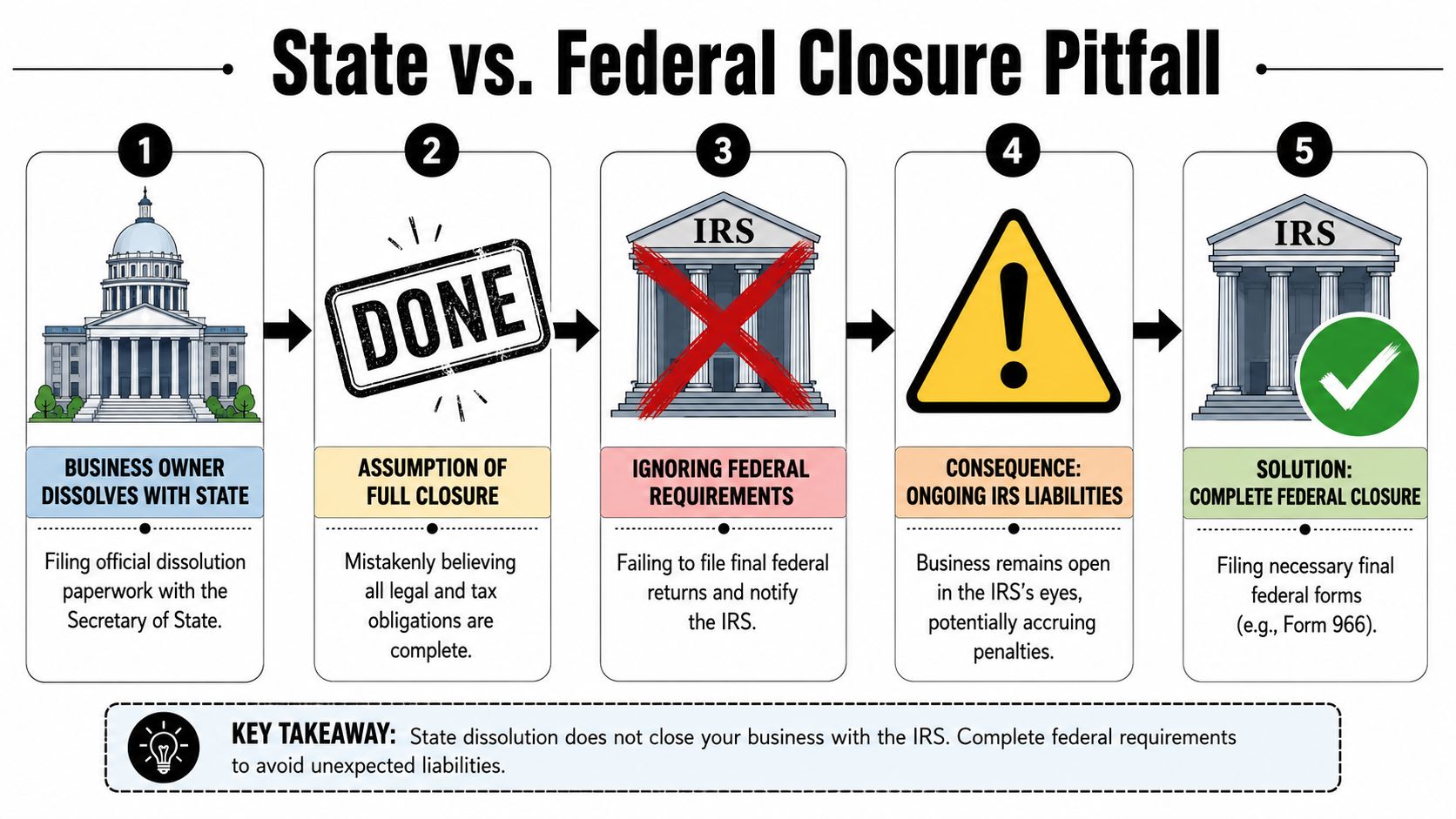
One of the most expensive assumptions in closing a business IRS matters is this: “I dissolved the company with the state, so I'm done.”
That isn't how it works.
State dissolution and federal tax closure are connected, but they are not automatic mirror images of each other. A business can stop existing under state law while the IRS still expects final federal action from that same entity.
Why the mismatch causes trouble
Many owners are often blindsided. The verified data here is unusually specific. A 2024 study by the National Small Business Association found that 42% of dissolving businesses incurred penalties due to misalignment between state dissolution dates and federal tax filings. This gap is particularly dangerous for LLCs and corporations where the state dissolution automatically terminates the legal existence, but the IRS continues to treat the entity as active if the final return isn't marked "final" and the EIN is not explicitly cancelled within 30 days of state dissolution.
That problem shows up in real life in a very ordinary way. An owner files dissolution documents with the Secretary of State in late December. The owner assumes the business is over and waits to think about taxes until regular filing season. The IRS, however, may still be looking for a properly marked final return and the related closure steps tied to the entity's actual legal end.
What works and what doesn't
What doesn't work:
- State-first with no federal coordination: Filing dissolution and assuming the federal side will sort itself out.
- Waiting for the next normal tax season: That can ignore entity-specific closure timing.
- Leaving the return unmarked: A return that lacks the final designation can keep the filing cycle alive.
What works:
- Matching dates intentionally: The legal dissolution date should line up with the final filing strategy.
- Reviewing the entity type first: LLCs, corporations, and partnerships don't all create the same filing pattern.
- Handling closure as one project: State law, payroll accounts, income tax returns, and EIN closure should be planned together.
Owners get into trouble when they treat dissolution as paperwork. It's really a timing decision with tax consequences.
The key takeaway is simple. Don't file the state dissolution until you know exactly how the federal returns will close and who is handling them. That one pause prevents many of the surprise notices that arrive after an owner thinks the matter is finished.
The Payroll Tax Trap Understanding Personal Liability
If your business has unpaid payroll tax issues, this is the part to read slowly. Dissolving the entity does not erase certain payroll tax exposure, and the corporate shield doesn't protect against everything.
What the Trust Fund Recovery Penalty means
When employees are paid, part of what is withheld is not the business's money to use for operations. Those withheld amounts are held in trust for the government. If the business uses that money to cover rent, vendors, or a last payroll cycle instead of remitting it, the IRS can pursue a Trust Fund Recovery Penalty against responsible individuals.
The verified data here is stark. Over 85% of small businesses with payroll tax debt do not understand that closing the business does not absolve the responsible individual of the 100% personal liability for the trust fund portion of unpaid taxes. A 2023 report by the Tax Policy Center revealed that 73% of individuals assessed the Trust Fund Recovery Penalty were unaware that dissolution does not extinguish their personal liability.
That's why this issue is more than a filing problem. It's a personal exposure problem.
Who can be at risk
Owners often assume only the named owner is exposed. That's too narrow. The IRS looks at control and responsibility. In practice, that can include:
- Owners and officers: Especially those who decided which bills got paid.
- People with signature authority: Check-signing power matters.
- Managers controlling payroll decisions: Title matters less than actual authority.
- Anyone who chose other creditors over payroll taxes: That decision can become central.
The legal question usually turns on who was responsible and whether the failure was willful. Those are fact-based issues, not labels on an org chart.
The business can close. The IRS inquiry into payroll tax responsibility can continue.
Why owners make the wrong call
Distressed owners usually don't set out to misuse payroll taxes. They're trying to survive. They pay the landlord to avoid lockout. They pay a key vendor to finish jobs in progress. They tell themselves they'll catch up next month.
By the time closure happens, they often still believe the unpaid payroll tax debt belongs only to the business. That belief is dangerous. If you have any concern about unpaid withholdings, you need to evaluate personal exposure before signing off on the shutdown.
For a fuller discussion of how this penalty works and what the IRS examines, this article on the Trust Fund Recovery Penalty is a solid next read.
How to Resolve Outstanding IRS Tax Liabilities
Discovering tax debt at shutdown doesn't mean you've reached a dead end. It means you need to stop treating the problem as clerical and start treating it as a resolution project. The right solution depends on what's owed, who owes it, whether collection has started, and what your finances look like now that the business is ending.
Comparing the main paths
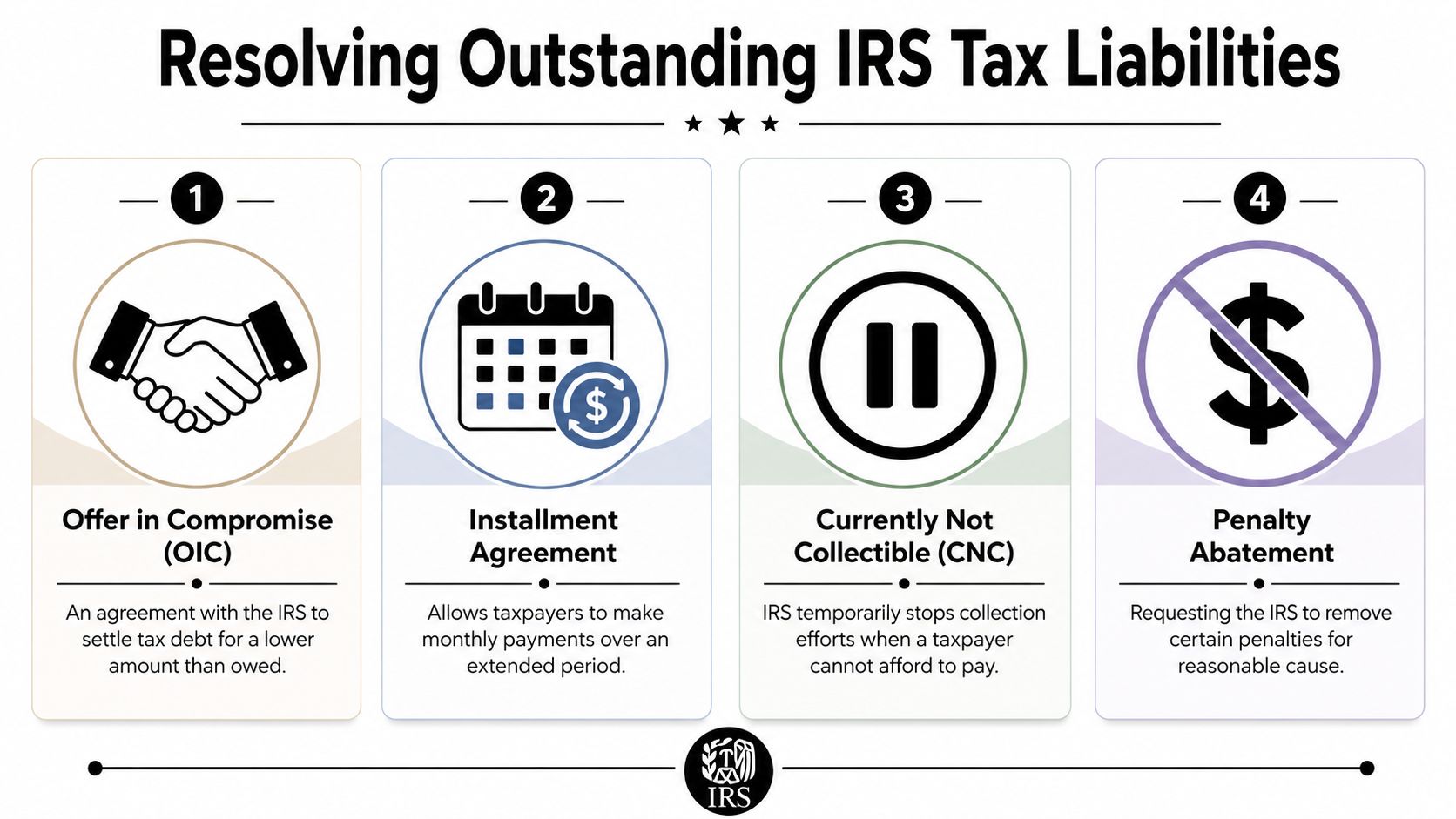
Here is the practical comparison I use with clients when evaluating next steps:
| Option | Best fit | Main advantage | Main trade-off |
|---|---|---|---|
| Installment Agreement | Taxpayer can pay over time | Creates a structured payment path | You're still paying the debt in full unless a different adjustment applies |
| Offer in Compromise | Taxpayer likely can't realistically pay the full balance | Can resolve for less than the full amount if accepted | The financial review is demanding and the preparation needs to be accurate |
| Currently Not Collectible | Taxpayer can't currently make payments | Collection pressure may pause | It doesn't make the liability disappear |
| Penalty Abatement | Penalties are driving the balance and there is a valid basis for relief | Can reduce part of the total burden | It usually addresses penalties, not the underlying tax itself |
What usually works in practice
An Installment Agreement works when the liability is real, the return filings are complete, and the taxpayer has enough predictable income to support monthly payments. It's often the cleanest fit for a former business owner who has moved into salaried work after shutting down.
An Offer in Compromise can make sense when the numbers show the IRS is unlikely to collect the full balance within a reasonable collection period. This option lives or dies on documentation. Sloppy disclosures, missing returns, or unrealistic expense claims undermine it quickly.
Currently Not Collectible status is often overlooked. For some owners, closure leaves them with little or no disposable income. In that situation, requesting a temporary halt to active collection can be the right short-term move while finances stabilize.
Penalty Abatement matters when the business owner filed or paid late for reasons that fit recognized relief standards. It isn't a cure-all, but in the right case it reduces friction and can make a payment plan realistic.
Strategy matters more than form names
Many owners come in asking for one program by name. That's understandable, but usually premature. The better approach is to identify:
- Whose liability it is
- Whether all required returns are filed
- Whether payroll tax exposure has a personal component
- What the owner can afford now
That sequence produces better decisions than chasing the most famous IRS relief label.
If you want a detailed walk-through of how these resolution paths are evaluated in real cases, this guide on how to settle tax debt with the IRS is a useful resource. One option some business owners consider is a formal analysis with Attorney Stephen A. Weisberg, whose practice focuses on IRS tax debt and controversy matters for businesses and individuals.
Your Step-by-Step Closure Action Plan
When owners ask what order to follow, the answer matters as much as the forms themselves. Closing a business IRS issue is easier to manage when every step is tied to the correct date and responsible party.
The IRS newsroom guidance gives the technical sequence clearly: legally dissolve under state law, close payroll and sales tax accounts, file all final federal and state returns marked "final," and then notify the IRS to close the EIN account. Corporations also must file Form 966 within 30 days after adopting a resolution to dissolve or liquidate, according to the IRS explanation of what business owners need to do when closing their doors for good.
A practical order of operations
Use this as the working roadmap.
Choose the actual shutdown date
Pick the final day of operations, not an aspirational one. This affects payroll, state accounts, and final return periods.Adopt formal internal approval
If your entity requires a member, shareholder, or board resolution, get that done and keep the records. For corporations, this also matters because of the separate federal Form 966 trigger.Run final payroll carefully
Don't process a last payroll casually. Confirm withholdings, deposits, and whether there's any unpaid trust fund exposure before funds are spent elsewhere.Close state tax accounts deliberately
Sales tax, employer withholding, unemployment, and related state accounts should be closed with attention to each agency's process.Prepare every final return as a closure filing
In a closure filing, dates, final boxes, and entity treatment all need to line up.Address unresolved tax balances before the EIN step
If there's debt, decide whether you're paying, entering a resolution track, or disputing liability.Notify the IRS regarding the EIN account
This is the end step, not the beginning.
Red flags that should stop a DIY approach
Some closures are straightforward. Others are not. Pause and get tax counsel if any of these are present:
- Unpaid payroll taxes: Personal exposure may exist.
- Disputed ownership or signatory control: Responsibility can become contested.
- Asset sales with tax consequences: Allocation and reporting may be more complex than expected.
- Multiple states involved: Closure timing and account shutoff become harder to synchronize.
- IRS notices already received: The matter may already be moving from compliance into enforcement.
If the business owes payroll tax or you're unsure who the IRS may treat as responsible, this is not the stage for guesswork.
What a clean closure looks like
A clean closure doesn't mean there was no hardship. It means the final filings match the legal reality, the remaining liabilities are identified, and there is a plan for any balance that can't be paid immediately.
That's the standard to aim for. Not perfection. Coordination.
Secure Your Financial Future Beyond the Business
A business closure is an ending, but it's also a financial handoff from the entity's life to your personal future. That's why the details matter. If the dates are wrong, the IRS may keep the filing cycle alive. If payroll taxes were left unpaid, the problem may not stay inside the company.
The strongest approach is proactive. Confirm the legal end date. Match it to the federal filings. Review payroll history before the last cash leaves the business. If debt remains, choose a resolution path based on facts, not panic.
Owners often feel embarrassed at this stage. They shouldn't. Businesses close for many reasons. Markets change. Partnerships fail. Health changes. Capital dries up. None of that means the situation is hopeless. It means the closure has to be handled with the same seriousness you would bring to starting the business in the first place.
A clean break is possible. What usually prevents it isn't bad intent. It's delay, assumptions, and incomplete advice. The standard checklist is necessary, but it isn't enough if your closure involves state dissolution timing issues or payroll tax debt.
If you're uncertain where the risk really sits, get the file reviewed before more forms go out. A short legal analysis at the right time can prevent months of notices, penalties, and avoidable personal exposure. That isn't fear-based advice. It's how owners protect the next chapter.
If you're closing a business and want a clear assessment of the IRS exposure before taking the final steps, Attorney Stephen A Weisberg offers a practical starting point through a tax debt analysis that looks at what you owe, who may be liable, and which resolution options may fit your situation.


