Certificate of Fiscal Residence USA: IRS Form 6166 Guide
Claim tax treaty benefits in 2026! Secure your official certificate of fiscal residence usa (IRS Form 6166) to prove US residency & reduce withholding.
In this article
- Your Foreign Client Asked for a What Now
- What the request usually means
- Why this catches people off guard
- Understanding the US Certificate of Fiscal Residence
- What Form 6166 is
- What Form 6166 is not
- Why foreign parties care about it
- When Do You Need IRS Form 6166
- The business situations where it matters most
- Why waiting for the request is often a mistake
- A quick decision guide
- How to Apply for US Residency Certification
- Start with the end use, not the IRS form
- Check timing before you pay the fee
- Complete Form 8802 with IRS records in mind
- Pay and submit the application the way the IRS currently requires
- Submission problems are usually small, but expensive
- When a straightforward filing is not actually straightforward
- Real-World Use Cases for Form 6166
- Four situations where the certificate matters
- Why the same form solves very different problems
- The hidden decision point
- Common Pitfalls and When to Call a Tax Attorney
- The mistakes I see most often
- The part foreign reviewers care about, but applicants miss
- When self-filing is usually reasonable
- When I would bring in legal help
A foreign customer is ready to pay you. Then their finance team sends a short request that stops everything: they need a certificate of fiscal residence from the United States before they can release payment without foreign withholding.
If you're a U.S. business owner, consultant, investor, or adviser, that request usually creates immediate confusion. The United States doesn't issue a document with that exact title. The request is still legitimate. The foreign payer is usually asking for the U.S. equivalent so they can apply the tax treaty rules correctly instead of withholding first and forcing you to clean it up later.
That U.S. equivalent is IRS Form 6166, the Letter of U.S. Residency Certification. It's the document foreign tax authorities, banks, and corporate registrars commonly accept as official proof that you or your entity is a U.S. resident for federal income tax purposes, which can help reduce or eliminate withholding on dividends, interest, and royalties under an applicable treaty, according to this overview of Form 6166 and Form 8802 requirements.
The hard part isn't just knowing the name of the document. It's knowing when you need it, how early to apply, what can stall the application, and what the IRS instructions don't say clearly enough for people who are trying to close a deal or get paid on time.
Your Foreign Client Asked for a What Now
The usual fact pattern is simple. A U.S. consultant signs a contract with a company in Europe. A software company licenses product to a foreign customer. An investor receives a request from a foreign custodian. Then someone abroad asks for a “certificate of fiscal residence USA” and expects you to know exactly what that means.
Few individuals do.
In practice, this request often arrives late. It shows up after the contract is signed, after the invoice is out, or after the foreign bank has already flagged the payment. That's why it feels more urgent than technical. You're not reading treaty articles for fun. You're trying to avoid a payment delay, an avoidable withholding problem, or a foreign compliance back-and-forth that drags on for weeks.
What the request usually means
When a foreign payer asks for a certificate of fiscal residence, they're usually trying to answer one question: are you a U.S. tax resident entitled to treaty treatment?
In the U.S. system, the IRS answers that question with Form 6166. You don't draft it yourself. You don't download a blank version and fill it in. The IRS issues it after reviewing Form 8802, the application for U.S. residency certification.
Foreign finance departments often use local terminology. The label may be unfamiliar, but the underlying request is routine in cross-border business.
That distinction matters because many taxpayers send the wrong thing first. They attach a Form 1040, Form 1120, W-9, or EIN letter and assume that should be enough. Sometimes the foreign side accepts it. Often it doesn't. Their tax team wants the formal IRS residency certification because that's the document that fits their treaty and withholding procedures.
Why this catches people off guard
The IRS process isn't hard in the abstract. The problem is timing and context. By the time you learn about Form 6166, someone else may already be waiting on it. If a bank, withholding agent, or customer has put payment on hold, a paperwork issue becomes a business issue.
That's why this process deserves more attention than its bland IRS name suggests.
Understanding the US Certificate of Fiscal Residence
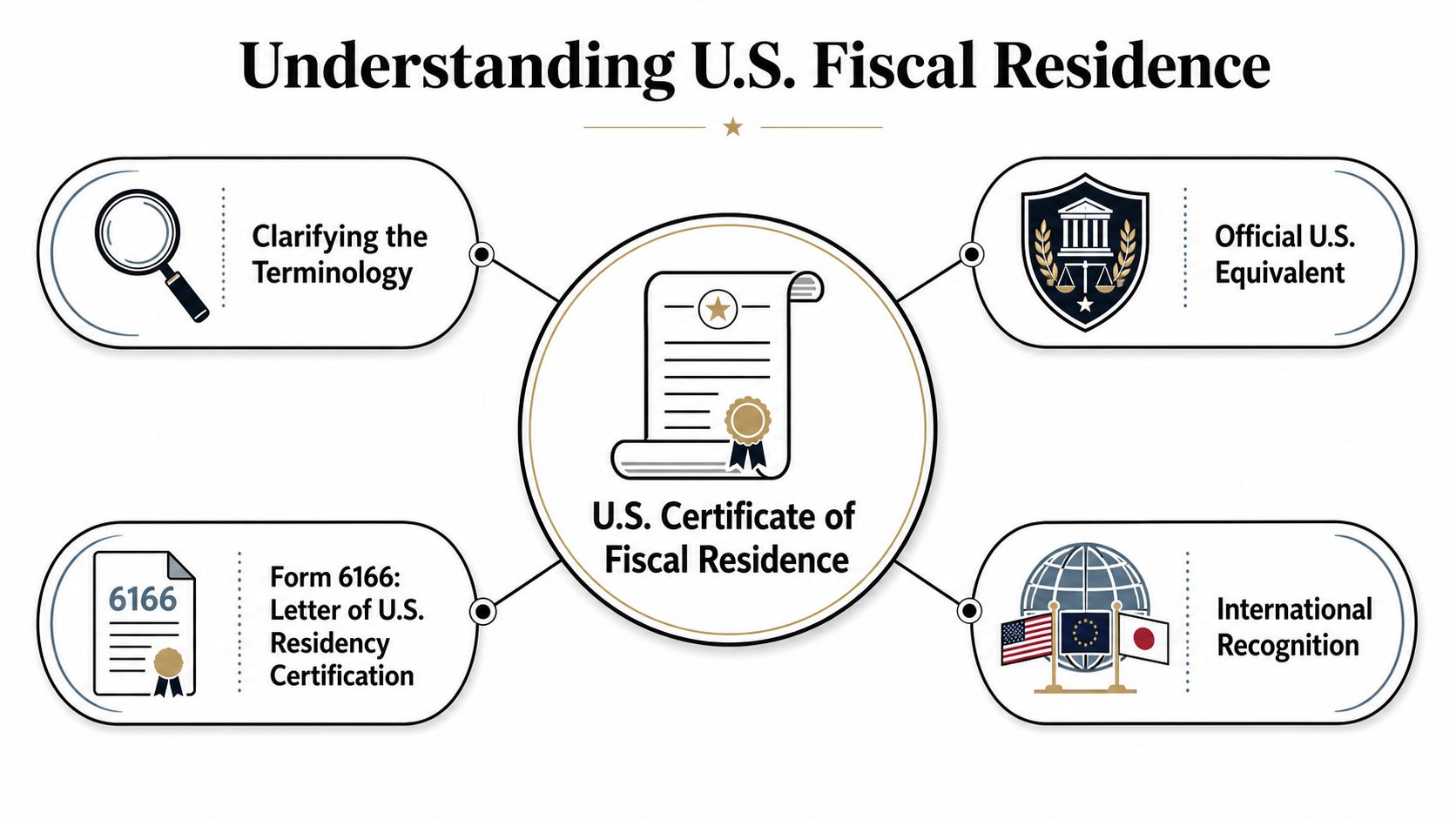
The phrase certificate of fiscal residence USA isn't an official U.S. tax label. It's the international business version of the request. The actual U.S. document is Form 6166, formally called the Letter of U.S. Residency Certification.
What Form 6166 is
Think of Form 6166 as a tax passport for treaty purposes. It tells a foreign government or withholding agent that the IRS recognizes the applicant as a U.S. resident for federal income tax purposes for the requested year.
The IRS doesn't treat Form 6166 as a fillable form. It is a computer-generated letter printed on U.S. Department of the Treasury stationery, and the IRS issues it only after it reviews and approves Form 8802 and confirms residency status for the requested tax year, as explained in this discussion of U.S. residency certification.
That point is easy to miss. People search online for “Form 6166 pdf,” expecting a standard IRS form package. There isn't one to complete. Your actual filing task is Form 8802. Form 6166 is the IRS's output after approval.
What Form 6166 is not
It isn't your tax return. It isn't a substitute for Form W-9. It isn't proof that a payment is exempt from every kind of foreign tax. And it isn't something the IRS sends automatically because you filed a return.
A return reports income and tax information to the IRS. A residency certification is a separate request for a separate purpose. It is tied to a specific year, and the certificate states that the person or entity is a U.S. resident for that year.
That year-specific feature creates practical consequences. If a foreign payer needs proof for one year and you request another, you've created a mismatch before the foreign reviewer even reaches the treaty question.
Why foreign parties care about it
Foreign withholding systems are often set up to withhold first unless the payee documents treaty eligibility. Form 6166 is often the document that satisfies the residency piece of that analysis.
Common users include:
- Service providers and consultants who need to support treaty claims with foreign clients.
- Licensing businesses receiving royalty income from abroad.
- Investors and entities dealing with foreign custodians, banks, or registrars.
- Owners with international structures who need clean proof of U.S. residency as part of a larger compliance package.
If your international profile is broad, it also helps to understand the compliance issues that often travel with cross-border banking and reporting, including foreign bank disclosure obligations.
Practical rule: If a foreign institution is asking for residency proof and your first instinct is to send a return transcript or W-9, stop and confirm whether they specifically need Form 6166. Very often, they do.
When Do You Need IRS Form 6166
You need Form 6166 when a foreign country, payer, or institution wants formal IRS proof that you qualify as a U.S. tax resident for treaty purposes. The most common trigger is money. More specifically, money that will be withheld unless you document residency properly.
The business situations where it matters most
A foreign client may be willing to pay your invoice only after receiving treaty documentation. A foreign licensee may need it before applying the reduced treaty rate to royalty payments. A bank or transfer agent may need it before processing income distributions without default withholding.
In other words, this isn't niche paperwork for large multinationals. Small businesses run into it all the time when they start earning outside the United States.
Here are common situations where the issue becomes real:
- Independent contractors get asked for residency proof after a foreign customer's accounts payable team reviews onboarding documents.
- SaaS and IP businesses run into it when payments are characterized as royalties under local law.
- Investors need it when foreign-source payments move through custodians that follow treaty procedures mechanically.
- Retirees or individuals abroad may need it to support local tax treatment of U.S.-connected income.
Why waiting for the request is often a mistake
The worst time to learn about Form 6166 is after money is already in the pipeline. At that point, the foreign payer has its own compliance timeline, internal reviewers, and country-specific paperwork. Even if your U.S. side is straightforward, the foreign side may not be.
That is why I usually tell business owners to ask one question early in any cross-border deal: Will your finance department require U.S. residency certification for treaty relief? It is much easier to gather what you need before the first invoice than after a payment hold.
A related issue is proof. Many taxpayers assume prior IRS filings are enough. Sometimes the foreign side still insists on formal residency certification and, in parallel, may ask for other IRS records depending on the transaction history. If you're sorting out what the IRS can provide in different contexts, this explanation of Form 4506-T helps separate transcript requests from residency certification.
A quick decision guide
| Situation | Is Form 6166 likely needed |
|---|---|
| Foreign payer asks for “certificate of fiscal residence” | Yes, often |
| You want treaty relief on foreign withholding | Usually |
| You only filed a U.S. return and have no foreign payer request | Not automatically |
| You're sending a W-9 and the foreign side accepts it | Maybe not, but confirm |
The key point is practical, not theoretical. If a missing certificate can delay payment, increase withholding, or derail treaty treatment, it stops being optional.
How to Apply for US Residency Certification
A foreign customer tells your accounting team, "We need the U.S. residence certificate before month-end or we will withhold at the local statutory rate." That is usually when Form 6166 stops feeling like a clerical task.
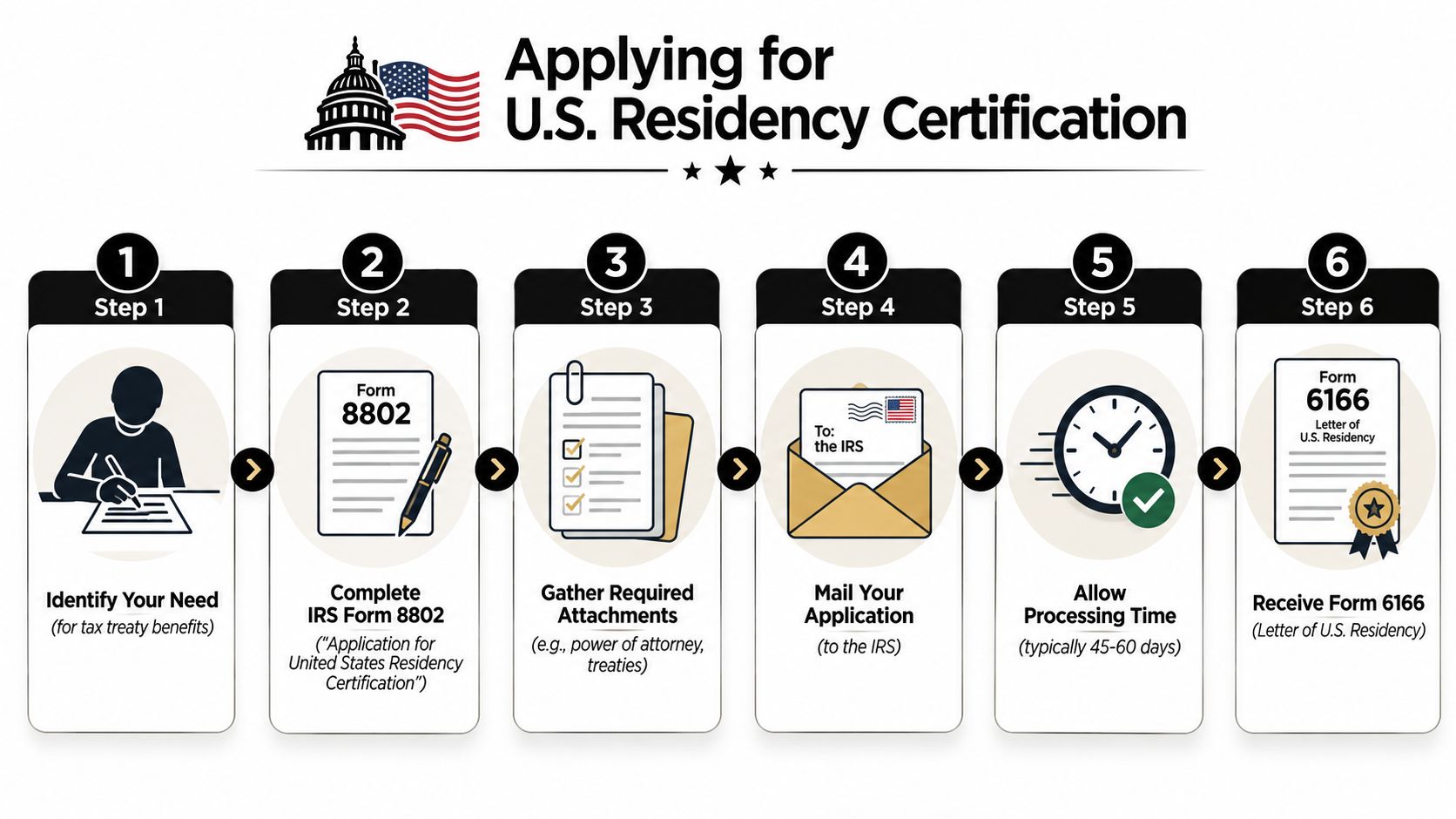
The IRS issues Form 6166 only after you file Form 8802 and meet the IRS requirements for residency certification. The form itself is manageable. The risk comes from filing it for the wrong taxpayer, the wrong year, or too late for the foreign payor's deadline.
Start with the end use, not the IRS form
Before preparing Form 8802, pin down four facts with the foreign party or its finance team:
- Who must be certified
- Which tax year or period they need
- Which country will rely on the certificate
- How many original certificates or copies they expect
That sounds obvious. It is also where avoidable mistakes start.
I often see applicants request a certificate for the current year because it is convenient, though the foreign bank or customer needs the prior calendar year. Others file in the individual owner's name even though the contract and payment flow sit with a corporation. The IRS may still process something, but it may not be the document the foreign side can use.
Check timing before you pay the fee
The IRS instructs taxpayers to file Form 8802 well before the certificate is needed, and the current user fee and submission procedures are listed on the IRS pages for Form 8802, Application for United States Residency Certification and Form 6166, Certification of U.S. Tax Residency. In practice, 45 days should be treated as a floor, not a planning target.
If a closing, dividend payment, licensing payment, or year-end distribution depends on the certificate, build extra time into the process. IRS processing is only one part of the timeline. The foreign withholding agent may need its own review after the certificate arrives.
The fee is nonrefundable. That matters. A preventable error on Form 8802 can turn into a second filing and a second fee.
Complete Form 8802 with IRS records in mind
Form 8802 asks for basic information, but accuracy matters more here than many applicants expect. The IRS will compare the application against its records and the taxpayer's filing history.
Pay close attention to these points:
- Applicant identity. The name, EIN, or SSN must match IRS records.
- Tax year requested. Form 6166 is issued for a specific period, so the year on the application has to match the foreign request.
- Country and copy count. One application can often cover multiple countries and multiple copies if that reflects the actual need.
- Return filing history. The taxpayer usually must have the underlying U.S. return position needed to support certification.
- Signature authority. The person signing must have authority to act for the applicant.
Representative authority causes more delays than clients expect. If someone other than the taxpayer will speak with the IRS or sign the submission, use proper authorization from the outset. Utilizing IRS Form 2848 instructions and practical guidance can effectively save time.
Pay and submit the application the way the IRS currently requires
Older articles on this process create confusion because the mechanics have changed over time. The IRS instructions for Form 8802 and the Pay.gov filing process control here, not an old checklist saved in someone's tax folder.
As reflected in the IRS materials and current filing workflow, applicants using Pay.gov must follow the IRS's electronic payment steps and include the required Form 8802 submission materials through that process or in the manner the IRS directs for the application type. Before filing, confirm the current mailing, fax, and electronic submission rules in the latest IRS instructions and on Pay.gov at the Form 8802 payment portal.
That extra check is not busywork. I have seen taxpayers rely on outdated online summaries, send the right form the wrong way, and lose weeks sorting out what the IRS received.
Submission problems are usually small, but expensive
The common failure points are rarely technical tax disputes. They are ordinary filing errors with real consequences.
- The application requests the wrong year.
- The legal name does not match the IRS record.
- The signer lacks authority.
- The taxpayer orders too few copies for the countries involved.
- The filing starts after the foreign payor has already set its withholding deadline.
A practical rule helps here. Prepare the filing backward from the foreign requirement, then compare it against the IRS instructions line by line.
When a straightforward filing is not actually straightforward
Some cases should not be handled as a quick admin task. Call a tax attorney or experienced international tax adviser if the applicant recently changed entity classification, merged, converted, changed name, uses a disregarded entity in the payment chain, or has gaps in U.S. filing history. The IRS instructions tell you what to send. They do not tell you whether the foreign side will reject a certificate issued in the technically correct name but the commercially wrong one.
That is the judgment call business owners usually need help with. The IRS process is formal and predictable. The harder question is whether the document you get will solve the withholding problem you have.
Real-World Use Cases for Form 6166
The easiest way to understand Form 6166 is to look at the types of people who need it. The legal principle is the same each time. The pressure point is different.

Four situations where the certificate matters
A freelance designer lands a contract with a Canadian company. The work is done remotely from the United States, but the foreign finance team still asks for official U.S. residency proof before processing payment under treaty treatment. Sending a W-9 alone may not satisfy that request. Form 6166 often does.
A U.S. software company licenses its product abroad. The foreign customer classifies the payment under local rules in a way that raises royalty withholding concerns. The company needs formal U.S. residency certification so the customer can process the payment with the correct treaty treatment instead of default withholding.
An individual investor holds shares in a foreign company through an international custodian. At distribution time, the custodian wants treaty documentation on file. The issue isn't whether the investor has a U.S. tax return. The issue is whether the custodian has acceptable residency proof in the format its compliance system expects.
A retiree living overseas deals with local tax authorities or pension administrators who want proof of U.S. tax residence for treaty analysis. The request may not use U.S. terminology, but the operational answer is still Form 6166.
Why the same form solves very different problems
These fact patterns look unrelated. They aren't. In each one, a foreign party needs a standardized way to document U.S. residency. Form 6166 gives them a formal IRS-issued answer.
That matters because foreign compliance staff usually don't make judgment calls from scratch. They work from checklists. If the checklist says “certificate of fiscal residence,” they want the recognized U.S. equivalent, not a bundle of substitute documents and a long email explanation.
A good rule in cross-border tax administration is simple. Give the foreign reviewer the document their process was built to accept.
The hidden decision point
The decision isn't only whether you can obtain Form 6166. It's whether your transaction is simple enough to handle as a document request or complex enough that the residency issue is only one piece of a larger tax problem.
If the payment involves layered entities, inconsistent tax filings, beneficial ownership questions, or a foreign rejection that doesn't make sense, the certificate may be the symptom, not the whole issue.
Common Pitfalls and When to Call a Tax Attorney
A foreign payer says the wire is ready once you send a certificate of U.S. fiscal residence. You file the request, assume the IRS part is routine, and then major problems surface. The tax return for the year in question was filed late. The entity that earned the income is not the entity listed in the contract. The foreign reviewer wants an apostille and no one mentioned that until after the IRS certificate arrived.
That is how a simple document request turns into a cash-flow problem.
Form 6166 is often treated like clerical work. In a clean case, it can be. In a messy case, the filing forces you to make statements about return filing, entity status, and the certification period that can create trouble later if they are wrong. The IRS process is paper-driven, but the consequences are operational. Delayed payments, rejected treaty benefits, compliance questions from a foreign bank, and signed statements you may need to defend later.
The mistakes I see most often
Timing causes more problems than taxpayers expect.
Clients often start after the foreign bank, customer, or withholding agent has already set an internal deadline. The IRS has its own processing time. The foreign institution may then add legal review, onboarding review, or authentication review before it releases funds or applies treaty rates. If the payment matters, build in enough time for all three steps, not just the IRS step.
The next problem is treating Form 8802 like a form you can complete from memory. You are making filing representations, including whether a U.S. return was filed for the period requested. If the answer is no, the form requires a signed statement about the intent to file by the due date, as described in this explanation of Form 8802 filing compliance and apostille issues.
That is where I tell clients to slow down.
If returns are late, amended, filed under a different entity classification, or inconsistent with how the income was reported abroad, the certificate request can expose a larger compliance issue. The official instructions tell you what box to check. They do not help much with the judgment call about whether your facts support the certification you are requesting.
The part foreign reviewers care about, but applicants miss
Many foreign institutions do not stop at Form 6166. They want the certificate authenticated for use in their jurisdiction.
That is a separate process. It can add time, mailing steps, and another opportunity for rejection if the foreign authority has country-specific requirements. I see this mistake regularly. Someone gets the IRS certificate, assumes the job is done, and only then learns that the foreign authority will not accept it in that form. At that point, the IRS did its part, but the payment is still on hold.
Another recurring issue is requesting the wrong period or the wrong number of copies. That sounds minor until a bank in another country rejects the package because the certificate year does not match its checklist or the original was sent to the wrong office.
When self-filing is usually reasonable
Handling it yourself often makes sense if the facts are clean and the request is administrative:
- Your U.S. filing history is current and consistent.
- The applicant is easy to identify, such as an individual or a simple entity with no ownership or classification confusion.
- The foreign party has clearly stated what year, how many originals, and whether authentication is required.
- The issue is residency proof only, not beneficial ownership, treaty article interpretation, or who earned the income.
When I would bring in legal help
Call a tax attorney when the certificate is only one piece of the problem.
Common examples include:
- Returns are late, disputed, or do not line up with the period you want certified.
- The entity structure raises real questions about who should apply.
- A disregarded entity, partnership, trust, or hybrid structure is involved and the foreign side is asking the wrong party for the certificate.
- A foreign bank or tax authority rejected the certificate and the stated reason does not match the facts.
- Significant funds are being held up and you do not have time to test guesses.
- Someone already filed an incorrect Form 8802 and now you need to correct the record without creating a second problem.
If you are trying to decide whether this is still paperwork or has become a legal judgment call, this guide on when to hire a tax attorney is a useful checkpoint.
My practical rule is simple. If the facts are clean, the timelines are manageable, and the foreign request is precise, careful self-filing is often enough. If the certificate request touches late filings, entity classification, treaty disputes, or a foreign rejection that makes no sense, get advice before you sign and submit. That usually costs less than fixing a bad filing after money is frozen or a foreign counterparty loses confidence.
If you need help with a Form 6166 issue, foreign withholding problem, or a residency certification request that has turned into a larger IRS matter, Attorney Stephen A Weisberg may be able to help. He represents individuals and businesses in tax matters and starts with a practical review of whether there's a real path forward before recommending paid work.


