Can Your Social Security Check Be Garnished?
Can your Social Security check be garnished? Understand which debts can lead to garnishment, your legal protections, and how to respond to a notice.
In this article
- Can Social Security Be Garnished? The Simple Answer
- The Exceptions to the Rule
- Quick Guide to Social Security Garnishment Rules
- Understanding The Shield Protecting Your Benefits
- The Power of Section 207
- What This Means For You In Practice
- When The Government Can Garnish Your Benefits
- Delinquent Federal Income Taxes
- Defaulted Federal Student Loans
- Social Security Overpayments
- What Happens to Your Social Security if You Default on Student Loans?
- A Problem That's Quietly Exploding
- How the Garnishment Actually Works
- Seeing the Impact in the Real World
- What About Garnishments for Child Support and Alimony?
- The Law That Opens the Door
- How Much of Your Check Can They Actually Take?
- What to Do if You Get a Garnishment Notice
- Step 1: Identify the Creditor and the Debt
- Step 2: Understand Your Rights and Options
- Step 3: Take Decisive Action
- Common Questions About Social Security Garnishment
- Can My Supplemental Security Income Be Garnished?
- How Do Banks Protect My Social Security Funds?
- Is There a Minimum Protected Amount?
It's one of the most common questions out there: can my Social Security check be garnished? The short answer is yes, but it's far from a simple free-for-all for creditors.
While federal law puts a protective shield around your benefits to guard them against most private debts, that shield isn't impenetrable. There are a few very specific, and very important, exceptions for money owed to the government or for family support.
Can Social Security Be Garnished? The Simple Answer

Many people operate under the assumption that their Social Security benefits are completely untouchable—a financial safety net that no creditor can ever reach. For the most part, that’s true. It's a dangerous misconception, however, to believe this protection is absolute.
The core protection comes from a federal law that generally blocks creditors from grabbing your Social Security payments for things like credit card balances, personal loans, or medical bills. But that protection evaporates when the debt is owed directly to the federal government or involves court-ordered family obligations.
The Exceptions to the Rule
So, whether your check can be garnished really boils down to who you owe. Think of your benefits as being inside a fortress with a very strong gate. While private debt collectors are stuck outside, a few powerful entities have a special key to get in.
These exceptions fall into three main buckets:
- Federal Government Debts: The U.S. government can absolutely collect on debts you owe it. This most commonly includes back federal income taxes owed to the IRS and defaulted federal student loans.
- Court-Ordered Family Support: State and federal laws make it clear that benefits can be garnished to pay for legal obligations like child support and alimony.
- Social Security Overpayments: If the Social Security Administration (SSA) accidentally paid you more than you were owed, they have the right to withhold future benefits to get that money back.
The key takeaway is simple: the federal government grants itself and family courts special authority to bypass the standard protections that keep private creditors at bay. This is the central reason your benefits could be at risk.
To help clarify, here’s a quick breakdown of what can and can't be garnished.
Quick Guide to Social Security Garnishment Rules
| Type of Debt | Can Social Security Be Garnished? | Key Details |
|---|---|---|
| Federal Income Taxes | Yes | The IRS can levy up to 15% of your monthly benefit. |
| Federal Student Loans | Yes | Up to 15% of your benefit can be garnished after a default. |
| Child Support & Alimony | Yes | Up to 50-65% can be taken, depending on the circumstances. |
| Social Security Overpayments | Yes | The SSA can withhold benefits to recover money it overpaid. |
| Credit Card Debt | No | Private debts like these are generally protected from garnishment. |
| Medical Bills | No | Your benefits are shielded from collections for medical debt. |
| Personal Loans | No | Lenders of personal, auto, or payday loans cannot garnish benefits. |
This table shows the clear line drawn between government/family debts and private debts.
Before we dive into the nitty-gritty of how these garnishments work, it helps to have a solid foundation. Understanding how your benefits are calculated in the first place provides crucial context. If you need a refresher, check out a complete guide to federal employee Social Security.
In the sections that follow, we'll break down exactly how each of these exceptions works, the legal limits on what can be taken, and what you can do if you get a garnishment notice.
Understanding The Shield Protecting Your Benefits
Think of your Social Security benefits as being wrapped in a powerful legal armor. This protection comes directly from a federal law, specifically Section 207 of the Social Security Act, which acts as a firewall to keep most private creditors at bay. It's the bedrock rule that says your essential income is off-limits for satisfying common debts.
This legal shield is precisely what stops collectors for credit card debt, personal loans, or medical bills from getting their hands on your benefits. The law sees these funds as critical for your basic living expenses, so it puts them out of reach of most commercial collection agencies. For millions of Americans, this is a fundamental and reassuring protection.
The Power of Section 207
The wording in Section 207 is incredibly clear and strong. It explicitly states that Social Security benefits are not subject to "execution, levy, attachment, garnishment, or other legal process." What does that mean in plain English? It means that even if a creditor for a private debt sues you and wins, they can't legally compel your bank to turn over your Social Security money to pay off the judgment.
Let's say you fall behind on a $5,000 credit card bill. The company takes you to court and gets a judgment. They still can't touch your Social Security check. That federal protection overrides the state court's decision. It's an automatic safeguard and a core tenet of the entire Social Security system.
The whole point here is that Social Security payments are meant to help you live. Allowing private creditors to snatch those funds would completely defeat the purpose of the program.
What This Means For You In Practice
Knowing this protection exists gives you real power when dealing with debt collectors. It's your defense against aggressive tactics for many common types of debt.
- Credit Card Companies: No matter what they say, they cannot legally access your Social Security benefits, even with a court judgment.
- Medical Providers: Unpaid bills from a hospital or doctor don't give them the right to garnish your benefits.
- Payday or Personal Loan Lenders: These types of unsecured private debts are stopped dead in their tracks by the federal shield.
However, it's crucial to see the whole landscape. A big part of understanding these protections is first knowing the basics of the benefits themselves, such as the Social Security Disability requirements. Grasping why you receive these funds in the first place helps clarify why they are so fiercely protected.
This idea of protecting retirement income isn't exclusive to Social Security, either. Other retirement savings have similar—though different—rules. For more on that, you can check out our guide on whether pensions can be garnished, which offers a broader perspective on safeguarding retirement assets.
By starting with the strength of this protective shield, you'll be in a much better position to understand the exceptions we're about to discuss. This default "hands-off" status is your primary line of defense. Knowing the rule helps you tell the difference between a legitimate government collection and an illegal attempt by a private creditor to take your protected income.
When The Government Can Garnish Your Benefits
While the legal shield protecting your Social Security is strong against private collectors, it was forged with a few specific exceptions. Think of it as a fortress wall designed to repel private armies but built with special gates that only the government itself holds the keys to. This is where the answer to "can your Social Security check be garnished?" shifts from a comforting "no" to a more complicated "yes, sometimes."
These exceptions aren't random; they're carved out by federal laws that give the government unique authority to collect what it's owed. It's crucial to understand these scenarios because they operate under entirely different rules than the private debts we've talked about. Let's walk through the three main circumstances where your benefits are vulnerable.
The image below gives you a good visual of the general rule—showing how your benefits are typically protected from common private debts.
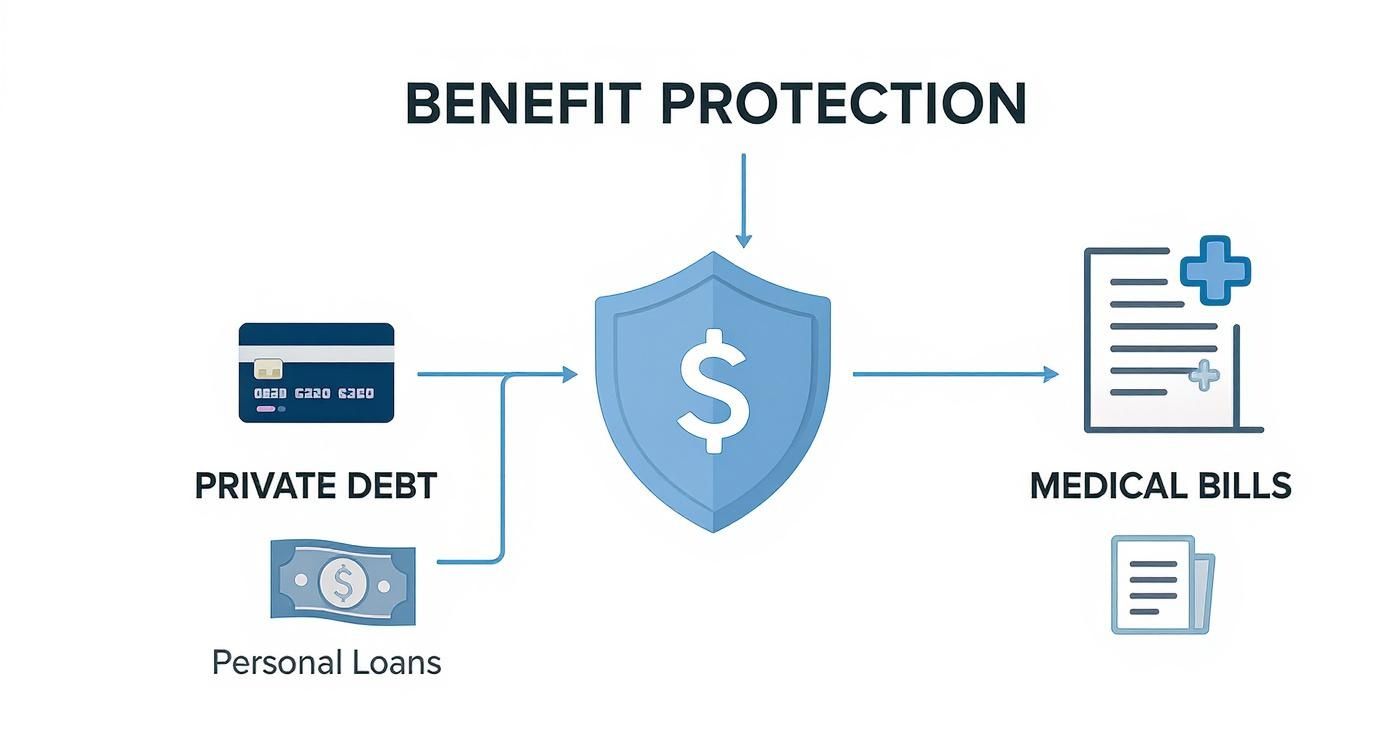
As you can see, that shield does a great job of blocking creditors for things like credit cards, personal loans, and medical bills. Now, let’s look at the situations where that shield can be bypassed.
Delinquent Federal Income Taxes
The first and most common exception is for unpaid federal taxes. When you owe the Internal Revenue Service (IRS), the agency has some powerful collection tools, and one of them is the power to levy your Social Security benefits directly. This isn't just a threat; it's a legal authority granted by federal law and a common way the IRS recovers long-overdue tax debts.
This process doesn't happen out of the blue. It’s part of a formal collection action known as the Federal Payment Levy Program (FPLP). Before the IRS can touch your benefits, it must send you a series of notices, culminating in a "Final Notice of Intent to Levy and Notice of Your Right to a Hearing." This final warning gives you a 30-day window to respond and make arrangements before the levy kicks in.
It's also worth noting that the IRS recently fired its automated levy programs back up after a temporary pause. For a deeper look at this, check out our article about the IRS restarting the Automated Federal Payment Levy Program.
The IRS can legally take up to 15% of your monthly Social Security payment. This percentage is fixed by law.
So, if you receive a monthly benefit of $1,800, the IRS can garnish up to $270 each month until your tax bill is paid. Ignoring those IRS notices is the surest way to find yourself in this situation.
Defaulted Federal Student Loans
Another major exception catches many people by surprise: defaulted federal student loans. It's a real shock for some retirees to find out that student loan debt from decades ago can suddenly resurface and take a bite out of their retirement income. This is done through the Treasury Offset Program (TOP), a centralized system that intercepts federal payments to pay off delinquent debts owed to federal agencies.
If you default on a federal student loan, the Department of Education can refer your debt to the Treasury Department. From there, the Treasury can direct the Social Security Administration (SSA) to withhold a portion of your benefits.
Just like with an IRS levy, you'll get a warning. You’ll receive a notice explaining the debt and your right to challenge its validity or work out a repayment plan. There are a couple of important protections in place here:
- The amount garnished cannot be more than 15% of your total monthly benefit.
- The garnishment cannot reduce your remaining monthly payment to less than $750.
That second point is a critical safety net. For instance, if your monthly benefit is $850, the most they could take is $100 (to bring you down to the $750 floor), even though 15% of $850 is actually $127.50.
Social Security Overpayments
Finally, the SSA can garnish your benefits to get back money it paid you by mistake. An overpayment can happen for all sorts of reasons—maybe a change in your living situation, marital status, or income wasn't reported quickly enough. The SSA has the authority to correct its own errors by withholding money from your future checks.
This isn't a minor issue. In fiscal year 2023, about $23 billion in Social Security overpayments remained uncollected, impacting nearly 2 million people. The SSA’s approach to clawing this money back has shifted, causing a lot of concern. As of July 24, 2025, beneficiaries who were overpaid and didn't respond to notices could see up to half their benefit check garnished.
Unlike other federal garnishments, the SSA often has more wiggle room in how it recovers these funds. You have the right to appeal the overpayment decision or request a waiver if you believe it wasn't your fault and paying it back would create a serious financial hardship. The default withholding rate is usually 10% of your benefit, but this can often be negotiated down.
What Happens to Your Social Security if You Default on Student Loans?
For a lot of people, student loans are a thing of the past—a financial hurdle they cleared decades ago. But for a growing number of retirees, that old debt is coming back with a vengeance, taking a surprise bite out of their Social Security checks. It's a jarring reality that's becoming more common every year.
This happens through something called the Treasury Offset Program (TOP). Think of it as the federal government's powerful collection agency. When you default on a federal student loan, the Department of Education can pass your debt along to the Treasury. From there, the Treasury has the green light to intercept federal payments owed to you, including your Social Security benefits, to pay back what you owe. An old, forgotten loan suddenly becomes a very real threat to your retirement income.
A Problem That's Quietly Exploding
Having your Social Security garnished for old student debt isn't some rare, fringe issue. It's a significant and rapidly growing problem, and the numbers are genuinely startling.
The data shows an almost unbelievable surge over the last two decades. Between 2001 and 2019, the number of retirees who had their Social Security benefits garnished for student loans skyrocketed by over 3,000%. That’s not a typo. We're talking about a jump from roughly 6,200 people to more than 192,300. To put that in perspective, offsets from tax refunds—a much more common collection method—only grew by about 90% during that same period.
The financial toll is just as shocking. In 2019 alone, the Department of Education collected $429.7 million this way. You can dig into the specifics in the Consumer Financial Protection Bureau's report on Social Security offsets. This is where the security of retirement collides head-on with decades-old debt, often pushing already vulnerable seniors into a tight spot.
How the Garnishment Actually Works
It’s easy to feel powerless when you hear the government can take part of your Social Security, but it’s not a free-for-all. There are specific rules that govern how it works, and understanding them is the first step to figuring out your options.
Here’s a breakdown of the process:
- The 15% Cap: The government can take up to 15% of your total monthly Social Security benefit. So, if you receive $1,600 a month, they could withhold up to $240 every single month until the debt is paid.
- The $750 Floor: There is a small but crucial safety net. Federal law says your benefit cannot be dropped below $750 per month because of a student loan offset. If your monthly check is only $800, the most they can take is $50, not the full 15%.
- You Must Be Notified: They can’t just start taking your money without warning. The Treasury Department is required to send you a formal notice before the offset begins. This letter will explain the debt, how much you owe, and your rights to challenge it.
That notice is your signal to act immediately. If you ignore it, the garnishment will start automatically, and you'll be left scrambling to make ends meet with a smaller check.
Seeing the Impact in the Real World
Let's look at how this plays out for someone like Maria, a 68-year-old retiree. Back in the 1990s, she took out federal loans to finish her degree while raising her kids. She made payments when she could, and used deferments and forbearances when times were tough. Eventually, she thought the debt was behind her.
Then, decades later, a letter arrives. Her $1,800 monthly Social Security benefit is being garnished. The government starts taking $270 (which is 15%) every month, leaving her with only $1,530. That unexpected hit forces her to make impossible choices—does she pay for her prescription refills or keep the heat on?
Maria’s story is all too common. It highlights the heavy financial and emotional weight these offsets carry, capable of turning a carefully planned retirement into a daily struggle. For many seniors, the average monthly garnishment of around $180 is the exact amount that pushes them from financial stability into hardship.
What About Garnishments for Child Support and Alimony?
Federal debts aren't the only crack in the armor that protects your Social Security. There's an entirely different category of obligation that can also lead to a garnishment: court-ordered family support. This is where things get even more complicated, as these debts operate under a completely different set of federal laws.
When a judge orders you to pay child support or alimony, that's not just another bill. The legal system sees these as fundamental family duties, not regular private debts. Because they're treated with such importance, Congress created a specific pathway to collect these payments, even from otherwise protected sources like Social Security.
The Law That Opens the Door
The authority to garnish your benefits for family support comes directly from the Consumer Credit Protection Act (CCPA). This is the law that sets the national rules for wage garnishment, and it makes an explicit exception for collecting child support and alimony from nearly all income sources—including your Social Security retirement and disability checks.
Think of it this way: The Social Security Act puts up a shield that blocks a creditor who won a lawsuit over a car accident or an old credit card bill. But a family court order for support is empowered by a different law, the CCPA, which essentially provides a key to get around that shield. It's a dual-track system that leaves your benefits safe from one type of creditor but wide open to another.
This means that while a private company you owe money to can't touch your benefits, a former spouse or a child with a court order absolutely can. The law places these family obligations above almost all others.
The rules for these garnishments are also much more aggressive than those for federal debts. The maximum amount they can take from your check is significantly higher, reflecting just how seriously the legal system takes enforcing these family duties.
How Much of Your Check Can They Actually Take?
The percentage of your Social Security that can be garnished for child support or alimony depends on your specific situation—namely, whether you're also supporting another spouse or child.
Here’s how the CCPA limits break down:
- You could lose up to 50% of your benefits if you are currently supporting another spouse or child (someone other than the person the support order is for).
- You could lose up to 60% of your benefits if you are not supporting another spouse or child.
- An extra 5% can be tacked on to those limits (pushing them to 55% and 65%) if your payments are more than 12 weeks behind.
Losing over half of your monthly income can be a massive financial blow. This is where family law and federal benefits collide, often creating serious financial stress. It’s also important to understand how these obligations connect with your taxes. The financial side of a separation can be a minefield, and you can learn more about the common tax issues in a divorce that frequently overlap with support payments. Getting through these situations requires a clear head and a solid grasp of your legal and financial position.
What to Do if You Get a Garnishment Notice

Seeing a notice that your Social Security benefits are about to be garnished can send a jolt of panic through anyone. It feels like a direct hit to your financial lifeline. But here’s the single most important rule: do not ignore it. That letter is your cue to act, not a final judgment.
How you respond in the first few days can completely change the outcome. Ignoring the notice guarantees the garnishment will happen exactly as planned. But if you take action, you open up several pathways to potentially stop, reduce, or challenge the collection altogether.
Think of that notice less as a warning and more as a critical document packed with information and deadlines. Your first job is to read it carefully and shift from a state of worry into a proactive plan.
Step 1: Identify the Creditor and the Debt
Before you do anything else, you need to figure out exactly who sent the notice and why. Is it the IRS for old taxes? The Department of the Treasury for a student loan that fell into default? Or maybe a state agency for child support? Each one plays by a different set of rules and has its own appeal process.
Scour that letter for these key details:
- The Agency Name: It will be printed clearly at the top (e.g., Internal Revenue Service, Department of Education).
- The Debt Amount: The notice will state the total amount they claim you owe.
- Case or Account Number: This is your unique ID for this debt. Keep it handy for every phone call and letter.
- The Deadline: This is the most crucial piece of information on the page. It tells you exactly how long you have to respond before they start taking your money. Missing this deadline can mean forfeiting many of your rights.
Knowing who you're up against is everything. The strategy for handling an IRS levy is completely different from dealing with the Treasury Offset Program for a federal student loan.
Step 2: Understand Your Rights and Options
Once you know who’s coming after your benefits, you can start exploring your rights. By law, that initial notice must tell you what your options are, and they usually fall into a few main categories. You absolutely have the right to challenge the action.
For example, you might be able to dispute the debt itself if you think the amount is wrong or you’ve already paid it. You can also request a review of the garnishment amount if it would cause you severe financial hardship. For some debts, particularly tax-related ones, you may have several paths to resolution. Our guide on how to stop IRS wage garnishment takes a much deeper dive into the specific strategies for handling tax problems.
Your right to appeal is on a ticking clock. The notice will give you a specific window—often just 30 to 60 days—to formally request a hearing or review. Acting fast is the only way to keep your options open and protect your income.
Step 3: Take Decisive Action
Now it’s time to move. Depending on the agency and your specific situation, your next step could be one of several things.
If it's an IRS levy, this could mean filing past-due tax returns, negotiating an installment agreement, or applying for Currently Not Collectible status if you're facing hardship.
For a student loan offset, you might look into a loan rehabilitation program to pull the loan out of default. If you’re dealing with a Social Security overpayment, you can file a waiver request (Form SSA-632), arguing that the overpayment wasn't your fault and paying it back would be a financial burden.
The key is to communicate proactively with the agency and follow their procedures to the letter. Don't just make a phone call—follow up in writing and keep a meticulous record of every single interaction.
Common Questions About Social Security Garnishment
Even when you know the basic rules, real-life situations always bring up new questions. Let's walk through some of the most common concerns people have when they worry about their Social Security check being garnished.
Can My Supplemental Security Income Be Garnished?
This is a critical point: No, it can't.
Supplemental Security Income (SSI) gets far stronger protection than standard Social Security retirement or disability benefits. Think of SSI as a safety net for basic needs—it's a needs-based program with very strict income and asset limits. Because of this, SSI payments cannot be garnished for almost any reason, not even for federal taxes or defaulted student loans.
The only time you might see a reduction is if the Social Security Administration itself overpaid you and needs to reclaim those specific funds. Otherwise, your SSI is secure.
How Do Banks Protect My Social Security Funds?
Your bank actually provides an automatic, built-in layer of defense. Federal banking regulations require financial institutions to take specific steps when they get a garnishment order.
Before they freeze anything, they have to look back at the last two months of your account history. They must automatically protect a total amount equal to two months’ worth of any direct-deposited federal benefits. This is a crucial safeguard that ensures you still have access to money for immediate needs.
But here’s the catch: this protection only works for funds that are directly deposited.
If you still get paper checks in the mail and deposit them yourself, this automatic protection doesn’t apply. Also, if you have more than two months of benefits saved up, you might have to go to court to prove those extra funds are exempt from the garnishment.
Is There a Minimum Protected Amount?
Yes, but only for certain types of debt. For most non-tax federal debts, like a defaulted student loan being collected through the Treasury Offset Program, there's a clear floor. The first $750 of your monthly benefit is off-limits.
So, if your monthly Social Security payment is $750 or less, it generally can’t be touched for those kinds of debts.
However, this protection has big exceptions. The $750 floor does not apply to garnishments for federal taxes, court-ordered child support, or alimony. Those debts play by a different set of rules and can be collected from your benefits even if your monthly payment is small.
Facing a potential garnishment can be overwhelming, but you don't have to navigate it alone. At Attorney Stephen A Weisberg, we start with a free analysis to understand your situation and find the best path forward. If you're dealing with the IRS, get the expert help you need by visiting Stephen A. Weisberg's tax law website.


