Can the IRS Take Your 401k and How to Protect It
Can the IRS take your 401k for back taxes? Learn the step-by-step process the IRS uses and discover proactive strategies to protect your retirement savings.

In this article
- Yes, the IRS Can Levy Your 401(k), but It’s a Last Resort
- Understanding the IRS Levy Process
- IRS Levy on 401(k) at a Glance
- The Path to an IRS Levy: A Step-by-Step Guide
- Step 1: The Initial Tax Assessment and Bill
- Step 2: A Series of Escalating Notices
- Step 3: The Final Notice of Intent to Levy
- Step 4: Issuing the Levy to Your 401(k) Plan Administrator
- Why Your 401(k) Isn't the Untouchable Fortress You Think It Is
- The Government Holds the Master Key
- ERISA vs. Federal Tax Law: A Tale of Two Debts
- The True Financial Damage of a 401(k) Levy
- The Layers of Financial Pain
- The Compounding Cost of Lost Growth
- How a $50,000 Tax Debt Vaporizes Over $71,000
- The True Cost of a $50,000 IRS 401(k) Levy
- How to Proactively Protect Your Retirement Savings
- Always File Your Tax Returns, No Matter What
- Option 1: Set Up an Installment Agreement
- Option 2: Settle for Less with an Offer in Compromise
- Option 3: Request Currently Not Collectible Status
- Your Top Questions About IRS 401(k) Levies, Answered
- Can the IRS take my spouse’s 401(k) for my tax debt?
- What’s the difference between an IRS lien and a levy?
- Will I get a warning before the IRS levies my 401(k)?
- Can I stop a 401(k) levy once it has been issued?
The idea of the IRS touching your retirement savings is enough to send a shiver down anyone's spine. And for good reason—your 401(k) is the result of years, maybe even decades, of hard work and planning. So, can the IRS actually take your 401(k)?
Yes, they can. But it is an absolute last-resort measure.
Yes, the IRS Can Levy Your 401(k), but It’s a Last Resort
Let's get the scary part out of the way first. While your 401(k) is heavily shielded from most creditors, the federal government plays by a different set of rules.
Think of your retirement account as a financial fortress. A powerful federal law—the Employee Retirement Income Security Act (ERISA)—builds incredibly strong walls around it, protecting it from creditors in bankruptcy or lawsuits. But the one entity that has a master key to that fortress is the IRS. After all, they’re the ones who grant its special tax-deferred status in the first place.
This power isn't something the IRS uses lightly. An IRS seizure of your 401(k) only happens after a long series of warnings. It’s the final play in their collection playbook, typically reserved for when a taxpayer has ignored repeated attempts to communicate and resolve the debt.
Understanding the IRS Levy Process
The IRS can't just wake up one morning and decide to empty your retirement account. There's a formal, drawn-out process they are legally required to follow.
Before a levy is even on the table, this sequence has to play out:
- First, the IRS calculates what you owe and sends a bill, officially called a Notice and Demand for Payment.
- Next, you have to neglect or refuse to pay the tax debt.
- Finally, the IRS must send you a Final Notice of Intent to Levy and Notice of Your Right to a Hearing.
This final notice is the flashing red light. It's your last official warning, giving you 30 days to pay the balance, appeal, or set up a payment plan before they can legally start seizing your assets—including your 401(k).
The IRS process for levying a 401(k) is formalized and requires specific procedures. The agency must provide a final notice, allowing the taxpayer a window to appeal or resolve the issue before any action is taken.
The good news is that this long road has several off-ramps. The key is to replace fear with knowledge, so you can see these opportunities and stop a levy long before it happens. The IRS will even consider things like economic hardship before taking such a drastic step.
To give you a clearer picture, here’s a quick breakdown of what the IRS looks at.
IRS Levy on 401(k) at a Glance
| Factor | What It Means for Your 401(k) |
|---|---|
| Federal Law (ERISA) | Provides strong protection from most creditors, but not from the IRS for federal tax debt. |
| IRS Collection Process | A levy is the final step after multiple notices are ignored. It's not a surprise attack. |
| Final Notice of Intent to Levy | This is the critical warning. You have 30 days to act before seizure can occur. |
| Taxpayer Response | Being proactive and communicative is key. Ignoring the IRS is what leads to a levy. |
| Economic Hardship | You can argue that a levy would create a significant financial hardship, potentially stopping the process. |
Ultimately, understanding the rules gives you back a sense of control. For a deeper dive into the specifics, you can find more information about the IRS 401(k) Levy process in our other articles or review the procedures directly from the IRS Taxpayer Advocate Service.
The Path to an IRS Levy: A Step-by-Step Guide
The thought of the IRS seizing your 401(k) is enough to cause a panic, but it's important to know this doesn't just happen overnight. An IRS levy isn't a surprise attack; it’s the final stop on a long, well-marked road. Think of it less like a sudden lightning strike and more like a slow-moving train you can see coming from miles away, with plenty of opportunities to get off the tracks.
When you understand the predictable steps the IRS must take, you can see the warning signs and take action long before your retirement savings are in jeopardy. Let's walk through that process.
Step 1: The Initial Tax Assessment and Bill
It all starts with a tax debt. Maybe you filed your return but couldn't pay the full amount. Perhaps an audit uncovered a shortfall. Or maybe you didn't file at all, and the IRS created a substitute return for you.
Once the IRS officially records your liability, they perform what’s called a tax assessment. Right after that, you'll get a letter in the mail. This first notice, often a CP14, is essentially a bill. It clearly states what you owe and demands payment.
This is your first and best chance to fix the problem. At this point, it's just a debt. You can pay it off or, if that's not possible, start exploring payment plans right away.
Step 2: A Series of Escalating Notices
If you don’t respond to that first bill, the IRS doesn't just forget about you. Instead, their automated system kicks in and starts sending a series of follow-up letters. You'll notice the tone of these letters gets more serious with each one that arrives.
Each notice is another reminder of the outstanding debt, pushing you to pay up or make other arrangements. This phase can stretch on for several months, giving you multiple opportunities to engage with the IRS and find a solution.
Step 3: The Final Notice of Intent to Levy
This is the big one. After all the previous letters have gone unanswered, the IRS will send a notice with a title that’s impossible to ignore: the Final Notice of Intent to Levy and Notice of Your Right to a Hearing (typically Letter 1058 or LT11).
This notice is the final legal hurdle the IRS must clear before seizing your assets. By law, they cannot levy your property—including your 401(k)—until 30 days after this final notice is sent.
This letter is your last official warning. It details how much you owe and makes it clear that if you don't act within 30 days, the IRS will start seizing your assets. This 30-day window is your last real chance to stop the levy before it happens. During this time, you have a legal right to request a Collection Due Process (CDP) hearing to appeal the levy and negotiate an alternative. You can learn more about the specifics of a notice of levy and your rights to fully understand your options.
The infographic below shows how a simple tax debt can escalate into a full-blown levy.
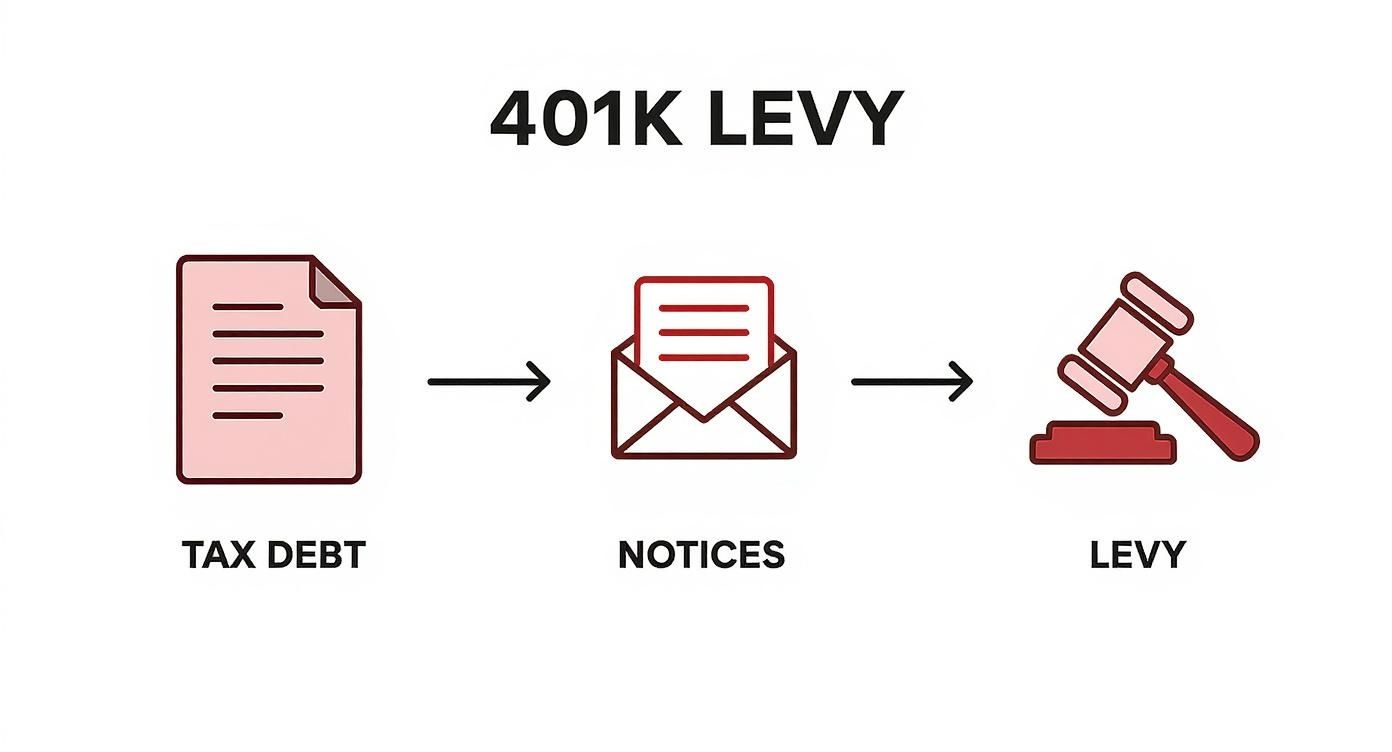
As you can see, a levy isn't the first move; it's the last resort after numerous attempts to contact you.
Step 4: Issuing the Levy to Your 401(k) Plan Administrator
If you ignore the Final Notice and that 30-day period comes and goes without a resolution, the IRS is legally cleared to proceed. They will then send a Notice of Levy (Form 668-A) directly to the company that manages your 401(k).
This isn't a request—it's a legal order. It commands your plan administrator to liquidate your retirement funds and send the money to the IRS. Your administrator is legally required to comply; they have no choice in the matter.
Once the levy is actually sent, your options for stopping it shrink dramatically. It’s always easier to prevent a levy by responding to the Final Notice than it is to reverse one already in progress. Paying attention to these early warnings is the most powerful thing you can do to protect your 401(k).
Why Your 401(k) Isn't the Untouchable Fortress You Think It Is
Most people believe their 401(k) is a financial fortress, and for the most part, they're right. We have a powerful federal law called the Employee Retirement Income Security Act of 1974 (you'll usually just hear it called ERISA) to thank for that. This is the law that keeps your retirement funds safe from most creditors.
If you lose a lawsuit or even have to file for bankruptcy, ERISA stands guard. It’s a core piece of our retirement system, designed to give you peace of mind that your nest egg will be there when you need it, safe from most of life's financial storms.
But here's the critical catch that trips a lot of people up. While ERISA is a nearly impenetrable shield against most creditors, it has one massive exception: the IRS.
The Government Holds the Master Key
Think about the incredible benefit a 401(k) offers. You get to invest money before taxes are taken out, and it grows for decades without you owing a dime on the gains. It's a sweet deal, but it's a deal offered by the government.
In exchange for that tax-deferred privilege, the government keeps a unique claim on those funds to settle federal tax debts. In other words, the very law that protects your 401(k) from everyone else was never intended to block the government from collecting taxes. This gives the IRS collection powers that far exceed those of a typical creditor, putting your retirement account squarely in their sights if you owe back taxes.
When it comes to collecting what's owed, the IRS plays by a different rulebook. The legal shield that protects your 401(k) from a lawsuit or bankruptcy simply doesn't apply to a federal tax levy.
This is the single most important thing to understand. Your 401(k) is protected from private creditors, but it is wide open to the public creditor—the U.S. government.
ERISA vs. Federal Tax Law: A Tale of Two Debts
To really see the whole picture, you have to understand the difference between the kinds of debt you might owe.
- Private Debt: This is what you owe to banks, credit card companies, or another person after a lawsuit. ERISA was built specifically to protect your retirement savings from these kinds of creditors.
- Federal Tax Debt: This is money you owe directly to the U.S. Treasury. Federal law grants the IRS extraordinary power to collect on this debt, allowing them to bypass most of the protections that apply to private debt.
Retirement plans have become massive pools of wealth over the decades. Back in 2001, there were around 106,579 private pension plans, and by 2005, that number had jumped to 117,406. You can dig into the history of private pension plans on the Department of Labor's site. While these accounts are fantastic for building wealth, they don't create an invincible wall against the IRS.
This clear legal distinction is why the answer to "can the IRS take my 401(k)?" is, unfortunately, a definite "yes." The special powers granted to the IRS are what make it so crucial to deal with tax debt head-on. Hoping the problem disappears only gives the IRS more time to work through its collection process, which can end with them seizing assets you thought were completely safe.
The True Financial Damage of a 401(k) Levy

When the IRS comes for your 401(k), the hit is far worse than just covering the tax bill. It's not a clean transaction. It’s a financial wrecking ball that triggers a brutal chain reaction of taxes, penalties, and permanent losses that can cripple your retirement plans.
Think of it like using a sledgehammer to crack a nut. The IRS just wants the nut—the money you owe—but the force they use shatters everything around it. The amount you ultimately lose is always significantly more than what you owed in the first place. This domino effect is what makes an IRS levy on a 401(k) so incredibly destructive.
The Layers of Financial Pain
The total amount yanked from your 401(k) has to cover much more than just the tax debt itself. It also has to pay for the new taxes and penalties created by the withdrawal.
This is where things spiral. The withdrawal amount has to get bigger and bigger to cover all the costs. Here’s a breakdown of the layers of financial damage that pile up:
- The Original Tax Debt Plus Penalties: This is the starting line. It's the amount the IRS wants to collect, which has probably already grown thanks to interest and failure-to-pay penalties.
- Mandatory Federal Tax Withholding: An IRS levy forces a distribution from your 401(k), and your plan administrator is legally required to withhold 20% for federal income taxes right off the top. No exceptions.
- The 10% Early Withdrawal Penalty: If you’re under age 59½, the IRS adds a 10% early withdrawal penalty to the bill for the "privilege" of raiding your retirement funds ahead of schedule.
- State Income Taxes: On top of everything else, you might also owe state income tax on the distribution, depending on where you live.
When you add it all up, a much larger chunk has to be ripped from your account to satisfy the original debt, effectively gutting your hard-earned savings.
The Compounding Cost of Lost Growth
The worst damage, though, isn't the money you lose today. It's the silent, irreversible loss of future growth. Every dollar the IRS takes is a dollar that can no longer work for you, compounding tax-deferred for years or even decades. That lost potential is the real, hidden tragedy of a 401(k) levy.
A single dollar you invested in your 30s could easily be worth $15 or $20 by the time you retire. When the IRS takes that dollar, they aren't just taking a dollar—they're erasing all the future wealth it was supposed to create.
The most devastating aspect of a 401(k) levy isn't the money taken today, but the future wealth it permanently destroys. You lose not only the principal but all the compounding growth it would have produced over the coming decades.
To really see how this plays out, let's look at a real-world example.
How a $50,000 Tax Debt Vaporizes Over $71,000
Let's say you're 50 years old and owe the IRS $50,000 in back taxes. You've ignored the notices, and now the IRS has levied your 401(k). The math is painful.
To get the $50,000 it's owed, the IRS forces a distribution that also accounts for the taxes and penalties it triggers. Here's how that breaks down.
The True Cost of a $50,000 IRS 401(k) Levy
| Cost Component | Estimated Amount | Explanation |
|---|---|---|
| Original Tax Debt | $50,000 | The amount the IRS must receive to satisfy the levy. |
| 20% Federal Tax Withholding | $14,286 | The plan must withhold 20% of the total distribution to cover taxes. |
| 10% Early Withdrawal Penalty | $7,143 | Since you are under 59½, an additional 10% penalty is applied. |
| Total Withdrawn from 401(k) | $71,429 | To net $50,000 for the IRS, a much larger amount must be withdrawn. |
Look at those numbers. To pay a $50,000 debt, a staggering $71,429 had to be ripped from your retirement account. You lost an extra $21,429 to immediate taxes and penalties alone.
Worse, that entire $71,429 is now gone forever, along with all the potential growth it would have generated until you retired. This is precisely why it's critical to deal with the IRS before it ever gets to this point. While 401(k)s have strong protections, it's worth knowing how other retirement plans are treated, too. You can learn more about how pensions can be garnished and their protection strategies in our detailed guide.
How to Proactively Protect Your Retirement Savings

When you’re staring down a potential IRS levy on your 401(k), it’s easy to feel overwhelmed. But here’s the most important thing to remember: you have options. The key is to get ahead of the problem. A levy is what happens when you ignore the issue; communication is what prevents it.
Think of the IRS as a creditor that would much rather get a steady stream of payments than go through the hassle of seizing your assets. They almost always prefer to work out a solution. By understanding your options and learning some strategies to reduce and manage tax debt effectively, you can keep your retirement funds out of harm's way.
This section is your playbook for resolving tax debt and keeping those savings secure.
Always File Your Tax Returns, No Matter What
This is the golden rule when you owe the IRS. You must file all your tax returns on time, even if you don't have a dime to send them. A lot of people make the critical mistake of not filing because they can't pay. This only digs the hole deeper.
When you don't file, the IRS tacks on a hefty penalty—often up to 25% of what you owe. More importantly, it sends a clear signal that you’re not cooperating, which makes them far less willing to negotiate. Filing on time, even if you can't pay yet, shows good faith and opens the door to finding a real solution.
Option 1: Set Up an Installment Agreement
For most people, the most straightforward path is an Installment Agreement (IA). This is simply a formal plan you set up with the IRS to pay off your tax debt in manageable monthly chunks. As soon as it’s in place, all collection actions stop. That means no more threats of a 401(k) levy.
The IRS has made it fairly simple to get on a payment plan, especially if your debt is below a certain amount. An IA gives you a clear, predictable schedule and the breathing room to get back on your feet. For a deeper dive, check out our ultimate guide to IRS back taxes and payment plan strategies.
Option 2: Settle for Less with an Offer in Compromise
What happens if the amount you owe is just impossible to pay back? For situations like this, you might be a candidate for an Offer in Compromise (OIC). This is a program that lets certain taxpayers settle their tax debt for less than the full amount they owe.
Getting an OIC isn’t easy, though. The eligibility rules are strict. The IRS will take a hard look at your complete financial picture, including:
- Ability to pay: What you can realistically afford after covering basic living expenses.
- Income: Your current and potential future earnings.
- Asset equity: The value of everything you own.
An OIC can be a lifesaver, but it's a long and complex process. It’s truly designed for people who have no realistic way of paying their tax bill, now or in the foreseeable future.
Option 3: Request Currently Not Collectible Status
If you’re facing a genuine financial crisis—like a job loss or major medical bills—you can ask the IRS to put your account in Currently Not Collectible (CNC) status. This isn’t forgiveness; it’s a temporary pause button on all collection efforts, including levies. The IRS is basically acknowledging that you can't afford to pay them and your basic living expenses at the same time.
To qualify, you’ll have to open up your books and prove your hardship. While you’re in CNC status, interest and penalties will keep adding up, but the IRS won’t touch your 401(k). They’ll also check in periodically to see if your financial situation has improved enough to start paying again.
The IRS's willingness to work with taxpayers is a cornerstone of the U.S. tax system. By engaging proactively, you can almost always find a path to resolution that avoids the devastating consequences of a levy on your retirement savings.
The agency knows that its collection efforts are tied to public trust. The more they work with people, the more likely people are to comply voluntarily. By keeping the lines of communication open, you’re choosing the path the IRS would much rather you take.
Your Top Questions About IRS 401(k) Levies, Answered
When the IRS is involved, the rules can feel confusing and intimidating. Let's cut through the noise and answer the real-world questions people ask when they're worried about their retirement savings. This is your straightforward guide to the most common concerns.
Can the IRS take my spouse’s 401(k) for my tax debt?
This is a huge source of anxiety for many couples, and the answer really depends on how you file your taxes and where you live.
If you and your spouse have always filed a joint tax return, the IRS considers that tax debt to be a shared problem. In their eyes, you’re both on the hook, which means they could potentially go after assets belonging to either of you—including your spouse's 401(k).
But if you’ve always filed separately and the tax debt is entirely your own (especially if it’s from before you were married), your spouse’s retirement account is generally safe. The IRS can’t just jump from your debt to their protected assets.
The big exception? Community property states. In these states, assets earned during the marriage are often considered co-owned. This can muddy the waters, sometimes making a spouse's 401(k) vulnerable even if you filed separately. Because state laws add a tricky layer, it's a very smart move to talk to a tax professional who knows your state's specific rules.
What’s the difference between an IRS lien and a levy?
People throw these two words around like they’re the same thing, but they are completely different actions in the IRS collection playbook. Getting this right is critical to understanding what’s actually happening.
A tax lien is simply a legal claim. When the IRS files a lien, it’s like they're putting a public "dibs" on your property—your house, car, or financial accounts—as collateral for what you owe. A lien doesn't take anything away from you; it just secures the government’s interest and stops you from selling those assets without settling up first.
A tax levy is the seizure. This is when the IRS actually takes your property to pay off the debt. The levy is the action that enforces the lien.
Think of it like this: a lien is a boot on your car for unpaid tickets. It stakes a claim and stops you from driving off. A levy is the tow truck physically hauling your car to the impound lot. The IRS has to put the boot on (the lien) before they can call the tow truck (the levy).
Will I get a warning before the IRS levies my 401(k)?
Yes, absolutely. The law is crystal clear on this. The IRS can’t just raid your 401(k) out of the blue. You will get multiple warnings and chances to fix the problem long before it gets to that point.
The most critical piece of mail you’ll receive is the "Final Notice of Intent to Levy and Notice of Your Right to a Hearing." This is the final warning shot.
Receiving this notice kicks off a crucial 30-day window. During these 30 days, you have the legal right to appeal the levy or work out an alternative arrangement with the IRS, like a payment plan. Ignoring this specific notice is the biggest mistake you can make, because it gives the IRS the legal green light to start seizing your assets, including your retirement funds.
Can I stop a 401(k) levy once it has been issued?
Trying to stop a levy after the IRS has already sent the paperwork to your 401(k) administrator is an uphill battle, but it’s not always impossible. The key is acting incredibly fast.
You have to contact the IRS immediately. You might be able to get them to release the levy if you can:
- Pay the entire tax bill in full, right away.
- Get them to approve you for an Installment Agreement.
- Prove that the levy is causing an immediate and severe economic hardship for your family.
But time is your worst enemy. Once your 401(k) provider cuts the check and sends the money to the IRS, it’s a done deal. The money is gone—and so is the extra they take out for early withdrawal penalties and taxes. It is infinitely easier to act during that 30-day warning period than to try and reverse a levy that's already in motion.
Don't let the threat of an IRS levy put your financial future at risk. If you're facing tax debt and are unsure of your next steps, Attorney Stephen A Weisberg offers a FREE, no-obligation Tax Debt Analysis to assess your situation and explain your options. Get professional guidance and find the best path forward by visiting https://weisberg.tax today.


