Can the IRS Levy My Bank Account
Can the IRS levy my bank account? Learn when it happens, how the notice process works, how levies differ from liens, and what to do if it happens to you.

In this article
- The Phone Call That Changes Everything
- The money may not be gone yet
- What an IRS Bank Levy Actually Means
- Why account ownership matters
- How the IRS Levy Notice Process Works
- What happens behind the notices
- Reading the Notice and Confirming the Levy
- Questions for the bank
- A quick authenticity check
- Collection Alternatives That Can Stop a Levy
- Collection alternatives compared
- Emergency Steps to Release a Bank Levy
- Build the financial file immediately
- Request a hardship release
- Why Professional Representation Matters Here
- Avoid resolution firms that sell fear
- What to Do in the Next 24 Hours
You swipe your debit card at the grocery store, and the transaction is declined. The banking app shows a pending freeze from the Department of the Treasury. Rent is due, payroll for two employees is scheduled to clear tomorrow, and you're trying to understand how the IRS could have reached your account without calling you directly. Your spouse asks, “What is a levy?” while you search the notice for a phone number.
The immediate questions are practical, not academic. What happened? Is the money already gone? Can the IRS take funds from a joint account? What can you do before the bank sends the money away? The answer to “can the IRS levy my bank account” is yes, but a levy usually follows a notice process, and the bank must generally hold the funds for 21 calendar days before surrendering them to the IRS. That short period can be the difference between a preventable loss and a negotiated release.
The Phone Call That Changes Everything
The first call is often to the bank, not the IRS. A declined card, returned payment, or account balance that cannot be withdrawn may be the first sign that a levy has reached you. The bank may call it a legal hold, Treasury freeze, or IRS levy. In practical terms, the bank has received a federal collection order affecting money in the account.

The IRS generally communicates through mailed notices rather than a personal warning call from an agent. A move, an overlooked notice, an online account message, or an old balance believed to be resolved can leave you unprepared. By the time the bank's legal department places the hold, the first direct conversation may already concern money you needed for rent, payroll, or automatic payments.
The money may not be gone yet
A freeze is not the same as a completed transfer. Under the IRS's guidance on bank levies and the holding period, the bank generally must wait 21 calendar days after receiving the levy before sending the held funds to the IRS. That period may allow time to arrange payment, request a release, show hardship, or correct an error.
Do not use the holding period as a reason to delay. Access may be blocked immediately, and scheduled payments can still fail. Record when you discovered the freeze, the account balance, the bank representative's information, and every IRS notice you can find. Then contact the IRS promptly and determine which unit is handling the case. The goal is specific: preserve the funds before the bank remits them, and address the collection problem so another levy does not follow.
What an IRS Bank Levy Actually Means
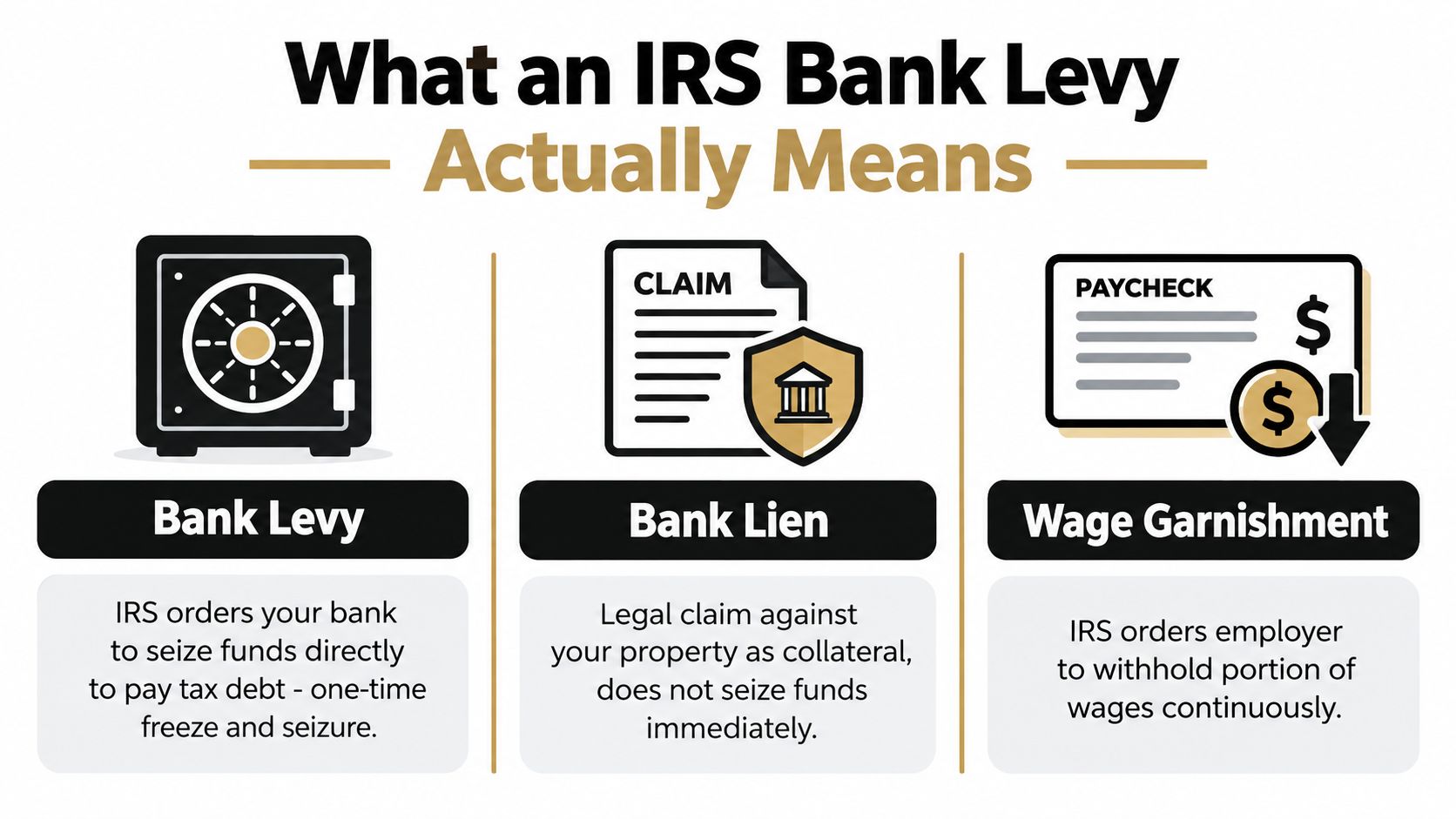
An IRS bank levy is a legal instruction served on a financial institution. It directs the bank to hold and surrender money in an account connected to a taxpayer's unpaid federal tax debt. The bank isn't deciding whether the tax is correct or whether the action feels fair. Once properly served, the bank has a legal duty to follow the levy.
A levy differs from three concepts that taxpayers often mix together:
- Bank levy: The IRS targets money already held in a bank account.
- Federal tax lien: The government asserts a claim against property as security for an unpaid tax debt.
- Wage garnishment: The IRS directs an employer to withhold part of future wages.
A useful analogy is a house. A lien resembles a creditor recording a mortgage claim against the property. A levy is closer to a locksmith arriving with authority to change the locks and take control of what is inside. A wage garnishment reaches future paychecks rather than the deposit already sitting in your checking account.
Why account ownership matters
The IRS may serve a levy against an account in which the taxpayer has an ownership interest or signing authority. A joint account can therefore create a separate dispute when another account holder claims that some or all of the money belongs to them. The nonliable person may need to provide records showing the source and ownership of the funds. Their relationship to the taxpayer alone doesn't answer the ownership question.
The bank usually won't adjudicate that dispute before honoring the levy. It freezes the account according to the order, then the taxpayer or other account holder must present the facts to the IRS and request appropriate relief. For a more detailed explanation of the mechanism, see what a bank levy is and how it differs from related collection tools.
Practical rule: A lien warns that property is encumbered. A levy takes an active step against property. Don't respond to a levy as though it were only a notice of a future claim.
How the IRS Levy Notice Process Works
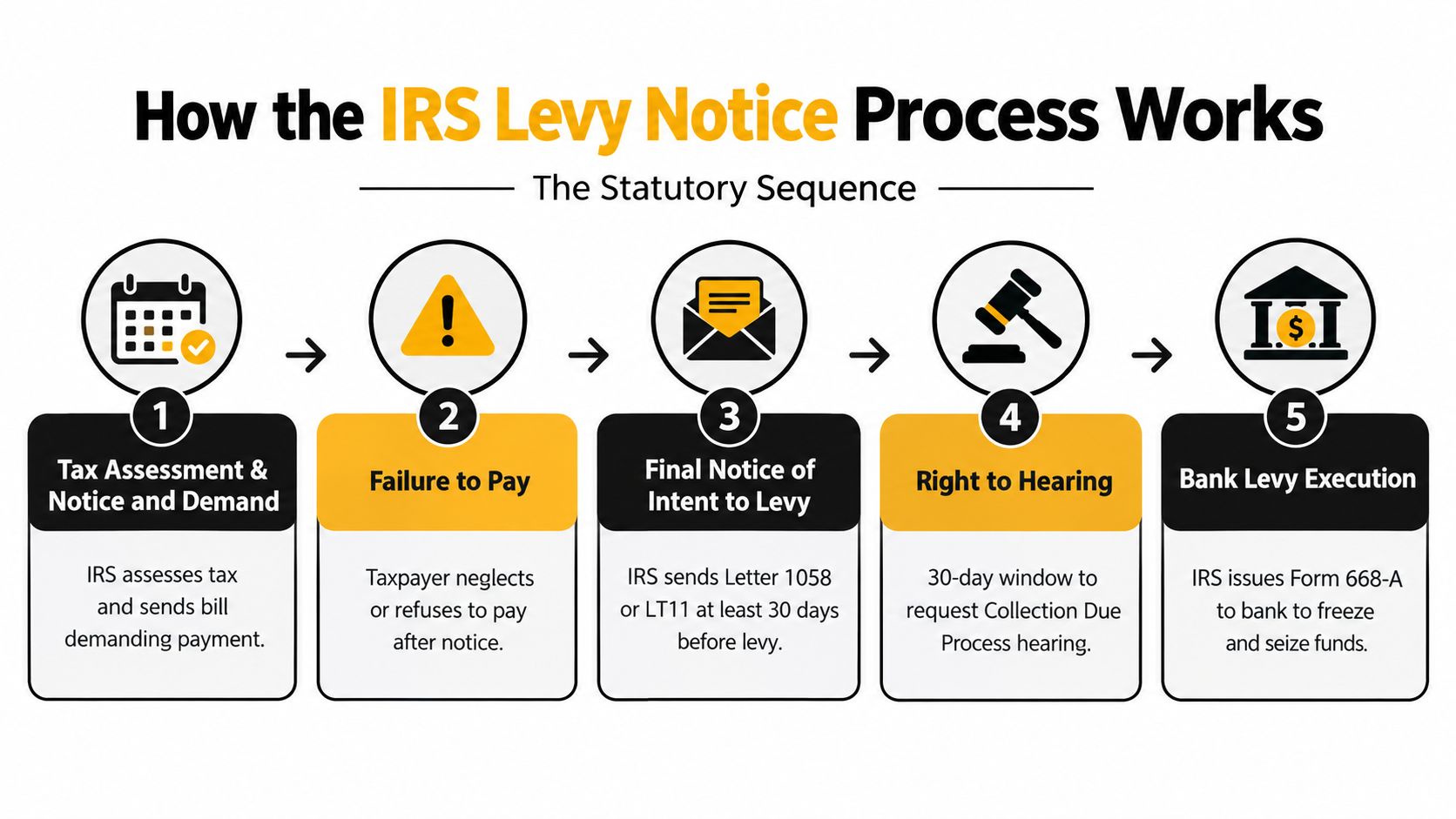
A bank levy usually follows unpaid assessments, balance-due notices, and a failure to resolve the account. In an ordinary collection case, the IRS generally must issue a Final Notice of Intent to Levy and give the taxpayer a formal opportunity to respond. Two safeguards matter: the pre-levy notice period and the bank's post-levy holding period.
The first deadline is the 30-day period described in IRS guidance about the CP504 notice and levy rights. Under Internal Revenue Code section 6331(d), the IRS generally must allow 30 days after the final notice for the taxpayer to request a Collection Due Process hearing or arrange payment. The final notice may be Letter 1058 or LT11, depending on the case and delivery method. This framework does not apply in every situation, including certain jeopardy or state refund levies.
What happens behind the notices
If the taxpayer does not respond, the case may remain with the IRS Automated Collection System or move to a revenue officer. That function reviews the balance and collection history, prepares the levy paperwork, and serves the financial institution. The bank then identifies funds covered by the order and places the hold.
The second deadline starts when the bank receives the levy. The bank generally must hold the affected funds for 21 calendar days before sending them to the IRS. The Internal Revenue Manual describes this waiting requirement after service, subject to limited extensions. This period is the practical window to request a release, resolve the liability, or document that some funds belong to another person.
Those days pass quickly. Establish the notice date, levy service date, account ownership, and source of the deposited funds at once. State banking procedures and account structures can affect the review, while exempt or protected funds may require records before the IRS will release them. For background on the first warning document, review the IRS notice of intent to levy process.
Reading the Notice and Confirming the Levy
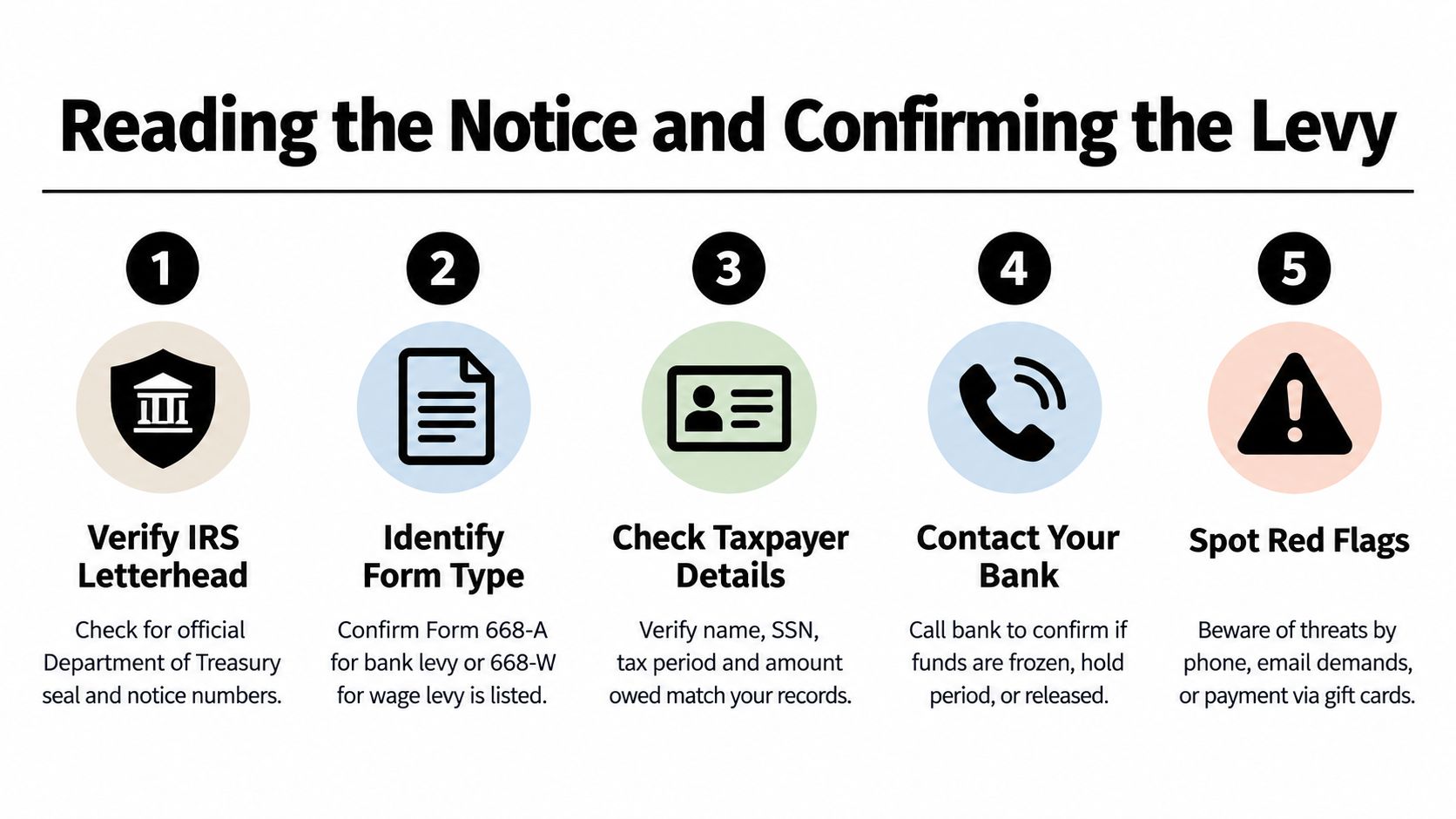
Start by separating the Final Notice of Intent to Levy from the document served on the bank. A Final Notice, such as an LT11 or CP504, warns you about collection and explains response rights. A bank levy notice, commonly associated with Form 668-A, is the order directed to the financial institution. Form 668-W relates to wage withholding, not a bank-account seizure.
The bank may not give you a copy of every IRS document, but its levy or legal department can usually confirm whether an order was received and what stage the account has reached. Ask precise questions rather than relying on the first customer-service representative's description.
Questions for the bank
Ask whether:
- The bank received an IRS levy or another type of legal hold.
- The affected account and taxpayer identification details match you.
- The bank has frozen funds, released them, or scheduled a transfer.
- The 21-calendar-day holding period has begun and what date the bank treats as the service date.
- The bank has a dedicated levy or legal department that can provide further instructions.
Then verify the case through the IRS number printed on your notice. Don't use a phone number supplied by an unexpected caller, email, text message, or social-media message. The IRS won't demand payment by gift card, threaten immediate arrest, or ask you to transfer money to an individual.
A quick authenticity check
Use this short checklist before discussing sensitive information:
- Match the taxpayer details. Check your name, taxpayer identification information, tax period, and stated balance against your records.
- Identify the document. Determine whether you're holding a Final Notice or a bank-directed levy form.
- Confirm the source. Call the IRS using the number on an authentic notice or an official IRS channel.
- Call the bank separately. Ask the levy department whether funds are frozen and when the hold ends.
- Preserve everything. Save letters, envelopes, account screenshots, and call notes.
A genuine levy can be challenged. A fraudulent demand should be reported and ignored after you secure your accounts.
Collection Alternatives That Can Stop a Levy
The right resolution depends on the reason the account can't be paid, the accuracy of the balance, and the taxpayer's ability to make future payments. Four options appear often, but they don't accomplish the same thing.
An installment agreement trades immediate full payment for scheduled payments. It may prevent a pending levy or support release of an active levy once the IRS accepts the arrangement. The payment must fit the taxpayer's financial reality, because a default can restart collection pressure.
An offer in compromise seeks to resolve eligible tax debt for less than the full assessed amount when the taxpayer meets the IRS's requirements. It demands detailed financial disclosure and isn't a shortcut for every taxpayer. The practical benefit is a potential final resolution, while the cost is extensive documentation and careful eligibility analysis. This guide to offers in compromise explains why the financial package matters.
Currently Not Collectible status is designed for genuine hardship. If paying anything would prevent the taxpayer from meeting basic living expenses, the IRS may temporarily suspend active collection. The debt doesn't disappear, and the IRS can later review the taxpayer's ability to pay.
Penalty abatement addresses penalties that have inflated the balance. It can reduce the amount owed when the facts support relief, but it rarely releases a bank levy by itself. A separate collection solution is usually needed to address the immediate freeze.
Collection alternatives compared
| Alternative | Best For | Effect on Active Levy | Typical Timeline |
|---|---|---|---|
| Installment agreement | Taxpayers who can make sustainable payments | May support release after acceptance | Depends on financial review and IRS processing |
| Offer in compromise | Taxpayers who meet eligibility and cannot reasonably pay the full balance | May prevent or stop collection when accepted or properly pending | Requires substantial review |
| Currently Not Collectible | Taxpayers facing documented economic hardship | Can support a hardship-based release | Depends on proof of essential expenses and income |
| Penalty abatement | Taxpayers with a defensible reason for penalty relief | Usually doesn't solve the levy alone | Depends on the request and supporting facts |
A financial statement such as Form 433-A may determine whether the IRS sees a workable payment or a hardship case. Accuracy matters. Understated expenses can make the taxpayer appear able to pay, while unsupported expenses can undermine credibility.
Emergency Steps to Release a Bank Levy
The first objective is not to write a perfect legal brief. It is to identify the decision-maker, establish the deadline, and prove why the levy should be released or modified.
Call the IRS Automated Collection System using the number on the notice. If a revenue officer is assigned, contact that officer and ask what documents are required for an immediate release request. Tell the representative that the bank has placed a levy hold and ask what date the IRS considers the bank's service date.
Build the financial file immediately
Gather documents that answer three questions, what money was frozen, where it came from, and what happens if you can't access it.
- Bank statements: Collect recent statements and identify the balance affected by the levy.
- Deposit records: Mark payroll, Social Security, business receipts, transfers, and money belonging to another account holder.
- Hardship evidence: Document rent, mortgage, utilities, food, medical costs, payroll obligations, and other essential expenses.
- Payment history: Include prior agreements, payments, filed returns, and correspondence showing attempts to resolve the account.
- Ownership records: For a joint account, separate each person's deposits and retain proof of the source.
A representative can use Form 2848 to authorize communication with the IRS. That authorization doesn't guarantee a release, but it allows the authorized practitioner to discuss the account and submit the resolution package directly.
Request a hardship release
IRC section 6343 permits levy release in circumstances including economic hardship. The showing must be concrete. Explain which basic living expenses the levy prevents you from paying, identify the funds needed, and attach records that support the statement. A business should explain how the freeze affects payroll, essential operations, and the ability to generate revenue, without treating every business expense as automatically protected.
The IRS's practical guidance on stopping an IRS levy is useful background, but the case still turns on your facts and documentation.
First 48 hours: Call the IRS, confirm the bank's service date, gather statements and hardship proof, and submit a complete request. Speed without evidence is weak. Evidence without speed may arrive too late.
Why Professional Representation Matters Here
Once a levy is active, the case changes from routine paperwork to time-sensitive collection negotiation. A qualified tax attorney, enrolled agent, or other authorized representative can contact the IRS Collection function, identify the assigned personnel, request appropriate action, and present a resolution package while the bank hold remains open.
The representative's value isn't just making a phone call. They can examine whether the liability is accurate, determine whether penalty relief is available, separate a joint account holder's funds, prepare financial disclosures, and match the taxpayer with an installment agreement, offer in compromise, or hardship request. They can also explain which appeal route fits the notice and deadline rather than filing a generic objection that doesn't stop collection.
Taxpayers who call without preparation often spend time moving between general phone lines and collection personnel. Different IRS employees may provide different procedural answers, and a levy may remain in place while the taxpayer is still gathering basic records. By the time the bank releases the funds to the IRS, negotiation becomes substantially harder.
Avoid resolution firms that sell fear
Be cautious when a firm:
- Promises certainty: No legitimate practitioner can guarantee a levy release or a particular settlement.
- Demands a large upfront fee: The fee should be explained in relation to defined work.
- Hides the representative: You should know whether a credentialed practitioner will handle the IRS conversation.
- Uses pressure tactics: Fear-based sales don't replace a financial analysis.
Ask who will sign the power of attorney, who will speak with the IRS, what documents the firm needs, and what happens if the levy deadline arrives before the case is complete. Competent representation is measured by clear strategy, accurate filings, direct communication, and respect for statutory deadlines.
What to Do in the Next 24 Hours
The next day is an evidence and communication deadline. Act before the bank's 21-calendar-day hold ends.
- Pull recent bank statements. Identify the frozen amount, accessible funds, and deposits belonging to another person.
- Locate the IRS notice number. Keep the Final Notice, Letter 1058, LT11, or other reference beside you for every call.
- Call the IRS with that information. Ask for the collection contact or manager who can address an emergency release. Record the time, name, and instructions.
- Document hardship. If the levy threatens housing, food, medical care, utilities, or necessary payroll, gather supporting records and request expedited consideration under applicable hardship provisions.
- Contact a qualified representative. An attorney or enrolled agent can determine whether a levy-release request, Collection Due Process request, or collection alternative fits before the bank transfers the funds.
A levy does not always mean permanent loss. The 21-calendar-day hold creates a narrow window to act deliberately, rather than panic.
Tax Attorney Stephen A Weisberg evaluates IRS bank levies, account freezes, hardship claims, and collection alternatives through focused tax debt analysis. Visit Tax Attorney Stephen A Weisberg to request help reviewing the levy, organizing evidence, and pursuing a practical resolution before the transfer.


