Can Student Loan Garnish Wages
Can student loan garnish wages. Can student loans garnish wages? Learn how federal and private garnishment works, your rights, and the practical steps
In this article
- When Wages Can Be Garnished for Student Loans
- The trigger is default, not one missed payment
- How Federal Wage Garnishment Works Step by Step
- What the employer receives
- Federal vs Private Student Loans The Core Difference
- Why private debt needs a separate strategy
- The Notice Window and Your Right to a Hearing
- Grounds that can change the result
- Real Scenarios How Garnishment Plays Out in Paychecks
- Practical Steps to Stop or Prevent Garnishment
- State Variations and Other Collection Channels
- Wage withholding isn't the only exposure
- Your Short-Term Action Plan After Reading This
- A focused checklist
Yes, defaulted federal student loans can garnish wages without a court order, up to 15% of disposable pay, and the notice window to challenge it is short. If a deduction suddenly appears on your paycheck, you may already be dealing with an administrative collection order rather than a lawsuit.
A nurse can work a full pay period, review the stub, and find that money has disappeared before anyone at the courthouse has contacted her. That shock is understandable because federal student-loan collection operates differently from ordinary private debt collection. The government can send an order directly to an employer, subject to federal protections and the borrower's right to challenge the action.
The key issue in 2026 is timing. Federal collection activity has shifted, with notices announced, involuntary collections paused, and possible restarts creating an unstable risk window for borrowers in default. Treat any official notice as active and urgent. Waiting for policy to settle can cost you part of your next paycheck.
When Wages Can Be Garnished for Student Loans
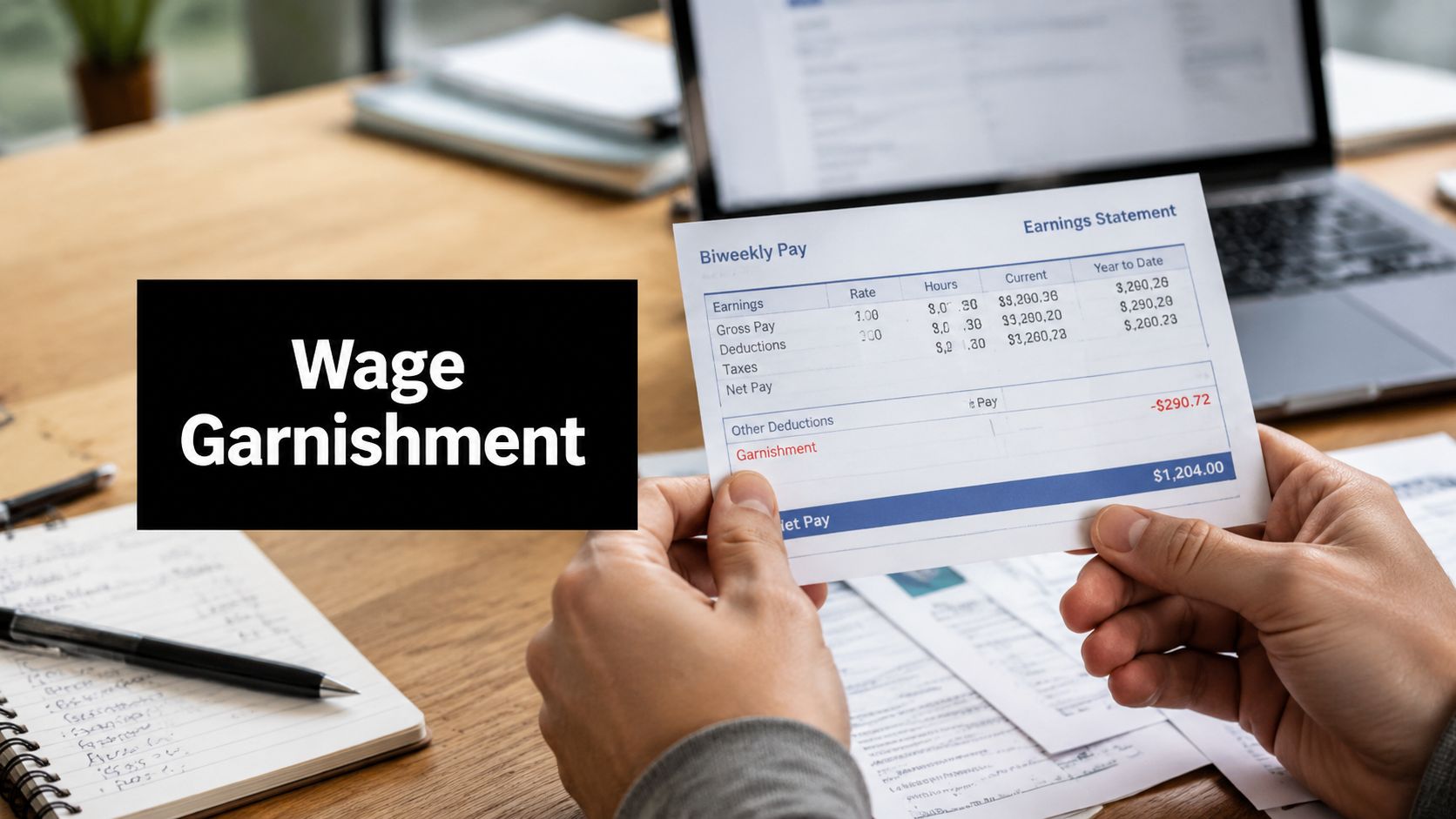
A borrower with defaulted federal loans may first discover the problem in a paycheck, not a courtroom. A nurse can finish a pay period, review the stub, and find that part of her earnings is gone. Payroll may then confirm that the employer received a federal student-loan garnishment order, even though she never appeared before a judge.
The direct answer is yes. Federal student loans can be collected through administrative wage garnishment without a court judgment, and the standard federal limit is up to 15% of disposable earnings. Disposable earnings generally means pay left after mandatory deductions, not the gross amount printed at the top of a pay stub. Federal rules also protect a minimum amount of weekly earnings, calculated using 30 times the federal minimum wage. The Department of Labor lists the federal minimum wage as $7.25 an hour, creating a protected weekly floor of about $217.50 (Department of Labor guidance).
The trigger is default, not one missed payment
Federal loans commonly enter default after 270 days past due. Once the loan is in default, the government can use administrative collection tools, including wage garnishment and federal-payment offsets. A lawsuit is not required first, so the process can move faster than private creditor collection (Investopedia's explanation of student-loan collection).
The 2026 risk window is active and unsettled. The Department of Education announced collection activity, paused involuntary collections, and signaled a possible restart while repayment reforms were considered (Student Loan Borrower Assistance's 2026 collection update). A pause is not a resolution. Treat every official notice as time-sensitive.
Confirm whether the debt is federal, verify its default status, and locate any garnishment notice. Depending on the facts, rehabilitation, consolidation, a timely objection, or a discharge application may stop or change the collection process. For additional background on wage orders and notice problems, review how BDJ Express Law helps borrowers.
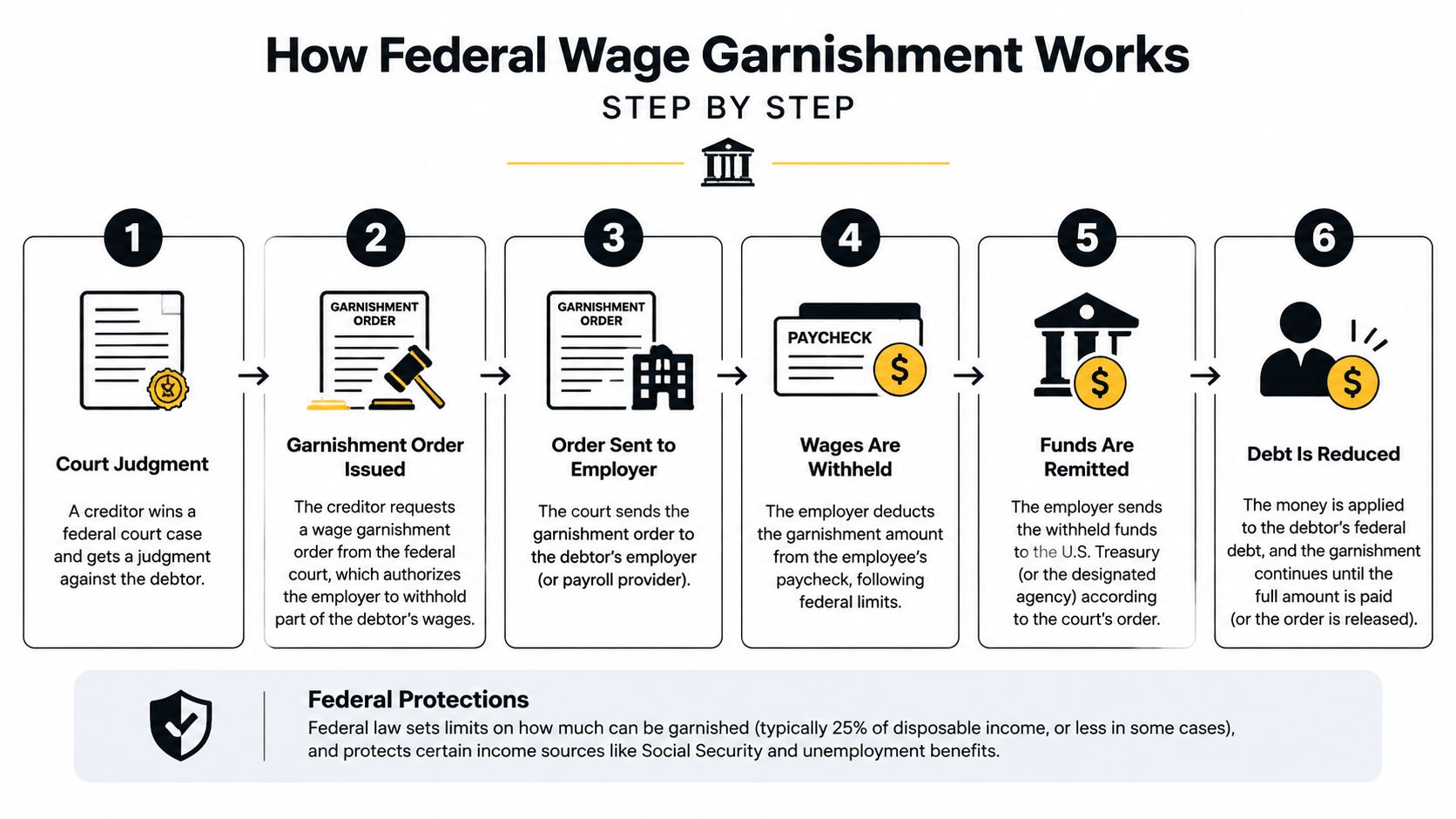
How Federal Wage Garnishment Works Step by Step
Administrative garnishment is a live process, not a settled rule. In 2026, the Department of Education has started collection activity, paused involuntary collections, and signaled a possible restart. A pause does not erase the debt or make an earlier notice harmless. Read every letter, confirm its date, and act before payroll receives withholding instructions.
The process usually begins with a demand or notice of intent. The government or its collection agency can then issue an administrative withholding order. Your employer does not decide whether the debt is valid. Payroll follows the order unless the agency corrects, withdraws, or replaces it.
The calculation starts with disposable pay, not gross wages. Mandatory deductions, including federal income tax, Social Security, and Medicare, generally reduce the amount used for the calculation. Voluntary deductions, such as health insurance, may not receive the same treatment, so the payroll figure can differ from your estimate.
The ordinary federal cap is 15% of disposable pay, and the earnings floor protects at least 30 times the federal minimum wage per week. Two employees earning the same salary can therefore face different withholding amounts when their mandatory deductions differ. Review the calculation with payroll and compare it with the order. The disposable-pay discussion from Investopedia explains the distinction.
What the employer receives
Request the withholding order and the account's collection history. Do not rely on an informal payroll explanation. The order may remain in place until the debt is paid, you leave default through an accepted remedy, or a hearing or legal process changes the result.
For the broader mechanics of government levies and wage garnishments, review this explanation of levy and garnishment. Track the notice date, response deadline, agency name, and every document you send.
Federal vs Private Student Loans The Core Difference
The procedural split determines your first move. Federal student-loan garnishment can be administrative, while a private lender generally must go to court before an employer can withhold wages. In 2026, that distinction matters because federal collection activity has started, paused, and signaled a restart. Treat federal garnishment as an active process, not a settled rule.
| Factor | Federal Loans | Private Loans |
|---|---|---|
| Initial collection route | Administrative wage garnishment may be used | Lawsuit and money judgment generally come first |
| Court order | Not required for the federal administrative process | Usually required before wage withholding |
| Federal collection tools | Wage garnishment and Treasury offsets may apply | The lender uses state-law judgment remedies |
| Repayment flexibility | Federal programs may offer rehabilitation or consolidation | Federal remedies don't apply |
| Main defense | Hearing request, default-resolution options, discharge claims | Defend the lawsuit, challenge the judgment, or assert state exemptions |
For federal debt, the government can direct an employer to withhold up to 15% of disposable pay without first obtaining a court judgment. The Department of Labor protections explain the federal limits that apply to wage deductions. A private lender normally has to prove the obligation in a civil case, obtain a judgment, and then follow the state garnishment procedure. State law controls the applicable limit and exemptions, including how certain income is treated.
Do not use a private-loan defense plan for a federal account. Federal borrowers may have rehabilitation, consolidation, hearing, and discharge options. Those remedies do not erase a private judgment or require a private lender to stop collection.
Why private debt needs a separate strategy
A private lender cannot use federal rehabilitation or consolidation to cure a private loan. You may need to defend the lawsuit, challenge service or accounting, negotiate with the lender, or claim an exemption. The statute of limitations depends on state law and the contract, so an old private loan is not automatically unenforceable.
Private loans also lack the federal system's collection and repayment structure. Handle the accounts on separate legal tracks. Resolving the federal account will not erase a private judgment, and negotiating with a private lender will not necessarily stop federal Treasury activity. Check which type of debt is moving before choosing a response.
The Notice Window and Your Right to a Hearing
The notice is your opening to act before the employer begins withholding. A federal loan commonly reaches default after 270 days past due, but the collection timeline after default depends on account processing, notices, and the agency handling the debt. Don't wait for the first reduced paycheck to start gathering records.
The notice of intent to garnish generally gives the borrower a 30-day period to request a hearing. Current borrower-assistance guidance identifies that deadline as critical (Saving for College's garnishment guidance). Submit the request in writing to the designated hearing official and keep proof of delivery. A phone call can help you understand the file, but it shouldn't replace a written request.
Grounds that can change the result
A hearing can address issues such as:
- Wrong borrower or wrong balance: Identity theft, clerical mistakes, or an incorrect payment history can undermine the proposed action.
- Financial hardship: A detailed household budget can show that withholding would prevent payment of basic expenses.
- Discharge eligibility: Total and permanent disability, borrower defense, or a closed-school discharge may affect collection.
- Recent employment circumstances: Certain employment-history facts may support an objection under the applicable rules.
Attach pay stubs, bank records, rent or mortgage information, medical documentation, and proof of dependents when those records support your objection. A bare statement that the garnishment feels unfair is weaker than a documented explanation of the error or hardship.
Requesting a hearing doesn't automatically solve the account. Continue pursuing rehabilitation or consolidation at the same time, and ask the collection agency how those steps affect the proposed order. Keep copies of every form, upload confirmation, letter, and payment record.
Real Scenarios How Garnishment Plays Out in Paychecks
The 15% cap does not tell you the exact amount that will leave each paycheck. The result depends on disposable pay, the protected earnings floor, payroll timing, and other legally authorized deductions. In 2026, that calculation matters during an active procedure. The Department of Education has started, paused, and signaled a restart of administrative wage garnishment, so borrowers should treat a paycheck change as a live collection event, not a distant possibility.
Consider a public-school teacher earning $48,000 in annual gross salary. If mandatory deductions leave about $3,100 in monthly disposable pay, the 15% ceiling would be approximately $465 for that month. This example shows the calculation, not a guaranteed result for every teacher. Payroll must apply the legal definition of disposable pay and the terms of the order.
| Scenario | Gross Monthly | Disposable Pay | 15% Cap | Actual Withheld |
|---|---|---|---|---|
| Public-school teacher | $4,000 | About $3,100 | About $465 | Depends on order and protected floor |
| 1099 contractor paid through payroll provider | Varies | Must be determined from covered pay | Depends on covered pay | Depends on worker status and order |
| Small-business owner with variable draws | Varies | Changes by pay period | Changes by pay period | May be intermittent |
A contractor paid through a payroll provider may not know whether the payments count as wages covered by the order. The answer depends on the payment arrangement and the provider's role. Request the withholding order and a written payroll explanation. A 1099 label alone does not resolve the issue.
A small-business owner may receive irregular draws rather than a steady salary. A deduction may therefore appear in one pay period and disappear in another, depending on how each payment is classified and processed. Keep every pay statement. An intermittent deduction can still show that an order remains active.
The protected weekly floor is based on 30 times the federal minimum wage, or about $217.50 using the federal minimum wage of $7.25 an hour (Department of Labor fact sheet). Child-support orders and other lawful deductions can reduce the money available for student-loan withholding. Review the complete payroll calculation, including the order, deductions, and protected amount, instead of looking only at the student-loan line.
Practical Steps to Stop or Prevent Garnishment
Once a notice arrives, move in deadline order. Don't begin with a broad internet search or wait for a collection agency to call back. Protect the hearing deadline first, then work on the underlying default.
Request the hearing in writing. Submit the request before the 30-day deadline stated in the notice. Make the request even if you're still assembling documents, then provide the supporting records through the permitted process.
Ask for a written resolution option. Contact the collection agency and request the available payment or default-resolution choices in writing. Don't rely on a verbal promise that payroll will be notified.
Start rehabilitation if it fits your circumstances. Rehabilitation can provide a route out of default, but the agreement and payment history matter. Ask the agency exactly when it will report completion and what happens to an existing garnishment order.
Evaluate federal consolidation. A Direct Consolidation Loan may move an eligible federal loan out of default faster than rehabilitation, but eligibility and timing are critical, especially if an order has already been issued.
Raise discharge and borrower-defense issues. If the school closed, misled you, or your disability creates a potential discharge basis, submit the appropriate application and identify that issue in the hearing response.
Get legal or legal-aid help. An administrative hearing is a formal dispute, not a customer-service complaint. If the balance, identity, hardship, or loan status is disputed, a student-loan attorney or legal-aid clinic can help organize the objection. Borrowers with private debt should also review Wisconsin wage garnishment rights and exemptions when Wisconsin law may govern.
Review an active order immediately. Ask payroll for the order, the effective date, and the calculation. For general guidance on stopping wage collection, review how to stop wage garnishment, then match the advice to your specific loan and state.
State Variations and Other Collection Channels
The federal administrative cap does not answer every paycheck question. State law can affect private-loan judgments, income exemptions, employer procedures, and protections for particular funds. Treat a federal student-loan order and a private creditor order as separate collection tools.
| State | Private Loan Garnishment Limit | Key Income Exemption | Federal Coordination |
|---|---|---|---|
| Texas | State protections may restrict private wage collection | State exemptions can protect wages and property | Federal collection tools remain separate |
| Pennsylvania | State rules may limit private wage garnishment | Exemptions depend on the claim and income type | Federal offsets may still apply |
| North Carolina | State protections may restrict ordinary private wage garnishment | State exemptions can be important | Federal collection remains available |
| South Carolina | State protections may restrict ordinary private wage garnishment | State exemptions vary by debt and income | Federal tools operate under federal rules |
| California | Broader creditor remedies may be available | State and federal exemptions may interact | Federal orders still require separate review |
| New York | State procedures can permit creditor garnishment | Exemptions depend on income and facts | Federal and state processes may overlap |
Use those state descriptions only as a starting point. The employer's location, governing order, debt type, and income source can change the result. For a private loan, obtain the judgment and garnishment papers before calculating what the lender may take.
Wage withholding isn't the only exposure
The Treasury Offset Program can intercept federal payments, including tax refunds and certain federal benefits. The offset may continue until the borrower repays the debt or leaves default, as explained in Saving for College's overview of offsets. A borrower can therefore avoid a wage deduction and still lose a federal payment.
The federal minimum-pay protection also matters for low-income borrowers. Someone near the protected floor may experience little or no wage withholding while remaining exposed to other collection channels. That protection does not resolve the default or prevent every type of federal collection.
Retirement income requires separate analysis. Review whether a pension can be garnished before assuming a pension receives the same protection as wages. In 2026, the Department of Education's start, pause, and indicated restart of administrative wage garnishment make timing important. Check notices and payment records now, because the collection method affecting you can change while you are still deciding what to do.
Your Short-Term Action Plan After Reading This
Use this week to replace uncertainty with documents. Start with your Federal Student Aid account and identify the loans, the current holder, and the status shown for each account. If the information is incomplete, contact the listed servicer or collection agency and request confirmation in writing.
A focused checklist
- Confirm ownership. Pull the federal loan information and identify who currently handles collection.
- Verify the default history. Ask for the default date, last payment date, balance, and complete collection history.
- Inspect your payroll. If money has already been withheld, request the employer's order, effective date, and calculation.
- Calendar the deadline. If you received a notice, mark the stated 30-day hearing period and request the hearing form before it expires.
- Choose a default remedy. Compare rehabilitation and consolidation based on eligibility, speed, payment terms, and the status of any existing order.
- Ask which state law applies. Your employer or payroll provider should identify the governing withholding instructions, but get the answer in writing.
- Escalate disputed matters. Contact a consumer-protection attorney or legal-aid office if the debt is private, the identity is wrong, the balance is disputed, or hardship documentation is substantial.
Don't delete letters or rely on memory. Create a folder containing notices, envelopes, pay stubs, account screenshots, payment confirmations, and every message sent to the collection agency. If you need help evaluating broader debt-resolution options, review this discussion of tax debt settlements, while remembering that student-loan collection requires its own analysis.
The question isn't only “can student loan garnish wages?” For defaulted federal loans, the answer is yes. The urgent questions are whether your account is in default, whether a notice was issued, whether the collection program is currently active, and what deadline controls your next move.
Tax Attorney Stephen A Weisberg helps individuals review tax and debt problems, understand collection exposure, and determine whether professional representation is appropriate before taking action. Visit Tax Attorney Stephen A Weisberg to request a free Tax Debt Analysis and discuss the documents and deadlines affecting your situation.


