Can Social Security Benefits Be Garnished? A Complete Guide
Can social security benefits be garnished? Discover the critical exceptions for taxes, student loans, and child support, and learn how to protect your income.
In this article
- The Reality of Social Security Garnishment
- Debts That Can Trigger Garnishment
- Debts That Generally Cannot Trigger Garnishment
- Quick Guide to Social Security Garnishment Rules
- Understanding the Federal Shield That Protects Your Benefits
- The Purpose Behind the Protection
- How Different Benefit Types Are Shielded
- When the Government Can Garnish Your Social Security
- Unpaid Federal Income Taxes
- Defaulted Federal Student Loans
- Other Federal Non-Tax Debts
- The Rules for Child Support and Alimony
- Why Child Support and Alimony Are Different
- Understanding the Garnishment Limits
- Garnishment Limits for Child Support and Alimony
- Dealing with Social Security Overpayments
- How the SSA Gets Its Money Back
- What to Do If You Get an Overpayment Notice
- How to Stop or Reduce a Garnishment
- Tackling Different Types of Debt
- When to Seek Professional Help
- Common Questions About Benefit Garnishment
- Are SSI Benefits Protected From Garnishment Too?
- Can a Credit Card Company Garnish My Social Security?
- What Happens If My Benefits Are In My Bank Account?
Yes, your Social Security benefits can be garnished, but it's not a free-for-all for creditors. A powerful federal law acts as a shield, protecting your benefits from most private debts like credit cards and medical bills. However, this protection isn't absolute. Certain debts, especially money owed to the federal government or for family support, can pierce that shield.
The Reality of Social Security Garnishment
For millions of Americans, Social Security isn't just a check—it's a financial lifeline. So, the thought of that essential income being siphoned off to pay old debts can be terrifying.
The good news is that a strong federal law, Section 207 of the Social Security Act, generally puts your benefits off-limits. Think of this law as a protective wall built around your monthly income.
However, this wall has a few specific, government-authorized gates. While a private creditor for a personal loan can’t touch your benefits, the government itself can. Understanding this distinction is the key to knowing where you stand.
This decision tree breaks down the core concept, showing which debts pose a real threat and which ones are blocked by that protective wall.
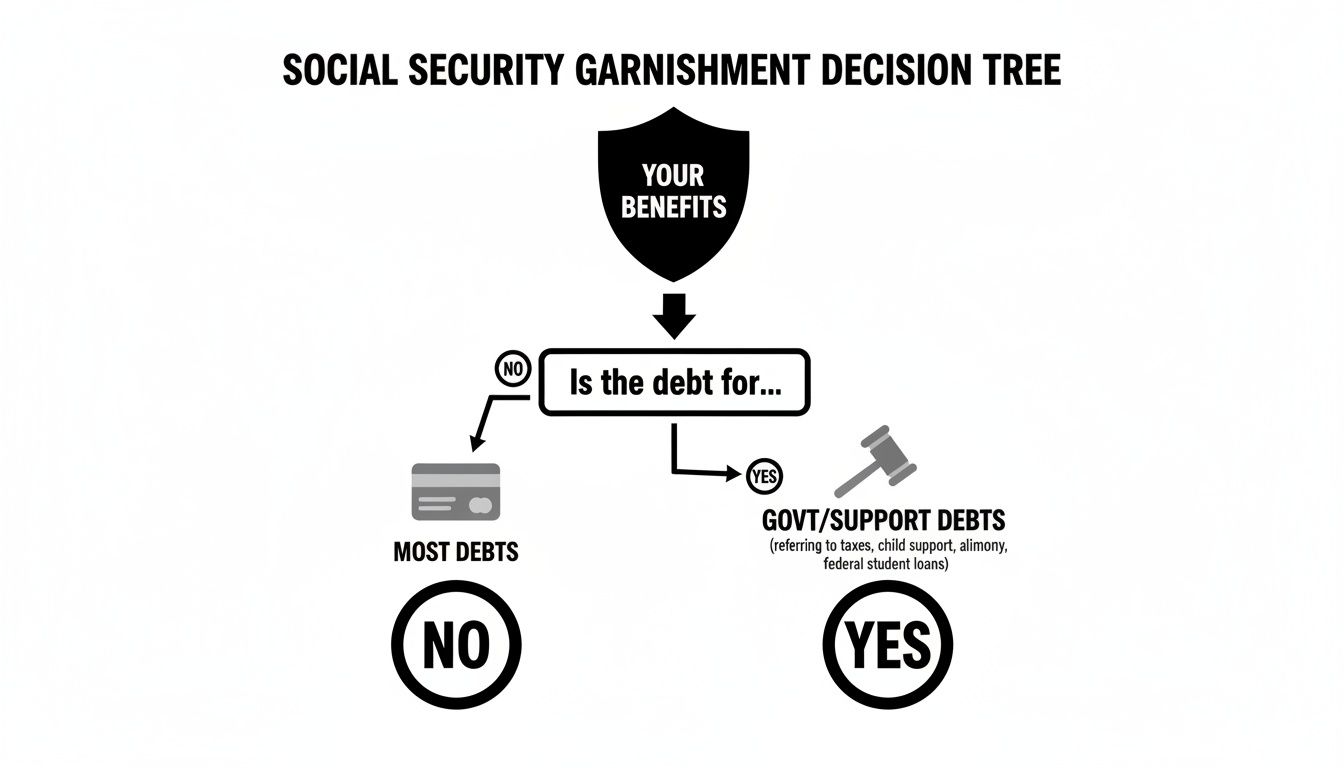
As you can see, the main takeaway is that the government—along with court orders for family support—are the primary exceptions to the rule.
Debts That Can Trigger Garnishment
When you ask, "can my Social Security be garnished?" the answer always comes down to who you owe. Knowing these exceptions is the first step toward protecting your income.
The most common debts that can lead to a garnishment are:
- Federal Income Taxes: The IRS doesn't need to ask for permission. It can levy up to 15% of your monthly benefits to satisfy an old tax bill.
- Federal Student Loans: If you've defaulted on a federal student loan, the Department of Education can garnish a portion of your benefits to collect.
- Child Support and Alimony: Court-ordered family support is a major exception. Garnishment for these obligations can be steep, potentially reaching 50-65% of your benefits depending on your circumstances.
- Other Federal Debts: Money owed to other federal agencies (for things like overpayments on other federal benefits) can also be collected through a process known as the Treasury Offset Program (TOP).
Debts That Generally Cannot Trigger Garnishment
On the flip side, that protective shield from Section 207 is incredibly effective against most private debts. Creditors for these types of obligations are legally barred from seizing your Social Security benefits directly.
This protection is designed to ensure that the money you rely on for basic living expenses isn't intercepted by collectors for common consumer debts. It applies to things like credit card bills, medical expenses, car loans, and personal loans.
To make this crystal clear, the table below provides an at-a-glance summary of which debts can and cannot lead to the garnishment of your Social Security payments.
Quick Guide to Social Security Garnishment Rules
This table offers a straightforward breakdown of which debts can impact your Social Security and which ones are generally blocked.
| Type of Debt | Can Benefits Be Garnished? | Primary Governing Authority |
|---|---|---|
| Federal Income Tax | Yes | Internal Revenue Service (IRS) |
| Federal Student Loans | Yes | Department of Education |
| Child Support & Alimony | Yes | Consumer Credit Protection Act |
| Credit Card Debt | No | Social Security Act (Section 207) |
| Medical Bills | No | Social Security Act (Section 207) |
| Personal & Payday Loans | No | Social Security Act (Section 207) |
As you can see, the dividing line is clear: federal and court-ordered family debts are the primary exceptions, while private consumer debts are kept at bay by federal law.
Understanding the Federal Shield That Protects Your Benefits
At the heart of Social Security's protections is a single, powerful federal law: Section 207 of the Social Security Act. This is the legal bedrock that stops most creditors in their tracks, ensuring the money you count on for essentials like food and housing stays in your hands.
Think of Section 207 as a vault built specifically for your benefits. Everyday creditors—like credit card companies, medical collectors, or personal loan providers—simply don't have the key. They can't get a garnishment order that the Social Security Administration will ever honor.
This isn't just for one type of benefit, either. This sturdy shield defends both Social Security Disability Insurance (SSDI) and retirement benefits equally, because the law recognizes that both are absolutely vital lifelines for millions.
The Purpose Behind the Protection
The thinking behind this federal shield is pretty simple. Social Security is a form of social insurance, created to keep seniors, people with disabilities, and their families out of poverty. If creditors could easily snatch those funds to cover consumer debts, the whole purpose of the program would fall apart.
Let's be real: for most people, these benefits are their primary, if not only, source of income. For the past 24 years, Gallup polls have consistently found that a staggering 86% of the 53 million retired workers rely on these payments to cover their basic expenses. Allowing garnishment would pull the rug out from under them.
In essence, Congress decided that ensuring a basic standard of living for beneficiaries was more important than allowing private creditors to collect on their debts from this specific source of funds.
This protection is a core principle of Social Security. But it's also critical to know that while the shield is strong, it's not unbreakable. The government carved out a few specific exceptions, mostly for debts owed back to the government or for family support obligations. We'll get into those next.
How Different Benefit Types Are Shielded
While both retirement and SSDI benefits fall under the protection of Section 207, there's another program that gets an even stronger defense: Supplemental Security Income (SSI). SSI is a needs-based program, a true safety net for disabled adults, children, and seniors who have very little income and few resources.
Because SSI is meant to cover only the most basic needs, its shield is practically impenetrable. SSI benefits are off-limits for almost every kind of debt, including federal taxes and student loans. The only major exception is when the Social Security Administration itself needs to recover an overpayment of SSI funds.
This is a crucial distinction. If you receive SSI, your benefits are far safer from the exceptions that can chip away at retirement or SSDI payments. It's a key detail to remember when you're asking "can my Social Security be garnished?"—because the answer really depends on which benefit you receive. These kinds of protections have a lot in common with other retirement funds, which you can learn more about in our guide on whether pensions can be garnished.
Now, let's dig into the specific situations where retirement and disability benefits aren't quite so protected.
When the Government Can Garnish Your Social Security
While the federal protection for Social Security is strong, it was created by the government—and the government carved out some specific exceptions for itself. When you owe money directly to a federal agency, that protective shield becomes much less effective. This is the biggest exception to the rule, and it’s the one that catches many people by surprise.
The main way the government collects these debts is through the Treasury Offset Program (TOP). Think of it as a centralized clearinghouse for all federal debts. Before any agency sends you a payment, like a tax refund or your Social Security check, it first has to run it through TOP to see if you owe money to another part of the government.
If the system finds a match, TOP intercepts—or "offsets"—a portion of your payment to cover the old debt before sending the rest to you. It's a powerful and automated system for collecting what's owed.
Unpaid Federal Income Taxes
The IRS is one of the most powerful creditors you can have. If you have an outstanding federal tax bill, the IRS has the authority to levy your Social Security benefits directly, and they don't even need to go to court to do it.
This process is separate from the Treasury Offset Program, giving the IRS a direct line to your benefits. But there are strict rules about how much they can take.
The 15% Limit: The IRS can levy up to 15% of your total monthly Social Security payment. So, if you receive $2,000 a month, the IRS can take up to $300 each month until your tax debt is paid off.
No Minimum Protection: Unlike other types of garnishment, there isn't a minimum amount that’s automatically safe from an IRS levy. That 15% rule applies no matter how large or small your benefit is.
A levy is a serious step, but it's also a final warning that you need to communicate with the IRS right away. Ignoring it won't solve anything. For a deeper look into this process, you can find valuable information in our complete guide to understanding IRS levies on bank accounts.
Long before a levy hits, the IRS is required to send you several notices, culminating in a "Final Notice of Intent to Levy and Notice of Your Right to a Hearing." This is your chance to get ahead of the problem by setting up a payment plan or exploring other ways to resolve the debt.
Defaulted Federal Student Loans
Another major exception is for federal student loans. If you default on a loan backed by the Department of Education, the government can garnish your Social Security to get its money back. This has become a surprisingly common issue, especially for older Americans who may have co-signed loans for their kids or grandkids.
The rules for student loan garnishment are a bit different than for tax levies.
- Garnishment Amount: The government can take up to 15% of your monthly benefit.
- Protected Amount: The first $750 of your monthly benefit is shielded from garnishment for student loans. If your benefit is $750 or less, they can't touch it for this type of debt.
Let’s see how that works. Say your monthly Social Security check is $1,200. The first $750 is protected. That leaves the remaining $450 exposed to the 15% garnishment. This means the government could take up to $67.50 each month ($450 x 0.15).
Other Federal Non-Tax Debts
Beyond taxes and student loans, you can owe money to other federal agencies for all sorts of reasons. These are called "non-tax debts," and they are almost always collected through the Treasury Offset Program.
Some common examples of these debts include:
- Overpayments from other federal programs (like VA benefits)
- Unpaid federal court-ordered restitution
- Defaulted loans from the Small Business Administration (SBA)
For these non-tax debts, the government can typically offset up to 15% of your Social Security benefits. Just like with student loans, you'll receive a notice from the Treasury Department at least 60 days before the offset starts. This notice gives you time to dispute the debt or work out a payment plan, making it a critical window of opportunity to keep your benefits intact.
The Rules for Child Support and Alimony
While federal law generally shields your Social Security benefits, there's a major exception that often comes as a shock: family support obligations. When it comes to court-ordered child support and alimony, the powerful protection you thought you had is dramatically reduced.
These aren't treated like credit card bills or personal loans. The law places the financial well-being of children and former spouses in a special category, giving them priority over almost everything else.
Why Child Support and Alimony Are Different
Think of it this way: the legal system sees family support as a core duty, not just a debt to be paid. This money is essential for a child's or dependent ex-spouse's basic needs—things like housing, food, and medical care. If someone could avoid these court-ordered payments just because their income comes from Social Security, it would create a massive loophole and undermine the family court system.
Because of this, a court can issue a garnishment order that the Social Security Administration (SSA) must follow. The SSA will then take the money directly from your monthly check and send it where it needs to go, bypassing the usual protections of 42 U.S.C. § 407.
Unlike a typical creditor, a person owed child support has a direct and legally enforceable claim against your benefits.
Understanding the Garnishment Limits
The most jarring difference here is just how much can be taken. While the IRS can only take 15% for back taxes, the Consumer Credit Protection Act (CCPA) sets a much higher ceiling for support orders. The exact amount depends on your current family situation.
Under the CCPA, up to 50% of your disposable benefits can be garnished if you are supporting another spouse or child. If you aren't, that number jumps to 60%. And if you're more than 12 weeks behind on your payments, those limits can be pushed even higher to 65%.
These incredibly high percentages show just how seriously the law takes these obligations. The way these amounts are set in the first place can be complex, and you can learn more about various child support calculation methods to better understand the process.
Garnishment Limits for Child Support and Alimony
The table below gives you a clear picture of the maximum garnishment percentages allowed by the CCPA, which vary based on your personal circumstances.
| Your Support Circumstance | Maximum Garnishment Percentage |
|---|---|
| Supporting a current spouse or child | 50% |
| Not supporting another spouse or child | 60% |
| Supporting a current spouse or child AND over 12 weeks in arrears | 55% |
| Not supporting another spouse or child AND over 12 weeks in arrears | 65% |
As you can see, a huge chunk of your monthly benefit can be diverted to cover these debts. This makes it by far the most impactful type of garnishment a Social Security recipient can face. If you get a notice about garnishment for child support or alimony, you have to act fast—the financial hit can be severe.
Dealing with Social Security Overpayments
Sometimes, the one you owe money to is the Social Security Administration (SSA) itself. It’s a strange and stressful situation that happens when the SSA sends you more money than you were actually supposed to get—what they call an "overpayment." It's confusing, and honestly, it’s often not even your fault.
Overpayments can happen for all sorts of reasons. Maybe there was a simple administrative error on the SSA's end, a delay in processing new income you reported, or a change in your living situation that didn't get updated in time. Whatever the reason, the SSA is legally required to get that money back, and it has the power to take it directly from your future benefits.
How the SSA Gets Its Money Back
When the SSA spots an overpayment, its go-to collection method is to simply withhold a chunk of your upcoming monthly checks. You can think of it as an internal garnishment. This can feel especially jarring because, unlike a typical creditor, the SSA doesn’t need to go to court to start taking your money.
How much they can take has been a hot topic lately. According to the Congressional Research Service (CRS), the SSA’s approach has been all over the map. Not long ago, the withholding rate was as low as 10% of your benefit. Then, a plan was announced to jump that rate all the way up to 100% by March 2025—a change that caused a huge outcry before it was walked back.
This back-and-forth really shows how seriously an overpayment recovery can affect people who are counting on every single dollar just to get by.
What to Do If You Get an Overpayment Notice
Getting an overpayment notice in the mail is enough to make anyone’s stomach drop. But the absolute worst thing you can do is ignore it. You have rights, but you also have a very tight window to act. Moving quickly is key to protecting your benefits.
The first thing to realize is that you have options. You don't have to just sit back and accept the SSA's decision.
Here's the most important thing to remember: You have the right to fight the decision and even ask the SSA to forgive the debt completely. But you have to act within the strict deadlines they give you in the notice.
What you do next really depends on your situation. Here are the three main paths you can take:
Request Reconsideration: If you think the SSA made a mistake and you weren't actually overpaid—or you believe the amount is wrong—you can file a "Request for Reconsideration." You must file this within 60 days of getting the notice. The good news is that the SSA will stop any collection attempts while they review your appeal.
Request a Waiver: Let's say you agree you were overpaid, but you believe it wasn't your fault and you can't possibly afford to pay it back. In this case, you can file a "Request for Waiver of Overpayment Recovery." You’ll have to prove that paying it back would create a real financial hardship, meaning you couldn’t cover your basic living expenses.
Negotiate a Lower Payment: If a waiver isn't an option but you can't handle the proposed withholding (often 10% or more), you can call the SSA and try to negotiate a lower monthly payment. Be prepared to provide details about your income and expenses to show them what you can realistically afford to pay back each month.
How to Stop or Reduce a Garnishment

Getting a notice that your Social Security benefits are on the chopping block can be a gut-wrenching experience. The absolute most important thing to do is take a deep breath, don't panic—and whatever you do, don't ignore it. Acting quickly and decisively is your best defense.
Tossing that official notice from the IRS, Department of Education, or family court in a drawer only guarantees the garnishment will move forward. On the other hand, a prompt response can open up a surprising number of ways to stop, reduce, or even prevent the seizure of your benefits altogether. Your specific strategy will hinge entirely on the type of debt you're facing.
Tackling Different Types of Debt
You can't use a one-size-fits-all approach here. How you deal with the IRS is completely different from how you handle student loans or child support.
For Federal Tax Debt: The IRS is surprisingly willing to work with taxpayers to resolve debt issues. You can often stop a levy dead in its tracks by getting on the phone with them to set up a payment plan. Options like an Offer in Compromise (OIC) or a formal Installment Agreement are common solutions. If you can prove genuine financial hardship, they might even place your account in Currently Not Collectible status. For a deep dive into your options, check out our guide on how to stop an IRS wage garnishment.
For Federal Student Loans: If your student loans are in default, the Department of Education has programs designed to help you recover. By entering a loan rehabilitation program, you agree to make a series of manageable monthly payments. Once you've completed the program, the default is cleared from your credit report, and the garnishment is lifted.
For Child Support or Alimony: These court-ordered debts are tougher nuts to crack, but it’s not hopeless. If your financial reality has drastically changed since the judge issued the order—maybe due to a new disability or a sharp drop in income—you have the right to petition the court to have it changed.
It's crucial to understand that only a judge can alter a court order. If your Social Security benefits are being taken for child support, your best path to relief might be learning the process for modifying child support orders.
When to Seek Professional Help
Sometimes, you can sort things out directly with the government agency. But in other cases, trying to go it alone is a big mistake. The rules around garnishments are a maze of legal and financial regulations, and one wrong turn can be incredibly costly.
It’s probably time to call in an expert if:
- The garnishment notice is confusing, and you’re not sure what it means.
- You think the debt is wrong or that you might be a victim of identity theft.
- You have to go to court to get a child support order changed.
- Your attempts to negotiate with the IRS or another agency have hit a brick wall.
A qualified tax attorney, a family law specialist, or even a local legal aid service can be a lifesaver. They can step in to advocate for you, make sure your rights are protected, and help you find the best possible outcome to safeguard your essential Social Security income.
Common Questions About Benefit Garnishment
Even when you know the general rules, real-world situations can bring up some tricky questions. Let's break down some of the most common scenarios people face when it comes to garnishing Social Security benefits.
Are SSI Benefits Protected From Garnishment Too?
Yes, and the shield around Supplemental Security Income (SSI) is even stronger. Think of SSI as a last-resort safety net for those with limited income and resources. Because of this, it gets special treatment.
SSI payments are off-limits for almost everything. They cannot be garnished for federal taxes, student loans, or even court-ordered child support. The only real exception is if the Social Security Administration itself needs to reclaim an overpayment it made to you.
Can a Credit Card Company Garnish My Social Security?
Absolutely not. Private creditors—like credit card issuers, hospitals with medical bills, or personal loan companies—are legally forbidden from touching your Social Security benefits directly. The law is crystal clear on this.
They might try to go after funds in your bank account, but even there, a special federal rule steps in to protect you if your benefits are direct-deposited. It’s an important line of defense.
Federal banking rules force your bank to automatically shield an amount equal to two months of your direct-deposited Social Security benefits. This "look-back" period prevents private creditors from freezing or taking that money.
What Happens If My Benefits Are In My Bank Account?
This is where things get a little more complicated. That automatic two-month protection is fantastic for stopping private debt collectors, but it does not stop the government.
If the IRS issues a levy for back taxes or a court orders garnishment for child support, that automatic safeguard disappears. Those specific, government-backed debts can still reach the money in your account. A levy notice is a formal legal action, and you can learn more about it in our guide explaining what a levy notice is and how it works.
It's a critical difference to remember: the money in your bank account is well-protected from private debt collectors but is vulnerable to the major exceptions like federal taxes and family support obligations.
Navigating IRS issues can be overwhelming, but you don't have to do it alone. Attorney Stephen A Weisberg offers a free Tax Debt Analysis to assess your situation and determine the best path forward before you ever pay a fee. Find out how we can help at https://weisberg.tax.


