Can Social Security Be Garnished? A Complete Guide
Can social security be garnished? Learn exactly when and how your benefits can be seized and what legal protections you have against debt collectors.

In this article
- Your Social Security Benefits Have a Powerful Shield
- But Every Shield Has Its Weak Points
- Why These Protections Matter So Much
- Social Security Garnishment At a Glance
- When the Government Can Garnish Your Social Gecurity Benefits
- Unpaid Federal Income Taxes
- Court-Ordered Child Support and Alimony
- Defaulted Federal Student Loans
- How the Process Usually Works
- How the Treasury Offset Program (TOP) Works
- TOP in Action: An Automated Process
- What Kinds of Debts Does TOP Collect?
- How Much of Your Social Security Can Be Taken?
- Federal Taxes and Student Loans: The 15% Rule
- Child Support and Alimony: The Stricter Limits
- Garnishment Rates in the Real World
- Maximum Garnishment Limits for Social Security Benefits
- What To Do If You Get a Garnishment Notice
- First Things First: Verify the Debt
- Don't Miss Your Deadline to Respond
- Special Protections for SSI and Bank Accounts
- Automatic Protection in Your Bank Account
- Common Questions About Social Security Garnishment
- Can a Credit Card Company or Debt Collector Take My Social Security?
- What if Social Security Is My Only Income?
- Is It Possible to Stop a Garnishment After It Starts?
- Are Disability (SSDI) and Retirement Benefits Treated Differently?
It’s a question that causes a lot of anxiety: can Social Security be garnished? The short answer is yes, but it’s not a free-for-all for creditors. While your benefits are shielded from most private debts, the government has given itself—and state agencies—a key to unlock that protection for specific obligations like back taxes, federal student loans, and family support.
Your Social Security Benefits Have a Powerful Shield
For millions of Americans, that monthly Social Security deposit is a financial lifeline. Recognizing this, federal law created a powerful shield to guard these funds from the hands of most creditors. This isn't just a suggestion; it's a legal firewall designed to ensure you can cover your basic needs.
Think of it like a financial bodyguard. This protection stands firm against private debt collectors, meaning your benefits are generally off-limits for things like:
- Unpaid credit card balances
- Old medical bills
- Personal loans from a bank
- Car repossessions or mortgage shortfalls
The legal muscle behind this comes from a law known as Section 207 of the Social Security Act (codified as 42 U.S.C. § 407). It explicitly forbids creditors from using garnishment, levies, or other legal tools to seize your benefits.
But Every Shield Has Its Weak Points
Here's where things get tricky. While that shield is strong, it wasn't designed to be impenetrable. The federal government carved out specific exceptions for itself and for certain court-ordered obligations. This is why the answer to "can Social Security be garnished?" isn't a simple no.
The rule of thumb is this: the same government that gives you the benefit can also take a portion of it back to settle a debt you owe to the government. Understanding this distinction is the key to knowing where you stand.
Because of this, debts owed directly to Uncle Sam or enforced by the courts can pierce right through that protective layer. It’s the reason the IRS can garnish your benefits for back taxes, but a credit card company can't. These same kinds of rules often apply to other retirement funds, a topic we cover in our guide on whether pensions can be garnished.
Why These Protections Matter So Much
To grasp the importance of these rules, just look at the numbers. As of October 2025, about 70.3 million people rely on Social Security, with the average check hovering around $1,868 per month.
Despite these protections, government garnishments are a real issue. For instance, the number of federal student loan borrowers over the age of 62 shot up by 59% between 2017 and 2023, now totaling around 2.7 million people. If you're looking for a deeper dive into how the system works, this complete guide to Social Security Benefits for Federal Employees is a fantastic resource.
Social Security Garnishment At a Glance
To make it easier to see what's what, this table breaks down the most common types of debt and whether they can lead to garnishment.
| Type of Debt | Can Social Security Be Garnished? | Governing Authority |
|---|---|---|
| Federal Income Taxes | Yes | Federal Law (IRS Levy) |
| Federal Student Loans | Yes | Debt Collection Improvement Act |
| Child Support & Alimony | Yes | Court Order / State Law |
| Credit Card Bills | No | Social Security Act (42 U.S.C. § 407) |
| Medical Debt | No | Social Security Act (42 U.S.C. § 407) |
| Personal & Auto Loans | No | Social Security Act (42 U.S.C. § 407) |
As you can see, the dividing line is clear: government-related debts get a green light for garnishment, while private consumer debts are stopped at the gate.
When the Government Can Garnish Your Social Gecurity Benefits
While your Social Security benefits are generally off-limits to private creditors, that protection isn't absolute. The federal government, which created this shield in the first place, also wrote the rules for when it can be lowered. Certain debts, especially those you owe to federal or state agencies, get a special pass to bypass these protections.
Think of it this way: when you owe the government money, it’s not a typical debt collection scenario. It’s more like the government settling an internal account. This is the crucial distinction that explains why, for specific obligations, Social Security absolutely can be garnished.
Let's look at the three main types of debt that can break through that protective barrier.
Unpaid Federal Income Taxes
If there's one creditor you don't want to have, it's the Internal Revenue Service (IRS). When you owe back taxes, the IRS has unique powers. They don't need a court order to start collecting from you; they can issue a levy directly against your Social Security benefits on their own authority.
This is an administrative process. As long as the IRS follows its own rules—which involve sending you a series of warning letters, including a "Final Notice of Intent to Levy and Notice of Your Right to a Hearing"—it can start taking a portion of your monthly check. Ignoring those letters is the surest way to see your benefits suddenly shrink.
Court-Ordered Child Support and Alimony
The legal system takes family support obligations very seriously. If you're behind on court-ordered child support or alimony, a state court can issue a garnishment order that the Social Security Administration is required to honor.
Even though the order comes from a state court, it's enforced at the federal level. The law places the financial security of children and former spouses at a very high priority, giving these debts a powerful claim on nearly any source of income, including Social Security.
Defaulted Federal Student Loans
This one catches a lot of people by surprise. If you've defaulted on a federal student loan, the U.S. Department of Education can take a piece of your Social Security benefits. They do this through a system called the Treasury Offset Program (TOP).
The government can garnish up to 15% of your Social Security benefits to repay a defaulted federal student loan. It's important to remember this only applies to federal loans—private student loan companies are treated just like any other private creditor and cannot touch your Social Security.
The rules around student loan collections can change based on federal policy. For example, wage garnishment data dropped from a peak of 3.9% in March 2020 to 2.8% by January 2024, thanks to pandemic-era relief programs that paused most collections. Always keep an eye on current federal policies, as they can directly impact how these debts are handled.
How the Process Usually Works
No matter which agency is coming after your benefits, they can't just start taking your money without warning. Due process is required, which means you have to be notified first. You will always receive official letters that explain what you owe, how much, and that the agency plans to start garnishing your benefits.
These notices are your lifeline. They spell out your rights, including how to appeal the decision, question the debt amount, or set up a repayment plan. The moment you get one of these letters is the moment to act. It's your best, and sometimes only, chance to protect your income.
For a deeper dive into tax rules, debt management, and other financial topics that intersect with federal and state debts, you can find more tax and financial insights. Knowing which debts can put your benefits at risk is the first step in protecting them.
How the Treasury Offset Program (TOP) Works
When a private creditor wants to collect a debt, they usually have to go to court and get a judge's order. The federal government, however, plays by a different set of rules. For non-tax debts, it has a powerful tool called the Treasury Offset Program, or TOP.
You can think of TOP as the government's highly efficient, in-house collection agency. Its job is simple: make sure federal debts get paid before any federal money, like your Social Security check, goes out the door.
So, while the technical term is an "offset," not a "garnishment," the end result feels the same if you're the one seeing a smaller check. The Department of the Treasury simply intercepts your payment, takes what's owed, and sends the rest to you.
TOP in Action: An Automated Process
The whole system is surprisingly automated. Let's say you have a delinquent student loan. The Department of Education flags your account and sends your information over to the Bureau of the Fiscal Service, the agency that runs TOP.
TOP's computers then constantly scan for any federal payments scheduled to come your way. The moment it finds a match—like your upcoming Social Security benefit—it automatically deducts the legally allowed amount to pay down your debt. The remaining balance is then sent to your bank account. It’s a fast and direct process that doesn't require any court hearings.
The most important part of this whole process for you is the "Notice of Intent to Offset." By law, the agency you owe must mail you this written warning at least 60 days before they start taking your money. This letter is your critical window to take action.
This notice isn't just a heads-up; it's your official opportunity to respond. It will explain the debt and outline your rights, including how to dispute the amount, negotiate a repayment plan, or request a review if the offset would cause severe financial hardship. Ignoring it is the surest way to have your benefits reduced.
What Kinds of Debts Does TOP Collect?
The Treasury Offset Program is used for a wide range of non-tax federal debts. Some of the most common culprits that can lead to a chunk of your Social Security being taken include:
- Defaulted federal student loans: This is, by far, one of the most common reasons people see their Social Security benefits offset.
- Federal benefit overpayments: If an agency like the Social Security Administration or the Department of Veterans Affairs accidentally paid you too much, they can use TOP to get it back.
- Defaulted federal loans: This could be an old loan from the Small Business Administration (SBA) or another federal agency.
- Unpaid federal civil penalties and fines.
It's also important to remember that the IRS has its own set of powerful collection methods for tax debts. To learn more about how they operate, you can read up on the IRS's Automated Federal Payment Levy Program, which is their version of TOP for tax obligations. Knowing the difference is crucial for protecting your income.
How Much of Your Social Security Can Be Taken?
Once you learn that your Social Security can be touched, the next question is always the same: how much? The answer isn't a single, clean number. The limits vary wildly depending on what kind of debt you owe. Some debts can only take a small slice of your benefits, while others can claim a huge chunk, making it critical to know the specific rules.
Thankfully, the government doesn't just pick a number out of a hat. Federal laws set strict caps to ensure that even after a garnishment, you have something left for basic living expenses. However, those caps are definitely more generous for some debts than others.
Federal Taxes and Student Loans: The 15% Rule
For most federal non-tax debts, like defaulted student loans, the garnishment limit is pretty straightforward. Through the Treasury Offset Program (TOP), the government can take up to 15% of your total monthly Social Security benefit.
But there’s a crucial safety net built into this rule. The law says that no matter what, you must be left with at least $750 in benefits each month. So, if taking the full 15% would drop your monthly payment below that $750 floor, the government can only take a smaller amount to keep you above that threshold.
The IRS generally follows a similar 15% limit when it levies Social Security benefits for unpaid federal income taxes. This consistency provides a predictable—though still painful—ceiling for most federal debt collections.
This flowchart shows how the Treasury Offset Program typically works, from the initial notice all the way to the final reduction of your benefits.
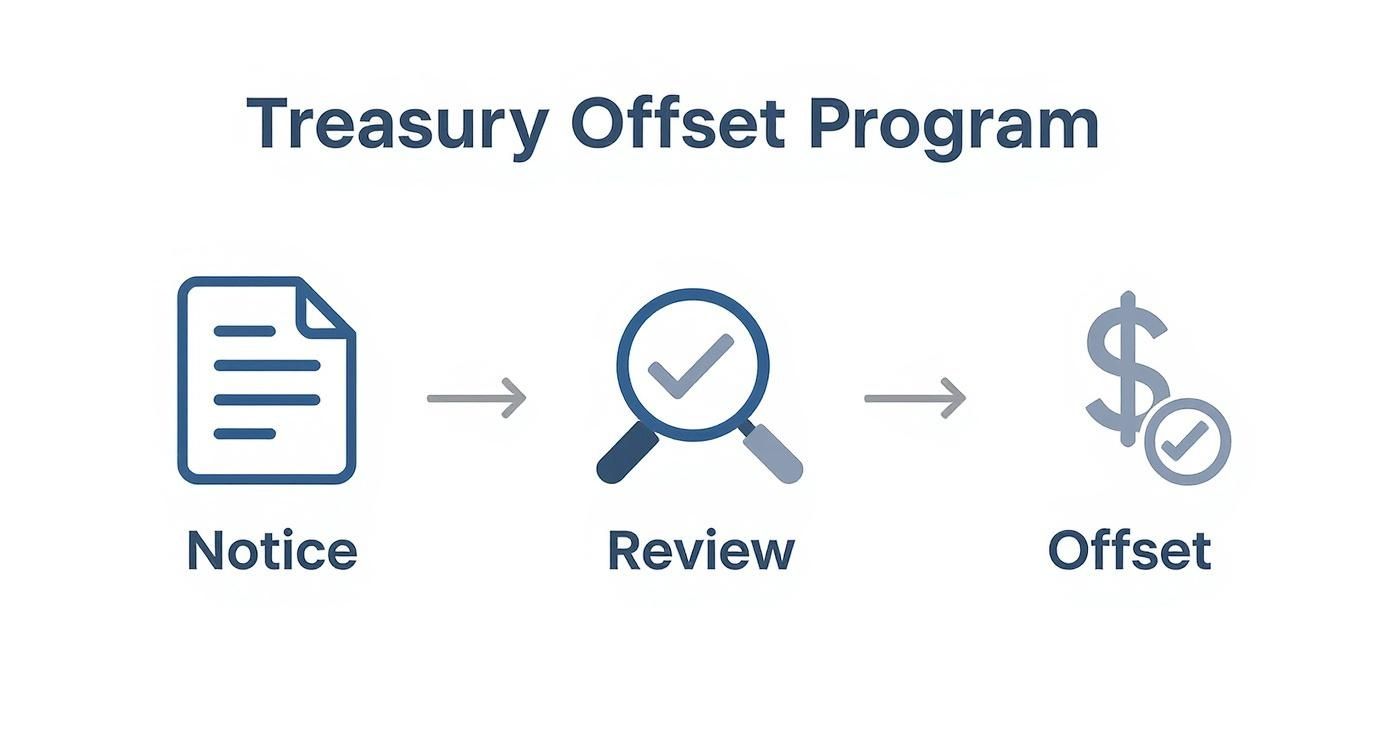
The whole process is designed to be automated and efficient, which is why it's so important to respond to that first notice before the offset kicks in.
Child Support and Alimony: The Stricter Limits
The rules change dramatically when it comes to court-ordered child support and alimony. These obligations are given top priority by the legal system, so the amount that can be taken from your benefits is much, much higher. The limits here are set by the Consumer Credit Protection Act (CCPA) and hinge on your personal circumstances.
- You could lose up to 50% of your benefits if you are currently supporting another child or spouse.
- That number jumps to 60% if you are not supporting another child or spouse.
- And if you’re more than 12 weeks behind on payments, another 5% can be tacked on, bringing the potential totals to 55% and 65%.
These percentages are calculated based on your "disposable earnings." For Social Security, that's almost always your total benefit amount, since there are no pre-tax deductions like you'd see on a paycheck.
These higher limits reflect the law's primary goal: ensuring family support obligations get paid, even if it means a significant hit to someone's retirement or disability income.
Garnishment Rates in the Real World
Garnishment is a widespread issue, and the data shows it often clusters around certain life stages and income levels. Research from the ADP Research Institute found that wage garnishment hits workers aged 35 to 44 the hardest—an age when financial duties like child support are common. It's also more frequent for those earning between $25,000 and $40,000 a year.
These trends paint a bigger picture of who is most at risk for collection actions that can eventually lead to Social Security offsets. You can explore more of the demographics in ADP's detailed report on U.S. wage garnishments.
To make this clearer, let's break down the different withholding limits side-by-side. The table below gives you a direct comparison of what to expect for each type of debt.
Maximum Garnishment Limits for Social Security Benefits
| Type of Debt | Maximum Withholding Percentage | Key Protections/Notes |
|---|---|---|
| Federal Student Loans | Up to 15% | You must be left with a minimum of $750 per month. |
| Federal Income Taxes | Up to 15% | A similar $750 monthly minimum protection usually applies. |
| Child Support/Alimony | 50% - 65% | The limit depends on if you support another family and how far behind you are. |
As you can see, the difference between what the Department of Education can take versus what a court can order for child support is massive. Knowing which rules apply to your specific situation is the first step in understanding your rights.
What To Do If You Get a Garnishment Notice

Getting an official letter saying your Social Security benefits are about to be garnished is a truly jarring experience. It's natural to feel a wave of panic, but the absolute worst thing you can do is nothing. Ignoring that letter won't make the problem go away—it just ensures the deductions will start exactly as planned.
Think of that notice as more than just a warning. It’s your opportunity to push back, ask questions, and find a solution. The letter holds all the key details: which agency is making the claim, how much they say you owe, and, critically, the deadline to respond. Your very first move should be to read it from top to bottom and circle that deadline on your calendar.
First Things First: Verify the Debt
Before you even think about paying, you need to confirm two things: the notice is real, and you actually owe the money. Scammers love to send out fake, official-looking documents to scare people into paying debts that don't exist. A legitimate notice will always come from a well-known government body, like the IRS, the Department of Education, or your state's child support enforcement office.
Once you're sure the agency is real, it's time to dig into the debt itself. Ask yourself a few basic questions:
- Does this debt ring a bell? Do I remember this obligation, and does the amount seem right?
- Could this be a case of mistaken identity? Double-check that all the personal information on the notice is yours and is 100% correct.
- Is the debt too old to be collected? While many federal debts don't have an expiration date, it's still something worth looking into.
If anything feels off, contact the agency directly using only the phone number or address printed on the official notice. Never use contact info you find in a random online search, as that could connect you with a scammer.
Don't Miss Your Deadline to Respond
That notice you received isn't just informational; it spells out your legal right to appeal or request a review of your case. This is a critical right, but it comes with a strict time limit—usually 30 to 60 days. If you let that window close without responding, you essentially forfeit your chance to challenge the garnishment before the money starts coming out of your checks.
Your best bet is to send a formal, written response via certified mail. This gives you a paper trail and proof they received it. In your letter, you have a few options:
- Dispute the Debt: If you're certain the debt is wrong, has been paid, or isn't yours, state your case clearly and include any proof you have.
- Negotiate a Payment Plan: You might be able to work out an alternative payment arrangement with the agency, which could stop the garnishment before it even starts.
- Request a Hardship Exemption: If losing a chunk of your benefits would make it impossible to cover basic needs like rent, food, or medical bills, you can officially request a financial hardship review.
Responding quickly and professionally is the most powerful move you can make. It puts the brakes on the collection process and forces the agency to take a second look at your situation, buying you precious time to work toward a better outcome.
When the garnishment is for federal taxes, knowing your rights is even more important. We cover this in detail in our guide to stopping an IRS wage garnishment, which lays out specific strategies for dealing with the IRS. Taking these steps puts you back in the driver's seat and helps protect the income you rely on.
Special Protections for SSI and Bank Accounts
When it comes to garnishment, not all federal benefits are treated the same. While your Social Security retirement or disability checks can be tapped for certain government debts, there's another kind of payment that gets a much higher level of protection: Supplemental Security Income (SSI).
SSI isn't an earned benefit; it's a needs-based program designed to help aged, blind, and disabled people with very little income cover basic living costs. Because of this, the law puts an ironclad wall around these funds.
Unlike regular Social Security, SSI benefits cannot be garnished or levied for any debt. That includes federal taxes, student loans, or even child support and alimony. It’s a complete shield, ensuring this essential lifeline isn't cut off.
Automatic Protection in Your Bank Account
This powerful protection doesn't just vanish once the money hits your bank. A crucial federal banking rule kicks in to safeguard your funds after they've been directly deposited. Think of it as an automatic, last line of defense.
Here’s how it works: If a creditor sends a garnishment order to your bank, the bank is legally required to review your account's activity for the past two months. If they see federally-protected benefits (like Social Security, SSI, or VA payments) were direct-deposited, they must automatically protect an amount equal to two full months of those benefits.
Let's say you get $1,500 a month in Social Security via direct deposit. If a garnishment order lands on your account, your bank must ensure that $3,000 is protected and available for you to use. This happens automatically—you don’t have to file any special paperwork or show up in court.
This rule is a financial backstop. It guarantees that even if a creditor tries to freeze your account, you'll still have a protected cushion of funds to cover essentials like rent, groceries, and medicine.
But there are a couple of important catches. This automatic protection only applies to funds that are directly deposited. If you still get paper checks and deposit them yourself, this rule doesn't kick in. The protection also only covers the amount equal to two months of benefits; any money in the account above that threshold could still be frozen.
Even with these safeguards, it's smart to know all the tools the government can use. For a deeper dive, check out our guide on understanding IRS bank levies. Knowing both the strengths and the limits of these protections is the key to keeping your finances secure.
Common Questions About Social Security Garnishment
Even after you get the basics down, real-life situations always bring up more specific questions. Let's tackle some of the most common things people worry about when it comes to having their Social Security benefits touched.
Can a Credit Card Company or Debt Collector Take My Social Security?
Absolutely not. This is probably the single most important protection you have under federal law. The Social Security Act puts a strong shield around your benefits, making them off-limits to private creditors trying to collect on consumer debts.
This protection covers things like:
- Unpaid credit card balances
- Medical bills
- Personal or signature loans
- Car loan shortfalls after a repossession
A private creditor can sue you and get a court judgment, but that piece of paper still doesn't give them the power to garnish your Social Security. That authority is reserved almost exclusively for the government and for family support obligations.
What if Social Security Is My Only Income?
If you rely solely on Social Security, you're in a pretty secure spot when it comes to most creditors. Since private debt collectors can't touch those benefits and you don't have any wages for them to go after, their options for collecting are extremely limited.
But—and this is a big "but"—this doesn't make you untouchable. The government can still come after your benefits for things like federal taxes, defaulted student loans, or court-ordered child support, even if it's your only source of money. The legal limits, like the 15% cap for most federal debts, are there to keep you from being left with nothing, but the garnishment itself can still happen.
Is It Possible to Stop a Garnishment After It Starts?
Sometimes, yes—but you have to act fast. What you can do really depends on who is taking the money and why.
- IRS Tax Debt: Your best bet is to get in touch with the IRS right away. You might be able to negotiate a payment plan (Installment Agreement), settle for less than you owe (Offer in Compromise), or have them pause collections if you can prove you're facing severe financial hardship.
- Federal Student Loans: You may be able to halt the offset by getting into a loan rehabilitation program or consolidating your defaulted loans. Again, proving financial hardship can sometimes provide at least a temporary pause.
- Child Support or Alimony: These are the toughest to stop. Your only real path is to go back to the court that issued the support order. If your financial situation has drastically changed for the worse, you can petition the court for a modification.
The worst thing you can do is ignore the notices. The problem won't go away on its own. Reaching out to the agency taking the money is the only way to find a solution and regain control over your income.
Are Disability (SSDI) and Retirement Benefits Treated Differently?
Nope. When it comes to garnishment rules, Social Security Disability Insurance (SSDI) and retirement benefits are treated exactly the same. Both are shielded from private debt collectors but can be garnished for the same government debts and family support orders. The withholding limits are identical for both.
The one major exception is Supplemental Security Income (SSI). SSI benefits have near-total protection and cannot be garnished for any debt, not even one owed to the federal government. It's critical to know the difference between SSDI and SSI, because their protections are worlds apart.
Getting a notice from the IRS about a levy on your Social Security can be terrifying. You don't have to face it by yourself. Attorney Stephen A Weisberg focuses on helping people resolve complicated tax problems and protect their financial well-being. If the IRS is threatening your benefits, start with a FREE Tax Debt Analysis to see what your options are. Find out more at https://weisberg.tax.


