Can IRS Tax Debt Be Discharged in Chapter 7? a Full Guide
Can IRS Tax Debt Be Discharged in Chapter 7. Find out when and how IRS tax debt can be discharged in Chapter 7 bankruptcy. Learn the lookback rules, exceptions
In this article
- Why This Question Comes Up So Often for People in Tax Trouble
- Chapter 7 is one possible exit
- What Chapter 7 Actually Does to Tax Debt
- Personal liability and liens are different
- The Three Timing Rules That Decide Dischargeability
- A calendar example
- Tax Debts That Are Never Discharged in Chapter 7
- Conduct and tax type matter
- Your Pre-Filing Tax Debt Checklist
- Build the tax-period file
- Red flags that deserve another review
- How Self-Employed and Small Business Owners Are Treated Differently
- The responsible-person trap
- Where Chapter 7 Stops and Other IRS Debt Options Begin
- Match the tool to the surviving debt
- Putting It All Together and What to Do Next
- Start with these records this week
A self-employed bookkeeper has watched business income fall while IRS notices keep arriving. She made some quarterly payments, but several required returns were never filed. Now the balance feels impossible, her personal assets are limited, and she's wondering whether Chapter 7 could finally end the pressure.
The answer to can IRS tax debt be discharged in Chapter 7 isn't a simple yes or no. Chapter 7 may eliminate certain individual income-tax liabilities, but only after the tax type, filing history, assessment date, collection activity, and possible liens are reviewed separately for each tax period. Filing too soon, relying on the wrong due date, or overlooking a payroll-tax exposure can leave the taxpayer with a bankruptcy case and the same IRS problem afterward.
Why This Question Comes Up So Often for People in Tax Trouble
Tax debt creates a different problem from ordinary unsecured debt. A credit-card balance and an IRS balance may both appear on a personal financial statement, but bankruptcy law doesn't treat them alike. Federal tax claims can receive priority over many unsecured claims, and several categories of tax debt remain collectible even after a Chapter 7 discharge.
That distinction matters to people who are self-employed, independent contractors, or small-business owners. A person may have income-tax liabilities from one year, employment-tax exposure from another period, penalties attached to a third balance, and a federal tax lien affecting property. Calling all of it “old IRS debt” hides the facts that control the outcome.
Chapter 7 is one possible exit
Chapter 7 can provide meaningful relief when qualifying individual income taxes satisfy the applicable rules. It isn't an automatic tax write-off, and it doesn't replace the need to file missing returns or address tax debts that fall outside the discharge rules.
The IRS explains that dischargeability depends on details such as the type of tax, whether required returns were filed, and how much time has passed since the relevant events. Taxes connected to unfiled or fraudulent returns, willful attempts to evade or defeat tax, and many priority or employment-related liabilities generally remain outside the discharge.
A taxpayer facing levies or other collection activity may also consider nonbankruptcy remedies. An installment arrangement, an offer in compromise, or a status based on inability to pay may fit better than Chapter 7, depending on income, assets, filing compliance, and the composition of the balance.
Practical rule: Don't ask only whether the IRS balance is old. Ask which tax period created it, what kind of tax it is, when the return was due, when it was filed, and when the IRS assessed it.
That analysis matters before signing a petition. A bankruptcy filing can change collection activity, but it won't turn an unfiled return, a trust-fund liability, or a surviving lien into a dischargeable debt.
What Chapter 7 Actually Does to Tax Debt
Think of Chapter 7 as clearing a room. Some unsecured obligations can be removed from the floor, but certain tax claims behave more like furniture anchored to the building. The bankruptcy case may release your personal responsibility for a qualifying tax, while leaving a separate property interest or another category of liability in place.
When a person files bankruptcy, the automatic stay generally pauses many collection actions while the case proceeds. That pause can provide room to review the tax accounts, but it isn't the same as a final discharge. A discharge releases personal liability only for debts that bankruptcy law permits the court to discharge.
Personal liability and liens are different
Suppose an otherwise qualifying income-tax liability is secured by a valid federal tax lien. The Chapter 7 discharge may remove the taxpayer's personal obligation, but it doesn't automatically erase the lien from property to which the lien attached. The IRS may retain rights against that property even though it can't pursue the taxpayer personally for the discharged balance.
The same separation applies to post-petition liabilities. A discharge addresses qualifying pre-petition debts. It doesn't eliminate tax obligations that arise after the case begins, and a business entity doesn't receive a Chapter 7 discharge in the same way an individual may.
The IRS bankruptcy frequently asked questions explain that only individuals receive a Chapter 7 discharge for personal debts, while a business Chapter 7 generally functions as a liquidation proceeding. That distinction is important for owners who assume closing a corporation or LLC will remove their personal exposure.
For a plain-language discussion of the interaction between bankruptcy and tax liabilities, Allied Tax Advisors tax guidance can provide additional background. You can also compare the basic discharge concepts with this bankruptcy tax debt explanation.
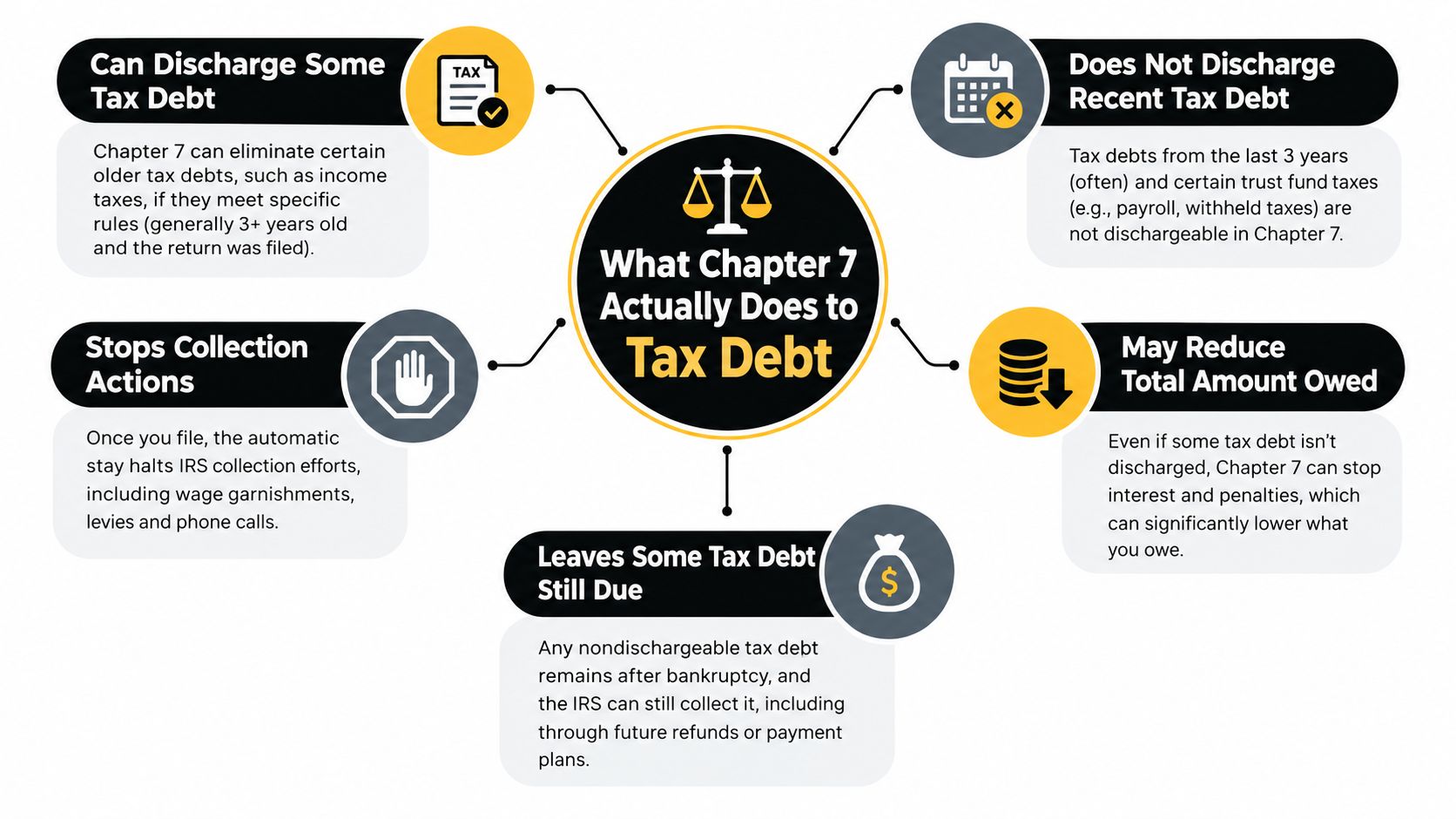
The key question isn't whether a bankruptcy case can pause collection. It can. The key question is what remains when the case ends, including liens, priority taxes, employment-related liabilities, and tax periods that fail one of the timing requirements.
The Three Timing Rules That Decide Dischargeability
For qualifying individual income-tax liabilities, dischargeability generally depends on three separate clocks. The taxpayer must satisfy all of them. Passing two clocks doesn't compensate for failing the third.
The first is the three-year rule. The underlying return must have been due, including a valid extension, at least three years before the bankruptcy filing. The relevant date isn't necessarily the ordinary filing date. An extension can affect when the return was due, so the calendar must reflect the actual due date recognized for that period.
The second is the two-year filing rule. The taxpayer must have filed the required return at least two years before filing bankruptcy. A late-filed return can create a problem even when the tax itself is more than three years old. Federal bankruptcy law generally preserves nondischargeability when that late return was filed within the two years before the petition, including a return filed under an extension.
The third is the 240-day assessment rule. The IRS assessment must generally have occurred at least 240 days before the bankruptcy filing. Certain events can suspend or extend the calculation, including a prior bankruptcy case or other collection-related circumstances. The assessment date therefore has to come from account records, not an estimate based on when a notice arrived.
A calendar example
Assume a taxpayer files Chapter 7 on March 1, 2026. A return was due April 15, 2023, but the taxpayer filed it on June 1, 2023. The due date is less than three years before the petition, so the period fails the three-year test even though the return was filed more than two years before filing. If the IRS assessed the tax in February 2024, the assessment would generally satisfy the 240-day requirement, but that doesn't repair the failed three-year test.
Another tax period may have an older due date but fail the two-year test because the return was filed recently. A third may satisfy both lookbacks but fail because the assessment occurred too close to the petition date. Each tax period requires its own calculation.
| Rule | Period measured | Key trigger date | Common tolling events |
|---|---|---|---|
| Three-year rule | Age of the tax return's due date | Due date, including a valid extension | Prior bankruptcy and statutory extensions |
| Two-year rule | Time since the return was filed | Actual filing date | Late filing, post-petition filing rules, and statutory exceptions |
| 240-day rule | Time since assessment | IRS assessment date | Prior bankruptcy, offers, litigation, and collection stays |
The IRS statute of limitations guidance can help explain why a tax account's age isn't the same as the age of every legal deadline. The governing framework also includes special rules and tolling provisions, so a professional should reconstruct the dates rather than rely on a rough calculation.
Tax Debts That Are Never Discharged in Chapter 7
Some tax liabilities remain nondischargeable because of what the taxpayer did, what the taxpayer failed to do, or the type of tax involved. A period that appears old enough can still survive if one disqualifying fact applies.
The clearest example is an unfiled return. If the taxpayer was required to file but never filed, the related tax generally isn't eligible for discharge. Filing a return after the IRS creates a substitute assessment may also require careful review. The question is whether the taxpayer filed the required return and whether the filing satisfies the applicable rules, not merely whether an account contains a number.
Conduct and tax type matter
A fraudulent return and a willful attempt to evade or defeat tax are excluded from discharge. Fraud doesn't require the taxpayer to use the word “fraud” in a notice for the issue to matter. The underlying conduct and the government's position must be reviewed closely.
Late filing presents another trap. A return filed late and within two years before the petition is generally nondischargeable under the federal rule. That makes the filing date as important as the tax year's age.
Employment-related liabilities create a separate problem. Trust-fund taxes can remain collectible from a responsible individual even when the business that withheld the money closes. An owner, officer, or other person with responsibility for collecting and paying withheld taxes may face personal exposure that doesn't disappear with an entity's financial failure.
Penalties also need their own analysis. A penalty may be dischargeable in some circumstances, but it can remain attached to a nondischargeable underlying tax or relate to an event within the relevant period. The trust fund recovery penalty guide explains why a business payroll problem can become an individual's liability.
| Category | Why it isn't discharged | Practical trigger |
|---|---|---|
| Unfiled return | The required return was never filed | Missing filing for the tax period |
| Late return within the statutory cutoff | The filing date falls too close to the petition | Return filed within two years before bankruptcy |
| Fraudulent return | Bankruptcy law excludes the fraudulent tax obligation | Fraudulent information or conduct |
| Willful evasion | Deliberate efforts to defeat or avoid the tax remain outside discharge | Conduct showing an attempt to evade collection |
| Trust-fund employment tax | Responsible-person liability can survive separately from the business | Withheld payroll taxes not paid over |
| Certain priority taxes and related liabilities | Priority treatment limits discharge | Tax type and timing place the claim in a protected category |
A single business can create several of these categories at once. Income taxes from a properly filed individual return may qualify, while payroll withholdings and a missing return from another period continue after the case.
Your Pre-Filing Tax Debt Checklist
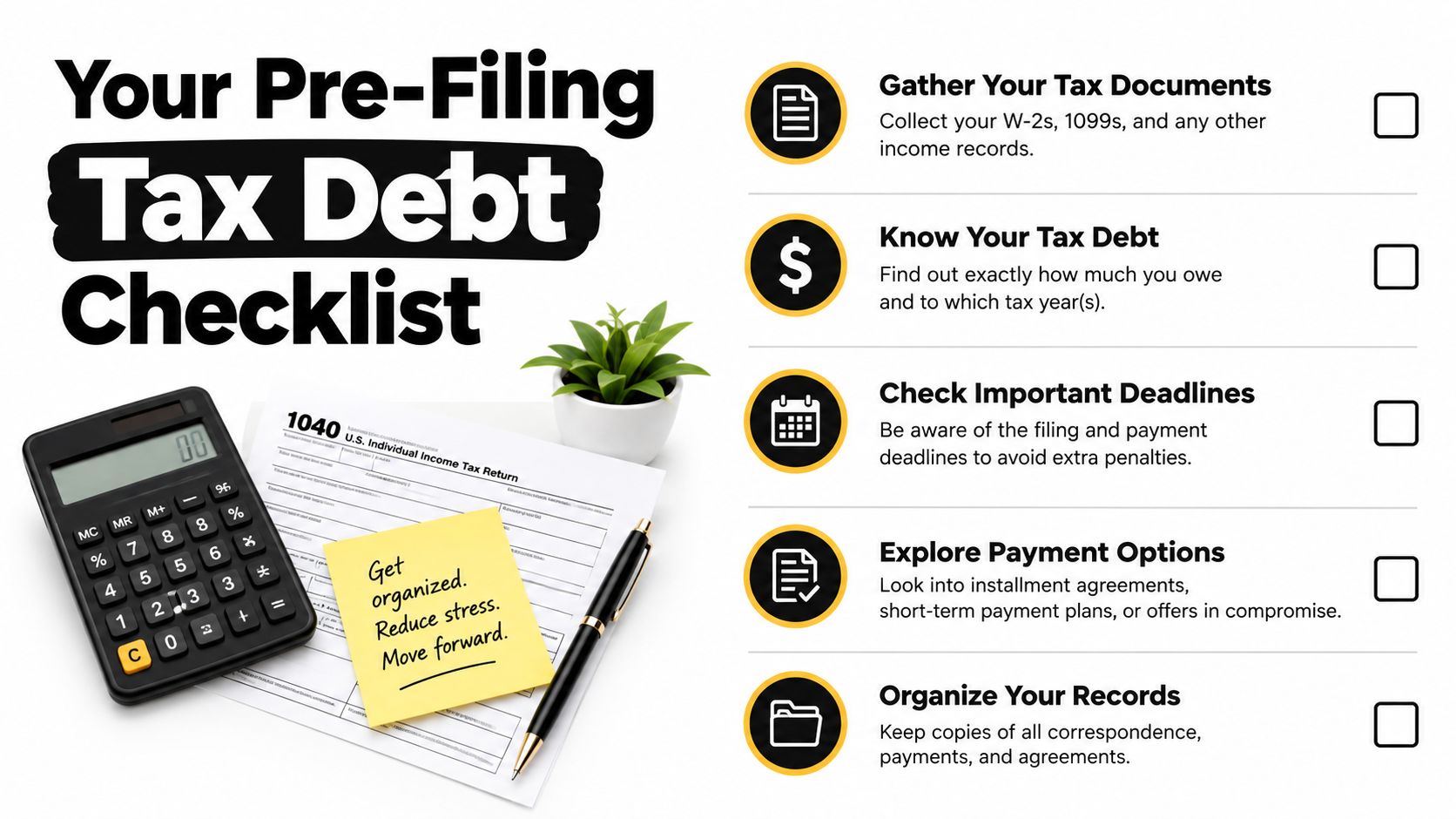
A sound Chapter 7 analysis starts with records, not the balance shown on the latest IRS notice. The IRS account can contain multiple tax periods, assessments, penalties, amended returns, and collection events. Before filing, separate those entries so the legal analysis matches the underlying facts.
Build the tax-period file
Start by obtaining IRS account and transcript records for every relevant period. Gather copies of the filed returns, proof of filing, extension documentation, notices of assessment, amended returns, and correspondence about audits or collection activity.
Then create a chronology for each tax year:
- Identify the tax type. Separate individual income tax from employment tax, penalties, and other liabilities.
- Confirm the due date. Include any valid extension that changed the filing deadline.
- Confirm the actual filing date. Don't substitute the date you prepared the return for the date the IRS received or accepted it.
- Record the assessment date. Use IRS account records and assessment notices where available.
- Check for tolling events. Review prior bankruptcy cases, offers in compromise, litigation, collection stays, and other events that may affect the clocks.
- Search for liens and levies. A discharge analysis must account for property claims and current collection activity.
A tax professional or bankruptcy attorney should also compare the taxpayer's records with the IRS transcripts. A return that the taxpayer believes was filed may not appear as filed in the account, and an assessment may have a different date from the notice that prompted the taxpayer to seek help.
Red flags that deserve another review
Pause before filing if a required return is missing, the IRS alleges fraud, an audit is open, a prior bankruptcy affected the same periods, or the account includes payroll withholdings. A recent offer in compromise or collection agreement may also affect the timing analysis.
Bring the chronology, transcripts, returns, notices, lien information, and business records to the initial consultation. The objective is to determine the status of each tax period before the petition makes an assumption that the IRS or a creditor can challenge.
How Self-Employed and Small Business Owners Are Treated Differently
A self-employed taxpayer often has more than one legal identity in the tax records. The person may report business income personally, operate through an LLC, own an S corporation, or control a corporation that owes taxes in its own name. Chapter 7 doesn't analyze those arrangements as one combined balance.
A sole proprietor commonly reports business income on an individual return. Qualifying individual income-tax liability may therefore be analyzed under the individual Chapter 7 rules. But the owner's payroll, sales, or trust-fund exposure can remain separate, and a valid lien may continue against property even if personal liability for a qualifying income tax is discharged.
A single-member LLC may also create personal income-tax reporting, while the entity's obligations and the owner's responsible-person exposure require separate review. The label “LLC” doesn't answer whether a tax belongs to the individual or the entity.
The responsible-person trap
An S corporation or corporation may owe employment taxes at the business level, but certain withheld payroll taxes can also lead to a responsible-person assessment against an individual. Closing the company doesn't automatically remove that personal claim. A Chapter 7 case for the owner and a liquidation or other proceeding involving the entity may address different liabilities.
Schedule C income also affects bankruptcy eligibility and the broader filing strategy. A person with continuing self-employment income may need to evaluate whether Chapter 7 is available and appropriate, rather than assuming that a large tax balance determines the chapter.
| Structure | Income-tax treatment | Payroll or trust-fund treatment | Lien risk after discharge |
|---|---|---|---|
| Sole proprietor | Individual income taxes may qualify if all rules are met | Personal exposure can remain for separate employment liabilities | A valid lien may continue against attached property |
| Single-member LLC | Reporting and liability depend on the tax classification and taxpayer | Owner exposure must be separated from entity obligations | Entity and individual property interests require review |
| S corporation owner | Personal income-tax items and company liabilities are analyzed separately | Responsible-person assessments may follow the individual | A lien can survive against property tied to the claim |
| Corporation owner | The entity doesn't receive an individual Chapter 7 discharge | Corporate payroll liabilities and personal assessments may differ | Corporate and personal liens need separate analysis |
For owners trying to understand payroll exposure, this discussion of small-business payroll taxes provides a useful starting point. The central question is not whether the business failed. It's which taxpayer owes which tax, and whether a separate personal assessment exists.
Where Chapter 7 Stops and Other IRS Debt Options Begin
Chapter 7 works best as part of a larger decision, not as a reflexive answer to an IRS balance. If older individual income taxes qualify, discharge may reduce the personal debt. If recent taxes, payroll liabilities, liens, or missing returns dominate the account, another remedy may be more useful.
Chapter 13 can provide a structured repayment framework for individuals who need time to address debts that Chapter 7 won't discharge. It may allow qualifying tax claims to be handled through a court-supervised plan while collection actions are addressed under the bankruptcy process. The suitability of Chapter 13 depends on income, assets, filing compliance, debt structure, and the taxpayer's ability to fund the plan.
An offer in compromise may be relevant when the taxpayer's realistic ability to pay is substantially below the balance, subject to IRS eligibility and financial review. An installment agreement can spread payments over time, while currently not collectible status may provide temporary collection relief when the taxpayer cannot pay without meeting basic living expenses.
Match the tool to the surviving debt
Innocent spouse relief may address a narrow situation where one spouse seeks relief from a tax liability connected to a joint return. Penalty abatement may also deserve review when the facts support reasonable cause or an applicable administrative program. Neither remedy automatically resolves every tax period.
The decision should account for three questions:
- What survives Chapter 7? Identify recent income tax, payroll exposure, liens, penalties, and unfiled returns.
- What pressure is immediate? Consider levies, garnishment, pending assessments, and property affected by liens.
- What dates are still moving? A filing date, assessment date, prior bankruptcy, or collection event may change the outcome.
For broader context about debt relief choices outside tax disputes, gambling debt relief in Wisconsin illustrates why the remedy must be matched to the type of debt and the person's financial circumstances. The same principle applies here. Chapter 7 may remove one category while leaving another untouched.
A combined strategy can be cleaner than filing first and investigating later. For one taxpayer, that may mean filing missing returns before choosing a chapter. For another, it may mean addressing a lien or payroll assessment separately while using bankruptcy for qualifying personal debt.
Putting It All Together and What to Do Next
The answer to can IRS tax debt be discharged in Chapter 7 depends on a tax-period analysis. In general, the liability must involve a qualifying tax, the required return must have been filed, no fraud or willful evasion can disqualify it, and the due-date, filing-date, and assessment-date rules must all be satisfied.
Extensions change the due-date calculation. Audits can change the assessment history. A prior bankruptcy can affect the timing clocks. A business owner may also have individual income-tax debt alongside payroll or trust-fund liabilities that follow a different path.
Start with these records this week
Order IRS transcripts for every relevant period and gather complete copies of the returns. Pull the financial disclosures and business records your attorney requests, including the information used to evaluate personal and business assets, income, expenses, and liabilities.
Then make three checks:
- Verify filing dates. Compare the IRS records with extensions, certified mailing records, electronic confirmations, and copies of the returns.
- Verify assessment dates. Determine whether each assessment is old enough under the applicable rule, while checking for events that may toll the calculation.
- Screen for protected categories. Flag unfiled periods, recent late-filed returns, priority taxes, payroll withholdings, alleged fraud, willful evasion, and recorded liens.
Don't combine the results into one average answer. One year may qualify while another doesn't. A discharge may remove personal liability but leave a lien against property. A sole proprietor's individual income tax may receive different treatment from a corporation's employment tax, even when both appear on the same collection notice.
Before paying a large amount, signing a settlement, or filing a bankruptcy petition, have a tax attorney or bankruptcy lawyer experienced with IRS matters review the chronology. The right strategy for one taxpayer can disqualify another taxpayer's potential discharge if the dates, filing history, or responsible-person exposure differ.
Tax Attorney Stephen A Weisberg offers a free tax debt analysis to review IRS records, filing history, assessments, liens, and available resolution paths before you commit to a strategy. Visit Tax Attorney Stephen A Weisberg to request a review focused on whether Chapter 7 addresses your specific tax periods and what obligations may remain.


