Can irs garnish your wages? can irs garnish your wages - A Practical Guide
can irs garnish your wages? Discover your options, how the process works, and steps to protect your income.

In this article
- The IRS Levy: A Powerful Collection Tool
- Key Differences You Need to Know
- IRS Levy vs Standard Wage Garnishment At a Glance
- How Much Can the IRS Take from Your Paycheck?
- The Warning Signs Before a Wage Levy Begins
- The Sequence of IRS Collection Notices
- The Final Notice of Intent to Levy
- How the IRS Calculates What They Can Take
- Understanding Your Exempt Amount
- The Role of IRS Publication 1494
- A Real-World Calculation Example
- Unique Risks for Business Owners and Freelancers
- Beyond the Paycheck Levy
- The Trust Fund Recovery Penalty
- Proven Ways to Stop an IRS Wage Levy
- Set Up an IRS Installment Agreement
- Negotiate an Offer in Compromise
- Qualify for Currently Not Collectible Status
- Request a Levy Release
- Why a Tax Attorney Can Be Your Strongest Ally
- Beyond Paperwork: A Strategic Negotiator
- The Value of Peace of Mind
- Common Questions About IRS Wage Levies
- Can I Quit My Job to Stop an IRS Levy?
- Does an IRS Wage Levy Expire on Its Own?
So, you have an unpaid tax bill and you're worried about your paycheck. Let's get straight to the point: can the IRS take money directly from your wages?
Yes, they absolutely can. But the way they do it is what really matters. The IRS doesn't use the typical wage garnishment process you might be familiar with. Instead, they have a much more direct and powerful tool at their disposal called a wage levy. Understanding this difference is critical to protecting your income.
The IRS Levy: A Powerful Collection Tool
When most people think of "wage garnishment," they picture a credit card company or a medical provider having to sue you first. That process involves going to court, winning a judgment from a judge, and only then getting a court order to take a piece of your paycheck. It can be a long, drawn-out affair.
An IRS levy is a completely different animal. Think of it this way: a normal creditor has to ask a judge for the key to your bank account. The IRS already has a master key. They don't need to sue you or get a court's permission to act. This is an administrative power, which means the process is internal to the IRS, making it faster and often more aggressive than a standard garnishment.
Key Differences You Need to Know
This isn't just a matter of semantics; the distinction between a levy and a garnishment has very real consequences for how quickly your money can be taken and how much you're left with.
Let's break it down side-by-side to see just how different these two collection methods are.
IRS Levy vs Standard Wage Garnishment At a Glance
The table below highlights the critical differences between how the IRS collects a tax debt versus how a private creditor collects theirs.
| Feature | IRS Wage Levy | Standard Creditor Garnishment |
|---|---|---|
| Court Order Required? | No, it's an administrative action. | Yes, requires a court judgment. |
| Legal Process | The IRS follows its own internal procedures. | Involves filing a lawsuit and winning. |
| Speed of Action | Can happen quickly after final notices. | Can take months or even years of legal battles. |
| Amount Taken | Determined by IRS formulas, often higher. | Limited by federal and state consumer protection laws. |
As you can see, the IRS operates on a much faster track with far fewer obstacles, which is why responding to their notices is so important.
How Much Can the IRS Take from Your Paycheck?
Regular creditors are usually held back by consumer protection laws, which often cap garnishments at 25% of your disposable income. The IRS doesn't play by those same rules.
Instead, the IRS calculates an "exempt" amount—the portion of your income they’ve determined you need for basic living expenses. This calculation is based on your tax filing status and the number of dependents you claim. They can levy everything above that exempt amount.
This process kicks off after the IRS sends a Final Notice of Intent to Levy, which is your last official warning. From the date on that letter, you typically have a 30-day window to make arrangements before they contact your employer.
To see how this works in practice, you can learn more about how much the IRS can garnish from your income. For a deeper dive into the IRS's broad authority, it's also worth asking, Can IRS Garnish Wages?
The Warning Signs Before a Wage Levy Begins
An IRS wage levy is a terrifying prospect, but here’s a crucial piece of good news: it never comes out of the blue. The IRS is legally required to send a series of warnings, giving you multiple chances to address the tax debt before they ever touch your paycheck. Think of it less as a sudden ambush and more like a series of increasingly loud alarm bells designed to get your attention.
Knowing this timeline is empowering. It demystifies the process, replacing fear with a clear understanding of where you are and how much time you have to act. Once you learn to recognize these official notices, you can regain control long before your wages are on the line.
The whole thing starts with a simple tax bill and only escalates to a final, legally binding notice if you don't take action.
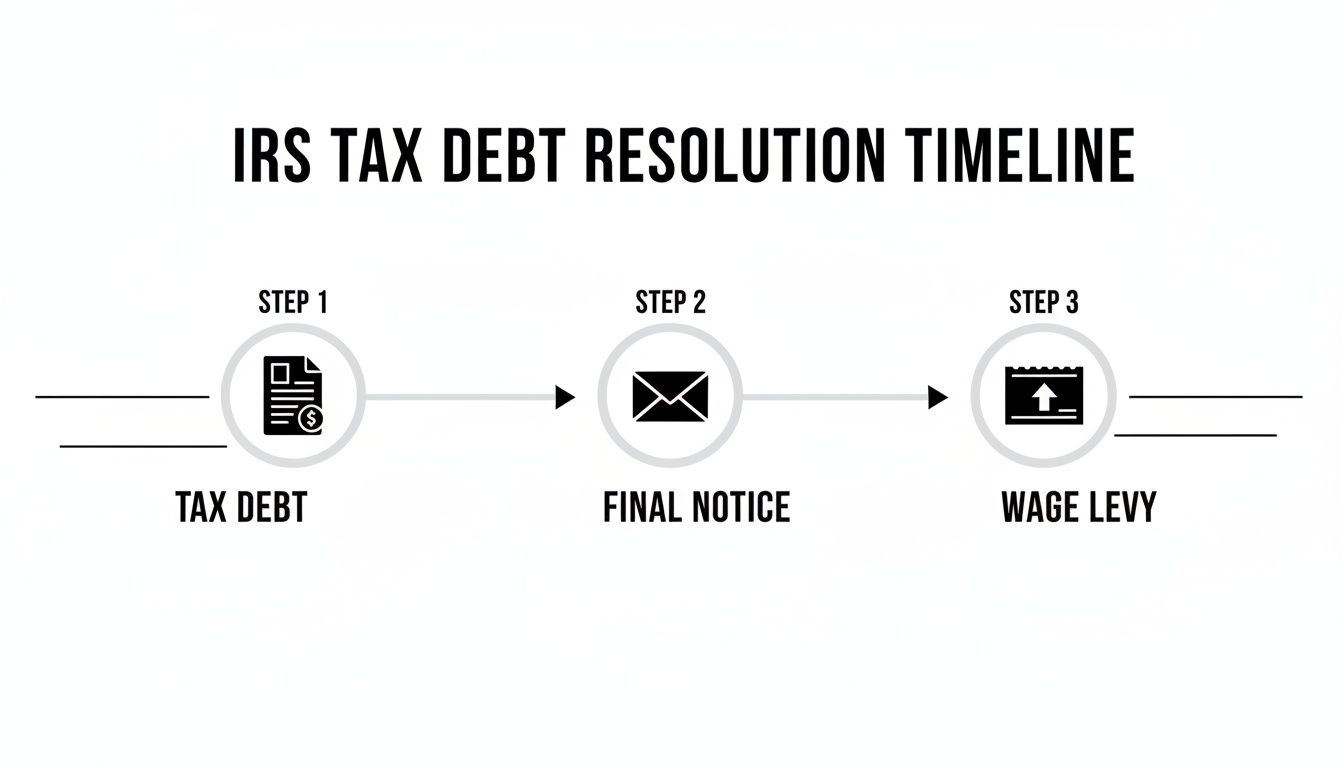
The Sequence of IRS Collection Notices
The road from an initial tax bill to a wage levy is paved with a predictable paper trail of letters sent by certified mail. Each notice serves a specific purpose, and ignoring them is the fastest way to let the situation spiral out of your control.
The first letter you’ll probably see is the CP14, Notice of Tax Due and Demand for Payment. This is the opening shot—the initial bill. It lays out what you owe, for what year, and gives you a deadline. The tone is formal but not yet aggressive; it's a straightforward "you owe this much" notice.
If the CP14 goes unanswered, the IRS follows up with a series of reminders. These often include the CP501, CP503, and then the CP504. Each one turns up the heat, with increasingly urgent language. But even these reminders don't yet give the IRS the power to take your wages.
The CP504 Notice of Intent to Levy feels like a final warning, but it's really the penultimate step. It threatens seizure of assets if you don’t pay, but it doesn't trigger your right to a formal appeal just yet.
Understanding what each notice means is critical. For example, getting ahead of the process means knowing how to handle the notice that comes before the final one. You can learn more by decoding the IRS CP504 notice, a key step in preventing the levy.
The Final Notice of Intent to Levy
This is the one that really counts. The most critical document in the entire process is the Letter 1058 or LT11, officially titled "Final Notice of Intent to Levy and Notice of Your Right to a Hearing." This is the last and most serious warning you will get. Period.
When this letter lands in your mailbox, it’s a game-changer. It means the IRS has done its part with preliminary notices and is now legally gearing up to seize your property, including your wages. What makes this notice different from all the others is that it officially starts the clock on your legal rights.
Specifically, it gives you 30 days from the date on the letter to do one of three things:
- Pay the debt in full.
- Get a payment plan or other resolution in place.
- File an appeal by requesting a Collection Due Process (CDP) hearing.
Requesting a CDP hearing is a powerful move. It slams the brakes on all collection activity, including the pending wage levy, while your case is reviewed by the IRS Independent Office of Appeals. This buys you—and your tax attorney—invaluable time to negotiate a real solution without the immediate threat of a financial hit.
As you can see from the timeline, inaction is the engine that drives this process forward. Every step is a direct result of not resolving the problem at the stage before.
How the IRS Calculates What They Can Take
 When you get a notice about a potential wage levy, the biggest fear is often the unknown. How much will they actually leave you with? Is it even possible to pay your rent, cover groceries, and keep the lights on? That uncertainty can be more stressful than the tax debt itself.
The good news is, the IRS doesn’t just pull a number out of a hat. There's a specific, predictable formula they have to follow. This means you can figure out exactly how a levy will hit your paycheck before it even happens.
It’s a common misconception that the IRS is limited to the same rules as private creditors, who are often capped at taking 25% of your disposable income. The reality is, the IRS can take far more. Their calculation isn't based on a simple percentage but on what’s left over after they account for a legally protected "exempt amount."
Understanding Your Exempt Amount
At the heart of every IRS wage levy calculation is the exempt amount. You can think of this as a financial shield—a portion of your income that the law protects to ensure you have a baseline amount to cover essential living expenses. The IRS is only allowed to touch the money that falls outside of this shield.
This exempt amount isn't a one-size-fits-all number. It’s personalized based on two key pieces of information:
- Your Tax Filing Status: Whether you file as single, married filing jointly, head of household, and so on.
- The Number of Dependents: How many qualifying dependents you claim on your tax return.
The more dependents you have, the larger your exempt amount becomes, which in turn means the IRS can take less from each paycheck. Your employer will use the information from your W-4 to help figure this out, but the final calculation is laid out in an official IRS document.
The Role of IRS Publication 1494
The exact dollar figures for these exemptions are found in IRS Publication 1494, also known as the "Tables for Figuring Amount Exempt from Levy on Wages, Salary, and Other Income." When your employer receives a wage levy notice, they are legally required to use these tables.
The tables cross-reference your pay period (weekly, bi-weekly, monthly) with your filing status and number of exemptions to find the precise dollar amount that must be left in your paycheck. Anything and everything above that number gets sent straight to the IRS.
For example, a taxpayer with four dependents might have $2,883 exempt from their monthly pay, while others in higher brackets could see $4,100 protected. This shows just how much more the IRS can take compared to the standard 25% cap for private creditors—a stark reminder of their powerful collection authority.
This system is designed to be purely mechanical. It removes all guesswork for both you and your employer.
A Real-World Calculation Example
Let's make this real. Imagine a single taxpayer named Alex who gets paid weekly and has no dependents.
- Weekly Paycheck: Alex earns $1,200 per week before taxes.
- Exempt Amount: According to the weekly table in Publication 1494 for a single person claiming one exemption (for themselves), the exempt amount might be $265.38.
- Amount Levied: The IRS would take the difference: $1,200 - $265.38 = $934.62.
In this scenario, Alex would take home only $265.38 of their $1,200 paycheck. The remaining $934.62 would go directly to the IRS. This would happen with every single paycheck until the tax debt is fully paid, the levy is officially released, or the collection statute expires.
Now, think about Maria, a married taxpayer with two children who is paid bi-weekly. Her family's larger size means her exempt amount would be significantly higher, offering much more protection for her income. You can explore a detailed breakdown of these calculations to get a look at the inside of the IRS wage levy formula. Having this knowledge is powerful—it gives you a concrete understanding of exactly what’s at stake.
Unique Risks for Business Owners and Freelancers

If you're a standard W-2 employee, an IRS wage levy feels like a punch to the gut. But if you’re a business owner or a freelancer, it’s a potential knockout blow. The way you earn and manage money is fundamentally different, and that exposes you to a far more dangerous set of IRS collection tactics.
When you’re self-employed, the IRS doesn't just see a single paycheck to target. They see a whole network of financial relationships: your clients, your bank accounts, your payment processors like Stripe or PayPal. This gives them multiple angles to attack, and a single levy can freeze your entire operation overnight.
Beyond the Paycheck Levy
A traditional wage levy, where the IRS tells an employer to withhold money, doesn't really apply to you. Instead, the IRS gets creative and aims for the heart of your business—your income sources and your operating capital.
This means they can intercept money before it ever hits your account. The IRS can send a levy directly to your clients, legally requiring them to send any money they owe you straight to the government. We call this an accounts receivable levy, and it’s devastating.
Imagine you're a freelance consultant who just finished a $5,000 project. Your client gets a notice from the IRS and is now legally required to send that payment to the government instead of you. Not only have you lost that income, but your professional relationship is now on incredibly shaky ground. This tactic can sever your cash flow right at the source.
A levy on a business bank account is one of the most destructive tools the IRS has. It freezes your funds instantly, meaning you can't make payroll, pay suppliers, or cover basic operating expenses. The bank is required to hold the funds for 21 days before sending them to the IRS, but during that time, your business is effectively frozen.
This is a world apart from a standard wage levy. An employee loses a chunk of their income, but a business owner loses access to all of their working capital, grinding the entire operation to a halt. You can dig deeper into how the IRS goes after non-traditional income by reading our insights on how the IRS deals with freelancers.
The Trust Fund Recovery Penalty
For business owners with employees, there's another level of risk that is frankly terrifying: payroll taxes. The money you withhold from employee paychecks for things like Social Security and Medicare are called “trust fund” taxes. You’re essentially holding that money in trust for the government.
Failing to hand over these taxes is one of the biggest mistakes a business owner can make. In response, the IRS can hit you with the Trust Fund Recovery Penalty (TFRP).
This penalty is so severe because it allows the IRS to completely bypass your business's legal structure. The TFRP can be assessed personally against anyone the IRS deems "responsible" for collecting and paying the taxes. This list can include:
- Business owners and partners
- Corporate officers and directors
- Even bookkeepers or controllers with signature authority
This means your LLC or S-Corp status won't protect you. The IRS can come directly after your personal assets—your savings account, your home, your car—to pay the business’s payroll tax debt. It’s a direct and immediate threat to your personal financial world.
Proven Ways to Stop an IRS Wage Levy
Feeling the threat of an IRS wage levy is enough to make anyone's stomach drop. It can feel like you’re trapped, with no way to protect the money you work so hard for. But here’s the good news: even if you’ve received that dreaded Final Notice of Intent to Levy, you still have options. The key is to stop reacting and start acting.
Instead of waiting for your paycheck to shrink, you can get ahead of the problem by communicating with the IRS. Believe it or not, they’d much rather work out a solution with you than go through the hassle of seizing your wages. Let’s walk through the most common and effective ways to get a levy stopped in its tracks.
Set Up an IRS Installment Agreement
One of the most straightforward ways to stop a wage levy is to get on a formal payment plan, known as an Installment Agreement (IA). Think of it as a peace treaty with the IRS. You agree to make consistent monthly payments you can afford, and in return, they agree to call off aggressive collection actions like a levy.
This is a fantastic option if you can't pay everything you owe right now but have a steady enough income to chip away at the debt over time.
- Guaranteed Installment Agreements: If you owe less than $10,000, you're pretty much guaranteed approval as long as you meet a few basic requirements.
- Streamlined Installment Agreements: For tax debts under $50,000, the process is much simpler and often doesn't require you to submit piles of financial paperwork.
- Partial Payment Installment Agreements: What if you can't pay off the full debt before the 10-year collection statute expires? The IRS might agree to let you pay a smaller monthly amount until the clock runs out.
The moment your Installment Agreement is officially approved, the IRS is required to release any active wage levy.
Negotiate an Offer in Compromise
An Offer in Compromise (OIC) is a game-changer for people in serious financial trouble. It’s an agreement that lets you settle your tax debt for less—sometimes much less—than the full amount you owe. This isn't just about asking for a discount; it's a formal program designed for those facing true hardship.
An OIC comes down to one core concept: your "reasonable collection potential." The IRS takes a hard look at your assets and future income and determines the most they could realistically hope to collect. If that number is less than what you owe, they may agree to settle for it.
The OIC path is intense. It requires a complete and honest look at your finances. But for those whose situations make full payment impossible, it can be a genuine fresh start. Crucially, while your OIC application is under review, the IRS has to pause any levy actions.
Qualify for Currently Not Collectible Status
What happens when you can't even afford a small monthly payment? If you're dealing with a major life event like unemployment, a serious illness, or a personal crisis, you might qualify for Currently Not Collectible (CNC) status.
Getting your account marked as CNC is like hitting the pause button on all IRS collections. The IRS essentially acknowledges that you don't have the ability to pay right now. They’ll stop calling, sending letters, and—most importantly—they’ll stop any wage levies or bank seizures.
To qualify, you’ll have to prove that your basic living expenses eat up all of your income. The IRS will check in on your financial situation every year or two to see if things have improved. While penalties and interest don't stop, CNC provides immediate relief when you need it most. Navigating financial distress often involves multiple avenues, and understanding how bankruptcy and wage garnishment interact can be an important part of a complete strategy.
Request a Levy Release
If a levy is already siphoning money from your paycheck, your first priority is to get it released. A levy release doesn't make the debt disappear, but it immediately stops your employer from sending your wages to the IRS. The fastest way to get one is by proving the levy is causing an "economic hardship."
This isn't just an inconvenience; it means you can't cover basic, reasonable living expenses for your family. You need to call the IRS right away, lay out your situation, and be ready to provide financial details.
The IRS will typically release a levy if you:
- Immediately set up an Installment Agreement.
- Prove that the levy is causing a severe and immediate economic hardship.
- Show that the asset being levied is worth far more than the tax debt.
- Can prove the levy was a mistake in the first place.
Getting that levy released gives you the critical breathing room you need to work out a more permanent solution, like one of the options above.
Why a Tax Attorney Can Be Your Strongest Ally
Let's be honest: facing an IRS wage levy is terrifying. The official notices are dense and intimidating, the rules feel impossible to understand, and one wrong move can make things much worse. It's a situation that can make anyone feel cornered and completely out of their depth. But you don't have to go through it alone.
Hiring a tax attorney is like bringing in a seasoned strategist who knows the IRS playbook inside and out. This isn't just about having someone make phone calls for you. It's about having a dedicated advocate who can level the playing field, immediately taking over all communication and stopping the harassing letters and calls.
Your attorney's job is to cut through the bureaucratic jargon and map out a clear path forward. A true expert understands the intricate details of the tax code and can pinpoint the best resolution for you—whether that’s an Installment Agreement, an Offer in Compromise, or getting you placed in Currently Not Collectible status.
Beyond Paperwork: A Strategic Negotiator
A good tax attorney does far more than just fill out paperwork. Their real value comes from negotiating from a position of strength, armed with a deep understanding of IRS procedures. They know what revenue officers need to see to grant relief and how to frame your financial situation to get the most favorable outcome. This experience is absolutely critical when you need to prove economic hardship or negotiate the fine print of a payment plan.
An attorney’s involvement completely changes the dynamic. It's no longer you against a massive government agency. Instead, it becomes a professional negotiation between two sides who speak the same legal language. This shift is often the key to protecting your rights and securing a better result.
This legal expertise is non-negotiable in more complicated cases, especially those involving business assets or the dreaded Trust Fund Recovery Penalty. While a CPA is great for preparing taxes, only a qualified attorney can provide legal representation and fight for you before the IRS.
The Value of Peace of Mind
Ultimately, the biggest benefit is getting your life back. The relief that comes from knowing an expert is handling every detail, shielding you from direct IRS contact, and fighting for the best possible outcome is immeasurable. It's about regaining control.
Many people hesitate because they worry about the cost. But a skilled tax attorney often saves clients far more than their fee by negotiating reduced tax debts, stopping costly enforcement actions, and getting a devastating wage levy released quickly. If you're considering getting help, it's worth understanding how to find a good tax attorney and what to look for. The right professional doesn't just offer legal advice; they provide a clear way out of the crisis.
Common Questions About IRS Wage Levies
When you're facing an IRS wage levy, a flood of questions and worries is completely normal. Getting straight answers is the first step toward regaining control. Let's tackle some of the most urgent questions we hear from people in this exact situation.
Can I Quit My Job to Stop an IRS Levy?
Quitting your job might seem like a quick way out, but it’s a strategy that backfires almost immediately. While it will stop the money from coming out of that specific paycheck, the levy itself doesn't just disappear.
The IRS levy remains active on your account. As soon as you start a new job, federal new-hire reporting systems will flag your name, and the IRS will simply send the levy notice to your new employer. It’s a temporary pause at best, one that only delays the inevitable while creating more instability for you.
Does an IRS Wage Levy Expire on Its Own?
Unfortunately, no. An IRS wage levy is not a one-time event; it's a continuous action that attaches to every single paycheck you receive. It will keep taking your money until one of three things happens:
- You pay the tax debt in full.
- The IRS officially agrees to release the levy because you've made other arrangements.
- The statute of limitations for collecting the debt runs out, which is typically 10 years from the date the tax was assessed.
Waiting it out is not a viable strategy. You have to take direct action to get the levy removed.
A quick but important distinction: people often confuse a tax lien with a tax levy. Think of it like this: a lien is a public claim, while a levy is the actual seizure. A lien is the IRS staking its claim on your property to secure the debt. A levy is the IRS actively taking that property—in this case, your wages—to satisfy the debt.
The IRS almost always files a lien first, putting the world on notice before they take the more aggressive step of levying your income.
Facing an IRS levy is overwhelming, but you don't have to navigate it alone. Attorney Stephen A Weisberg has years of experience helping taxpayers resolve complex debt issues. Before you make any decisions, start with a FREE Tax Debt Analysis to understand your options and find the best path forward.


