Understand can irs debt be discharged in chapter 13: Get relief today
Discover can irs debt be discharged in chapter 13 and learn eligibility, limits, and steps to a fresh start with IRS tax debt relief.

In this article
- How Chapter 13 Bankruptcy Deals With IRS Debt
- The Three Buckets of Tax Debt
- Tax Debt Treatment in Chapter 13 Bankruptcy at a Glance
- The Three Critical Tests for Discharging Income Tax Debt
- The 3-Year Rule: How Old is the Tax Return?
- The 240-Day Rule: When Did the IRS Officially Bill You?
- The 2-Year Rule: When Did You Actually File the Return?
- When Your IRS Debt Is Not Dischargeable
- The Problem with Payroll Taxes
- Tax Debts from Fraud or Evasion
- The Challenge for Business Owners
- How Federal Tax Liens Complicate Your Bankruptcy Case
- The Lien Can Survive Bankruptcy
- How Liens Are Handled in a Chapter 13 Plan
- Chapter 13 vs. Chapter 7: Which Is the Right Tool for Your Tax Debt?
- Why Chapter 13 Is a Powerful Reorganization Tool
- Chapter 7 vs. Chapter 13 for Handling IRS Tax Debt
- Navigating the Chapter 13 Process with the IRS
- Building a Plan the Court Will Approve
- The Importance of Consistency and Compliance
- Common Questions About Chapter 13 and Tax Debt
- Can I File Chapter 13 If I Haven't Filed My Tax Returns?
- What Happens to My Tax Refund During a Chapter 13 Case?
- Will Chapter 13 Stop an IRS Wage Garnishment?
- Can State Tax Debts Also Be Handled in Chapter 13?
When you're staring down a mountain of IRS debt, it's easy to feel trapped. But there's a well-established path forward for many people. The big question is, can you actually wipe out IRS debt in a Chapter 13 bankruptcy? The short answer is a resounding yes, but it’s not automatic. It all comes down to the specific age and type of your tax debt.
Think of it like having a set of keys. Only the right ones, fitting the very specific locks of federal tax and bankruptcy law, will open the door to relief.
How Chapter 13 Bankruptcy Deals With IRS Debt
Filing for Chapter 13 means you propose a structured plan to repay your debts over a three to five-year period. The IRS gets in line with your other creditors, but how much they get paid—and whether the debt can be eliminated—hinges on how the bankruptcy court classifies your tax liabilities. This classification is the single most important factor determining your financial future.
Instead of facing one giant, intimidating bill from the government, the court breaks your tax debt down into manageable categories. Understanding these "buckets" is the first step to seeing the light at the end of the tunnel.
The Three Buckets of Tax Debt
Your tax liabilities will be sorted into one of three distinct categories, and each comes with its own set of rules for repayment and, most importantly, discharge.
- Priority Debt: This is the IRS’s first claim. It includes recent income tax debts that are simply too new to be discharged, along with trust fund taxes like payroll taxes. You are required to pay these priority debts in full through your Chapter 13 plan. No exceptions.
- Secured Debt: This category comes into play if the IRS has already filed a Notice of Federal Tax Lien against your property (like your home or car). That lien acts like a mortgage, giving the IRS a direct claim on your assets. Your plan must account for paying the value of the property the lien is attached to.
- General Unsecured Debt: This is the category everyone hopes for. It's made up of older income tax debts that meet a very strict set of timing rules. These debts are lumped in with your other general unsecured creditors, like credit cards and medical bills. Often, you only pay a small fraction of what you owe, and the rest is completely wiped out when you finish your plan.
Here's a simple way to look at it: Priority debt is a critical utility bill you can't skip. Secured debt is the mortgage you must pay to keep your house. But general unsecured debt? That’s like an old store credit card that can be completely forgiven.
Let's say you're a freelancer who fell behind on taxes during a rough year. Can Chapter 13 offer a fresh start? Absolutely, but only if you meet the rigid timelines set by law. For an income tax debt to become a dischargeable general unsecured debt, a few things must be true:
- The tax return was originally due more than three years before you file for bankruptcy.
- The IRS officially assessed the tax at least 240 days before your filing date.
- You actually filed the tax return more than two years before filing for bankruptcy.
These rules were tightened by the Bankruptcy Abuse Prevention and Consumer Protection Act (BAPCPA) back in 2005. You can always dig into the IRS's official guidance on bankruptcy to see their detailed perspective on how these rules apply.
Tax Debt Treatment in Chapter 13 Bankruptcy at a Glance
To make this a bit clearer, here’s a quick summary table. It shows how the different types of IRS debt are handled in a Chapter 13 plan and whether they can ultimately be discharged.
| Type of Tax Debt | Chapter 13 Treatment | Potential for Discharge? |
|---|---|---|
| Priority Income Taxes (Recent) | Must be paid in full through the plan | No |
| Secured Taxes (IRS Lien Filed) | Paid up to the value of your property | No, but the underlying liability might be |
| General Unsecured Taxes (Older) | Paid a percentage alongside other unsecured debts | Yes, often dischargeable after plan completion |
As you can see, the potential for relief is real, but success lies in the details. Getting the classification right is everything when it comes to finding freedom from old tax debt.
The Three Critical Tests for Discharging Income Tax Debt
When it comes to getting rid of old income tax debt in Chapter 13, you have to play by a very strict set of rules. Think of it like trying to open a high-security vault—you need to turn three different keys in the right order. If even one of these timing tests fails, that tax debt stays on the books as a "priority debt," and you'll have to pay it back in full through your plan.
Let's walk through each of these rules. Getting a handle on them is the first step to figuring out if Chapter 13 can really solve your IRS problems.
The 3-Year Rule: How Old is the Tax Return?
First up is the 3-Year Rule. This one is all about when the tax return was originally due. For a tax debt to even be considered for discharge, the return it belongs to must have been due at least three years before you file for bankruptcy. This includes any extensions you might have gotten.
This rule exists for a simple reason: to stop people from running up a huge tax bill one year and immediately wiping it out in bankruptcy the next.
So, if you file for bankruptcy on May 1, 2025, the tax debt from your 2021 return (due April 15, 2022) would clear this hurdle. But the debt from your 2022 return (due April 15, 2023) is still too new. It would be considered a priority debt.
This decision tree gives you a great visual of how the IRS sorts these debts.
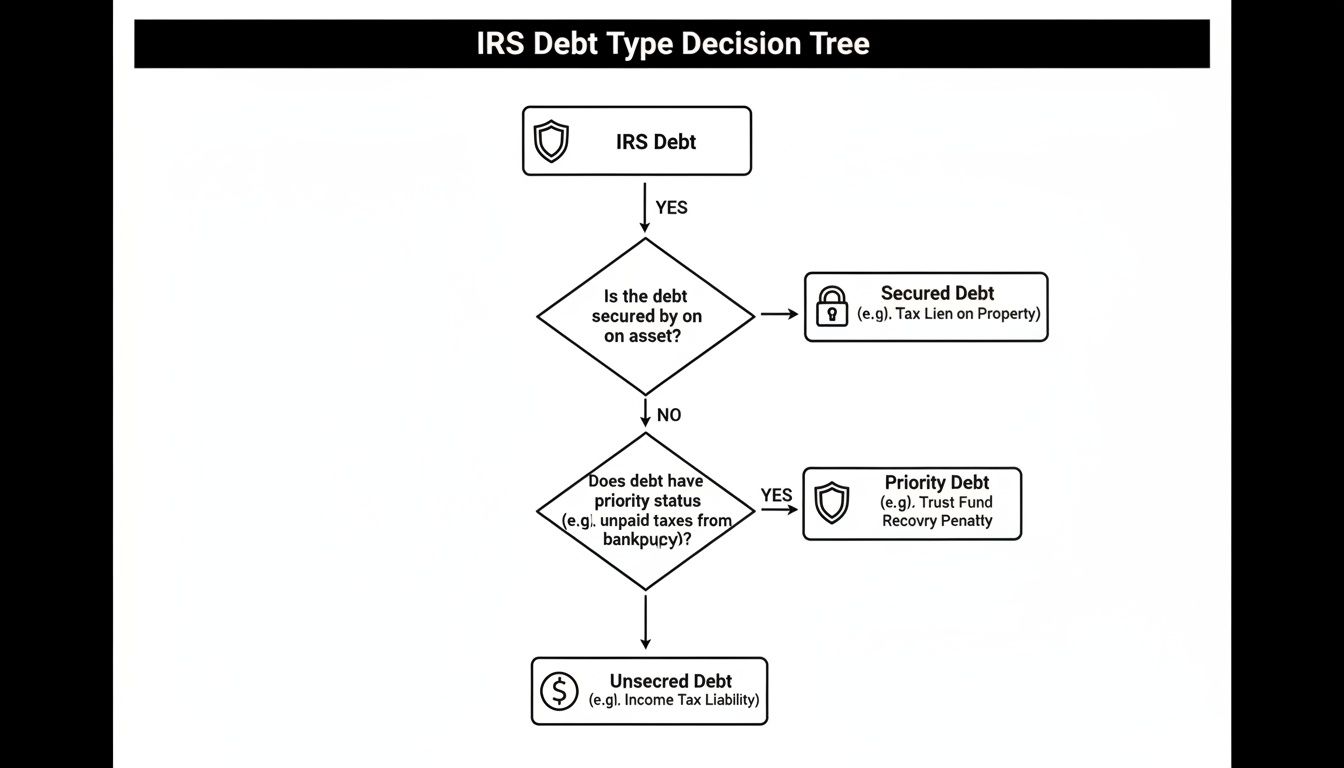
As you can see, a tax debt has to pass several checkpoints before it can land in the "general unsecured" bucket, which is the only category that allows for a discharge.
The 240-Day Rule: When Did the IRS Officially Bill You?
Next, we have the 240-Day Rule. This test hinges on when the IRS officially recorded what you owe, a date known as the "assessment date." The tax must have been assessed by the IRS at least 240 days before your bankruptcy petition is filed.
What does "assessed" mean? For most people who file on time without any issues, the assessment happens shortly after the return is processed. But this is where things can get tricky. That 240-day clock can be paused by certain events, like an audit, an Offer in Compromise, or even a previous bankruptcy filing. These "tolling events" can add months or even years to the countdown, which is why having a firm grasp of the IRS statute of limitations is absolutely essential.
The 2-Year Rule: When Did You Actually File the Return?
Finally, there’s the 2-Year Rule. This one is simple but catches a lot of people with unfiled returns. You must have physically filed the tax return for the specific debt at least two years before you file for bankruptcy.
This rule is all about preventing a last-ditch effort to get tax relief. You can't just file five years' worth of back taxes on Monday and then walk into bankruptcy court on Tuesday expecting a fresh start. The law requires a two-year waiting period to show you’re making a good-faith effort to get compliant.
The Bottom Line: All three of these rules must be met. No exceptions. A tax debt from a return that was due four years ago (passing the 3-year rule) won't be dischargeable if you only filed it last year (failing the 2-year rule).
Here's how this plays out in a real-world scenario:
- The Situation: A freelance graphic designer has a large tax bill from their 2020 tax year and plans to file for Chapter 13 on November 1, 2025.
- Running the Numbers:
- 3-Year Rule: The 2020 tax return was due April 15, 2021. The bankruptcy filing date is well past the three-year mark. Check.
- 240-Day Rule: She filed on time, and the IRS assessed the tax on May 20, 2021. This is far more than 240 days before the bankruptcy. Check.
- 2-Year Rule: Since she filed the return back in 2021, she easily satisfies the two-year filing lookback period. Check.
Because she passed all three tests, her 2020 income tax debt can be treated as general unsecured debt. In her Chapter 13 plan, she'll likely pay just pennies on the dollar for that debt, and the rest will be discharged when she completes the plan. This is a perfect example of how the question, "can IRS debt be discharged in Chapter 13," is answered with a "yes" when all the timelines are met correctly.
When Your IRS Debt Is Not Dischargeable
While Chapter 13 bankruptcy can be a lifesaver for old income tax debt, it isn't a magic wand for every IRS problem you might have. Some federal tax obligations are completely off the table for a discharge. You will have to pay these back in full, and understanding what they are is the first step in building a Chapter 13 plan that actually works.
Think of it this way: Congress has decided that certain tax debts are too critical to public funding to simply be wiped away. In the world of bankruptcy, these are called priority debts. Your Chapter 13 repayment plan absolutely must account for paying these priority taxes back in full over its three-to-five-year lifespan. Trying to sidestep them is one of the quickest routes to getting your case thrown out of court.
The Problem with Payroll Taxes
If you're a small business owner, the most common and dangerous non-dischargeable tax is what’s known as "trust fund" taxes. This is almost always the payroll tax—the Social Security and Medicare you withhold from your employees' paychecks. Legally, that money was never yours. You were simply holding it "in trust" for the government.
Because of that special status, these debts are pretty much bulletproof in bankruptcy. It doesn't matter how old they are. If your business fell behind on payroll tax deposits, Chapter 13 is going to force you to pay back every single cent.
It gets worse. The IRS has a powerful tool called the Trust Fund Recovery Penalty (TFRP), which allows them to hold business owners, officers, or key employees personally liable for the unpaid portion. This means the IRS can come after your personal bank accounts, house, and other assets to collect, even if the business is long gone. That personal TFRP assessment is also non-dischargeable.
Tax Debts from Fraud or Evasion
It probably comes as no surprise that bankruptcy won't help you if your tax problems stem from illegal activity. Any tax debt connected to a fraudulent return or a willful attempt to evade paying taxes is completely non-dischargeable. The court simply won't reward that kind of behavior.
So, what does "willful evasion" actually mean? It’s not just about not having the money to pay. It’s about a deliberate, conscious choice to duck your tax duties.
- Example of Willful Evasion: Imagine a contractor who intentionally underreports income for years, transfers assets into a relative's name to conceal them from the IRS, and deals exclusively in cash to avoid leaving a paper trail. That pattern of behavior screams intent, and the tax debt that results from it would not be dischargeable.
The burden of proof is on the IRS to show you acted willfully. An honest mistake or simple negligence usually isn't enough to prevent a discharge, but a long history of non-compliance can certainly be used as evidence of intent.
A Chapter 13 plan must be built on a foundation of reality. Acknowledging non-dischargeable debts like payroll taxes or debts from fraud isn't a failure; it's the first step toward creating a plan that actually works and leads to long-term financial stability.
The Challenge for Business Owners
For entrepreneurs stuck with payroll tax issues or a TFRP assessment, Chapter 13 is a much tougher road. The numbers paint a stark picture. Data on Chapter 13 outcomes for unsecured creditors (which can include the IRS for some debts) shows a huge disparity. One report revealed that while 26% of cases paid these creditors over 70% of what was owed, a staggering 55% of cases only managed to pay back 1-39%. You can dig deeper into these figures by reviewing reports on consumer bankruptcy filings. This really underscores the tightrope walk required to craft a plan that can satisfy the absolute priority of non-dischargeable taxes while still being affordable.
How Federal Tax Liens Complicate Your Bankruptcy Case
When the IRS files a Notice of Federal Tax Lien, it completely changes the game. This single document elevates the IRS from just another creditor you owe to a secured creditor with a powerful legal claim on your property. It's a critical distinction that dramatically affects how—and if—you can get rid of IRS debt in Chapter 13.
Think of it like a mortgage. Before the mortgage, the bank is an unsecured lender. After it’s recorded, the bank has a direct stake in your home. An IRS lien works the same way, but it's far broader. It doesn't just attach to your house; it can latch onto nearly everything you own.
This includes your car, your business assets, your personal property, and even assets you get after the lien is filed. Your tax debt is no longer just a figure on a statement; it's now physically anchored to your property.

The Lien Can Survive Bankruptcy
Here’s one of the biggest and most dangerous myths about bankruptcy and tax debt: many people assume that if their tax debt is dischargeable, the lien just vanishes with it. That’s not how it works. Even if the underlying income tax debt meets all the rules for discharge, the lien itself can survive the bankruptcy.
This is what lawyers call an in rem liability. It means the claim is attached to the property (the "thing") itself, not just to you as a person.
So, what does that look like in the real world?
- Your Personal Liability Is Gone: Chapter 13 can wipe out your personal obligation to pay the old tax debt. After a successful case, the IRS can't come after your wages or your bank account for that specific liability anymore.
- The Lien on Your Property Remains: The lien, however, stays put. If you go to sell your house five years later, the IRS is still first in line to get paid from the sale proceeds.
You get a fresh start personally, but your property doesn't. While the IRS might not foreclose on your home after bankruptcy, that lien sits there quietly, waiting to collect its due anytime you try to sell or refinance.
A bankruptcy discharge may sever your personal connection to the debt, but it doesn't automatically break the chain the IRS has attached to your assets. That lien can remain long after your case is closed.
How Liens Are Handled in a Chapter 13 Plan
Since a tax lien makes the IRS a secured creditor, your Chapter 13 plan has to treat them like one. This means your repayment plan must account for the value of the lien. Specifically, you have to pay the IRS an amount equal to your non-exempt equity in the assets the lien is attached to.
Let's say you own a car worth $10,000 with no loan on it, and the IRS has filed a lien. Your Chapter 13 plan must be structured to pay the IRS that full $10,000 over the three to five years of your plan. This is what's required to "satisfy" their secured claim and protect your property.
Any tax debt you owe above that secured amount can be treated as general unsecured debt, which might be discharged at the end of your case. But that secured portion has to be paid, which can make your Chapter 13 payment much higher and harder to manage.
Dealing with a lien requires a smart, forward-thinking strategy. It’s essential to explore all your options, including understanding how to remove a tax lien through various methods, to find a complete and lasting financial solution.
Chapter 13 vs. Chapter 7: Which Is the Right Tool for Your Tax Debt?
When you’re staring down a mountain of IRS debt, choosing the right type of bankruptcy isn't just a detail—it's the whole ballgame. The two paths available to most people, Chapter 7 and Chapter 13, treat tax debt in completely different ways. The best choice for you hinges entirely on the kind of tax debt you have, how old it is, and what assets you need to protect.
Think of Chapter 7 as a surgical strike. It’s a liquidation bankruptcy designed to wipe the slate clean, and it can be incredibly fast. If your tax problems are mostly older income taxes that meet the very specific timing rules for discharge, Chapter 7 can eliminate them completely in just a few months.
But that’s where its usefulness ends. Chapter 7 offers zero help for what the law calls non-dischargeable tax debts—things like very recent income taxes or payroll taxes. It also can’t make a federal tax lien that the IRS has already placed on your property just disappear. If your tax troubles include these issues, Chapter 7 will leave you exposed.
Why Chapter 13 Is a Powerful Reorganization Tool
Chapter 13, on the other hand, is a reorganization. It gives you a powerful framework to get control over all your tax debts through a structured three- to five-year repayment plan. This is where Chapter 13 really shines, offering breathing room and a clear path forward that Chapter 7 simply can't match for more complex tax situations.
Under a Chapter 13 plan, you can force the IRS to accept manageable monthly payments for priority taxes—the ones you absolutely have to pay. At the same time, you can lump older, dischargeable income taxes in with your other general unsecured debts. Often, you’ll end up paying just pennies on the dollar for those older taxes before the remaining balance is wiped out. To see exactly how this works, you can find a complete breakdown in our guide that details whether bankruptcy clears tax debt.
This unique ability to tackle different types of tax debt simultaneously makes Chapter 13 the go-to solution for anyone juggling a mix of dischargeable and non-dischargeable liabilities.
The Bottom Line: Chapter 7 is like a quick demolition—it’s fast and effective for old, qualified debts but leaves anything non-qualifying standing. Chapter 13 is a complete financial renovation—it addresses every single debt under one comprehensive blueprint, rebuilding your finances over time.
Chapter 7 vs. Chapter 13 for Handling IRS Tax Debt
To really see the strategic differences, it helps to put them side-by-side. This table shows why understanding the specifics of your tax liability is so critical when deciding which chapter to file.
| Feature | Chapter 7 (Liquidation) | Chapter 13 (Reorganization) |
|---|---|---|
| Dischargeable Income Tax | Discharged completely in a few months. | Discharged after completing a 3-5 year plan. |
| Priority Tax Debt | Remains fully due and collectible after bankruptcy. | Paid back in full, without interest and penalties, through the plan. |
| Federal Tax Liens | The lien survives bankruptcy and stays attached to your property. | Your plan pays the value of the lien over time, protecting your assets. |
| Unfiled Tax Returns | Can be a complete roadblock to filing. | The plan provides a way to get your returns filed and become compliant. |
| Best For | People with mainly old, dischargeable income tax and few assets. | People with a mix of tax debts, valuable assets, or non-dischargeable liabilities. |
Looking at this, the right path becomes much clearer.
Let's imagine you owe $50,000 in income tax from six years ago, and it checks all the boxes for discharge. In that scenario, Chapter 7 is a fantastic tool. It could get rid of that entire debt, quickly and for good.
But what if you owe that same $50,000, plus $20,000 in priority taxes from last year, and the IRS has already slapped a lien on your house? Suddenly, Chapter 7 is a terrible choice. Chapter 13 becomes the far better strategy, allowing you to protect your home by paying the lien's value over time, paying off the priority taxes in manageable chunks, and still discharging the old income tax debt at the end of your plan.
Navigating the Chapter 13 Process with the IRS

Knowing the rules for discharging IRS debt is just the first step. The real test is actually making it through the entire three-to-five-year Chapter 13 process. A successful outcome hinges on a precise strategy from day one, transforming legal theory into a practical, court-approved repayment plan that you can actually live with. This is where so many people stumble, often leading to their case being dismissed and landing them right back where they started with the IRS.
The journey begins with meticulous preparation, long before you file anything with the court. You need to gather all the essential documents, starting with your IRS account transcripts. These transcripts aren't just tax returns; they're the IRS's official record of your entire tax history. They show when you filed, when taxes were assessed, and any payments you've made—all critical dates for applying the discharge rules correctly.
Building a Plan the Court Will Approve
With your financial records in order, the next big hurdle is drafting the Chapter 13 plan itself. This document is far more than a simple household budget. It's a formal proposal you make to the court and all your creditors, including the IRS. It must carefully and correctly categorize your tax debts—separating them into priority, secured, and general unsecured claims—and propose a monthly payment that the trustee finds feasible.
One of the most common reasons cases get thrown out is an unrealistic plan. If your proposed payments don't cover your priority and secured IRS debts in full, or if the court simply doesn't believe your budget is sustainable, your plan will be rejected. This is why having a crystal-clear financial snapshot is so critical. Our guide on the https://www.weisberg.tax/articles/form-433-f-guide-resolving-irs-collection-case-yc4z6-kw2re-h8azc can give you an idea of the level of financial detail the government expects.
The Importance of Consistency and Compliance
Think of your Chapter 13 case as a marathon, not a sprint. To get that final discharge at the finish line, you have to stay current on every single plan payment for the entire term. You also have a continuing responsibility to file all future tax returns on time and pay any new taxes that come due. If you fall behind on these post-filing obligations, you risk jeopardizing the entire case.
During this long process, you may need a professional to speak to the IRS for you. This requires a properly executed IRS Power of Attorney (Form 2848). This form authorizes your attorney to communicate directly with the IRS on your behalf, which is invaluable for resolving any issues that pop up during your case.
A successful Chapter 13 plan is a living document, built on accurate data and a realistic budget. The goal isn't just to get the plan confirmed by the court, but to create a payment structure you can actually maintain for up to five years.
The stakes are incredibly high, and trying again after a failed case can be even harder. In 2023, a staggering 35% of people filing for Chapter 13 had already filed a previous petition within the last eight years. This history can seriously complicate their ability to get relief, especially from older tax debts that might have otherwise qualified for discharge. The timing rules can mean a recent bankruptcy filing completely blocks them from wiping out IRS income taxes a second time.
Common Questions About Chapter 13 and Tax Debt
When you're staring down a mountain of IRS debt, the idea of bankruptcy brings up a lot of questions. It's a complex world where tax law and bankruptcy law intersect, so it's natural to have concerns. Let's walk through some of the most frequent questions people ask.
Can I File Chapter 13 If I Haven't Filed My Tax Returns?
That's a hard no. Before you can even think about getting relief through Chapter 13, you have to get current on your tax filings.
The court requires that you file all legally required federal tax returns for the four years leading up to your bankruptcy filing. Without those returns, neither the court nor the IRS can figure out what you actually owe. It’s a foundational step, and skipping it will get your case thrown out almost every time.
What Happens to My Tax Refund During a Chapter 13 Case?
Don't plan on seeing that money. During your Chapter 13 plan, any tax refunds you get are considered assets of the bankruptcy estate.
This means the trustee will require you to hand over your federal and state tax refunds each year. Those funds go directly into your plan to pay back creditors, including the IRS. In very rare situations, you might be able to ask the court for permission to keep a portion for a true emergency, but you should never count on it.
Will Chapter 13 Stop an IRS Wage Garnishment?
Yes, and it stops it cold. The second your Chapter 13 case is officially filed, a legal protection called the automatic stay kicks in.
This is a powerful court order that immediately freezes almost all collection actions against you. That means the wage garnishments, bank levies, and property seizures stop. It gives you the breathing room you desperately need while your attorney gets your repayment plan sorted out and approved by the court.
The automatic stay is one of the most powerful tools in bankruptcy. It forces the IRS to pause its aggressive collection machine and play by the court's rules.
Can State Tax Debts Also Be Handled in Chapter 13?
Absolutely, in many cases. The rules for discharging state income taxes in Chapter 13 mirror the rules for federal income taxes.
They still have to pass the same timing tests—the 3-year, 240-day, and 2-year rules—to be considered old enough to be treated as general unsecured debt. Just be aware that this generally applies to income tax. Other state obligations, like sales tax or employment taxes, are a different animal and are almost never dischargeable.
Are you facing overwhelming tax debt and unsure where to turn? At Attorney Stephen A Weisberg, we begin with a free, no-obligation Tax Debt Analysis to determine exactly how we can help before you ever pay a fee. Contact us today to find your path to financial relief.


