can i pay installments on my taxes: Your quick guide
can i pay installments on my taxes: Learn IRS payment plan basics, eligibility, and steps to reduce your tax bill.
In this article
- Understanding Your Tax Payment Options
- Key Features of an Installment Agreement
- IRS Installment Agreement at a Glance
- Qualifying for an IRS Payment Plan
- The Must-Haves to Qualify
- A Common Pitfall in Action
- What If You Owe More Than $50,000?
- How to Apply for Your Payment Plan Online
- What to Gather Before You Start
- Navigating the OPA Tool
- Understanding The True Cost Of An Installment Plan
- Breaking Down The Costs You Will Face
- Comparing IRS Installment Agreement Setup Fees
- The Ongoing Costs: Interest and Penalties
- A Real-World Cost Example
- The #1 Reason People Default on Their Plans
- Practical Tips for Keeping Your Agreement Secure
- What to Do If Your Financial Situation Changes
- Got Questions? We’ve Got Answers About IRS Payment Plans
- What if I Owe More Than $50,000?
- Can I Pay My Monthly Installments with a Credit Card?
- What Happens if the IRS Rejects My Application?
- Will an IRS Payment Plan Tank My Credit Score?
Yes, you can absolutely pay your taxes in installments. Staring down a large tax bill is a stressful experience, but the good news is you don't have to pay it all at once. The IRS has a formal solution called an Installment Agreement, which lets you make manageable monthly payments over time.
Understanding Your Tax Payment Options

When the amount you owe feels impossible to cover in one go, it's a huge relief to know there are other paths forward. The IRS offers these payment plans precisely for taxpayers who can't pay their debt in a single lump sum.
Getting on a plan is more than just a convenience—it's a protective measure. As long as you stick to the terms, an installment agreement can prevent the IRS from taking more aggressive collection actions, like garnishing your wages or levying your bank account.
And you're not alone if you need one. The IRS sets up around 3 million installment agreements each year, so this is a very common tool for Americans. For many people, qualifying for a streamlined plan is straightforward, especially if you owe less than $50,000 in combined tax, penalties, and interest. These plans can often stretch out for up to 72 months (that's six years), giving you a realistic timeframe to get back on solid ground.
Key Features of an Installment Agreement
Before you jump in, it’s helpful to understand the basic structure of a payment plan. This helps set the right expectations from the start.
While the specifics can change based on your situation, most agreements share a few core components. These plans are a central piece of the tax relief options available, many of which were expanded to help taxpayers catch up. If you're dealing with a significant tax burden, you might find our guide on the https://www.weisberg.tax/articles/irs-fresh-start-program-8xhcg-52jra-mlrzh particularly useful.
To make it easy to see what a standard plan looks like, I've put together a quick summary table.
IRS Installment Agreement at a Glance
This table breaks down the core components of a standard IRS installment agreement, giving you a quick reference for the most important details.
| Feature | Details |
|---|---|
| Eligibility Limit | Typically for debt under $50,000 (tax, penalties, and interest combined). |
| Repayment Period | Can extend up to 72 months (6 years), depending on your specific situation. |
| Associated Fees | A setup fee applies, which varies by application method and income level. |
| Ongoing Costs | Interest and penalties continue to accrue on your unpaid balance until it's paid in full. |
Think of this as the blueprint for most agreements. The key takeaway is that while an installment plan stops more severe collection actions, the clock on interest and penalties keeps ticking until the debt is fully paid.
Qualifying for an IRS Payment Plan
So, you owe the IRS and want to set up a payment plan. It sounds straightforward, and for many people, it is. But the IRS has a few boxes you need to check before they'll give you the thumbs-up. Knowing these requirements ahead of time can save you from a rejected application and a lot of headaches.
The easiest and most common option is the streamlined installment agreement, which you can apply for online. The main requirement here is the amount you owe—your total combined tax, penalties, and interest must be under $50,000. If your tax debt is higher, a payment plan is still on the table, but it's a different process that requires a much closer look at your finances.
The Must-Haves to Qualify
Think of it like this: before the IRS agrees to a payment plan, they need to see you're playing by the rules. It's a matter of compliance.
First and foremost, you must have filed all your required tax returns. This is the biggest showstopper I see in my practice. The IRS won't even consider a payment plan if you have unfiled returns from past years hanging out there. It's non-negotiable.
You also can't be in an active bankruptcy case. If you've filed for bankruptcy, that legal process takes priority, and you'll have to work through that system first.
Expert Insight: The most common reason for a payment plan rejection is unfiled returns. The IRS can't set up a payment arrangement for one tax year if they don't have the full picture of what you might owe for all the others. Get current first, then apply.
A Common Pitfall in Action
Let's look at a real-world example. I once worked with a freelance graphic designer who owed $15,000 from a great year. She was well under the $50,000 threshold, so she went online to set up a plan. She was immediately rejected.
Why? It turned out she had completely forgotten to file a tax return from two years prior, a year where she only had a small amount of income from a short-term contract. Even though she likely didn't owe anything for that year, the unfiled return made her non-compliant in the eyes of the IRS.
Before we could get her $15,000 debt on a payment plan, we had to go back and file that old return. Once it was processed, her application for the installment agreement was approved without a hitch.
This all comes down to the IRS wanting to ensure they can collect what's owed. Studies from organizations like the OECD show that well-managed payment plans can result in recovery rates of over 80%, a massive improvement over the near 40% default rate when taxpayers have no structured plan. It’s a win-win.
What If You Owe More Than $50,000?
If your tax bill tops that $50,000 mark, don't panic. You can still get an installment agreement, but the path is a bit more demanding.
The IRS will want to verify your ability to pay, which means you'll almost certainly need to submit a Collection Information Statement. This is a detailed financial form where you lay out your income, assets, and living expenses. For an in-depth look at what this entails, you can read our complete guide on the IRS Form 433-F. This statement gives the IRS the information it needs to determine a monthly payment amount that you can actually afford.
How to Apply for Your Payment Plan Online
Once you've figured out you qualify, it’s time to actually apply. The good news is that the IRS has made this much easier than it used to be. Their Online Payment Agreement (OPA) tool is, without a doubt, the fastest way to get it done. In many cases, you can get an approval on the spot.
The whole process is designed to be pretty intuitive, but a little prep work goes a long way. Before you even open your web browser, take a few minutes to gather the necessary documents. It’s like getting all your ingredients ready before you start cooking—it just makes everything go smoother.
What to Gather Before You Start
To get through the online application in one go, you'll need a few key pieces of information handy. Trust me, you don't want the system to time out while you're digging through a file cabinet for an old tax bill.
Here’s a quick checklist of what to have on your desk:
- Your Personal Details: This is the easy stuff—full name, current mailing address, email, and your Social Security Number (SSN) or Individual Taxpayer Identification Number (ITIN).
- A Copy of Your Tax Bill: Grab the most recent notice the IRS sent you, like a CP14. You’ll need the exact amount you owe.
- Your Latest Tax Return: The online system will ask for details from your most recently filed Form 1040 to confirm it’s really you.
- Bank Account Info: If you want to set up automatic payments (which I strongly suggest, as it can lower your setup fee), you’ll need your bank's routing and account numbers.
Taking five minutes to collect this upfront will save you a major headache.
Navigating the OPA Tool
You can find the Online Payment Agreement tool right on the IRS website. The first thing you'll do is go through an identity verification process to make sure your financial information stays secure.
This is what the starting page of the application looks like on the IRS site.
This screen is your entry point, and it gives you a clear roadmap of what you'll need and what to expect.
After you're logged in and verified, the system will show you the payment options available for your situation. It's a far cry from the old days of endless paperwork. This more modern approach, heavily influenced by financial technology trends, allows for things like automatic deductions and reminders, making the experience much less painful for taxpayers. The evolution of digital payments has been a game-changer, a topic McKinsey & Company explores in depth.
Pro Tip: When it comes to proposing a monthly payment, be realistic. It’s tempting to offer a tiny amount, but the IRS system has a minimum payment it will accept, usually calculated by dividing your total debt by 72 months. If you propose a payment at or above that minimum, your odds of getting instantly approved are much, much higher.
Once you submit your proposed terms, you'll usually get an immediate decision. If you're approved, the system will lay out all the details: your setup fee, monthly payment amount, and the first due date. Make sure to print or save a digital copy of this confirmation for your records.
If you’re having trouble figuring out what you can realistically afford each month, take a look at our guide on how to use an IRS payment plan calculator. It can help you find that sweet spot between what you can pay and what the IRS will accept.
Understanding The True Cost Of An Installment Plan
An IRS installment plan can feel like a lifeline when you're facing a large tax bill, but it's crucial to go into it with your eyes wide open. This isn't a free service. Think of it as a loan from the IRS—the convenience of making smaller monthly payments comes with its own set of costs that will add to the total amount you eventually pay back.
The journey from application to final payment involves a few key stages, and staying on top of your agreement is just as important as setting it up correctly.
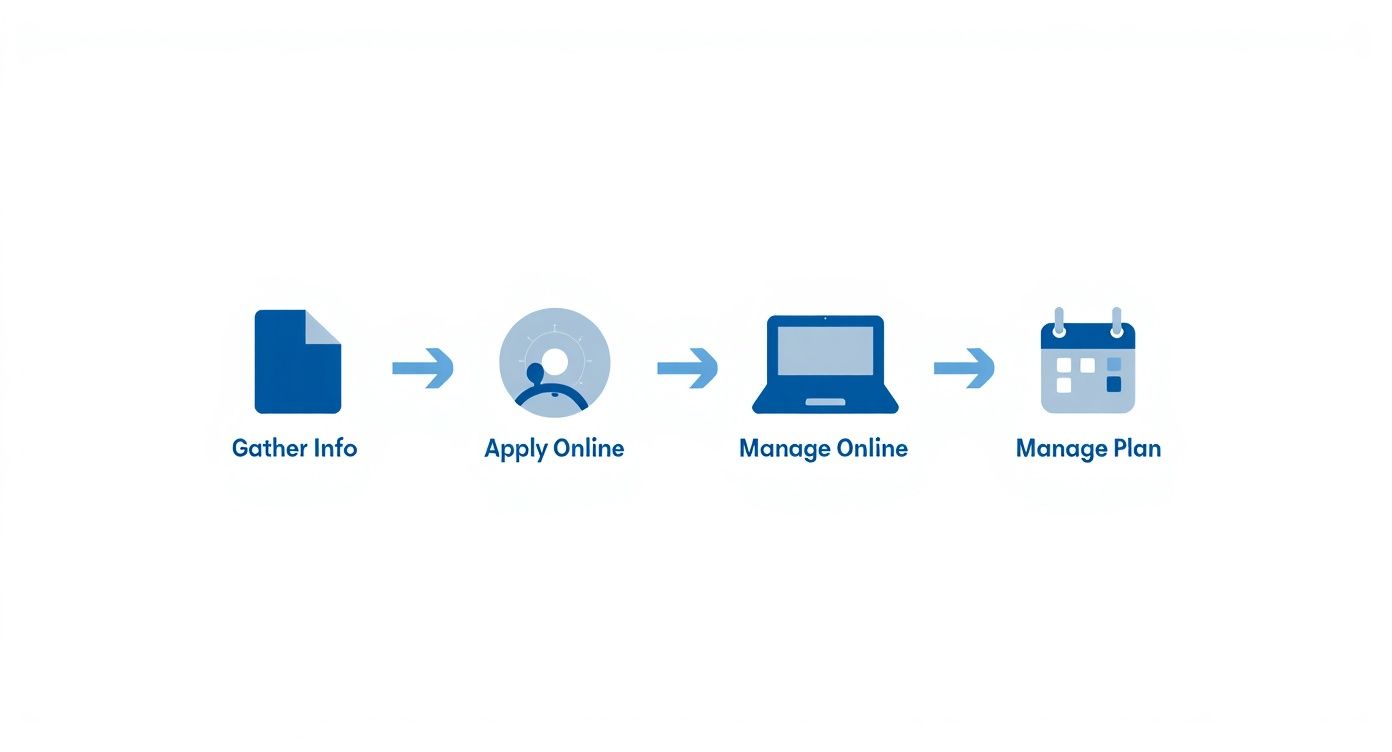
As you can see, getting the plan in place is just the first step. Managing it successfully is what gets you to the finish line.
Breaking Down The Costs You Will Face
When you enter into an IRS payment plan, you're looking at three main costs: a one-time setup fee, ongoing interest, and penalties.
The setup fee is the most straightforward cost and it changes based on how you apply and how you decide to make your monthly payments. The IRS really wants you to apply online and use direct debit, so they've priced the fees to encourage that.
Here's a quick look at the different setup fees you might encounter when establishing a long-term plan.
Comparing IRS Installment Agreement Setup Fees
| Application Method | Payment Method | Standard Fee | Low-Income Fee |
|---|---|---|---|
| Online Application | Direct Debit | $31 | $31 (may be waived) |
| Online Application | Other | $130 | $43 |
| Mail, Phone, In-Person | Any | $225 | $43 |
As the table shows, applying online and setting up automatic payments from your bank account is by far the cheapest option. Low-income taxpayers can get a significant discount or even have the fee waived, but choosing direct debit is still the best way to keep those initial costs as low as possible.
The Ongoing Costs: Interest and Penalties
Beyond that initial fee, your balance will continue to grow due to interest and penalties. The failure-to-pay penalty is typically 0.5% of your unpaid taxes each month. The good news? As soon as your installment agreement is officially active, the IRS cuts that penalty rate in half to 0.25%.
Interest, however, is a different story. The rate is set quarterly and it compounds daily on your entire outstanding balance—that includes the original tax, any penalties, and the interest that has already been added.
Key Takeaway: An installment agreement is a huge help because it reduces the failure-to-pay penalty by 50%, but it does not stop interest from piling up. Your total debt will keep climbing, just at a slower pace, until you've paid every last cent.
A Real-World Cost Example
Let's put this into perspective. Say you owe the IRS $10,000. You do the smart thing and apply online, setting up direct debit for your payments. You’ll pay the $31 setup fee upfront.
With the agreement active, your monthly failure-to-pay penalty immediately drops from $50 to $25 (0.25% of $10,000). But remember, interest is still being calculated and added to your balance every single day.
To get a clearer picture of how these charges add up over the life of your plan, you'll need more than just simple math. Our detailed guide on the https://www.weisberg.tax/articles/irs-installment-agreement-calculator-swdaf-r43ds-6cfg7 can help you run the numbers and estimate your total payoff amount.
While an IRS plan is a great, structured way to handle tax debt, it isn't always the cheapest option. For some people, the combined cost of interest and penalties might make other solutions more attractive. It’s always a good idea to explore personal loan options for tax payments to see if you could get a lower interest rate. The goal is to find the path that resolves your debt in the most affordable and effective way for your situation.
You’ve done the hard work and secured an IRS installment agreement. That’s a huge win, but the work isn’t quite over yet. Now, the focus shifts to managing your plan successfully so you can finally put this tax debt behind you for good. This means being diligent and proactive, not just reactive.
The golden rule is straightforward but absolutely critical: make every single payment on time. There's no wiggle room here. A single late payment can jeopardize the entire agreement you worked so hard to get. While the IRS gives you a few ways to pay, the most foolproof method is a Direct Debit Installment Agreement (DDIA). It's an automatic withdrawal from your bank account each month, which basically eliminates the chance of human error or a simple “I forgot.”
The #1 Reason People Default on Their Plans
Beyond just making that monthly payment, there's another requirement that trips up more people than anything else I've seen in my career. To keep your agreement active, you must file and pay all your future taxes on time and in full.
This is, without a doubt, the most common reason these agreements fall apart. Someone gets so fixated on paying down the old debt that they neglect their current tax obligations. Once you fall behind on a new tax year, the IRS can—and often will—terminate your existing plan. Suddenly, you're back at square one, but now the debt is bigger and the collection notices are more aggressive.
Here’s how it plays out: Let's say you're on a payment plan for a $12,000 tax bill from a couple of years back. You're making your monthly payments like clockwork. But then April comes, and you discover you owe another $2,000 for the current year that you can't pay. The IRS will likely tear up your $12,000 agreement, leaving you with a $14,000 total debt and the full force of their collection machine starting up again.
Practical Tips for Keeping Your Agreement Secure
Staying organized is your best weapon in this fight. You have to start treating your tax obligations with the same priority as your rent or mortgage.
Here are a few things you can do right now to protect your agreement:
- Make Your Calendar Your Ally: Set up recurring reminders for everything. Put your monthly installment payment due date in your calendar. If you're self-employed, add reminders for your quarterly estimated tax payments, too.
- Automate, Automate, Automate: If you didn't opt for direct debit when you first applied, it’s not too late. You can still set it up. Automation builds consistency and removes the temptation to "borrow" from your tax payment for other expenses.
- Check Your Paycheck Withholding: Are you a W-2 employee? Use the official IRS Tax Withholding Estimator to do a quick checkup. Making sure enough is being taken out of each paycheck is the best way to avoid a nasty surprise—and a new tax bill—next spring.
What to Do If Your Financial Situation Changes
Life is unpredictable. If you suddenly lose your job, face a medical emergency, or encounter some other financial crisis that makes your payment impossible, don't just go silent. Ignoring the IRS is the worst thing you can do.
The moment you know you can't make a payment, get on the phone with them. It is often possible to change the terms of your agreement. They might be willing to lower your monthly payment for a while or even grant you a temporary pause until you can get back on your feet. When it comes to the IRS, proactive communication is always, always better than silence.
Got Questions? We’ve Got Answers About IRS Payment Plans
When you’re staring down a tax bill, it’s natural for a bunch of “what if” questions to pop into your head. Even when you have the basics down, the specifics can be tricky. Let’s clear up some of the most common questions people have when setting up an IRS payment plan.
What if I Owe More Than $50,000?
If your total tax debt—and that includes penalties and interest—crosses the $50,000 threshold, the rules of the game change a bit. You can't just hop online and use the streamlined Online Payment Agreement tool.
An installment agreement is still definitely on the table, but the IRS is going to want a closer look at your financial picture. This means you'll need to submit Form 9465, Installment Agreement Request. Along with that, expect to fill out Form 433-F, Collection Information Statement. Think of this as a financial snapshot for the IRS, detailing your income, assets, and living expenses so they can figure out a payment you can truly afford.
Can I Pay My Monthly Installments with a Credit Card?
Yes, you absolutely can use a credit or debit card, or even a digital wallet, to make your monthly payments. But there's a catch. The IRS doesn't handle these transactions themselves; they pass you off to a few approved third-party payment processors.
What does that mean for you? It means you're going to pay a processing fee on top of your payment. These fees are completely separate from the interest and penalties the IRS is charging. For debit cards, it's usually a small flat fee. For credit cards, you’re looking at a percentage of your payment, often around 2%. That might not sound like much, but it can really add up over the life of your agreement.
A Quick Word of Advice: Pulling out the plastic is convenient, but those processing fees can make it a surprisingly expensive way to pay off your tax debt. Do a little math and compare the fee percentage to the interest rate on your IRS balance to see which is actually costing you more.
What Happens if the IRS Rejects My Application?
Getting a rejection notice in the mail is a gut punch, for sure. But don't panic—it's not the end of the line. The very first thing you need to do is read that letter carefully. The IRS will spell out exactly why they turned you down.
From my experience, rejections usually boil down to a few common issues:
- You haven't filed all your tax returns. The IRS won't even consider a payment plan if you have unfiled returns from past years.
- Your application was incomplete. Maybe you missed a box or left out some key information.
- The payment you offered was too low. Your proposed monthly payment might not meet the minimum the IRS calculates you can afford.
The notice will also detail your right to appeal, a process you typically have to start within 30 days. Honestly, your best move is to fix the root problem first. Get those old returns filed, track down the missing info, and then you can either appeal or simply re-apply. Your odds of success will be much higher the second time around.
Will an IRS Payment Plan Tank My Credit Score?
This is a big one for a lot of people. The short answer is no, the installment agreement itself won't hurt your credit. Your payment arrangement is a private deal between you and the IRS, and they do not report it to credit bureaus like Experian, Equifax, or TransUnion.
But here's where it gets complicated. The underlying tax problem can affect your credit. If the amount you owe is significant, the IRS might file a Notice of Federal Tax Lien. That lien is a public record, and credit reporting agencies often find it and add it to your report. A federal tax lien can do serious damage to your credit score.
The good news? Getting on an installment plan is a huge step in the right direction. It can even help you get a tax lien withdrawn once you’ve made a string of on-time payments, giving you a chance to repair your credit.
At Attorney Stephen A Weisberg, I help people navigate these exact kinds of complex tax situations every single day. I don’t ask for a big retainer to get started. Instead, I offer a FREE Tax Debt Analysis to figure out the best way to help you. If you're feeling overwhelmed by tax debt and need a clear plan, visit https://weisberg.tax to get started.


