Can I Claim Myself as a Dependent? An IRS Rule Guide
Can I claim myself as a dependent? The IRS says no. Our guide explains the rules, why you can't, and who qualifies as a dependent to avoid costly mistakes.

In this article
- The Core Reason You Cannot Be Your Own Dependent
- Taxpayer vs. Dependent: Why You Can't Be Both
- Who Actually Qualifies as a Dependent
- The Qualifying Child Test
- The Qualifying Relative Test
- Understanding the Critical 50% Support Test
- What Counts as Support
- Calculating the 50% Threshold
- The Consequences of an Improper Dependency Claim
- The Financial Fallout and Penalties
- Why a Bad Claim Invites an Audit
- It's Not a Gray Area
- Navigating Special Scenarios and Common Questions
- What if I Am a Student and Pay My Own Way?
- What if I Am Unemployed?
- How Do Government Benefits Affect Dependency?
- What if I Am Divorced or Separated?
- When You Should Get Professional Tax Help
- Clear Signs You Need an Expert
- Frequently Asked Questions About Dependency Status
- What if I Forget to Check the 'Someone Can Claim You' Box?
- My Parents Help Some But Not Most, So Can They Claim Me?
- If I Am Not a Dependent, What Tax Breaks Can I Claim?
It’s one of the most common questions we hear, and the answer is refreshingly simple: no, you absolutely cannot claim yourself as a dependent on your own tax return. The U.S. tax code is built on the idea that the "taxpayer" and the "dependent" are two completely separate roles.
Trying to be both at the same time is a fundamental misunderstanding of how tax returns work and can quickly get your filing rejected by the IRS.
The Core Reason You Cannot Be Your Own Dependent
Think of your tax return as having a lead role and a supporting role. You, the person filing, are always the lead—the taxpayer. A dependent is a supporting character, someone who relies on you for financial support. You can't play both parts.
This isn't just a technicality; it's the bedrock of the entire system of exemptions and credits. By definition, a dependent is someone else—a qualifying child or relative you support. The IRS has very specific tests to determine who qualifies, and you automatically fail them for yourself. After all, if you’re supporting yourself, you can’t also be dependent on someone else.
Taxpayer vs. Dependent: Why You Can't Be Both
To really drive this point home, let's look at how the IRS defines these two mutually exclusive roles. Getting this right is the first step to filing an accurate return and avoiding costly mistakes.
This table breaks down the fundamental differences between being the taxpayer and being a dependent.
| Role | Who It Applies To | Key Function on a Tax Return | Can You Be This for Yourself? |
|---|---|---|---|
| Taxpayer | The individual (or couple) filing the return. | Reports all income, claims eligible deductions and credits, and is legally on the hook for the tax bill. | Yes (This is your default role when you file.) |
| Dependent | A qualifying child or relative who relies on the taxpayer for more than half of their financial support. | Allows the taxpayer to claim certain tax benefits, such as the Child Tax Credit or the Credit for Other Dependents. | No (This role must be filled by another person.) |
A person can either file their own return and claim their own personal tax benefits or be claimed as a dependent by someone else—but never both in the same tax year. This rule exists to prevent "double-dipping" on tax deductions and credits.
This principle is woven into the fabric of tax law. Every IRS rule for dependents is based on tests—like relationship, age, residency, and support—that are impossible for you to apply to yourself. It's a frequent point of confusion, but if you're new to filing, just remember that you can't claim myself as a dependent.
Getting this wrong can unfortunately trigger an audit or penalties, so it's critical to understand the distinction from the start.
Who Actually Qualifies as a Dependent
Alright, so the golden rule is clear: you can't claim yourself as a dependent. But that just opens up the more important question—who can you claim? Getting this right is a big deal, as correctly identifying a dependent can unlock some significant tax benefits.
The IRS gives us two main paths for someone to qualify as your dependent. Think of them as two different sets of rules, and the person you want to claim only needs to fit into one of them, not both.
The two categories are:
- A Qualifying Child
- A Qualifying Relative
Before we dive into the details, this visual helps frame the entire concept. Support flows from the taxpayer to the dependent. It's a one-way street.
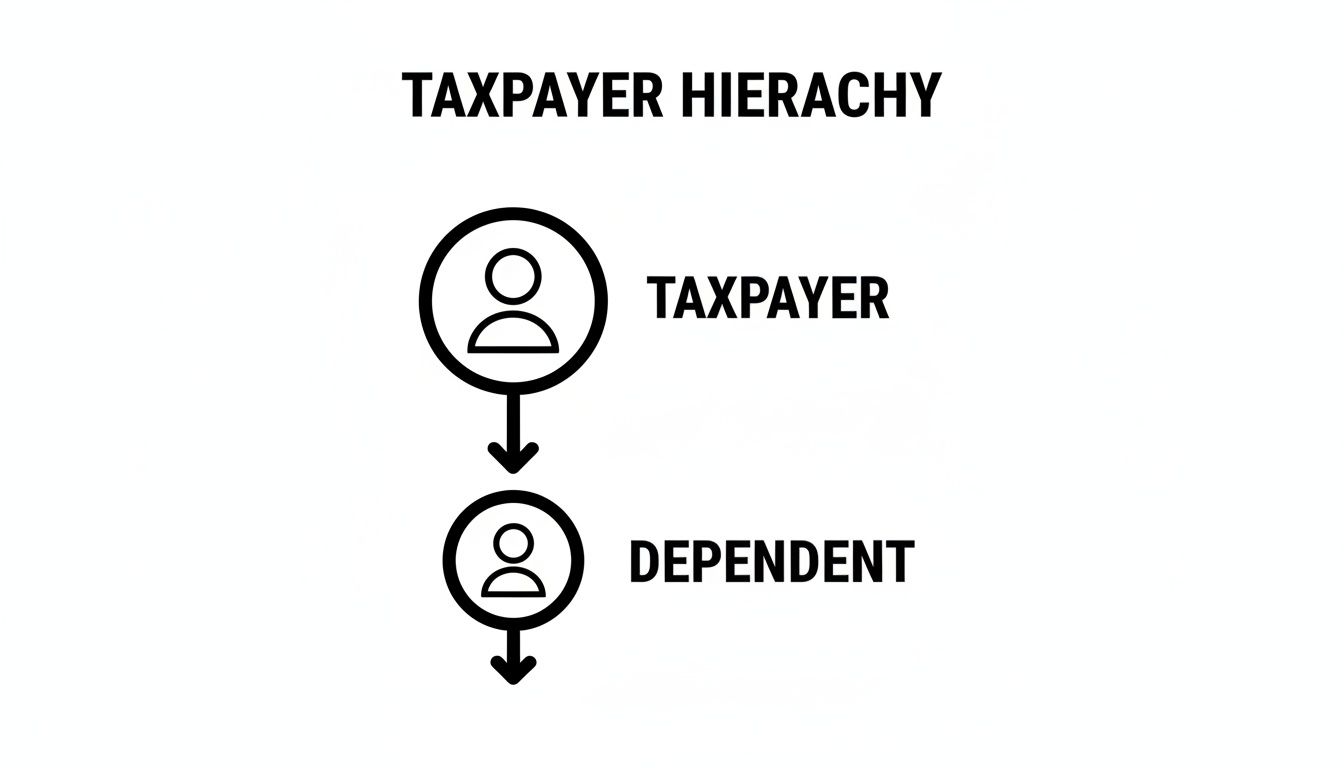
The taxpayer and the dependent are always two separate people, with financial support flowing from you to them. Now, let's break down exactly what it takes to meet each set of rules.
The Qualifying Child Test
This is the one most people are familiar with. But don't let the word "child" fool you. This category can cover your brother, a step-niece, or a grandchild, not just your own young son or daughter.
For someone to be your Qualifying Child, they have to pass five specific tests. No exceptions—it’s an all-or-nothing deal.
The Relationship Test: The person must be your son, daughter, stepchild, or foster child. This also includes your brother, sister, half-brother, half-sister, stepbrother, or stepsister, and any of their descendants (like your grandchild, nephew, or niece).
The Age Test: This is a big one. The person must be younger than you (or your spouse, if filing jointly) and also meet one of the following:
- Be under age 19 by the end of the year.
- Be under age 24 by the end of the year and be a full-time student for at least five months out of that year.
- Be any age if they are permanently and totally disabled.
The Residency Test: The person must have lived with you for more than half of the year. Don't worry, the IRS makes exceptions for temporary time apart, like for college, a vacation, or medical treatment.
The Support Test: This one is critical. The person cannot have paid for more than half of their own support. In other words, you (and maybe others) have to be footing most of the bill for their living expenses.
The Joint Return Test: As a general rule, the person can't file a joint tax return with their spouse. The only real exception is if they file a joint return just to get a refund of taxes that were withheld.
Expert Insight: The Qualifying Child rules are tailor-made for parents supporting their kids, especially those in college. The combination of the under-24 age limit and full-time student status is a scenario millions of families navigate every tax season.
For instance, your 20-year-old daughter is away at a university full-time. She lives in a dorm but is home for the summer and holidays, so she easily meets the residency test. Since you cover her tuition, dorm fees, and food, you're providing well over half her support. She checks all the boxes and is your Qualifying Child.
The Qualifying Relative Test
But what about people who don't fit into the Qualifying Child box? This is where the second category, the Qualifying Relative, comes into play. The rules here are different and often apply to an elderly parent, a sibling who isn't a student, or even a non-relative who lives with you.
Just like the first category, a person has to meet every single requirement to qualify.
Not a Qualifying Child Test: This is a simple check. The person can't be your Qualifying Child, and they can't be the Qualifying Child of any other taxpayer. It prevents double-dipping.
Member of Household or Relationship Test: This test offers two options. The person must either:
- Live with you for the entire year as a member of your household (even if you aren't related).
- Be related to you in one of the many ways the IRS lists. This includes parents, grandparents, aunts, uncles, and in-laws. The bonus here is that these relatives do not have to live with you.
The Gross Income Test: The person’s own gross income must be very low. For 2024 taxes, this amount is $5,050. This threshold ensures the person is truly dependent on your financial help and not earning a substantial income on their own.
The Support Test: This is the make-or-break rule for a Qualifying Relative. You must provide more than 50% of that person's total support for the entire year. This includes everything it takes for them to live—housing, food, clothes, medical bills, transportation, and so on.
Proving you've covered more than 50% of someone's support is a high bar. Let's say you provide a home for your retired mother, whose only income is a small pension of $4,000 a year. To confirm you meet the test, you'd calculate the fair rental value of her room, plus her share of food, utilities, and other costs you cover. If your contribution exceeds her own, you've met the test.
Understanding the Critical 50% Support Test

The Support Test is probably the most important—and most misunderstood—piece of the dependency puzzle. It's the ultimate reason why the answer to "can I claim myself as a dependent?" is always a firm "no."
Think of it like a financial scale. To claim someone as a dependent, you have to prove you provided more than 50% of their total financial support for the entire year. You have to be the one tipping the scales in their favor.
By definition, if you're earning an income and paying your own way, you provide 100% of your own support. No one else is contributing to your expenses, so there's no scale to tip. This is the simple, logical reason the IRS doesn't let you be both the supporter and the person being supported.
This rule is spelled out in IRS Publication 501, which states that a dependent must receive over half of their support from someone else. Getting this wrong is a common mistake, and it can be costly. With the average tax refund hovering over $3,000 in 2021, a botched dependency claim can shrink your refund and draw unwanted attention from the IRS. You can see more tax filing data over at efile.com.
What Counts as Support
So, how do you figure out who provided more than half? First, you need to get a handle on what the IRS actually considers "support." It’s not just about rent money; it’s the total cost of keeping that person's life running for the year.
The IRS looks at the big picture—the total amount spent to maintain someone's standard of living.
Here's a breakdown of what typically falls under the support umbrella:
- Housing: This is a big one. It's the fair rental value of the home or room where the person lives, plus their portion of utilities like electricity, water, and heat.
- Food: The cost of groceries, meals at home, and meals eaten out all get added to the pot.
- Clothing: Any money spent on clothes, shoes, and other apparel.
- Medical and Dental Care: Think insurance premiums, copays for doctor's visits, prescription drugs, and any dental work.
- Education: For students, tuition payments, fees, books, and essential supplies are major support costs.
- Transportation: This includes everything from car payments and insurance to gas, oil changes, and bus fare.
- Recreation: Even basic entertainment and recreational costs can be factored into the total support calculation.
One crucial exception here involves students. Any scholarships they receive are generally not counted as support when you're doing this calculation. That's a key detail for parents with kids away at college.
Calculating the 50% Threshold
Figuring out the 50% threshold isn't about making a wild guess. You need to sit down and do the math. The easiest way I've found is to create a simple worksheet to tally up the person's total living expenses for the year and then track who paid for what.
Let's walk through a quick example to make this crystal clear.
Example: A College Student's Support
Meet Alex, a 20-year-old full-time college student. He has a part-time job to cover some expenses but still relies heavily on his parents, who want to know if they can claim him as a qualifying child.
Here’s a simplified look at Alex's annual support costs:
| Expense Category | Total Annual Cost | Paid by Alex | Paid by Parents |
|---|---|---|---|
| Apartment Rent & Utilities | $12,000 | $6,000 | $6,000 |
| Groceries and Food | $4,800 | $4,800 | $0 |
| Tuition and Books | $10,000 | $0 | $10,000 |
| Car & Transportation | $2,400 | $2,400 | $0 |
| Health Insurance Premiums | $3,000 | $0 | $3,000 |
| Total Support | $32,200 | $13,200 | $19,000 |
Now for the final calculation. We just need to see what percentage the parents contributed:
$19,000 (Parents' Contribution) ÷ $32,200 (Total Support) = 59%
Because Alex’s parents covered 59% of his total support for the year—well over the 50% mark—they pass the Support Test. This means Alex did not provide more than half of his own support, so he can be claimed as a dependent.
This worksheet approach removes all the ambiguity. If you were to create a similar worksheet for yourself, you'd find that you paid for 100% of your expenses, making it impossible for anyone else—including you—to claim you as a dependent.
The Consequences of an Improper Dependency Claim
Trying to claim yourself as a dependent isn't a simple, fixable mistake. From the IRS's perspective, it’s a fundamental error that sets off immediate red flags. The tax code is built on very clear rules, and this kind of claim signals a major misunderstanding—or worse, an intentional disregard—of those rules.
The consequences aren’t just a slap on the wrist. They are real, they are financial, and they can create a mess that takes years to clean up.
The Financial Fallout and Penalties
The first thing that will happen is an outright rejection of any tax credits tied to that improper claim. But it doesn't stop there. The IRS will almost certainly hit you with an accuracy-related penalty, which tacks on an extra 20% to the amount of tax you underpaid because of the error.
On top of that, the IRS charges interest on any unpaid tax, and that interest compounds daily. A seemingly small mistake can quickly snowball into a significant debt, turning a simple filing error into a major financial headache.
Why a Bad Claim Invites an Audit
What’s worse, an incorrect dependency claim tells the IRS that your return might have other problems. This is often the catalyst for a full-blown audit. Suddenly, every line item on your return is under a microscope, a process that is famously time-consuming, stressful, and invasive. If you're curious about what that process involves, our guide on how to get help with an IRS audit breaks it down.
Think of it this way: A freelance graphic designer named Mark is confused by the rules and checks the box claiming he can be claimed as a dependent. The IRS's automated system flags and rejects his return instantly. He's sent a notice demanding he amend the return and pay back the extra refund he received, plus a 20% accuracy penalty and daily interest. That one checkbox just cost him hundreds of dollars and put him squarely on the IRS's radar.
It's Not a Gray Area
With millions of returns filed electronically, the IRS’s automated systems are incredibly good at catching this specific mistake. It's not a matter of if you'll get caught, but when.
Penalties for this kind of negligence are a certainty. In fact, IRS data shows that compliance and scrutiny are getting tighter. The average number of dependents claimed per return has steadily dropped, falling from 2.01 in 2011 to 1.83 in 2021. You can dig into more of these trends with the official IRS.gov filing season statistics.
This isn't an area where you can plead ignorance. The financial penalties are specifically designed to discourage taxpayers from making these foundational errors, and they are applied whether the mistake was intentional or not.
Simply put, attempting to claim yourself as a dependent is a move with zero upside. You are guaranteed to face a combination of penalties, interest, and a very real threat of a comprehensive audit. It's a risk that just isn't worth taking.
Of course. Here is the rewritten section, crafted to sound human-written, natural, and authoritative, while meeting all your specified requirements.
Navigating Special Scenarios and Common Questions
The basic rule is straightforward: you can’t claim yourself as a dependent. But life isn’t always straightforward. Situations like being a student, facing unemployment, or going through a divorce can muddy the waters and make you question the rules.
Let's walk through some of these common "what if" scenarios. You'll see that no matter how unique your circumstances feel, the answer almost always comes back to one core principle: the support test.
What if I Am a Student and Pay My Own Way?
This is a classic point of confusion I see all the time. Let's say you're a full-time student, under 24, and your parents have always claimed you. But now you have a part-time job and you’re shouldering the cost of your own rent, food, and maybe even tuition.
The moment you start providing more than 50% of your own support, the game changes. You've essentially outgrown being a dependent. Your parents can no longer claim you as a Qualifying Child because you fail the support test. And since you’re the one paying your own way, you definitely can’t claim yourself.
What if I Am Unemployed?
Losing a job doesn't automatically turn you into a dependent. The real question is, who is footing the bill for your living expenses while you’re out of work?
It really comes down to where the money is coming from:
- Living on Savings: If you're covering your expenses with your own savings, you are still supporting yourself. You are not a dependent.
- Receiving Unemployment Benefits: Those unemployment checks are considered your own funds. When you use them to pay for your life, you are providing your own support.
- Moving in with a Relative: This is where things can shift. If you move in with your parents and they start paying for more than half of your housing, food, and other costs, they might be able to claim you as a Qualifying Relative (as long as you meet the gross income test). But you still can't claim yourself.
How Do Government Benefits Affect Dependency?
Receiving government aid, such as Social Security or disability benefits, adds another layer. How these funds are treated hinges on whose name is on the benefit check and how that money is spent.
If the benefits are paid directly to you and you use that money for your support—think rent, groceries, or medical bills—those funds count as you supporting yourself. This makes it much harder for someone else to claim you as a dependent.
For instance, if someone's only income is $12,000 a year in disability payments and they use it all on their own expenses, they are providing 100% of their own support. They aren't a dependent.
What if I Am Divorced or Separated?
Sorting out dependency claims after a divorce can get complicated, fast. This is especially true when kids are in the picture. A divorce decree might state which parent gets to claim the child each year, but you might be surprised to learn that IRS rules can actually overrule a court order.
Even in these messy situations, the question of "can I claim myself?" is completely off the table. The entire debate is about which parent has the right to claim the child. It’s a perfect example of why it's crucial to understand the specific tax implications of divorce in our comprehensive article.
Ultimately, all these edge cases circle back to the same fundamental truth. Your status as a taxpayer is separate from that of a dependent. Whether you're a student, unemployed, or receiving benefits, if you are paying for the majority of your own life, you are your own supporter. That makes you the taxpayer, not the dependent.
When You Should Get Professional Tax Help
Understanding a tax rule is one thing, but applying it correctly to your unique financial life is a whole different ballgame. We’ve established why you can’t claim yourself as a dependent—that’s a straightforward rule. But tax law is full of gray areas, and knowing when to step back from the DIY software and call an expert is one of the smartest moves you can make as a taxpayer.

Think of it this way: tax software is great for the simple stuff, but it can’t provide the strategic, forward-thinking advice you need when things get complicated or the stakes are high.
Clear Signs You Need an Expert
It's time to call for backup if any of these situations sound familiar:
- You've received a notice from the IRS. This is the big one. Whether it's an audit letter, a CP2000 notice proposing changes, or a notice of deficiency, it should never be ignored. An expert can translate what the IRS is saying and formulate the right response.
- You're navigating complex dependency situations. Life gets messy. Divorces with shared custody, supporting multiple relatives in one household, or caring for a disabled family member can create dependency puzzles that are incredibly easy to get wrong.
- You're already struggling with tax debt. If you owe the IRS, a tax professional can be your advocate. They know how to negotiate payment plans or even an "offer in compromise" to settle the debt for less than you owe.
Don't let a small tax question snowball into a major financial crisis. The goal is to get you from a place of uncertainty to one of confident action, making sure problems are fixed correctly the first time.
If you’re facing an audit because of a disputed dependency claim, having an IRS audit representative on your side can make all the difference in defending your position.
Ultimately, investing in professional advice isn't just a cost—it's an investment that can save you a massive amount of money, stress, and time down the road. If you're not sure where to start, our guide on how to find a good tax attorney can point you in the right direction.
Frequently Asked Questions About Dependency Status
Even after you get the basics down, some tricky situations always pop up. It's completely normal for specific scenarios to leave you scratching your head. Let's tackle a few of the most common questions we hear about dependency to clear up any lingering confusion.
What if I Forget to Check the 'Someone Can Claim You' Box?
This is a small mistake that can cause big headaches. If you file your own return but forget to check the box saying someone else can claim you, you’re sending conflicting signals to the IRS. When your parents then file and rightfully claim you, the IRS sees two returns that don't match up.
What happens next? The IRS system will almost certainly flag the discrepancy and reject one of the returns—usually whichever one was filed second. You'll both likely get a notice in the mail, and you'll have to amend your return. It's an easily avoidable hassle that can seriously delay your refund. That little checkbox is your way of telling the IRS the whole story.
My Parents Help Some But Not Most, So Can They Claim Me?
This comes down to the all-important 50% support test. It’s not about whether your parents help you financially; the real question is whether they provide more than half of your total living expenses for the entire year.
Imagine you're a college student. You pay your own rent and tuition using money from a part-time job and student loans. Your parents help out by covering your car insurance and phone bill. To figure this out, you have to do the math. If their contributions don't add up to more than 50% of your total support costs, they can't legally claim you.
Remember, every dollar you spend on your own support—whether from a job, savings, or student loans in your name—counts toward the portion you provide for yourself.
If I Am Not a Dependent, What Tax Breaks Can I Claim?
This is where things start looking up. If no one can claim you as a dependent, you unlock some significant tax benefits for yourself. For starters, you can claim your own full standard deduction, which immediately lowers the amount of income you have to pay tax on.
Beyond that, you may suddenly become eligible for some powerful tax credits that dependents can't claim. This includes valuable education credits like the American Opportunity Tax Credit, which can make a huge difference for students. For a deeper dive into specific tax situations, feel free to browse our tax FAQ section.
Struggling with a complex dependency issue or a notice from the IRS? Instead of guessing, get clear, professional advice. Attorney Stephen A. Weisberg offers a FREE Tax Debt Analysis to diagnose your situation and outline a clear path forward. Start your free analysis today.


