Can a Tax Attorney Negotiate with IRS? Full Guide
Wondering can a tax attorney negotiate with IRS? Learn the truth about their powers, process, and how they compare to CPAs and EAs.

In this article
- The Moment a Tax Notice Changes Everything
- What the IRS actually responds to
- The Legal Authority That Lets an Attorney Talk to the IRS
- What Form 2848 actually unlocks
- Why attorneys matter more when the case may leave the IRS
- How Attorneys Differ From CPAs and Enrolled Agents
- What each professional can do
- Why the legal license changes the negotiation
- The blunt recommendation
- The Formal Tools Attorneys Use to Negotiate
- The main tools and when they fit
- What a strong submission looks like
- Why Most Offers Get Rejected and How to Beat the Odds
- The math drives the result
- A simple example of why documentation wins
- Why the Engagement Model Matters as Much as the Lawyer
- What a bad sales process looks like
- The questions you should ask
- Putting It All Together Your Next Step With the IRS
- Common Questions About Tax Attorney IRS Negotiation
Yes, a tax attorney can negotiate with the IRS, but only after filing Form 2848 and working through formal IRS tools like installment agreements, Offers in Compromise, penalty abatements, and hardship relief. This is not back-room bargaining. It's a procedural legal process with rules, limits, and a real paper trail.
You're probably staring at a notice right now, wondering whether hiring a lawyer changes anything or just adds another bill. Maybe the balance is growing, the letters are getting sharper, and you're trying to figure out whether the word negotiate means real influence or just a sales pitch.
The Moment a Tax Notice Changes Everything
A self-employed contractor opens a letter from the IRS and sees a balance due tied to a prior year return. The first thought is usually not strategy, it's panic. The second thought is whether a lawyer can do anything, or whether this is the point where a tax debt company talks fast, demands money, and promises miracles.

The honest answer is simple. A tax attorney can negotiate with the IRS because the IRS's own authorization rules allow a representative with Power of Attorney to “represent, advocate, negotiate and sign on your behalf”. The agency also recognizes attorneys, CPAs, and enrolled agents as eligible representatives, and the IRS says that even when a settlement is reached, approval still depends on the appropriate official's sign-off through formal procedure, not casual bargaining. That's why the work happens through structured tools, not vague promises. See the practical guide on Allied Tax Advisors tax help if you want another plain-English overview of the process.
What the IRS actually responds to
The IRS doesn't reward volume, emotion, or urgency. It responds to documentation, eligibility, and the right request in the right format. If the facts support an installment agreement, that's what gets discussed. If the facts support an Offer in Compromise, that's the lane. If the taxpayer can't pay without basic hardship, the conversation shifts again.
Practical rule: If someone says they can “talk the IRS into” a deal without looking at returns, transcripts, and financial records, they're selling fantasy.
That's why the first real question isn't whether negotiation is possible. It's whether the case can be presented in a way the IRS can legally accept. The lawyer's job is to build that file, make the request, and keep the IRS inside the boundaries of its own procedures.
The Legal Authority That Lets an Attorney Talk to the IRS
A tax attorney can't just call the IRS and start discussing your case. The IRS won't deal with the lawyer as your representative until Form 2848, Power of Attorney and Declaration of Representative, is filed and accepted for the specific matters at issue. Without that authorization, the attorney is just another outsider as far as the agency is concerned. For a plain-language walkthrough of the authorization process, how to authorize tax representation is a useful reference, and the IRS also spells out the basic authorization framework in its Power of Attorney and other authorizations guidance.
What Form 2848 actually unlocks
Once the form is on file, the attorney can receive confidential tax information, speak directly with IRS personnel, and act for the taxpayer on the listed issues and periods. That means the lawyer can ask for transcripts, respond to collection contact, and submit proposals inside the authorized scope. It does not mean the attorney gets unlimited access to every tax matter in a client's life.
That narrow scope matters. IRS authority is tied to the exact matter and tax periods listed, so negotiation is always fact-specific. If the lawyer is handling a payroll tax problem for one year, that authority doesn't magically cover every other issue the taxpayer might have.
Why attorneys matter more when the case may leave the IRS
The attorney's role becomes even more important when the dispute might move beyond collections and into federal court. Attorneys are licensed to represent taxpayers there, while ordinary administrative negotiations alone don't guarantee a binding result. That's the edge a tax attorney brings, the ability to handle both the IRS side and the courtroom side if the case escalates.
For a more technical setup guide, the instruction page at Form 2848 instructions breaks down the paperwork details. The point is not paperwork for its own sake. The point is access. Without proper authorization, there's no negotiation, only silence.
How Attorneys Differ From CPAs and Enrolled Agents
A lot of people assume every tax professional can do the same thing. That's wrong. CPAs and enrolled agents can represent taxpayers before the IRS on many audit, collection, and appeal matters, but only attorneys can represent clients in federal court. That single distinction changes the strategy when a case is close to litigation or already carrying litigation risk.
What each professional can do
| Representation Right | Tax Attorney | CPA | Enrolled Agent |
|---|---|---|---|
| Speak with the IRS after authorization | Yes | Yes | Yes |
| Receive taxpayer information for authorized matters | Yes | Yes | Yes |
| Negotiate collection and settlement issues | Yes | Yes | Yes |
| Represent the taxpayer in federal court | Yes | No | No |
That table is the dividing line. If your case is purely administrative, a CPA or enrolled agent may be enough. If the IRS dispute might move to Tax Court, federal court, or involve broader legal exposure, an attorney is the right tool.
Why the legal license changes the negotiation
A tax lawyer does more than fill out forms. The attorney can frame the dispute as a legal problem, not just a numbers problem. That matters because IRS personnel know when a case has litigation potential, and that pressure affects how they evaluate the file.
The best negotiation posture is often the one backed by courtroom credibility.
That doesn't mean every case should become a fight. It means the person handling your matter should know when to push, when to compromise, and when the facts support escalation. Benefits of hiring a tax attorney lays out the broader practical differences if you want a deeper comparison.
The blunt recommendation
If your issue is small, straightforward, and purely administrative, a CPA or enrolled agent can be enough. If the debt is large, the facts are messy, the IRS is pushing collection hard, or litigation is realistic, hire an attorney from the start. Don't bring in court-level problems and then hope a form-preparer can somehow turn that into a legal advantage.
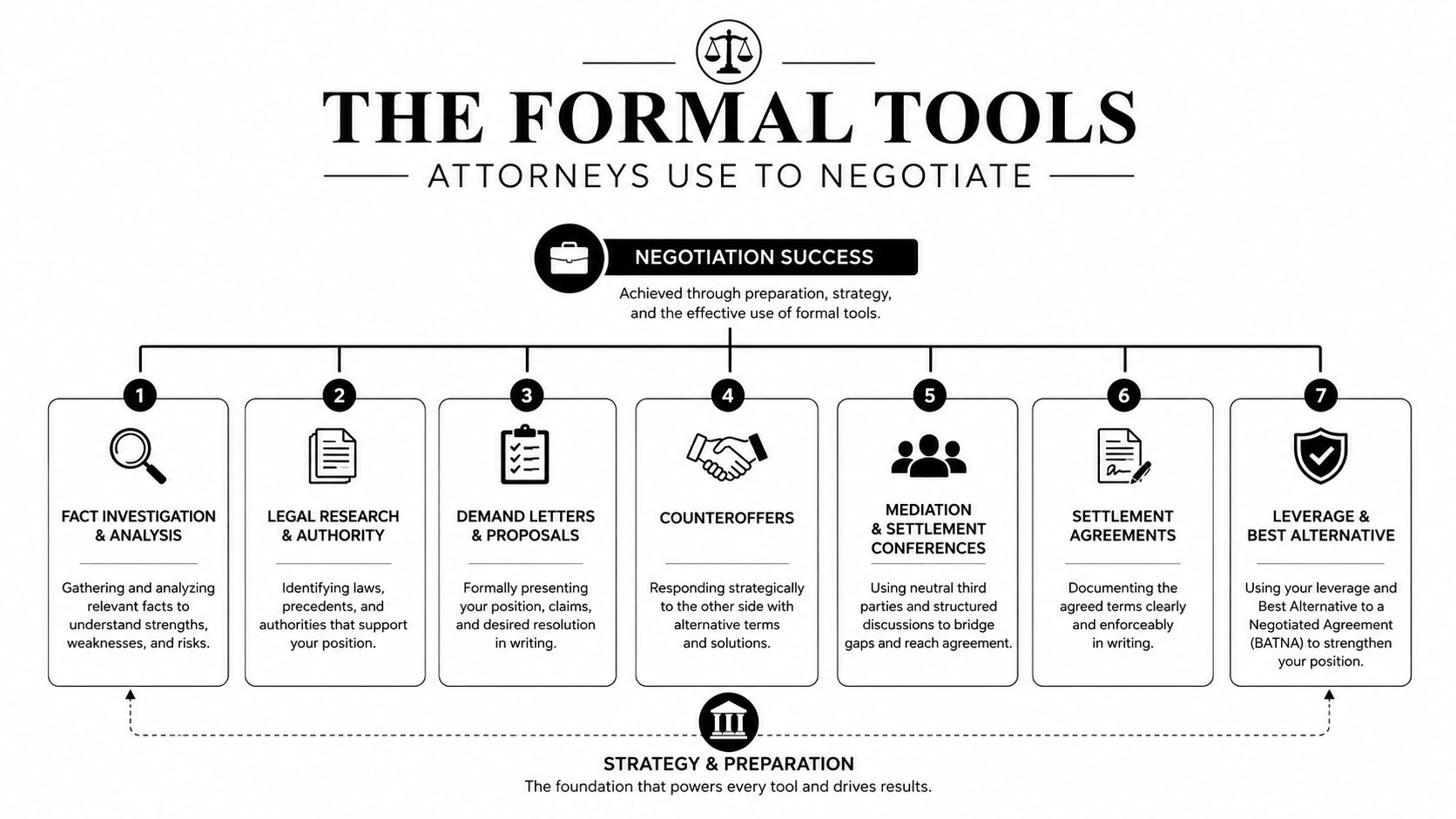
The Formal Tools Attorneys Use to Negotiate
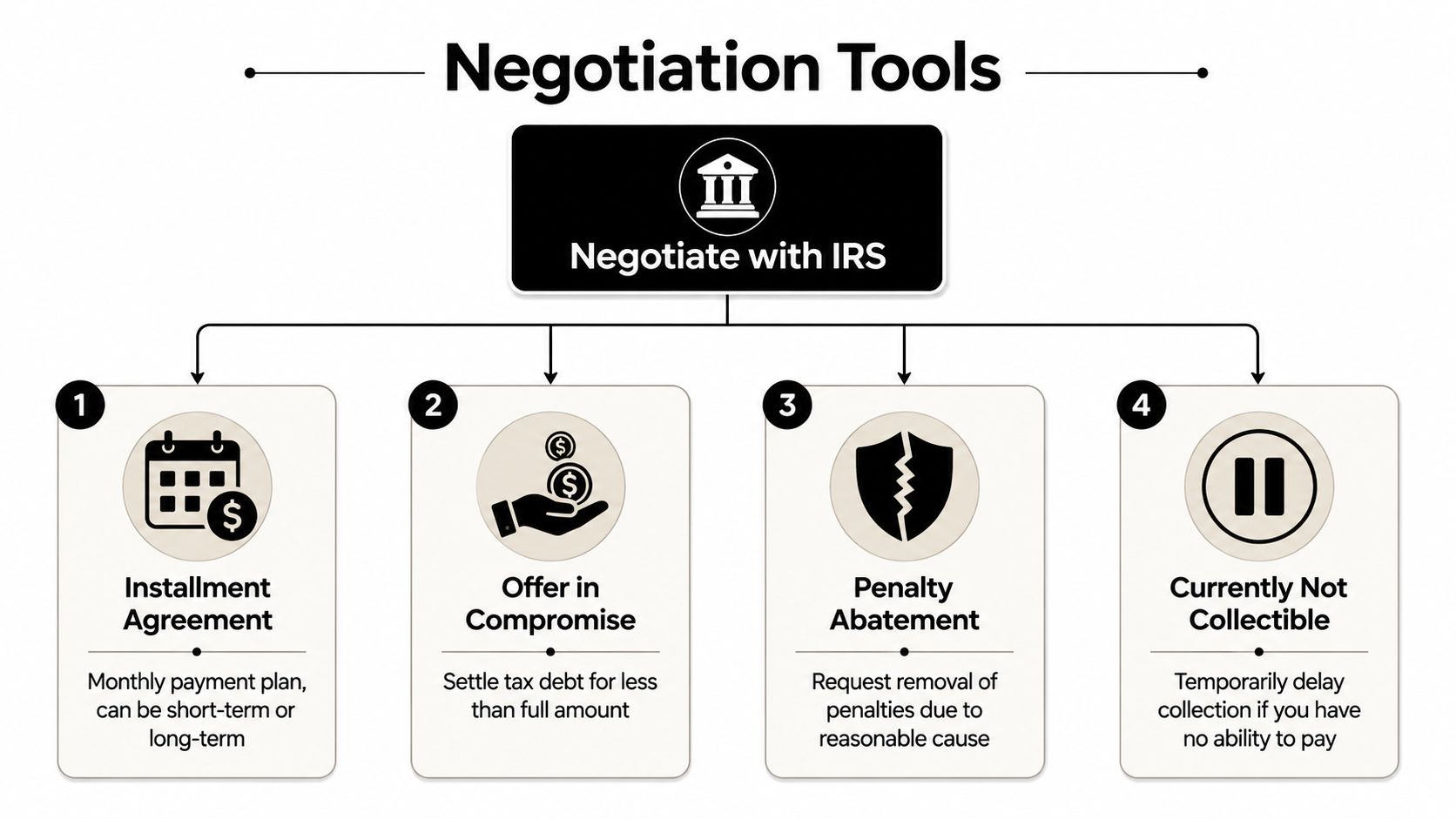
Attorneys don't negotiate with the IRS by improvising. They use specific programs the IRS already recognizes, and each one has its own standards. The common ones are installment agreements, Offers in Compromise, penalty abatement, and currently not collectible status.
The main tools and when they fit
Installment agreements spread the debt into monthly payments. They don't reduce the tax itself, but they can stop the case from escalating while the taxpayer stays current. If cash flow is tight but stable, this is often the cleanest resolution.
Offers in Compromise try to settle for less than the full amount owed. The IRS only accepts them when the file shows that the amount offered is all it can reasonably collect. That's why the paperwork matters more than the pitch.
Penalty abatement asks the IRS to remove or reduce penalties when there's reasonable cause. Illness, disasters, and other documented problems can matter here, but the request has to be specific and supported.
Currently not collectible status pauses collection when the taxpayer can't pay without sacrificing basic living expenses. It doesn't erase the debt, but it can stop active collection pressure while the financial picture improves.
What a strong submission looks like
The IRS is not interested in a story that sounds sympathetic but isn't documented. It wants a clean financial picture, accurate returns, bank records, income proof, and a clear explanation of why the proposed resolution fits the facts. That's where attorneys earn their keep. They organize the numbers, identify the right relief path, and submit the case in the format the IRS expects.
For the paperwork behind an Offer in Compromise, Form 433-A OIC guidance is worth reviewing. It's the kind of form that separates a serious file from a wish list.
Why Most Offers Get Rejected and How to Beat the Odds
The biggest mistake taxpayers make is thinking an Offer in Compromise is a persuasion exercise. It isn't. IRS settlement outcomes are constrained by Reasonable Collection Potential, the agency's calculation of what it could collect based on current income, allowable monthly expenses, bank and investment balances, home equity, retirement assets, vehicles, business assets, and future earning capacity. Independent reporting cited in the brief says the IRS accepts only about 40% of Offer in Compromise requests, and that tells you everything you need to know about how selective the process is.
The math drives the result
If the IRS thinks it can collect more from you through its normal framework than what you're offering, the offer gets rejected. The agency isn't evaluating whether you feel trapped. It's evaluating what it can collect and whether your file proves a lower collectible amount.
That's why a clean cash-flow analysis matters. A taxpayer with unstable income, high necessary living costs, and limited assets can look very different from a taxpayer who only hopes the IRS will compromise. The difference is documentation.
A simple example of why documentation wins
Two taxpayers owe similar amounts. One sends a bare offer and a short hardship letter. The other sends bank statements, income records, expense documentation, and a financial picture showing very limited collectibility. The second taxpayer gives the IRS a way to justify acceptance under its own rules. The first one gives the IRS a reason to reject the file as incomplete or unsupported.
Bottom line: The IRS doesn't buy arguments, it buys evidence.
That's why attorneys spend so much time on transcripts, asset analysis, and the numbers behind the case. When the file shows that the collectible amount is lower than the balance claimed by the IRS, the negotiation has a real chance. When the file is vague, the offer dies fast.
Why the Engagement Model Matters as Much as the Lawyer
The tax debt resolution industry has a trust problem. A lot of firms push big upfront retainers before they've even confirmed whether the case is viable. That puts all the risk on the taxpayer and gives the firm money before it has earned the right to ask for it.
What a bad sales process looks like
If a company starts with pressure, not analysis, be careful. If the first conversation is about urgency, “limited-time” pricing, or a scary warning that your case will get worse unless you pay immediately, that's not legal advice. That's a sales funnel.
A better model starts with a real review of the returns, notices, and financial facts. The attorney should tell you whether the case has a plausible resolution path before asking you to commit to paid representation. That's the approach Tax Attorney Stephen A Weisberg uses through a free tax debt analysis, where the point is to determine whether help is possible and what form it would take before charging to resolve the matter.
The questions you should ask
- What exactly would you file first? If the answer is vague, the plan is vague.
- What facts could make this case fail? A serious lawyer will tell you.
- Do you start with a fee before analysis, or after you confirm the resolution path? The answer says a lot about the firm's incentives.
- Will you handle the IRS directly, or just hand work to staff? You want to know who's doing the negotiation.
A good engagement model protects you from paying for hope. A bad one monetizes panic. I'd rather have a lawyer tell me a case isn't a fit than hand over a retainer to someone who promised results before reading the file.
Putting It All Together Your Next Step With the IRS
A tax attorney can negotiate with the IRS, but the negotiation is real only when it's anchored to the agency's procedures, authorized through Form 2848, and supported by the right financial proof. The IRS deals in formal tools, not charm, and it evaluates cases through documentation, collectibility, and procedural compliance. If a representative can't explain which tool fits your facts, keep looking.
The practical test is simple. You want someone who can talk through installment agreements, Offers in Compromise, penalty abatement, and hardship relief without overselling any of them. You also want someone who will tell you, plainly, whether your case is strong enough to justify pursuing one of those options.
For a plain guide on the mechanics, how to negotiate with the IRS lays out the basic approach in more detail. If you're still unsure what your notice means or whether a lawyer can move the case forward, get the facts reviewed before you send money to a tax relief company.
Common Questions About Tax Attorney IRS Negotiation
How much does a tax attorney cost? It depends on the complexity of the case, the amount of work required, and whether the matter stays administrative or moves toward appeals or litigation. Simple negotiation is usually cheaper than a fully contested case.
How long does it take? Some payment plans move quickly, while Offers in Compromise and other formal relief requests take longer because the IRS reviews the financial file carefully. Timing depends on how complete your documents are and how much back-and-forth the case needs.
What should you bring to a first consultation? Bring IRS notices, recent tax returns, bank statements, proof of income, and anything showing expenses or assets. The more complete the file, the faster a lawyer can tell you what's realistic.
Tax Attorney Stephen A Weisberg handles IRS debt problems, notices, and negotiation strategy with a focus on real procedural options, not scare tactics. If you want a candid review of your situation before you pay anyone, visit Tax Attorney Stephen A Weisberg and request a free tax debt analysis.


