Can a tax attorney help with back taxes? Key steps to relief
Can a tax attorney help with back taxes? Learn how they negotiate settlements, stop IRS levies, and secure relief.

In this article
- Your Strategic Advocate for IRS Problems
- How an Attorney Provides Immediate Relief
- How a Tax Attorney Solves Your Back Tax Problems
- Building a Path to Resolution
- The Unique Legal Powers of a Tax Attorney
- The Shield of Confidentiality
- Exclusive Authority in the Courtroom
- Finding a Way Out of Overwhelming Tax Debt
- Offer in Compromise: A True Fresh Start
- Installment Agreements: A Structured Path Forward
- Penalty Abatement: Wiping Away Costly Add-Ons
- Choosing Your Expert: Tax Attorney vs. CPA or EA
- When to Call a CPA or Enrolled Agent
- Red Flags That Demand a Tax Attorney
- Tax Pro Comparison: Attorney vs. CPA vs. EA
- What to Expect When Working with a Tax Attorney
- The Initial Consultation and Strategy Session
- Gathering Your Financial Story
- Granting Power of Attorney and Taking Control
- The Negotiation and Resolution Phase
- Take the First Step to Resolve Your Tax Debt
- From Worrying to Acting
- Frequently Asked Questions About Tax Attorneys
- How Much Does a Tax Attorney Cost for Back Taxes?
- Can a Tax Attorney Really Stop an IRS Bank Levy?
- Is It Worth Hiring a Tax Attorney for a Small Tax Debt?
- What Is Currently Not Collectible Status?
If you're staring down a mountain of IRS debt, you're probably wondering if a tax attorney can actually help. The answer is a resounding yes. Think of a tax attorney as your legal shield—they step in between you and the IRS, taking over all communications and using their deep knowledge of tax law to defend your rights and your assets.
Your Strategic Advocate for IRS Problems

When you owe the government money, it’s not just a financial problem; it’s a legal one. This is exactly where a tax attorney’s unique skills come into play. While a CPA or Enrolled Agent is fantastic for preparing returns and planning, a tax attorney is a legal specialist trained for battle, especially when you’re facing serious threats from the IRS or state.
Imagine getting a notice that the IRS is about to levy your bank account or garnish your wages. That’s not a polite request for payment—it's an aggressive legal maneuver. It demands an equally strong legal defense.
A tax attorney's first job is to jump in and stop the bleeding, halting these collection actions to give you the breathing room to find a real solution. They become your official representative, which means the IRS has to talk to them, not you. This simple step can dramatically lower your stress and stop you from accidentally saying something that could make your situation worse.
How an Attorney Provides Immediate Relief
From the moment you hire them, a tax attorney switches into stabilization mode. They analyze your whole situation to figure out the best way forward. This isn't just about paperwork; it's about building a solid legal argument to present to the IRS. You can learn more about the specific benefits of hiring a tax attorney in our detailed guide.
Their first moves often involve:
- Stopping Collections: Getting on the phone with the IRS to put a temporary hold on bank levies, wage garnishments, and property liens.
- Handling Communications: All those intimidating calls and letters from the IRS? They now go to your attorney's office.
- Assessing Your Options: Quickly evaluating whether you're a good candidate for programs like payment plans or debt settlements.
- Protecting Your Rights: Making sure the IRS is playing by the rules and not overstepping its legal authority.
A tax attorney's role extends beyond mere compliance. They act as your dedicated legal counsel, using the law itself as a tool to negotiate resolutions that financial professionals without a law license cannot.
A good tax attorney provides a clear road map out of your tax troubles. The table below breaks down the key ways they can help.
How a Tax Attorney Solves Your Back Tax Problems
| Area of Assistance | How an Attorney Helps |
|---|---|
| Legal Representation | Acts as your official advocate, forcing the IRS/state to communicate directly with them, not you. |
| Stopping Collections | Immediately works to halt aggressive actions like bank levies, wage garnishments, and property liens. |
| Negotiation | Uses deep knowledge of tax law and IRS procedures to negotiate the best possible outcome on your behalf. |
| Penalty Abatement | Builds a legal case to argue for the removal of penalties based on "reasonable cause." |
| Offer in Compromise | Prepares and submits the complex legal and financial paperwork to settle your tax debt for less than you owe. |
| Criminal Defense | Provides crucial legal defense if your case involves allegations of tax evasion or fraud. |
This strategic approach is what sets a tax attorney apart and provides the most comprehensive protection.
Building a Path to Resolution
Once the immediate threats are contained, the real strategic work begins. Your attorney will dig into your unfiled returns, analyze your income and assets, and figure out what caused the debt in the first place.
This deep dive is critical for choosing the right solution. For example, they can determine if you're a good candidate for an Offer in Compromise (OIC), a program that lets you settle your debt for a fraction of what you owe.
If that's not the right fit, they might negotiate a realistic Installment Agreement or build a case for Penalty Abatement to have penalties waived. Each of these options requires a strong legal and financial justification.
Ultimately, a tax attorney turns a chaotic, frightening situation into a structured, manageable process. They replace the fear and uncertainty with a clear, actionable plan to put your back taxes behind you for good.
The Unique Legal Powers of a Tax Attorney
When you're dealing with back taxes, it's easy to assume all tax professionals are the same. But they aren't. While CPAs and Enrolled Agents are fantastic at what they do—accounting and tax prep—a tax attorney brings a whole different toolkit to the fight. Think of them less as a number cruncher and more as your legal shield.
Their most critical advantage is attorney-client privilege. This isn't just a promise to be discreet; it's a legally binding fortress around every conversation you have with them. You can lay all your cards on the table—every mistake, every fear, every unfiled return—and know that it cannot be used against you by the IRS.
This protection is a game-changer, especially if your situation has the potential to become a criminal matter. With an attorney, you can speak freely, which is the only way for them to build the strongest possible defense for you.
The Shield of Confidentiality
Let's play out a scenario. Imagine you're explaining several years of unfiled tax returns to your CPA. If the IRS smells fraud and opens a criminal investigation, they could subpoena that CPA and force them to testify about everything you said.
Attorney-client privilege slams that door shut. It ensures your private financial discussions stay private, period. This allows your lawyer to get a complete, honest picture of your legal risks before a single word is ever exchanged with the IRS.
Attorney-client privilege is not just a professional courtesy; it is a fundamental legal right. When you hire a tax attorney, you are invoking a powerful legal principle that shields your sensitive financial discussions from the government's reach, a protection not fully extended to other tax professionals.
This legal shield provides a massive strategic advantage. It lets your attorney map out all the potential weaknesses and strengths of your case in a secure environment, which is absolutely essential in high-stakes tax disputes.
Exclusive Authority in the Courtroom
Another power exclusive to tax attorneys is their ability to fight for you in court. CPAs and Enrolled Agents can represent you in front of IRS revenue officers and in administrative appeals, but that’s where their authority ends.
Only a licensed attorney can represent you in U.S. Tax Court or other federal courts. If your disagreement with the IRS can't be settled through negotiations and has to go to trial, a tax attorney is your only option. They are the only professionals who can file petitions, argue your case before a judge, and legally challenge the IRS’s decisions.
This ability to go to court gives them serious leverage during negotiations. The IRS is well aware that an attorney can escalate the matter, often making them more open to reaching a fair settlement.
An attorney's role can include several key legal actions:
- Filing Official Court Petitions: To challenge an IRS Notice of Deficiency in U.S. Tax Court.
- Litigating Tax Disputes: To argue the legal merits of your case in front of a federal judge.
- Challenging IRS Legal Interpretations: To argue that the IRS has incorrectly applied tax law to your situation.
Having the option to take the fight to the next level can be a powerful deterrent against an unreasonable stance from the IRS. To learn more about these strategic benefits, you can read about why to use an IRS lawyer for your tax issues.
In the end, a tax attorney does far more than just prepare documents. They interpret and apply dense tax law to defend your rights, analyzing your case through a legal lens to find arguments and defenses others might overlook. From the confidentiality of attorney-client privilege to the power of courtroom representation, their unique skills are designed to protect your assets and secure your financial future.
Finding a Way Out of Overwhelming Tax Debt
Staring at a massive tax bill can feel paralyzing, like you’re lost with no map. This is where a tax attorney steps in. They don't just put a band-aid on the problem; they build strategic escape routes. Think of them as experts in navigating the IRS's complex world of resolution programs, turning what feels like an impossible debt into a clear, manageable plan.
We're not talking about simple payment plans here. These are legally structured agreements designed to get you back in good standing with the government without wrecking your finances. A good attorney dives deep into your specific financial situation to build a rock-solid case, showing the IRS why accepting their proposed solution is in everyone's best interest.
This is all about a combination of legal strategy, confidentiality, and the power to represent you in court if needed.
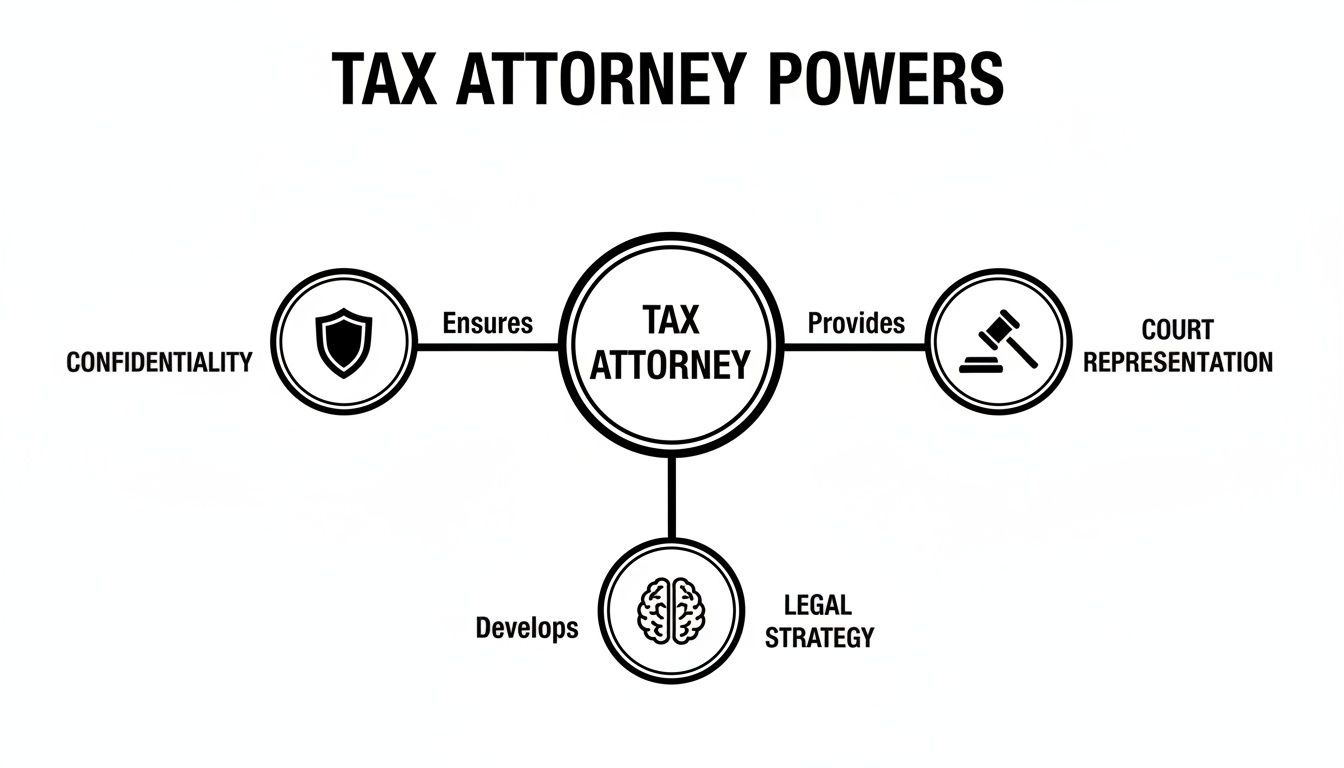
This powerful trio gives them the leverage needed to negotiate the best possible outcome for you.
Offer in Compromise: A True Fresh Start
One of the most powerful tools in a tax attorney’s arsenal is the Offer in Compromise (OIC). You can think of it as an official settlement with the IRS. It gives certain taxpayers who are in serious financial trouble a chance to clear their tax slate for a fraction of what they originally owed.
But make no mistake, this isn't a walk in the park. The OIC application is an incredibly detailed process. You have to provide extensive proof that you can't pay your full tax debt now or in the foreseeable future. The IRS will put your income, expenses, assets, and earning potential under a microscope.
This is where having an attorney is a game-changer. They know exactly how the IRS calculates what a "reasonable" offer looks like. They can frame your financial story in a way that checks all the agency's strict legal boxes, which dramatically boosts your odds of getting approved. This solution is a core part of the IRS Fresh Start Program.
An Offer in Compromise isn't a loophole. It's a legitimate program for people facing genuine economic hardship. A successful OIC hinges on a perfectly prepared application that legally proves the IRS will get more money by settling with you now than by chasing the full amount for years.
The numbers show just how tough it is to get an OIC approved. The IRS is trying to close a massive tax gap—only 83.6% of taxes are paid on time. In a recent year, the agency collected $120.2 billion in unpaid taxes but only accepted 7,199 Offers in Compromise out of 33,591 applications. The successful ones are often guided by expert tax attorneys who know how to get these complex deals across the finish line.
Installment Agreements: A Structured Path Forward
If an OIC isn’t the right fit, an attorney can negotiate a formal Installment Agreement (IA). This is much more than an informal payment plan; it’s a legally binding contract that lets you pay off your back taxes through manageable monthly payments, often over a period of up to six years.
While you can sometimes set up a basic payment plan on your own for smaller amounts, an attorney can negotiate much better terms when the debt is substantial. Their job is to argue for a monthly payment that actually works with your budget, so you can cover your living expenses without fear of defaulting on the agreement.
An IA negotiated by an attorney comes with critical protections:
- Stops Aggressive Collections: Once the agreement is locked in, the IRS has to stop stressful collection tactics like bank levies and wage garnishments.
- Creates Financial Predictability: You get a fixed monthly payment, which makes budgeting and planning your financial life much easier.
- Shows Good Faith: It proves to the IRS that you’re serious about resolving your tax debt.
Penalty Abatement: Wiping Away Costly Add-Ons
Finally, a huge chunk of many tax debts isn't even the tax itself—it’s the mountain of penalties for filing late, paying late, or other missteps. These penalties can sometimes grow to be larger than the original tax bill. A tax attorney can formally request Penalty Abatement to have these costly additions removed.
To get penalties waived, you have to prove you had a reasonable cause for the mistake. This could be anything from a serious illness or a natural disaster to relying on bad advice from a tax professional. An attorney excels at building a persuasive legal case, gathering the right documents, and citing specific tax laws to back up your claim. Getting thousands of dollars in penalties erased can be the key to making an overwhelming debt finally feel manageable.
Choosing Your Expert: Tax Attorney vs. CPA or EA
When you're staring down a serious tax problem, figuring out who to call can be half the battle. You'll hear about Tax Attorneys, Certified Public Accountants (CPAs), and Enrolled Agents (EAs), and it's easy to think they're all interchangeable. They're not. Making the wrong choice here can be a very expensive mistake.
Think of it like a health issue. Your CPA or EA is your family doctor. They are fantastic for routine check-ups—like preparing your annual taxes, handling your bookkeeping, and offering financial planning advice. They keep your financial health in good shape year after year.
A tax attorney, however, is the specialist—the surgeon. You don't see a surgeon for a common cold. You call them when the problem is serious, the stakes are high, and you need someone who can operate within the complex legal system. Once your back tax problem stops being about numbers and starts being about a legal fight, an attorney's skills are non-negotiable.
When to Call a CPA or Enrolled Agent
Both CPAs and EAs are excellent, highly-qualified tax pros. CPAs have a wide-ranging background in all things accounting, making them perfect for business accounting and holistic financial planning. EAs are laser-focused, federally-licensed specialists who live and breathe taxation and can represent you before the IRS.
You should lean on a CPA or EA for:
- Annual Tax Preparation: Getting your yearly federal and state returns filed correctly and on time.
- Financial Planning: Getting smart advice on tax-friendly strategies for your business, investments, or retirement.
- Bookkeeping and Accounting: Keeping your business's financial records clean and compliant.
- Basic IRS Notices: Helping you sort out simple letters from the IRS about a math error or a missing document.
For these day-to-day financial matters, their expertise is precisely what you need. But their authority hits a wall when things get legally complicated.
Red Flags That Demand a Tax Attorney
Some situations are giant, flashing signs that your problem has left the realm of accounting and entered a legal minefield. These are the moments you need the unique protections and legal muscle that only a licensed attorney can bring to the table.
If any of these sound familiar, it's time to call a lawyer:
- Potential Criminal Charges: If words like "tax evasion" or "fraud" are even whispered, you need the protection of attorney-client privilege right away. Only an attorney can offer this legal shield, which means your conversations are confidential and can't be used against you.
- Representation in Tax Court: Want to fight an IRS decision by suing them in U.S. Tax Court? Only a tax attorney is licensed to argue your case before a judge. A CPA or EA simply can't do it.
- Large and Complex Tax Debts: When the amount you owe is substantial (think $50,000 or more) and requires a sophisticated solution like an Offer in Compromise, an attorney's negotiation skills and legal knowledge are essential.
- IRS Appeals: If you've been audited and you flat-out disagree with the outcome, a tax attorney can manage the formal appeals process. They will build a legal case to challenge the IRS's findings, citing law and precedent.
- Aggressive Collection Actions: Is the IRS threatening to seize your home, levy your bank accounts, or garnish your wages? An attorney can step in with legal force to halt these actions and protect your assets.
Think of it this way: A CPA or EA can help you explain what happened on your tax return. A tax attorney is there to defend you and argue why it happened, using the tax code itself as your shield.
To help clarify these roles, here’s a simple breakdown of how these professionals stack up.
Tax Pro Comparison: Attorney vs. CPA vs. EA
| Professional | Primary Role | Best For |
|---|---|---|
| Tax Attorney | Legal representation and advocacy. Specializes in tax law, disputes, and litigation. | Complex legal issues, criminal tax defense, Tax Court, large debts, and stopping aggressive IRS collections. |
| CPA | Broad financial accounting, auditing, and tax preparation. | Business accounting, financial planning, regular tax filing, and general financial advice. |
| Enrolled Agent (EA) | Tax-focused preparation and IRS representation. | Complicated tax returns, audit representation (non-litigation), and resolving routine IRS notices. |
Ultimately, choosing the right pro comes down to the nature of your problem. While CPAs and EAs are masters of numbers and compliance, attorneys are masters of law and conflict. When the IRS is building a legal case against you, you need a lawyer in your corner to fight back.
Knowing how to choose the right professional is a huge first step. For more advice, check out our guide on how to find a good tax attorney.
What to Expect When Working with a Tax Attorney
Deciding to hire a tax attorney is a huge step, and it’s completely normal to wonder what actually happens next. Knowing the process, from that first phone call to getting the final "case closed" letter, can take a lot of the anxiety out of the equation.
Think of it like this: you're handing over a heavy, complicated burden to someone who deals with this stuff every single day. The entire process is designed to get the IRS off your back so you can get back to your life.

Let's walk through the typical journey.
The Initial Consultation and Strategy Session
It all starts with an initial consultation. This isn't a high-pressure sales pitch; it's a diagnostic session. A good tax attorney will spend most of the time listening to your story, looking over any scary notices you've received, and asking specific questions to get the full picture.
They're trying to figure out how serious the situation is, whether there are immediate threats like a bank levy or wage garnishment, and what your best options for resolution might be. You should walk away from this first meeting feeling like you have a clear, honest assessment of your situation and a potential game plan.
Gathering Your Financial Story
Once you decide to hire them, the next phase is all about gathering documents. Your attorney will give you a clear, specific list of what they need to build your case.
This usually includes things like:
- IRS and State Notices: Every single letter you’ve gotten. Each one tells part of the story.
- Past Tax Returns: Whether you filed them or not, these are the foundation.
- Financial Records: This means bank statements, pay stubs, and if you own a business, your profit-and-loss statements.
- Asset and Liability Information: They need a complete snapshot of your financial health to negotiate effectively.
Getting this information together is essential. If your tax problem ever becomes a full-blown audit, your attorney will guide you through it, which requires meticulous preparing for a financial audit.
Granting Power of Attorney and Taking Control
After your attorney has the necessary paperwork, you’ll sign an IRS Form 2848. This document is the Power of Attorney (POA), and it's a game-changer. It legally authorizes your attorney to represent you and speak to the IRS for you.
Once that Power of Attorney is signed, your attorney becomes your official shield. The threatening letters stop coming to your mailbox. The persistent phone calls end. All communication from the IRS must go through them. You don't have to talk to the IRS ever again.
This one step immediately stops the harassment and protects you from accidentally saying something that could make your situation worse. From this point on, your attorney is in the driver's seat.
The Negotiation and Resolution Phase
Now comes the part where your attorney’s expertise really makes a difference. They'll take all the information you've provided, combine it with their deep knowledge of tax law, and begin negotiating with the IRS to find a permanent solution. This could mean submitting an Offer in Compromise, setting up a manageable Installment Agreement, or fighting to get penalties removed.
The results can be life-changing. In a recent year, the IRS concluded over 505,000 audits and recommended an eye-watering $29 billion in additional taxes. Yet, a skilled attorney can often slash what their clients owe. For instance, some firms have a 95% success rate with Offers in Compromise, with one client successfully settling a $1.6 million debt for a little over $60,000—a 96% reduction. This kind of success boils down to mastering complex IRS formulas that cause the agency to reject nearly 78% of offers submitted without professional help. You can see more about these IRS statistics and outcomes on JDavidTaxLaw.com.
Finally, a quick word on fees. Any reputable tax attorney will be upfront about costs. Most work on a flat-fee basis for a specific resolution, while others may charge an hourly rate. You should always get a clear engagement letter that spells out all the costs before you pay a dime. Trust and transparency are key to resolving your tax debt for good.
Take the First Step to Resolve Your Tax Debt
Staring down a mountain of back taxes is an overwhelming and often lonely experience. But realizing you don't have to face it alone is the first real step toward a solution. We’ve walked through exactly how a tax attorney can be your advocate and your shield, offering legal protections and strategies that other tax professionals simply can't.
Think of it this way: they’re not just managing the paperwork; they’re building a legal fortress around you. With the power of attorney-client privilege and the expertise to negotiate complex resolutions like an Offer in Compromise, their entire focus is on solving the problem for good.
The cost of doing nothing is staggering. Every single day that passes, more penalties and interest pile on, digging the hole deeper. That inaction can quickly lead to the IRS taking aggressive collection actions—slapping a lien on your house, garnishing your wages, or levying your bank account. These aren't just threats; they are real-world consequences that can turn your financial life upside down.
From Worrying to Acting
On the flip side, taking decisive action brings an immediate sense of relief. There’s a profound peace of mind that comes from handing over this massive burden to a professional who fights these battles for a living. Imagine no more threatening letters, no more stressful phone calls from revenue agents. You get to focus on your life while your attorney steps into the ring for you.
Seeking a professional consultation isn't just another expense—it's an investment in your future. It's the moment you decide that tax debt will no longer control you, and you start creating a clear plan to get out from under it.
Getting started is far simpler than most people think. Any reputable tax attorney will offer some form of initial consultation or case analysis. It's a chance to get a straight, legally-informed opinion on your unique situation without any pressure or commitment.
Don't let another day of stress and uncertainty go by. There is a clear path forward, and it starts with getting an expert on your side. It’s time to move from worrying about your tax debt to actively resolving it.
Ready to see what your options are? We offer a free, no-obligation Tax Debt Analysis to give you a clear, honest assessment of your situation and a roadmap to get it fixed. Contact us today and take that first crucial step toward financial peace of mind.
Frequently Asked Questions About Tax Attorneys
When you're dealing with back taxes, a million questions can pop into your head. It’s a stressful situation, so let's cut through the noise and get straight to some of the most common things people ask when they're thinking about hiring a tax attorney.
How Much Does a Tax Attorney Cost for Back Taxes?
This is the big one, right? The cost really depends on how tangled your tax situation is. Most attorneys charge by the hour, and you can expect rates anywhere from $250 to over $600 per hour. Some might offer a flat fee for a specific task, like putting together an Offer in Compromise, which is nice because you know the exact cost upfront.
A word of caution: be very skeptical of any firm that asks for a huge retainer before they've even given you a clear plan. A good, trustworthy attorney will always dig into your tax details first and then explain their fees and strategy.
Can a Tax Attorney Really Stop an IRS Bank Levy?
Yes, absolutely. This is one of the most powerful reasons to bring in an attorney. The moment they file a Power of Attorney (Form 2848) with the IRS, they are officially your legal representative. They can get on the phone with IRS Collections right away and demand a hold on aggressive actions like bank levies or wage garnishments.
This gives you immediate breathing room to figure out a long-term solution. But you have to act fast. The IRS has strict deadlines once a levy is in motion, so the sooner you get help, the better your chances are of protecting your money.
Think of it this way: when an attorney steps in, it's a formal legal move. It tells the IRS you're not ignoring the problem anymore and that you have a professional in your corner. This alone is often enough to make them pause collections and open the door to real negotiations.
Is It Worth Hiring a Tax Attorney for a Small Tax Debt?
That really depends. If your tax bill is small, you're not struggling to pay it, and you feel comfortable setting up a payment plan on the IRS website, you probably don't need to hire someone.
However, even a "small" debt can get complicated. If paying it would cause serious financial hardship, if there are a bunch of penalties you think are unfair, or if you're also dealing with an audit, an attorney is a smart move. They can often save you much more than their fee by getting penalties reduced or negotiating a payment plan you can actually afford.
What Is Currently Not Collectible Status?
Currently Not Collectible (CNC) is basically the IRS hitting the "pause" button on your collections. You have to prove to them that after paying for basic living expenses like housing and food, you simply have nothing left to give them. If they agree, they’ll stop trying to levy your accounts or garnish your wages.
But here’s the critical part: CNC is temporary, not a get-out-of-jail-free card. The debt doesn't go away. It’s still there, racking up interest and penalties. The IRS will also check in on your financial situation periodically to see if you can start paying again. It’s very different from an Offer in Compromise, which is an agreement to settle your tax debt for good for a lower amount.
At Attorney Stephen A Weisberg, we don't believe in high-pressure sales tactics or demanding a big check before we've done anything. We start with a FREE Tax Debt Analysis to see exactly what's going on and figure out the best way forward. Let's find out what your options are and start putting this behind you.