Can a Small Business Get a Tax Refund: A Practical Guide
Can a small business get a tax refund? Learn when refunds happen, which taxes qualify, how to claim them, and common mistakes to avoid.
In this article
- What a Small Business Tax Refund Really Means
- Refunds come from overpayment, not status
- Which Business Structures Can Get a Refund
- Pass-throughs usually route refunds to the owner
- C corporations are the direct refund case
- Income, Payroll, and Sales Tax Refunds Explained
- Income tax refunds live on the right return
- Payroll and sales tax refunds require different corrections
- Refundable Credits That Pay You Even With No Tax
- Look for programs that refund or offset directly
- How owners actually find these credits
- Forms, Amended Returns, and the Statute of Limitations
- Use the form that matches the mistake
- Why records decide the claim
- Common Mistakes That Cost Small Businesses Their Refunds
- The errors I see most often
- The mental checklist before filing
- Real Examples for Sole Proprietors, S-Corps, and Small C-Corps
- When to Bring in a Tax Attorney and What to Ask For
- The warning signs are straightforward
You're staring at a tax payment you probably didn't need to make, or a refund you assumed would show up automatically and didn't. Maybe you run a sole proprietorship and overpaid estimates. Maybe your S corporation cut a payroll check, filed everything, and still ended up owing. Maybe your LLC is brand new and you're not even sure which return is supposed to produce the refund.
The short answer to can a small business get a tax refund is yes, but not in the way most owners mean it. A refund is usually just the government giving back money you paid in excess of your final tax liability. For small businesses, that's a cash-flow question, an entity-type question, and a claim-timing question, not a size question. Small-business refund activity is real and seasonal, with major systems like the IRS tracking refunds weekly during filing season and showing just how routine overpayment reconciliation is in tax administration (IRS filing-season refund statistics).
What a Small Business Tax Refund Really Means
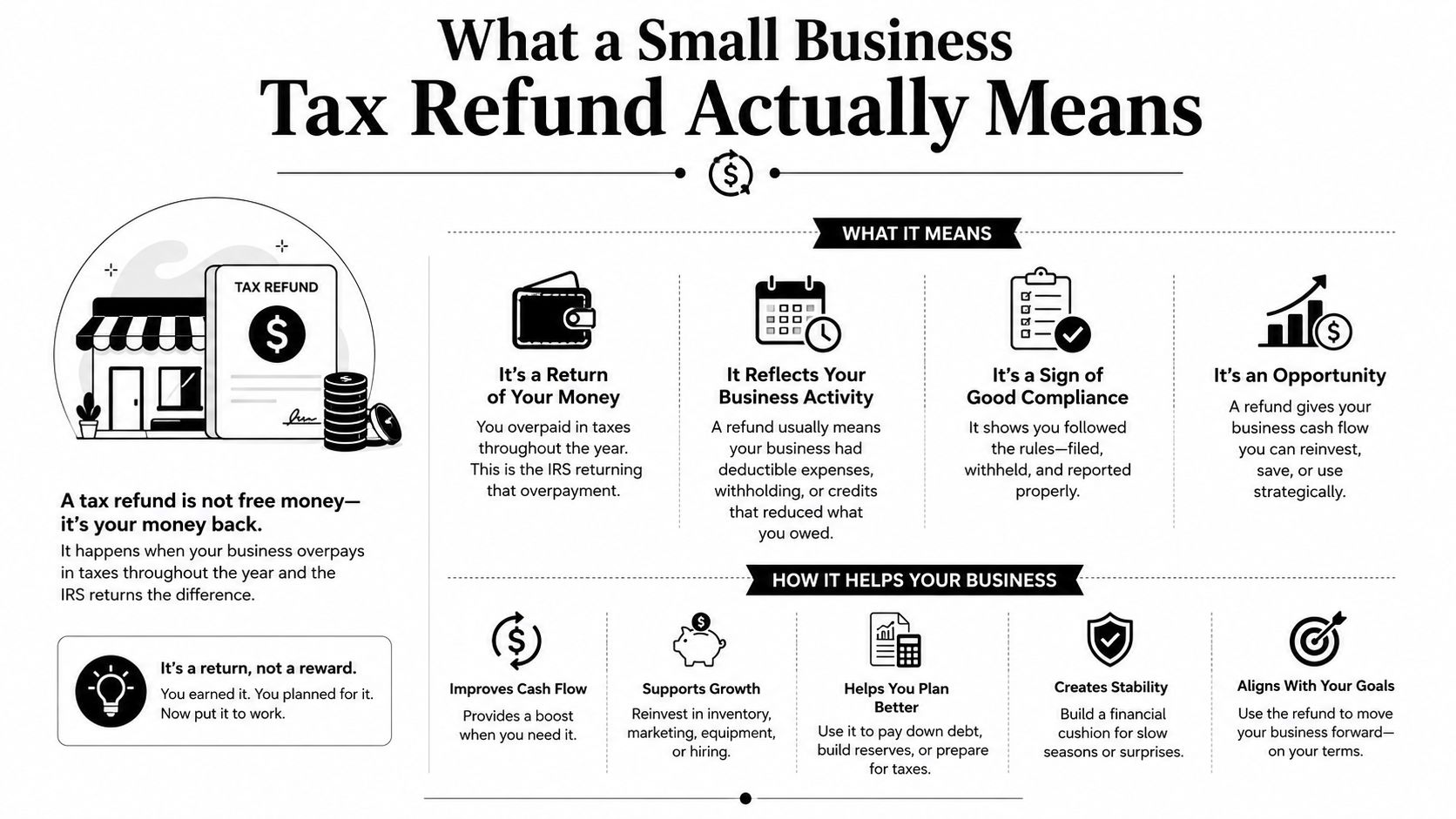
A lot of owners ask about a refund after the check is already out the door. That is usually the wrong time to ask, because the key decision happened earlier, when you chose how to pay in. If you prepaid through withholding, estimated tax, or payroll deposits, and your final tax bill came in lower, the extra amount can come back as a refund.
I do not treat refunds as windfalls. I treat them as proof that the business sent too much cash to the government during the year. In the United States, a survey-based analysis reported that 67% of small business taxpayers got a tax refund in the season studied, while 19% owed money and 14% neither got a refund nor owed tax; the same source said 25% of refund recipients got only a small refund (Firm of the Future analysis). That is the reality most owners face, mixed outcomes and often modest refunds, not giant checks.
Refunds come from overpayment, not status
A business does not get a refund because it is “small.” It gets one because it paid more than it owed. That overpayment usually happens through one of four channels, overwithholding, estimated tax, refundable credits, or corrected filings. Once you understand that, you stop asking whether the IRS gives small businesses special treatment and start asking where the money went.
Practical rule: If the business paid in too much, there may be a refund. If it did not prepay, there usually is not one.
That framing matters because the answer changes with the tax type and the entity. A sole proprietor can overpay personal estimated tax and get money back on a 1040. A C corporation can receive a direct corporate refund. A pass-through entity often cannot receive a federal income tax refund in its own name at all. The refund starts looking less like a perk and more like a bookkeeping correction.
Which Business Structures Can Get a Refund
The entity type is the first thing I check. If you get this wrong, you can spend weeks preparing the wrong form for the wrong taxpayer. Sole proprietorships, partnerships, LLCs, and S corporations usually sit in the pass-through bucket, which means the income is taxed on the owner's personal return rather than at the business level (LendingTree explanation).
Pass-throughs usually route refunds to the owner
If your business is a pass-through, the business itself usually doesn't get a federal income tax refund. The owner does, if anything, because the final tax bill lives on the individual return. That means an overpayment shows up as a refund on the owner's Form 1040, not as money sent to the LLC or S corp as a separate taxpayer.
LLCs confuse people because the legal label is not the tax label. A single-member LLC can be taxed like a sole proprietorship, and a multi-member LLC can be taxed like a partnership or, if it elected it, like a corporation. The entity on paper doesn't decide the refund path by itself. Tax classification does.
C corporations are the direct refund case
A C corporation is the main small-business structure that can receive a federal refund directly from the IRS when estimated payments exceed the final corporate liability (LendingTree explanation). That's the cleanest refund path because the corporation is its own taxpayer. If the company overpaid, the company gets the money back.
For owners, that difference is more than technical. It affects where the refund lands, who signs the return, and whether the issue belongs on a business return or a personal return. If your structure is pass-through, stop looking for a business-level income tax refund and focus on the owner's return, payroll corrections, or refundable credits. If you're a C corp, the company itself may be the claimant.
Income, Payroll, and Sales Tax Refunds Explained
A small business can trigger refunds in three very different tax buckets, and mixing them up is how owners lose money. I see it all the time. Someone hears “refund” and assumes one form fixes everything, but income tax, payroll tax, and sales tax each have their own mechanics, their own filing path, and their own timing.
Income tax refunds live on the right return
For income tax, the refund comes from a mismatch between what was paid in and what was owed. That can happen on the owner's 1040, on a corporate 1120, or on the return that matches the entity type. If you're a sole proprietor, you look at your personal return. If you're a C corporation, you look at the corporate return. If you're an S corporation, the corporation usually isn't the refund recipient for federal income tax, because the income passes through.
That's the reason a business owner can say, “My company paid in too much,” and still need to file on the personal side. The money followed the tax. It doesn't care how the operating account is titled.
Payroll and sales tax refunds require different corrections
Payroll tax refunds usually come from incorrect withholding or FICA reporting, then a correction on the right adjusted return. If the wages were coded wrong, or a deposit was made in error, the refund path runs through payroll reporting, not the income-tax return. For a plain-English guide on the payroll side, see Weisberg's payroll tax overview.
Sales tax is state-specific, but the principle is familiar. If a business remitted more sales tax than it collected or owed for the period, many states let the owner amend the return and claim the overpayment back. The exact form depends on the state, which is why businesses with multiple locations or online sales can't afford lazy bookkeeping.
If you want a useful deduction-oriented reference point while sorting this out, Baron Tax deductions for small business is a solid companion read because it helps owners separate deductions from actual refund mechanisms.
Bottom line: income tax refunds, payroll tax refunds, and sales tax refunds are different claims. File the wrong one and you just create delay.
Refundable Credits That Pay You Even With No Tax
This is the part owners miss. Refundable credits are not deductions, and they are not ordinary nonrefundable credits. A deduction cuts taxable income. A nonrefundable credit can wipe out tax liability. A refundable credit can still put money back in your hands even when the business owes nothing. That is the closest thing the tax code offers to a real refund engine.
Look for programs that refund or offset directly
Maryland's Small Business Relief Tax Credit is refundable up to $500 per employee and $7,000 per business for eligible employers with 14 or fewer employees (Maryland Commerce program). Owners ignore this kind of credit because they assume relief only matters after a profitable year. It matters when cash is tight, and it matters just as much when the return shows little or no tax.
Federal small-business credit programs can be even more powerful in structure. Some programs offer credits as high as $7,000 per employee per quarter, with eligibility tied to a 20% quarterly gross-receipts decline and an annual cap of $28,000. The point is not the headline number. The point is that the tax code sometimes pays a business for fitting a narrow eligibility window, not just for showing profit.
How owners actually find these credits
Start with the state where the business operates, then check whether the credit is refundable, transferable, or only an offset. Read the eligibility language closely. Many credits turn on employee count, revenue decline, industry, or filing status. A business with little taxable income can still qualify for a refund claim if the credit is written that way.
Check the rule, not the vibe. The claim lives or dies on the statute and the return you file.
Professional review matters here. A good CPA can spot the credit. A tax attorney earns the fee when the credit overlaps with a notice, an amended return, a disputed issue, or a deadline problem. If the refund claim is clean, file it. If it touches multiple tax years or any contested item, slow down and get counsel.
Forms, Amended Returns, and the Statute of Limitations
A refund right is useless if you miss the filing path. The IRS and most states don't chase you down to hand money back. If the return is wrong or the payment was misapplied, you usually have to claim the refund yourself, and you have to do it before the deadline runs out. That's why form choice matters as much as the underlying math.
Use the form that matches the mistake
For a sole proprietor or S corp owner who needs to fix the owner-level income tax result, the normal route is an amended personal return, usually Form 1040-X. For a payroll tax correction, the common route is Form 941-X, which adjusts federal payroll reporting and supports a refund or credit for overpaid employment tax. For situations where the IRS claim doesn't fit a normal amended return, a formal claim for refund is filed on the IRS claim form, often Form 843, depending on the issue.
The deadline question matters just as much. The general refund window is tied to the statute of limitations, and for many claims the clock is three years from filing, or two years from payment in some situations. The important thing is not to wait until the paperwork is emotionally convenient. By then, the statute may already have closed.
If you want a deeper look at amendment timing, this guide on how far back you can amend taxes is the right companion piece.
Why records decide the claim
A refund claim lives or dies on records. Payroll claims need wage detail, deposit history, and corrected returns. Owner-level income tax claims need proof of the payment trail and the return position you're changing. If you can't connect the overpayment to the right year and the right taxpayer, the IRS is going to deny, reduce, or stall the claim.
The related concept to keep in mind is carryback treatment for losses. That's a separate refund lever, not a substitute for a standard overpayment claim. If you're trying to use a loss to create a refund, get the year-by-year mechanics right before you file.
Common Mistakes That Cost Small Businesses Their Refunds
Most lost refunds are not caused by bad law. They're caused by bad filing. Owners assume the IRS will sort out the details, and that assumption costs real money. The agency isn't in the business of fixing messy records for you.
The errors I see most often
- Wrong taxpayer name or entity data: If the return doesn't match the legal taxpayer, the refund can get stuck or denied. A mismatch between the LLC, the owner, and the elected tax classification is a classic self-inflicted wound.
- Payroll forms that don't reconcile: If the 941 doesn't match W-2 and W-3 reporting, the IRS has a reason to pause the claim. That's especially common after bonus runs, ownership changes, or late corrections.
- Estimated payments applied to the wrong year: This one is brutal because the money was paid, but it was posted to the wrong period. The result is an artificial balance due in one year and a phantom overpayment in another.
- Missing the limitation period: A legitimate refund claim filed too late is just an untimely claim. The IRS doesn't owe you a second chance.
- Treating a refundable credit like a nonrefundable one: If you report it wrong, you leave cash on the table. The form has to reflect the actual credit type.
The mental checklist before filing
If the names match, the year matches, the payments match, and the return type matches, you're in the right neighborhood.
I'd add one more point. Don't try to “clean it up later” if the refund amount is meaningful. Small errors become big problems once the IRS notices them, and by then you're fighting the clock as well as the paperwork. That's how a refund turns into a correspondence problem, then an appeal problem, then a statute problem.
Real Examples for Sole Proprietors, S-Corps, and Small C-Corps
Abstract rules make sense only when you put them on a real return. Here's the practical version.
A freelance designer operated as a sole proprietor, paid $9,000 in quarterly estimates, and finished a lower-income year with a $2,400 federal refund on her personal return. That is a classic pass-through result. The business did not get a refund in its own name, the owner did, because the tax lived on the owner's return.
An S-corp consulting firm with three W-2 employees overpaid Social Security and Medicare for one quarter after a bonus was miscoded. The correction went through Form 941-X, and the business recovered $1,180 in payroll tax. That wasn't an income tax refund. It was a payroll correction with the right paper trail.
A small C corporation made a $25,000 safe-harbor estimated payment in Q4 and ended the year with $14,000 of liability. The result was an $11,000 refund from the corporate overpayment position. That's the clearest case of a business-level refund because the corporation itself was the taxpayer.
For owners comparing refund paths across jurisdictions, this Australian small business refund example is useful context because it shows how refund timing can vary by regime even when the underlying issue is still overpayment and reconciliation.
| Entity Type | Income Tax Refund Filed On | Payroll Tax Refund Filed On | Typical Trigger |
|---|---|---|---|
| Sole Proprietorship | Owner's personal return | Payroll return if applicable | Estimated tax overpayment |
| S Corporation | Owner's personal return | Form 941-X if wages were overpaid | Payroll correction or owner overpayment |
| C Corporation | Corporate return | Form 941-X if payroll was overpaid | Estimated payments above final liability |
If you run a sole prop and want a smarter way to separate payments from deductions, this strategic guide for sole proprietor tax deductions is a good companion, because the refund question is only half the story. The other half is what should never have been paid in the first place.
When to Bring in a Tax Attorney and What to Ask For
DIY works when the refund is obvious and the return is clean. It stops being safe when the claim touches notices, multiple tax years, payroll exposure, or a deadline that's already tight. If the IRS has reduced the refund, denied it, or misapplied the payment, you're no longer doing routine prep work. You're in controversy territory.
The warning signs are straightforward
If the issue involves a payroll correction that could spill into Trust Fund Recovery Penalty risk, bring in a tax attorney. If you're amending more than one year, or you're close to the statute of limitations, bring in a tax attorney. If an audit, notice, or collection issue is attached to the refund claim, bring in a tax attorney. That's not because CPAs aren't capable. It's because the job has shifted from preparation to defense.
A CPA can prepare and correct returns. A tax attorney can do that too, but can also handle the dispute posture, privilege-sensitive strategy, and the legal argument when the IRS says no. Those are different jobs. A $3,000 refund question may only need careful preparation. A $30,000 disputed claim can justify legal oversight because the downside of a wrong move is bigger than the fee.
If you're trying to choose counsel, this guide on how to find a good tax attorney will help you separate real controversy experience from general tax marketing.
My rule: if the refund is simple, file it. If the refund is contested, time-sensitive, or tied to payroll exposure, get legal eyes on it before you send anything.
Tax Attorney Stephen A Weisberg offers a free Tax Debt Analysis, which is useful here because it lets an owner find out what's possible before committing to a full engagement. That's the right sequence when the refund claim is tangled with notices, penalties, or IRS correspondence. This week, gather the return, the payment proof, and the IRS letters, then get a real assessment before the deadline gets ahead of you.
If you're dealing with a refund that didn't show up, a payroll correction that's already messy, or a claim that may be running toward the statute, visit Tax Attorney Stephen A Weisberg and ask for a free Tax Debt Analysis. He works directly with business owners on IRS and state tax issues, and he can help you figure out whether you have a refund claim worth pursuing or a problem that needs to be handled before it gets more expensive.


