California Underpayment Penalty: 2026 Guide
Confused by the California underpayment penalty? This 2026 guide explains calculations, safe harbors, & waivers for individuals and businesses. Avoid penalties.
In this article
- Introduction to the FTB Underpayment Penalty
- Decoding the California Underpayment Penalty
- What the late payment penalty looks like
- Who usually gets hit
- Why California enforces it so aggressively
- Calculating the Underpayment Penalty Step by Step
- Start with the payment timeline
- A practical example
- What to review on Form FTB 5805
- Why the annualized income approach matters
- What works and what doesn't
- Safe Harbors That Can Protect You From Penalties
- Safe harbor table
- Which safe harbor fits which taxpayer
- The strategic trade-offs
- A better planning habit
- California vs Federal Underpayment Rules
- The biggest practical difference
- Side-by-side comparison
- Why business owners should care
- Special Rules for Businesses and High-Income Earners
- Why business cases are different
- High-income taxpayers lose margin for error
- Short method versus regular method
- What tends to work in complex cases
- How to Request a Waiver and Appeal a Penalty
- What reasonable cause usually looks like
- How to build the request
- If the waiver is denied
- Next Steps and When to Consult a Tax Professional
You open the mail, see Franchise Tax Board, and your stomach drops. You filed the return. You paid a big balance at tax time. So why is California still saying you owe a penalty?
In many cases, the issue isn't that you filed late. It isn't even that you failed to pay by the return deadline. The problem is that California expects many taxpayers to pay tax during the year as income is earned, and the state can assess a california underpayment penalty when those payments didn't happen in the right amounts or at the right times.
That catches people off guard all the time. Self-employed professionals, independent contractors, business owners, S corporation shareholders, and high-income employees with stock compensation often assume they can square up in April. California doesn't always agree. The state looks at timing, payment method, and whether you met one of the available protection rules.
Introduction to the FTB Underpayment Penalty
A typical notice arrives after the return is filed. The taxpayer sees a balance they already paid, then a separate amount labeled as a penalty or interest. That creates confusion because the return may have been accurate. The issue is often the underpayment of estimated tax system, not the return itself.
California uses a pay-as-you-go approach. If too little tax was paid during the year through withholding or estimated payments, the Franchise Tax Board may treat that shortfall as an underpayment even if the final return was filed on time and the entire tax was later paid. That distinction matters because the response strategy changes depending on the type of penalty involved.
From a controversy standpoint, the first task is identifying what the notice is assessing. Some notices involve estimated tax issues. Others involve a late payment penalty on unpaid tax after the filing deadline. Still others involve dishonored payments or business-related liabilities. If you respond to the wrong problem, you waste time and often make the case harder to fix.
Practical rule: Read the notice line by line before you pay or protest anything. The label on the assessment tells you what set of rules applies.
The good news is that this area becomes much more manageable once you separate the moving parts. You need to know what triggered the penalty, how California computes it, whether a safe harbor protected you, and whether a waiver or reduction is realistic. Those are legal and procedural questions, not just math questions.
If you're dealing with a recent FTB notice, start with the assumption that the state is looking backward at timing. That's why someone can owe a penalty even after writing a large check with the return.
Decoding the California Underpayment Penalty
The easiest way to understand this penalty is to think of California tax as an installment obligation. If you earn income during the year, the state expects tax payments during the year. Waiting until the return is due may satisfy the tax itself, but it may not satisfy the payment timing rules.
For many taxpayers, that issue shows up in two different ways. One is the estimated tax underpayment system for people who should have made quarterly payments. The other is a late payment penalty when tax remained unpaid after the due date. Taxpayers often blend these together, but they are not the same.
What the late payment penalty looks like
California's late payment underpayment penalty is calculated as 5% of the unpaid tax plus 0.5% of the unpaid tax for each month or part of a month it remains unpaid, with the total not exceeding 25% of the unpaid tax, according to the FTB penalties and interest rules. For smaller balances due on a return, where the balance is $540 or less, the penalty is capped at the lesser of $135 or 100% of the amount due, under the same FTB penalties and interest guidance.
That is different from an estimated tax penalty. The late payment penalty applies after tax is due and unpaid. The estimated tax penalty applies because required payments were not made during the year.
Who usually gets hit
The taxpayers most likely to face a california underpayment penalty are the people whose income doesn't arrive in neat payroll cycles:
- Self-employed individuals: Consultants, freelancers, and sole proprietors usually don't have automatic withholding doing the work for them.
- Independent contractors: When income is irregular, tax planning often lags behind cash flow.
- Owners of pass-through businesses: S corporation shareholders, single-member LLC owners, and partners can receive income in uneven bursts.
- High-income wage earners with non-wage income: Equity compensation, bonuses, investment gains, and K-1 income can create large shortfalls.
Why California enforces it so aggressively
California wants tax collected as income is earned. That's the policy behind the system. The state isn't waiting until return season to find out what happened. It measures whether enough tax reached Sacramento during the year.
That strict approach creates trade-offs. Waiting to preserve cash may help a business in the short term, but it can generate penalties and interest later. Overpaying estimates can protect against penalties, but it can also tie up money the business needed for operations. Good planning is about managing that tension early, not reacting after the notice arrives.
A taxpayer can owe no late filing penalty at all and still face an underpayment problem because the timing of payments was wrong.
Calculating the Underpayment Penalty Step by Step
The calculation becomes less mysterious once you stop treating it as one year-end number. California evaluates installments over time. That means a payment made later can help, but it doesn't erase the fact that an earlier due date was missed.

Start with the payment timeline
For individuals, Form FTB 5805 is the usual framework. California looks at the required installments and compares them to what was paid through withholding and estimated payments. The process is dynamic, not static.
The due dates matter because the penalty accrues from the due date of an underpaid installment until the date that underpayment is paid, or until the return due date if it remains unpaid. If income is uneven, a later payment may reduce an earlier shortfall, but the penalty still runs for the time that shortfall existed.
According to this discussion of Form FTB 5805 mechanics, an overpayment in one quarter can be applied to an underpayment in a prior quarter, but the penalty for the underpaid period still runs from the original due date to the date the later payment was made. That same explanation notes that the accrual is daily and uses variable interest rates, making precise timing important.
A practical example
Take a freelance graphic designer with uneven income. In the spring, cash flow is strong, then work slows, then a large project pays late in the year. The taxpayer assumes that making a big catch-up payment later will solve the issue.
It helps, but only partially.
If the April installment was too low, California starts measuring from that April due date. If the taxpayer sends a larger payment in June, the excess can be applied to reduce the earlier underpayment. But the April shortfall still generated penalty exposure from April until that June payment date.
That is where many taxpayers go wrong. They focus on the annual total. California focuses on the path you took to get there.
What to review on Form FTB 5805
When I'm evaluating exposure, I usually break it into four questions:
- What was the required installment? The answer depends on the taxpayer's safe harbor position and income pattern.
- What got paid by that date? Include withholding and estimated payments.
- Was there an underpayment for that period? If yes, the clock starts.
- When was the shortfall cured? That date matters because the penalty runs until payment.
For taxpayers who made every payment on time but still face a mismatch, the short method may be available in some situations. For taxpayers with late payments or irregular timing, the regular method often produces the more accurate result and is usually where the primary analysis takes place.
The most common mistake is assuming a big January or April payment fixes a June problem. It doesn't fully fix the timing issue.
Why the annualized income approach matters
Not every taxpayer earns income evenly. A seasonal consultant, real estate professional, or business owner with back-loaded revenue may have valid grounds to compute required installments based on when income was received rather than assuming a flat pattern across the year.
That can reduce or eliminate penalty exposure in the right case. But it has to be done carefully, with records that support the timing of income and payments. If the numbers are weak or the documentation is sloppy, the annualized approach can create more problems than it solves.
A useful starting point is reviewing the estimated tax payment schedule and due date framework alongside your books, bank records, and payment confirmations. The form itself doesn't tell the whole story. The support behind the form is what matters when the FTB questions it.
What works and what doesn't
A few patterns show up again and again in real cases:
- What works: Matching estimated payments to actual income spikes as the year unfolds.
- What works: Keeping proof of payment dates, not just proof that payment was eventually made.
- What works: Recomputing estimates after a major contract, asset sale, or bonus event.
And what usually fails:
- Waiting until return preparation: By then, the timing damage is already done.
- Guessing at installment allocations: California's forms are mechanical. Unsupported estimates invite trouble.
- Using a shortcut when the facts aren't simple: Irregular income usually needs a more careful calculation.
Safe Harbors That Can Protect You From Penalties
For prevention, the safe harbor rules matter more than anything else. If you meet the right safe harbor, California generally won't assess an underpayment penalty even when you still owe additional tax with the return. That is why experienced planning starts with identifying the right target, not trying to predict the final tax bill with perfect precision.
California taxpayers can generally avoid penalties by paying the lesser of 90% of the current year's tax or 100% of the prior year's tax, but if California AGI exceeds $150,000, the prior-year requirement increases to 110%; for AGI over $1,000,000, the prior-year safe harbor is eliminated and the taxpayer must rely on 90% of current-year tax, according to California safe harbor guidance summarized here.
Safe harbor table
| California AGI (Married Filing Jointly) | Required Payment (Lesser of) | Notes |
|---|---|---|
| At or below $150,000 | 90% of current-year tax or 100% of prior-year tax | Prior-year method remains available |
| Above $150,000 and below $1,000,000 | 90% of current-year tax or 110% of prior-year tax | Higher-income taxpayers must increase prior-year target |
| $1,000,000+ | 90% of current-year tax | Prior-year safe harbor is not available |
Which safe harbor fits which taxpayer
The prior-year safe harbor is often the cleanest solution for taxpayers whose current year is volatile. If last year's tax liability was manageable and this year's income may surge, anchoring estimates to the prior year can protect against surprises.
That works especially well for:
- Business owners in a growth year: Revenue may jump, but the prior-year benchmark provides a fixed target if the AGI rules allow it.
- Professionals with variable bonuses or K-1 income: A stable prior-year number is easier to manage than guessing current-year tax quarter by quarter.
- Taxpayers who value predictability: Fixed estimates are easier to calendar and fund.
The current-year method is a different animal. It can be more precise, but it requires better forecasting. For high earners who lose access to the prior-year method, there is no substitute for active planning.
The strategic trade-offs
The safe harbor rules are protective, but they are not always cash-efficient. Paying based on the current year can avoid overpaying if income drops. Paying based on the prior year can be simpler, but it may still require substantial cash outflow even if the current year softens.
That is where planning becomes practical instead of theoretical. The right answer depends on the taxpayer's risk tolerance, recordkeeping quality, and ability to monitor income in real time.
If your income is rising quickly and your AGI still permits the prior-year method, that approach is often the least fragile option.
What doesn't work is mixing methods without discipline. Taxpayers sometimes make a rough payment in April, skip a review in June, then promise themselves they'll catch up later. That approach creates the exact kind of timing mismatch California penalizes.
A better planning habit
The taxpayers who avoid trouble usually do three things consistently:
- They pick a safe harbor early: That creates a clear payment target.
- They review income mid-year: A major change in business or compensation can force a course correction.
- They treat California separately from federal: The state system has its own traps.
Safe harbors are not a loophole. They are the main defensive structure in this area. If you're not using one deliberately, you're usually relying on luck.
California vs Federal Underpayment Rules
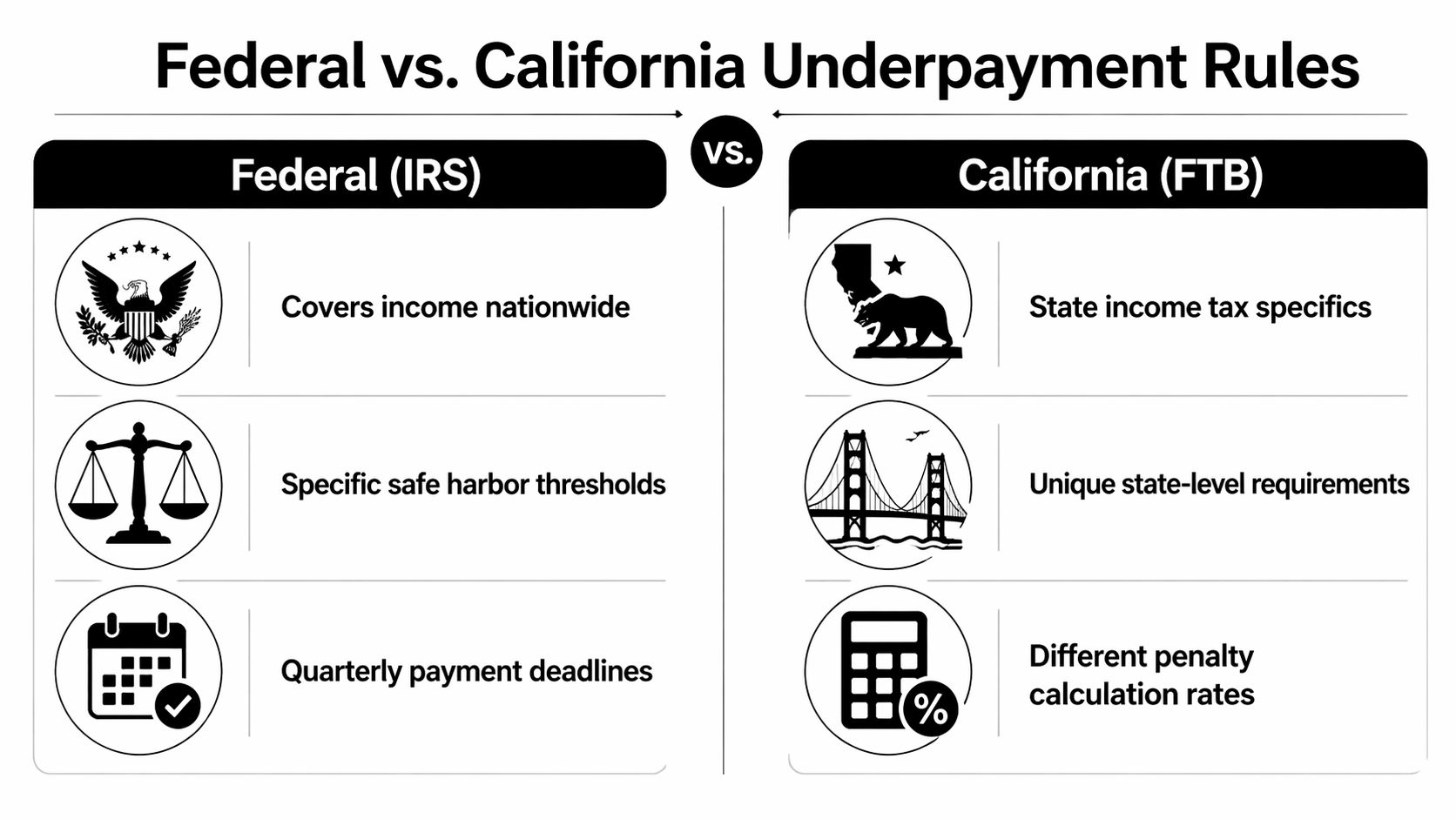
A frequent source of trouble is assuming the IRS and California use the same timing logic. They don't. A taxpayer can be fully compliant federally and still face a california underpayment penalty at the state level.
The biggest practical difference
California's estimated tax system is more front-loaded. The state requires approximately 30% by April 15, 70% by June 15, and 100% by January 15 of the following year under its estimated tax framework, as described in this California safe harbor overview.
That timing catches taxpayers who are used to thinking in equal federal quarters. A payment pattern that feels reasonable under federal planning can still leave California short in the early part of the year.
Side-by-side comparison
| Issue | Federal approach | California approach |
|---|---|---|
| Installment rhythm | More familiar equal-quarter mindset | More front-loaded timing |
| Reliance on prior-year safe harbor for high earners | Federal planning often still centers on prior-year options | California becomes stricter at higher income levels |
| Effect of catching up later in the year | Federal analysis may feel more forgiving in common planning discussions | California's earlier checkpoints create more timing exposure |
The exact trap is easy to see in practice. A taxpayer may make strong payments later in the year and satisfy the annual amount they had in mind. California can still assess a penalty because the shortfall existed at an earlier checkpoint.
Why business owners should care
Business owners and professionals often plan at the federal level first. Their CPA software may focus on the federal estimate. Their attention goes to the larger tax bill. The California piece gets treated as a side calculation.
That is risky when income is uneven, especially with stock compensation, large bonuses, or pass-through income. The state doesn't care that the federal estimate looked reasonable if the California timing rules were missed.
Federal compliance is not a defense to a California underpayment notice.
The practical fix is straightforward. Track California separately, use a California-specific estimate workflow, and revisit the state target whenever income changes materially. Treating the FTB as an afterthought is one of the most expensive habits I see.
Special Rules for Businesses and High-Income Earners
Once you move from a straightforward wage-earner case to a business or high-income case, the analysis gets more technical. The forms change. The payment sources multiply. And the margin for error gets smaller.
For LLCs and corporations, California calculates underpayment issues on Form FTB 5806, which covers shortfalls in annual tax, LLC fees, and NCNR tax, and the form uses a cumulative exception method where overpayments in early quarters can offset later underpayments, as explained in this discussion of FTB 5806 and California business penalty mechanics.
Why business cases are different
Businesses often juggle several liabilities at once. The owner may be making individual estimated payments while the entity is also dealing with annual tax, LLC fee issues, payroll obligations, or pass-through planning. A cash crunch in one area can create exposure in another.
The cumulative exception method can help when payments were uneven but not entirely deficient. That flexibility is useful for companies with fluctuating cash flow. It is not a substitute for planning, though. If the business did not fund required payments, the form won't manufacture a defense.
High-income taxpayers lose margin for error
The toughest cases often involve taxpayers whose income crosses the highest AGI threshold and who no longer have the prior-year safe harbor available. That forces them to work with current-year projections. If compensation is lumpy, that becomes a moving target.
Common examples include:
- Consultants with a breakout year: A few major contracts can radically change state tax liability.
- Owners with pass-through income spikes: Year-end profit allocations often arrive after earlier payment deadlines have passed.
- Employees with equity events: Large vesting or exercise events can upset planning that looked fine a few months earlier.
Short method versus regular method
Generic advice often falls short. Some taxpayers want the simplest possible underpayment calculation and assume the shortcut will be better. Sometimes it is. Sometimes it overstates the problem or ignores timing nuances that help the taxpayer.
When income is irregular or payments were made late, the regular method usually deserves a serious look. It allows the chronology to matter. That can be important for a self-employed taxpayer who paid aggressively after one weak quarter or a business that overpaid earlier and underpaid later.
A good starting point for owners is reviewing how self-employed quarterly taxes interact with both entity-level and owner-level obligations. In practice, many penalty problems start because the owner looked only at one side of that ledger.
What tends to work in complex cases
The businesses that handle this well usually have a process, not just a tax preparer. They reconcile entity obligations and owner estimates together, revisit projections when cash flow changes, and document payment timing carefully.
What tends not to work is making decisions from the bank balance alone. Cash available today does not answer whether the payment should be made today, whether withholding should be increased instead, or whether a cumulative exception could reduce exposure later.
How to Request a Waiver and Appeal a Penalty
Even careful taxpayers make mistakes, and some penalties can be challenged. The key is approaching the request like a legal submission, not a casual apology letter.
What reasonable cause usually looks like
A waiver request has the best chance when the taxpayer can show a concrete event that interfered with compliance despite ordinary care. Serious illness, a death in the family, or disruption from a natural disaster are the kinds of facts that can support relief. Mere oversight usually doesn't.
The strongest requests are documented. Calendar explanations are helpful, but records are better. Hospital records, death-related documents, evacuation materials, financial records, and account access issues can all matter depending on the case.
If you're assembling support, the discipline used in managing audit evidence properly is surprisingly useful here. The more clearly you organize dates, records, and cause-and-effect, the easier it is to present a credible waiver package.
How to build the request
A solid waiver submission usually includes:
- A clear timeline: State what happened, when it happened, and how it affected the ability to pay or calculate correctly.
- Supporting records: Attach documents that prove the disruption, not just your memory of it.
- A compliance narrative: Show that the problem was isolated and that you acted once you were able.
A taxpayer asking for abatement should also review the legal framing behind reasonable cause for penalty abatement. The facts matter, but so does how those facts are presented.
Don't argue that the penalty feels unfair. Show why compliance was not reasonably possible under the circumstances.
If the waiver is denied
A denial isn't always the end of the matter. Some cases are denied because the taxpayer sent too little detail, attached weak proof, or addressed the wrong penalty type. Others are denied because the FTB interpreted the facts too narrowly.
At that point, the issue becomes procedural as much as substantive. Preserve copies of everything submitted, note response deadlines, and evaluate whether the dispute is really about law, facts, or documentation. Appeals that succeed usually do so because they sharpen the record and narrow the issue.
Next Steps and When to Consult a Tax Professional
If you're dealing with a california underpayment penalty, the right first step is diagnosis. Identify whether you're looking at estimated tax exposure, a late payment issue, a business-form calculation, or a waiver case. Each one calls for a different response.
For future years, the practical priorities are simple. Choose a safe harbor deliberately, track California separately from federal, and revisit the plan when income changes. Good systems help here. Many taxpayers benefit from tools that centralize payments, records, and tax workflows, including options discussed in this overview of Cloud Based Tax Software.
Professional help makes the most sense when the notice is large, the issue spans multiple years, the taxpayer owns a business, or the facts support a waiver but need to be framed correctly. If that describes your situation, don't guess. Review the indicators in this discussion of when to hire a tax attorney and get a strategy before responding.
Attorney Stephen A Weisberg helps individuals, business owners, and professionals dealing with California and IRS tax problems through weisberg.tax. He has over 10 years of experience representing taxpayers in audits, tax debt matters, and controversy cases. If you're facing an FTB penalty, need help analyzing estimated tax exposure, or want a second opinion before responding to the state, you can start with a FREE Tax Debt Analysis to find out whether he can help and what the best next move looks like.


