Business Tax Attorney: A Guide to Solving IRS Problems
Facing an IRS audit or business tax debt? Learn when to hire a business tax attorney and how they can resolve your tax problems. Get a free analysis.

In this article
- That Official-Looking Envelope Has Arrived Now What
- First rule after an IRS notice
- What this moment usually means
- What a Business Tax Attorney Actually Does
- Legal representation in a controversy
- Strategic planning when transactions create tax risk
- Resolution work, not just defense
- Attorney vs CPA vs EA Who to Call for Tax Problems
- The clean comparison
- Who should lead
- A simple rule for owners and referral partners
- When referral partners should make the call
- Common IRS Nightmares a Tax Attorney Can Solve
- Audit problems that stop being routine
- Payroll tax debt and the Trust Fund Recovery Penalty
- Income tax debt that will not resolve on its own
- Levies and aggressive collections
- When Your Business Absolutely Needs to Hire a Tax Attorney
- The clearest trigger events
- If you're a CPA, EA, family lawyer, realtor, or lender
- Preparing for Your First Meeting with a Tax Attorney
- What to gather before the call
- What the attorney needs to know
- Questions worth asking
- The Path to Resolution and Your First Step
You open the mail, see the IRS logo, and your stomach drops.
Maybe you're a business owner who already feels stretched thin. Maybe you're a CPA, family lawyer, realtor, or lender looking at a client's notice and realizing this tax issue is about to derail something bigger. A loan closing stalls. A sale gets delayed. A divorce can't finalize. A payroll problem that seemed manageable suddenly looks personal.
That moment calls for calm, not guesswork.
A Business Tax Attorney isn't just another tax professional. In the right situation, this is the person who steps in to protect communications, deal directly with the IRS, and build a legal strategy around the problem instead of just reacting to notices one by one. If the issue involves audits, collections, payroll tax debt, appeals, or a proposed penalty against an owner, waiting usually makes the situation harder and more expensive to fix.
I take a simple view of these cases. Before anyone pays for a full engagement, they should understand what the IRS is doing, what legal options exist, and whether a specialist is necessary. Clarity comes first.
That Official-Looking Envelope Has Arrived Now What
The envelope lands on your desk the same week a loan is underwriting, a property is under contract, or a divorce settlement is close to signature. Then everything pauses. A business owner sees the IRS logo and worries about the tax bill. A CPA, family lawyer, realtor, or lender sees the same notice and realizes the tax issue may now control the entire deal.

Start with one assumption. The notice may be about more than a balance due. IRS problems often surface at the worst possible time, when a transaction needs clean records, payoff certainty, or proof that the government will not step in next. That is why tax debt regularly becomes a deal problem, not just a tax problem. The same issue that worries an owner can stall financing, delay a sale, complicate a support dispute, or raise questions about whether prior transfers were at fair value. If that issue touches a pending transaction, the arm's length transaction definition can help frame why pricing and documentation matter.
First rule after an IRS notice
Do not call the number on the letter until you know what the letter is.
Read the notice number. Confirm the tax year or quarter. Mark the response deadline. Identify what the IRS says it has already done, or plans to do next. Then pull the matching return, payroll records, prior correspondence, and proof of payment. If you need help reading the notice, this guide on responding to IRS letters is a useful place to start.
Practical rule: Identify the notice, the deadline, and the immediate risk before anyone speaks to the IRS.
That one step prevents a lot of avoidable mistakes. Business owners stop guessing. Professional advisors stop giving partial answers based on a quick skim of the first page. You need the file before you need a strategy.
What this moment usually means
Some notices are routine and fixable with records. Others are early warnings of a larger problem. Missing payroll tax filings, proposed assessments, collection notices, interview requests, and letters assigned to a Revenue Officer deserve prompt review. So do notices that arrive while a refinance, business sale, real estate closing, or divorce matter is pending.
My recommendation is simple. If the notice could affect ownership, cash flow, closing timelines, or personal exposure, get a business tax attorney involved early. That advice applies to business owners and to the CPAs, family lawyers, and real estate professionals around them. A short legal review at the front end is often what keeps a tax issue from spreading into every other part of the case.
Clarity changes the tone immediately. Once you know what the IRS is asking, what deadlines control, and whether the problem is administrative or legal, you can make a clean decision instead of reacting notice by notice.
What a Business Tax Attorney Actually Does
A Business Tax Attorney is not just a tax preparer with a law degree. The role is legal advocacy in a tax dispute.
Think of it this way. Your CPA or accountant is often your primary care doctor for tax compliance. They keep the system healthy. A business tax attorney is the specialist you call when the diagnosis gets serious, the consequences get personal, or the government starts pushing back.
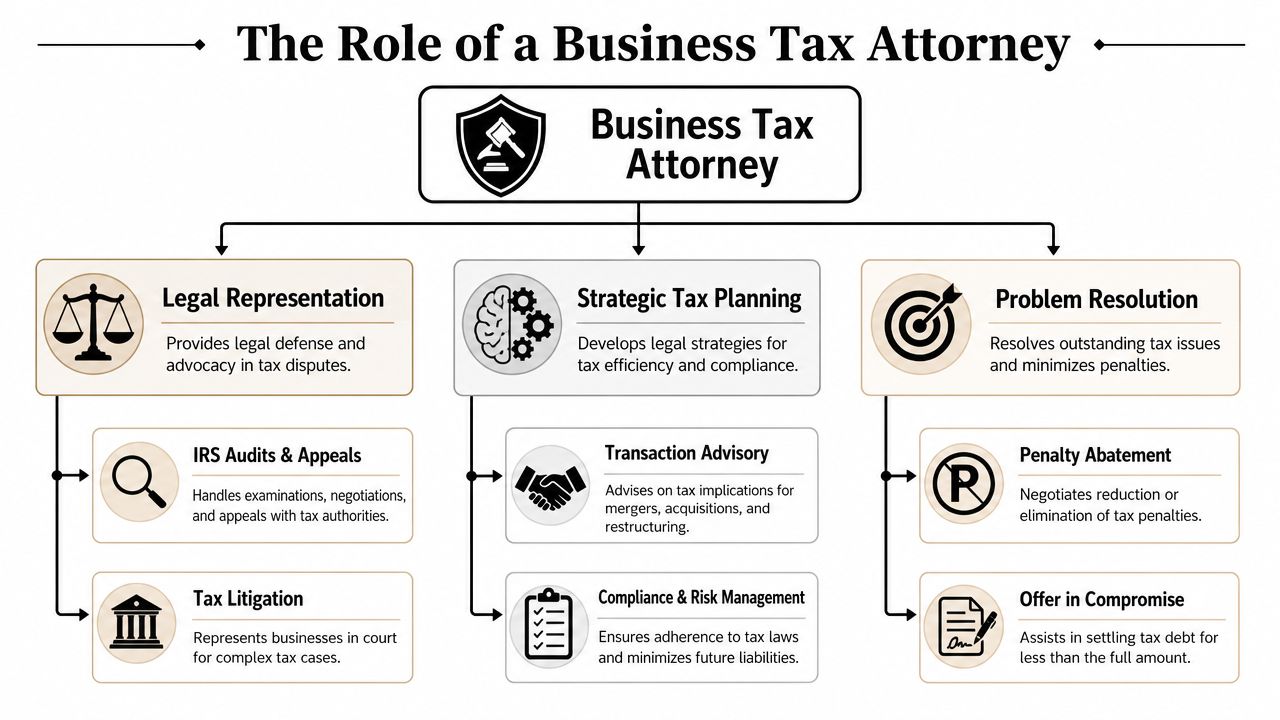
Legal representation in a controversy
When the IRS opens an audit, proposes an assessment, assigns a Revenue Officer, or starts collection action, the job changes from filing forms to defending a position.
A business tax attorney can:
- Stand between you and the IRS by communicating with the agency on your behalf
- Analyze legal exposure when notices involve payroll taxes, owner liability, or appeal rights
- Prepare and present arguments supported by records, law, and procedure
- Handle court-bound matters if the dispute reaches Tax Court or another litigation setting
This isn't paperwork for its own sake. It's legal positioning.
Strategic planning when transactions create tax risk
Not every business tax attorney matter starts with a crisis. Some start with a business event that has tax consequences. Ownership changes, restructurings, buyouts, and related-party transactions can create disputes later if they aren't handled carefully.
If you're sorting through valuation or affiliated-party issues, it helps to understand the arm's length transaction definition because tax authorities care whether a transaction reflects terms independent parties would accept.
The best tax controversy work often starts before the IRS hardens its position. Early legal framing can change the entire outcome.
Resolution work, not just defense
A good tax attorney doesn't just tell you what's wrong. The attorney maps a path out.
That can include:
- Negotiating collection alternatives when full payment isn't realistic
- Seeking penalty relief where the facts support it
- Developing an Offer in Compromise strategy when the legal and financial standards fit
- Structuring disclosures and responses so you don't create unnecessary damage while trying to fix the problem
If you're trying to understand why legal representation can matter so much once the IRS problem turns adversarial, this explanation of why to use an IRS lawyer lays out the distinction well.
Attorney Stephen A. Weisberg's practice, for example, focuses on tax debt analysis and IRS controversy work for business owners and for professionals whose clients need a specialized legal solution before a case, loan, or transaction can move forward.
Attorney vs CPA vs EA Who to Call for Tax Problems
A business owner gets an IRS notice two weeks before closing a loan renewal. The CPA has the returns. The payroll company has partial records. A family lawyer is trying to finish a divorce. Everyone is involved, but no one is clearly in charge of the tax problem.
That is the moment to stop asking who is smart enough and start asking who is assigned to the right job.
CPAs, EAs, and tax attorneys each serve a different function. Choosing correctly early usually means less delay, fewer bad statements, and a better record.
The clean comparison
| Professional | Primary Role | Attorney-Client Privilege | Best For |
|---|---|---|---|
| Attorney | Legal representation in audits, appeals, collections, and litigation | Yes, with legal protections that matter in controversy matters | High-stakes disputes, payroll tax exposure, appeals, owner liability, litigation |
| CPA | Tax preparation, accounting, financial reporting, compliance | Not the same legal privilege as an attorney in a tax controversy | Returns, bookkeeping, tax planning, financial cleanup, audit support |
| EA | Tax representation before the IRS and return-related matters | Not the same legal privilege as an attorney in a tax controversy | Return issues, IRS correspondence, administrative representation in less complex matters |
Who should lead
Use a CPA or EA for compliance work. That includes preparing returns, fixing books, responding to routine notices, and cleaning up reporting problems before they turn into disputes.
Use a business tax attorney when the facts may create legal exposure, when the IRS is expanding its questions, or when personal liability is on the table. The same is true if you are dealing with payroll tax issues, liens, levies, summonses, formal appeals, or statements that could be misunderstood later.
Privilege matters here. If the problem involves judgment calls, internal communications, missing records, inconsistent filings, or the possibility that more than one agency may care, counsel should direct the response from the start.
A simple rule for owners and referral partners
Ask one question. Is this mainly a filing problem, or is it now a defense problem?
A filing problem usually belongs with a CPA or EA. A defense problem needs an attorney.
That distinction helps more than business owners. CPAs, family lawyers, realtors, lenders, and deal professionals often spot the issue first. If tax debt is blocking a sale, refinancing, divorce settlement, probate distribution, or business purchase, bring in tax counsel early. The goal is not to replace the existing advisor. The goal is to give the matter a legal lead while the other professionals stay focused on their own piece of the file.
When referral partners should make the call
If you are a CPA or EA, referring out a controversy matter protects the client and usually protects your relationship with the client. You can still supply records, explain reporting history, and help quantify options.
If you are a family lawyer or realtor, look for practical triggers. IRS transcripts that do not match what the client says. A federal tax lien that blocks closing. Payroll tax debt tied to a closely held business. A revenue officer contact that freezes progress on the transaction. Those are specialist issues.
If your business operates internationally or you're trying to understand UK tax for businesses while also dealing with a U.S. tax problem, keep those functions separate. International compliance content can be useful, but it is not a substitute for U.S. controversy counsel.
If the question is who should prepare or correct the filing, a CPA or EA may be the right first call. If the question is who should protect the client, control the facts, and negotiate the dispute, call a tax attorney.
If you need a practical screening framework, this guide on how to find a good tax attorney is a useful place to start.
Common IRS Nightmares a Tax Attorney Can Solve
A client is trying to close a sale, refinance a property, settle a divorce, or make payroll. Then the IRS problem that was sitting in the background turns into the main obstacle. That is the point where legal strategy matters.
These are the disputes where a business tax attorney earns the fee, not by filling out forms, but by controlling the facts, protecting the client, and pushing the case toward a workable resolution. If you are a CPA, family lawyer, realtor, or lender watching a file stall because of tax debt, these are the problems that justify bringing in controversy counsel.
Audit problems that stop being routine
Some audits stay narrow. Others spread fast.
The warning signs are clear. The IRS starts asking about multiple years, broadens document requests, questions how decisions were made inside the business, or focuses on intent rather than simple math. At that stage, a loose response can create new problems.
Business owners often hurt themselves by trying to sound cooperative. They give answers that are too broad, volunteer documents without context, or lock themselves into facts that were never carefully reviewed. A tax attorney sets the scope of the response, prepares the client for interviews, protects legal positions, and decides whether the case should stay in examination or move to appeals.
Payroll tax debt and the Trust Fund Recovery Penalty
Payroll tax cases deserve special attention because the IRS may try to assess the Trust Fund Recovery Penalty under IRC §6672 against individuals, not just the business. That can include owners, officers, bookkeepers, or anyone the IRS believes had enough control over paying bills and taxes.
Once personal exposure is on the table, this is no longer an accounts-payable problem. It is a legal defense matter.
The work is fact-heavy. The attorney reviews signature authority, cash flow decisions, payroll practices, interview records, internal roles, and whether the IRS followed proper procedure before proposing the penalty. For referral partners, this is one of the clearest handoff points. If your client says, "The company owes it, not me," but the IRS is asking who decided which creditors got paid, get tax counsel involved.
Income tax debt that will not resolve on its own
Old income tax debt usually comes with layers. Filed returns may be wrong. Some years may be missing. Penalties and interest may have turned a manageable balance into a serious business problem. In other files, the IRS assessed tax based on substitute returns that overstated income from the start.
Clients need a plan tied to the actual posture of the case.
That may mean challenging the amount assessed, fixing filing history, seeking penalty relief, structuring payments the business can sustain, or presenting a settlement based on documented finances. The right option depends on what the IRS has already done and what deadlines still exist. A rushed installment agreement can be a mistake if the numbers are wrong. So can filing forms before the record is cleaned up.
Levies and aggressive collections
A levy threat changes the timeline immediately. If the IRS is targeting bank accounts, receivables, or operating cash, normal business decisions start getting made under pressure.
The first job is to stop the immediate harm if there is still time. The second is to put a longer-term resolution in place so the problem does not come right back. If you need a plain-English explanation of how fast this can move, review this guide on IRS levies on bank accounts.
For business owners, the trigger is simple. If IRS collections are interfering with payroll, vendors, closing funds, or daily operations, stop treating it like routine tax admin work. For professional partners, use the same rule. Once the tax issue is blocking the transaction or putting the client's personal exposure in play, bring in a business tax attorney.
When Your Business Absolutely Needs to Hire a Tax Attorney
A business owner is trying to close a sale, fund payroll, or finalize a divorce settlement, and then the tax issue stops everything. That is the point to bring in tax counsel. The question is not whether the problem is annoying. The question is whether it now affects deadlines, personal exposure, or a pending deal.
Some tax matters stay in the lane of return preparation and accounting support. Others turn into legal problems. Once that line is crossed, delay usually makes the file harder and more expensive to fix.
The clearest trigger events
Call a business tax attorney when any of these are true:
- You received a Statutory Notice of Deficiency. That notice starts a legal deadline. If you miss it, you can lose the chance to challenge the proposed tax in Tax Court before paying.
- An IRS Revenue Officer contacted you. That usually means the case has moved beyond routine notice handling and into active collection or investigation.
- The IRS is examining payroll taxes or proposing personal liability. If the government may assess trust fund recovery penalties against an owner, officer, or manager, get counsel involved early.
- Your tax problem is blocking a transaction or legal milestone. Business sales, refinancing, real estate closings, partner buyouts, and divorce settlements often stall until someone deals with the tax issue directly.
- The facts are messy. Commingled accounts, missing books, unfiled returns, nominee issues, disputed ownership, or years of conflicting advice create legal and strategic problems, not just accounting problems.
- You are worried about criminal exposure. Stop talking your way through it and get legal advice first.

One more practical rule. If you are making decisions based on fear of the next IRS letter, you are already past the point where clearer legal strategy helps.
If you're a CPA, EA, family lawyer, realtor, or lender
You do not need to solve the controversy yourself. You do need to spot the handoff point quickly.
The IRS recognizes that taxpayers may need legal representation when tax problems become formal disputes or collection matters, as noted in its discussion of legal representation options for tax problems. For professional partners, that means referring early when the issue affects rights, timing, or a transaction that cannot close with unresolved tax debt in the background.
Use these referral triggers:
- The client says, "It's payroll tax." Treat that as an immediate escalation issue.
- The client cannot close a deal until the tax problem is addressed. Sales, loans, listings, probate distributions, and divorce settlements often need a tax strategy, not more document gathering.
- The client has been calling the IRS for months without progress. At that point, the problem usually needs a controversy plan with deadlines, records, and positioning.
- You can organize records but you are not handling the dispute itself. That is the right dividing line. Keep supporting the facts and let tax counsel handle the legal posture.
Refer when the tax issue starts affecting legal rights, settlement terms, financing, or closing dates. That is the moment a business tax attorney adds real value.
Preparing for Your First Meeting with a Tax Attorney
A first meeting goes better when you bring facts, not guesses. You don't need a perfect file. You do need the key documents and a straight story.
What to gather before the call
Bring the documents that tell the timeline and the amount at issue:
- All IRS notices and letters you've received, even if they seem repetitive
- Filed tax returns for the relevant periods
- Unfiled-year information if returns are missing
- Business financial records that show revenue, expenses, payroll, and available cash
- Bank statements and payroll records if the issue involves employment taxes
- Any prior agreements or submissions made to the IRS by you, a CPA, an EA, or another firm
If a lender, divorce attorney, or trustee is waiting on resolution, bring that context too. It changes how the strategy should be prioritized.
What the attorney needs to know
Don't polish the facts. Explain them.
Start with these points:
- What happened first. When did the IRS contact begin?
- What changed recently. New notice, levy threat, audit expansion, denied payment arrangement, or proposed penalty?
- What matters outside the IRS case. Pending sale, financing issue, divorce, licensing concern, or cash flow pressure.
- Who has already been involved. Accountant, payroll company, prior resolution firm, prior lawyer.
A useful first consultation feels less like a sales pitch and more like a diagnosis. The attorney should identify the procedural posture, the immediate risk, and the realistic next steps.
Questions worth asking
Ask direct questions. You are not wasting anyone's time.
- What is the IRS trying to do here?
- What deadlines matter most?
- Do I need to worry about personal exposure?
- What can be handled quickly, and what takes longer?
- What documents are missing that would change the analysis?
- Should my CPA stay involved, and if so, in what role?
Good tax counsel should leave you with a clearer map, even if the full solution will take time.
If the lawyer offers a free tax debt analysis, use it the right way. Treat it as a fact-finding session. The point is to learn whether the case needs legal intervention, what form that should take, and what your options really are before committing to a larger engagement.
The Path to Resolution and Your First Step
IRS cases rarely resolve overnight. They do become less overwhelming once there's a plan.
That plan might involve contesting an assessment, securing more time, pursuing an Offer in Compromise, setting up an installment agreement, or placing the account into a status that pauses active collection. In other cases, the first priority is narrower. Stop a levy. Respond to a notice properly. Prevent a business payroll issue from turning into personal exposure.
What matters most is sequencing. The IRS problem you are facing might not be the core issue. Sometimes the key issue is privilege. Sometimes it's procedure. Sometimes it's a deadline that maintains an advantageous position. Sometimes it's the fact that a deal, a divorce, or a financing event can't move until someone resolves the tax issue the right way.
If you've made it this far, you're already past the most unhelpful stage, which is staring at the notice and hoping it gets less serious by itself. It won't.
Take the first step that gives you actual information. Get the notices reviewed. Get the timeline straight. Find out whether this is a compliance issue, a collection issue, or a legal controversy that needs immediate handling. Once you know that, the path gets clearer fast.
Attorney Stephen A Weisberg offers a free consultation through Weisberg Tax for business owners and professionals dealing with IRS tax debt, audits, payroll tax exposure, and other controversy matters. If a tax problem is blocking your business, your client matter, or an important deal, a focused legal review can tell you what the IRS is doing, what options exist, and whether formal representation makes sense.