Business Income Tax: A Practical Guide for Owners
Master business income tax with this practical guide. Learn entity differences, filing forms, deductions, and compliance strategies for your business.
In this article
- Understanding Business Income Tax Obligations
- Why historical rates still matter
- The Scale and Scope of Corporate Taxation
- Rates don't predict the final payment
- Corporate Versus Pass-Through Tax Structures
- Compare the total burden, not the label
- Navigating Filing Forms and Deductible Expenses
- Build the filing map
- Make deductions defensible
- Modern Reporting Thresholds and Compliance Workflows
- Use a vendor workflow, not a year-end guess
- Understanding Losses, Self-Employment Tax, and Deductions
- Follow the loss decision tree
- Protect cash flow
- Consequences of Noncompliance and Trust Fund Penalties
- Understand what makes the risk personal
- Actionable Steps for Remediation and Legal Counsel
You're looking at a year's worth of receipts, contractor invoices, payroll records, and bank statements, while your tax software asks a deceptively simple question: What type of business do you operate? The answer determines who reports the income, where deductions are claimed, how distributions are treated, and whether an unpaid payroll liability can become your personal problem.
Business income tax isn't one bill calculated from gross revenue. It's a set of federal, state, and sometimes local obligations shaped by entity classification, taxable profit, deductions, credits, payroll practices, and record quality. The practical objective is to identify where the tax is imposed, preserve the records that support your position, and address payroll or filing problems before they become collection cases.
Understanding Business Income Tax Obligations
A consultant operating as a sole proprietor may report business profit on an individual return. A partnership generally passes its income to its partners. An S corporation reports through the entity and passes items through to shareholders. A C corporation generally pays tax at the corporate level, with another potential tax consequence when it distributes profits. The same revenue can therefore produce very different filing and cash-flow results depending on the legal and tax structure.
That's why a business owner who says, “My company made money, so I owe the corporate rate,” may be starting from the wrong premise. Gross receipts aren't taxable income. The calculation usually begins with income and then considers allowable expenses, depreciation, losses, credits, and other rules. State taxes can add another layer, and some states tax receipts or business activity differently from federal taxable income.

Why historical rates still matter
The federal corporate income tax has changed substantially over time. Congress first imposed it in 1909 at a 1% rate on business income above $5,000, and the rate later reached a historical peak of 52.8% in 1969. The Tax Reform Act of 1986 reduced the top corporate rate from 46% to 34%, while legislation in 1993 raised it to 35% until the Tax Cuts and Jobs Act took effect.
Beginning January 1, 2018, the federal corporate rate became a flat 21% rather than a graduated structure, as documented in this history of federal corporate tax rates. That history explains why comparisons across decades can mislead. A statutory rate is only one input. The effective result also depends on the tax base, deductions, credits, losses, entity type, and applicable state taxes.
For a working checklist, use this small-business tax checklist, then verify the details against the entity's actual filings and accounting records. The right first question isn't “What rate applies?” It's “Who is legally responsible for reporting and paying each category of tax?”
The Scale and Scope of Corporate Taxation
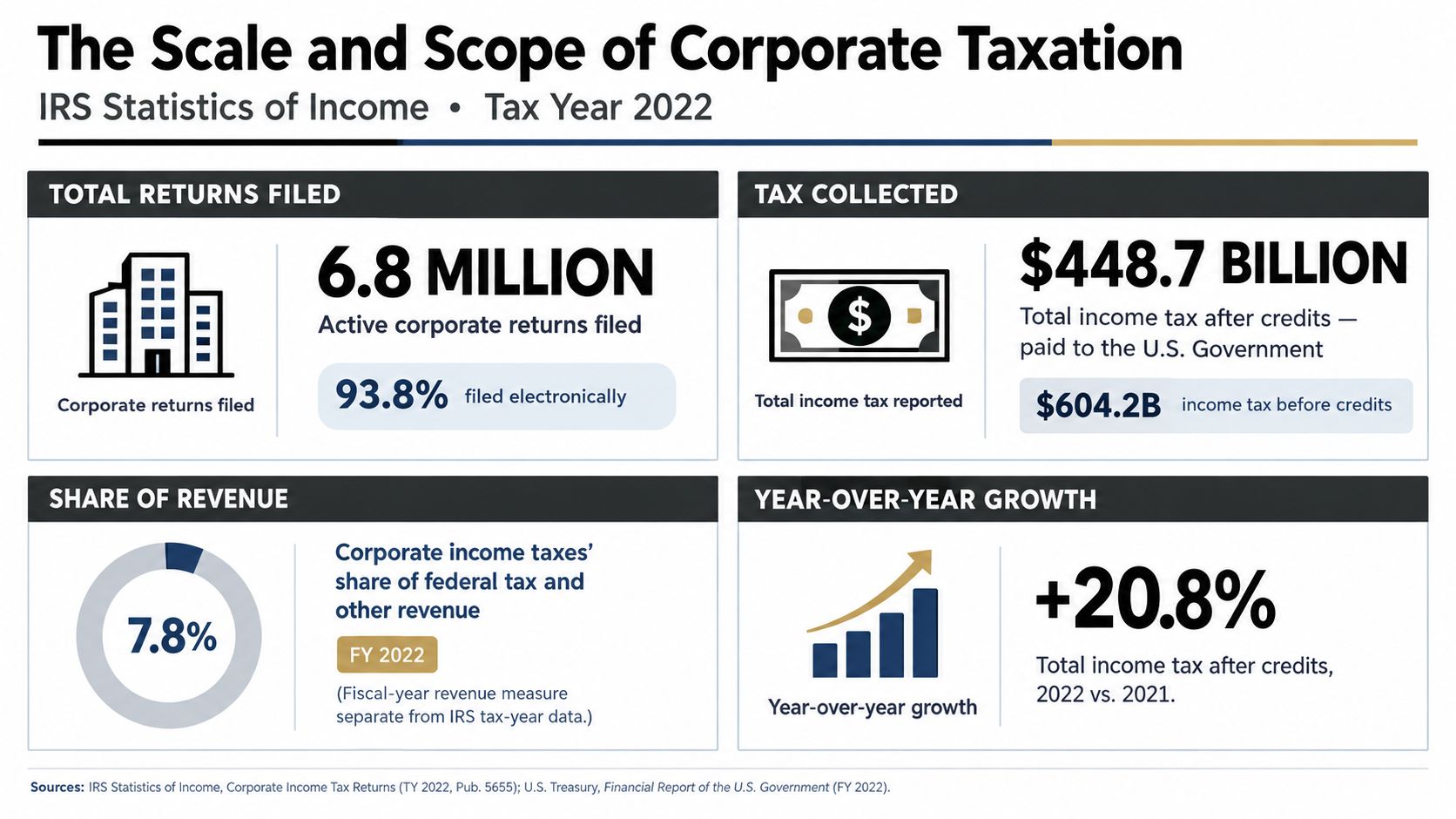
Corporate tax compliance operates at a scale that makes classification and documentation more than administrative details. IRS Statistics of Income data for Tax Year 2022 covered approximately 6.8 million active corporate income tax returns, and about 93.8%, roughly 6.4 million returns, were filed electronically, according to the IRS corporate income tax statistics.
Those returns reported $45.3 trillion in total receipts from operations and investments. Total deductions reached $41.3 trillion, while net income was approximately $4.8 trillion. The relationship between those figures illustrates the point owners often miss: receipts are not the same as taxable profit, and taxable profit is not necessarily the same as the amount ultimately remitted.
Rates don't predict the final payment
Reported income tax before credits reached $604.2 billion, while tax after credits, the amount paid to the federal government, was approximately $448.7 billion. The difference reflects the effect of credits and other adjustments. It also shows why multiplying profit by a headline rate is a poor substitute for preparing an actual tax computation.
The year-over-year figures reinforce the same lesson. Receipts increased 13.9%, deductions increased 13.5%, net income increased 17.7%, reported tax before credits increased 18.8%, and tax after credits increased 20.8%, all from the IRS data linked above. These are aggregate figures, not a forecast for any individual business, but they demonstrate how changes in income, deductions, credits, and losses can move independently.
A sound business income tax review therefore separates four questions:
- What came in? Reconcile sales, investment income, refunds, and other receipts.
- What was spent? Classify expenses and retain evidence that connects them to the business.
- What remains taxable? Apply the rules for depreciation, losses, credits, and entity reporting.
- What must be paid now? Consider estimated payments, payroll deposits, state obligations, and filing deadlines.
Practical rule: Never use the statutory rate as the budget number until the tax base, credits, entity structure, and state obligations have been modeled.
Corporate Versus Pass-Through Tax Structures
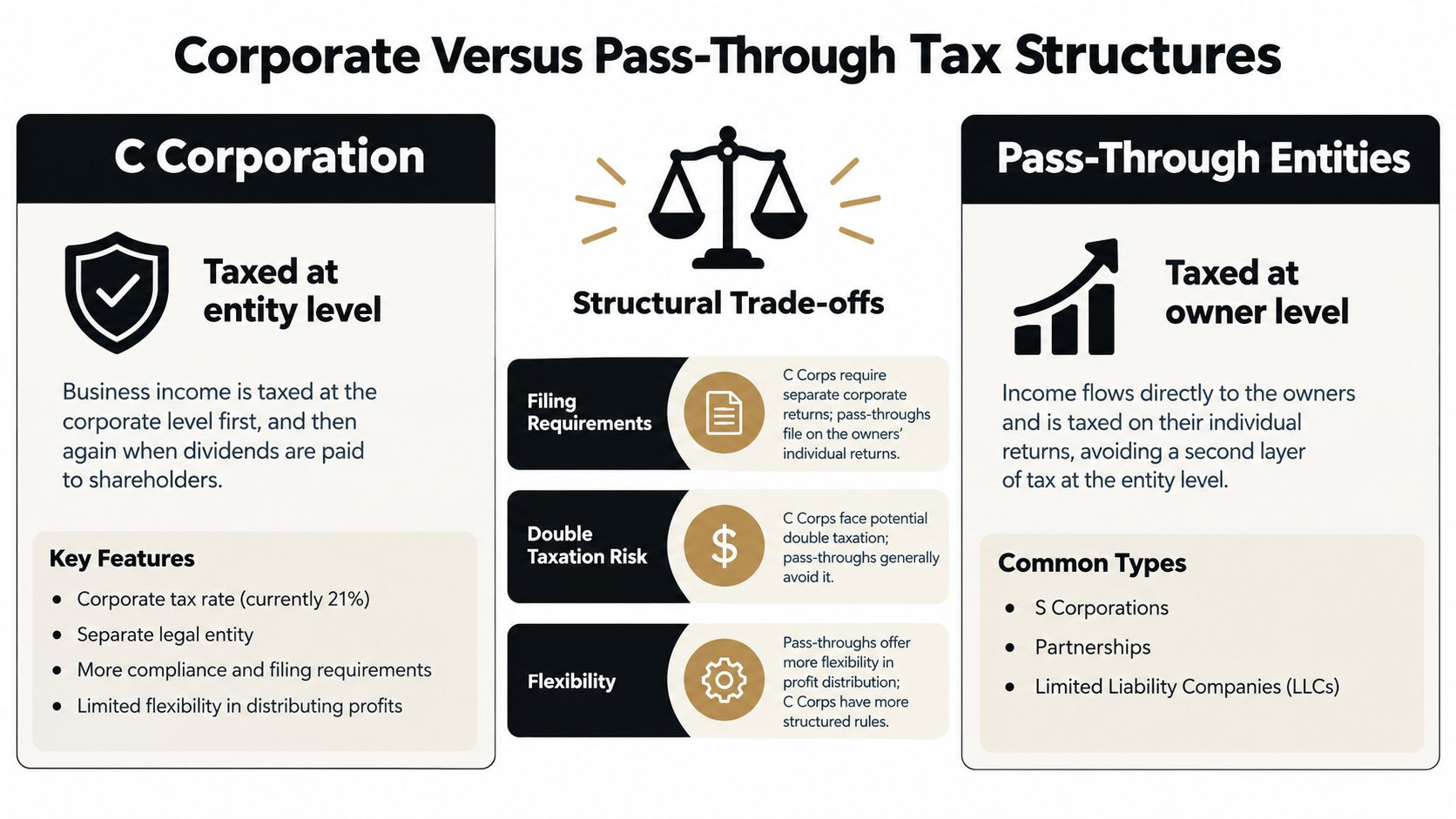
The central distinction is where the government imposes tax. A C corporation generally calculates and pays tax at the entity level. If the corporation distributes after-tax profits to shareholders, those distributions can create a separate shareholder-level tax consequence. That's the classic two-layer taxation concern.
Pass-through entities take a different route. Partnerships, S corporations, and eligible single-owner entities generally report business items to their owners rather than paying entity-level federal corporate income tax on ordinary operating profit. The owners then account for their shares under the rules that apply to them.
Compare the total burden, not the label
A pass-through structure can avoid entity-level corporate tax, but that doesn't mean the owners automatically pay less. Owners may face individual income tax, self-employment tax or payroll-tax considerations, restrictions on losses, and limitations on deductions. A corporation may retain earnings for business needs, which can defer shareholder-level tax, but distributions and compensation require careful planning.
The useful model is operating profit after all relevant taxes, not the nominal rate printed next to the entity name. For each structure, project:
| Planning question | C corporation | Pass-through entity |
|---|---|---|
| Where is ordinary income first reported? | At the corporate level | Generally by the owners |
| What happens when cash is distributed? | A second shareholder-level tax consequence may arise | Cash and taxable income may not match |
| What requires close attention? | Retained earnings, compensation, dividends, corporate deductions | Owner compensation, distributions, basis, self-employment or payroll-tax rules |
| What can distort the comparison? | Credits, losses, state taxes, dividend treatment | Individual tax rates, loss limitations, special deductions |
Changing an entity solely because another owner claims it “saves taxes” usually doesn't work. The decision should account for ownership, expected profit, reinvestment, compensation, distributions, administrative costs, state rules, and exit plans. For businesses operating internationally or considering another jurisdiction, a practical resource on UAE corporate tax planning can help frame the broader issues, but it shouldn't replace advice based on the company's actual structure and residency.
Single-member LLC owners often need particular care because the legal LLC label doesn't by itself answer the federal tax question. The owner may need to report activity directly, or the LLC may have made an election that changes its filing obligations. This step-by-step guide to filing LLC taxes is a useful starting point, but the filed election and accounting records control the analysis.
Navigating Filing Forms and Deductible Expenses
Tax preparation becomes manageable when the owner starts with the entity classification and works outward. Don't begin by searching for deductions. First identify the return that reports the business income, the schedules that support it, and the related payroll or information returns.
Build the filing map
A sole proprietor or a disregarded single-member LLC generally reports business activity through the owner's individual filing. A partnership generally files an information return and provides owners with their distributive information. An S corporation files its corporate return and issues shareholder reporting. A C corporation files its own income tax return and separately handles shareholder distributions.
The exact forms depend on facts such as elections, ownership, accounting method, payroll, foreign activity, and state requirements. Create a written filing map that names:
- Income return: Identify the entity or individual return carrying the business activity.
- Owner schedules: Record how profit, loss, compensation, and distributions reach each owner.
- Payroll filings: Separate wages and withheld taxes from contractor payments.
- Information returns: Track reportable payments and exceptions by vendor.
- State filings: Confirm income, franchise, sales, payroll, and business activity obligations.
Make deductions defensible
A deduction should have a business purpose, a clear amount, and supporting records. A bank statement may prove that money left the account, but it may not explain what was purchased or why it was ordinary and necessary for the business. Keep invoices, contracts, receipts, mileage records, loan documents, and approvals together.
Separate business and personal finances. A dedicated account and business card won't make a personal expense deductible, but commingling makes legitimate expenses harder to prove and obscures owner draws, loans, and distributions. Reconcile the books to the bank statements regularly rather than trying to reconstruct the year from memory.
A deduction that exists only in a spreadsheet is fragile. A deduction supported by an invoice, contract, payment record, and business explanation is much easier to defend.
Some costs require special treatment rather than an immediate deduction. Equipment, improvements, startup costs, vehicle use, meals, insurance, and owner compensation can each involve distinct rules. Use this guide to small-business tax deductions as a planning reference, then have the preparer reconcile the claimed items to the general ledger and source documents.
Modern Reporting Thresholds and Compliance Workflows
Fewer information returns don't mean fewer compliance responsibilities. The IRS says the reporting threshold for many Forms 1099-MISC and 1099-NEC rises to $2,000 for payments made after December 31, 2025, and Treasury estimates that approximately 3.6 million taxpayers, about 98% of them small entities, are affected. Eligible small entities are expected to issue about 10 fewer information returns on average, according to the IRS guidance on the reporting threshold.
That change may reduce paperwork, but it doesn't erase the underlying transaction. The business still needs to know who was paid, why the payment was made, how the vendor was classified, and whether another reporting rule applies. A payment that falls below a federal information-return threshold may still matter for deductible-expense support, worker classification, state reporting, backup withholding, or payroll analysis.
Use a vendor workflow, not a year-end guess
At onboarding, collect the vendor's legal name, taxpayer information where appropriate, entity classification, service description, contract, and payment method. Store the information in the accounting system rather than in an email inbox or an unstructured spreadsheet.
During the year, reconcile the accounts-payable ledger to the bank and card accounts. Separate payments for services from merchandise, rent, legal work, medical services, interest, and other categories that may have different reporting treatment. Flag payments made through third-party settlement platforms and review whether the platform, rather than the business, has the reporting obligation.
At year-end, run a vendor report and document why a form was issued or not issued. Keep invoices and contracts even when no 1099 is required. The key question is not only, “Which payments no longer require a 1099?” It's also, “Can the business prove the expense, the recipient, and the business purpose?”
Understanding Losses, Self-Employment Tax, and Deductions
A tax loss doesn't always mean an immediate cash refund, and it doesn't always eliminate every tax obligation. The IRS's 2025 small-business guide states that self-employed taxpayers generally must file when net earnings reach $400, that Schedule C profit flows to Form 1040, and that a loss from one business generally reduces profit from another when calculating self-employment earnings. The details appear in the IRS small-business guide.
The confusion arises because several systems operate at once. Book income, taxable income, self-employment earnings, basis, at-risk amounts, passive losses, and excess-business-loss rules don't answer the same question. A loss may reduce income tax while producing a different result for self-employment tax, or it may be suspended and become useful only after a later event.
Follow the loss decision tree
Start with the entity. A sole proprietor and a single-member LLC owner may calculate self-employment earnings differently from an S corporation shareholder receiving wages and distributions. Don't assume that a distribution is automatically free from employment-tax analysis, and don't assume that an owner's preferred characterization controls.
Separate ordinary profit from self-employment earnings. The Schedule C result is relevant, but the self-employment-tax computation has its own rules. A business can show a loss for income-tax purposes while another category of earnings or another business affects the self-employment calculation.
Test basis and at-risk limits. Owners can't deduct losses beyond the economic investment or amount for which they're at risk. A loss disallowed under these rules is generally suspended, not necessarily destroyed.
Apply passive-activity and excess-loss rules. A loss from one activity may not be immediately available against unrelated income. The excess-business-loss rules can also restrict current use, even where the bookkeeping shows a substantial operating loss.
Evaluate QBI separately. The IRS guide states that the 20% qualified business income deduction has been made permanent and that the excess-business-loss disallowance has been extended. The QBI deduction isn't a blanket deduction for every owner or every type of income, so calculate it after identifying eligible business income and applicable limitations.
Protect cash flow
Estimate tax from the owner's full picture, not only the business bank balance. Include multiple businesses, wages, distributions, estimated payments, suspended losses, and expected deductions. If a loss is likely to be limited, preserve the supporting records and model when it may become usable instead of treating it as an immediate tax asset.
Consequences of Noncompliance and Trust Fund Penalties
Owners often focus on unpaid business income tax and overlook withheld payroll taxes. That's dangerous because trust fund taxes are collected from employees or customers for the government. When a business withholds payroll taxes and fails to remit them, the IRS can investigate the individuals who had responsibility and authority over the collection and payment process.
The Trust Fund Recovery Penalty can be assessed personally against responsible persons who willfully fail to collect, account for, or pay over withheld taxes. Closing the company, changing its name, or filing bankruptcy doesn't automatically erase that exposure. The government can pursue the individual even when the business itself has little remaining value.
Understand what makes the risk personal
The analysis turns on facts such as who signed checks, controlled bank accounts, decided which creditors were paid, hired or fired staff, reviewed payroll, and had knowledge of the unpaid liability. Responsibility can involve more than the formal owner or officer. Willfulness doesn't necessarily require an intent to cheat the government. Continuing to pay other creditors while knowing withheld taxes remain unpaid can create serious problems.
Unpaid income and payroll liabilities can also lead to interest, civil penalties, collection notices, liens, levies, and disrupted operations. Criminal exposure depends on the conduct and facts, but owners shouldn't wait for a criminal referral before taking the matter seriously. Businesses with obligations in other jurisdictions can also benefit from organized deadline planning, such as this tax deadline guidance from Chern & Co, while recognizing that U.S. federal and state rules require separate analysis.
Do not use withheld payroll taxes as working capital. If the business can't fund payroll tax deposits, escalate the issue immediately and preserve the payment history.
An owner who receives an IRS interview request, Form 4180 questionnaire, revenue officer contact, or proposed Trust Fund Recovery Penalty assessment should obtain counsel before giving an informal statement. This explanation of the Trust Fund Recovery Penalty can help identify the issue, but representation is often necessary when the IRS is deciding personal liability.
Actionable Steps for Remediation and Legal Counsel
Start with facts, not promises. Pull account transcripts, filed returns, payroll records, bank statements, payment histories, notices, and the general ledger. Identify which returns are missing, which taxes remain unpaid, whether payroll deposits were applied correctly, and whether the government has named any responsible person.
Then prioritize the obligations that can create personal exposure. Bring current filings up to date where possible, stop new payroll liabilities from accumulating, and avoid diverting withheld taxes to vendors or other creditors. A payment plan may be appropriate after the liability is accurately established. In some cases, an offer in compromise or another collection alternative may be worth evaluating, but eligibility depends on finances, compliance, and the government's assessment of collectibility.
Tax Attorney Stephen A Weisberg works with individuals, businesses, and their owners on IRS and state tax debt, audits, payroll tax problems, and Trust Fund Recovery Penalty matters. His practice begins with a free tax debt analysis to determine whether representation is appropriate and what resolution path may fit the facts.
The most useful long-term system is simple: classify the entity correctly, reconcile the books regularly, separate payroll money, document deductions, review vendor reporting, and address notices before deadlines expire. If those controls have already failed, professional guidance can help you move from scattered records and escalating notices to a documented remediation plan.
Tax Attorney Stephen A Weisberg can review your business income tax, payroll tax, audit, or Trust Fund Recovery Penalty situation and help determine the next practical step. Visit Tax Attorney Stephen A Weisberg to request a free tax debt analysis before committing to a resolution strategy.


