Spotting Bogus IRS Letters and Tax Scams
Think you received bogus IRS letters? Learn to spot red flags, verify official notices, and protect yourself from sophisticated tax scams with our expert guide.
In this article
- How to Tell If an IRS Letter Is Real
- Initial Verification Steps
- Common Scam Giveaways
- Anatomy of a Bogus IRS Letter
- Language and Tone That Scream “Scam”
- Inspecting the Call to Action
- Official IRS Mail vs Scam Letter Red Flags
- Digital Scams Impersonating the IRS
- Common Digital Tactics
- Protecting Yourself from Online Fraud
- How to Verify and Report Tax Scams
- Taking Action by Reporting Fraud
- Your Verification and Reporting Checklist
- What to Do After Receiving a Fake IRS Letter
- Taking Proactive Security Measures
- When Scammers Have Already Used Your Information
- Knowing When to Bring in a Tax Professional
- Don't Get Scammed While Looking for Help
- Common Questions About Fake IRS Letters
- Will the IRS Ever Call Me First?
- Can I Deduct Losses from a Scam?
- What If I Ignored a Letter I Thought Was Fake but It Was Real?
Getting mail from the IRS can make your heart skip a beat, but it’s crucial to know how to spot a fake. Bogus IRS letters are simply scams designed by criminals to scare you into sending them money or sensitive personal information.
Your first move should always be to treat any unexpected notice with a healthy dose of skepticism. Never, ever use the phone number or website listed in a suspicious letter to "verify" it. That just leads you right back to the scammer.
How to Tell If an IRS Letter Is Real
Let’s be honest, no one is happy to see an IRS envelope in their mailbox. But learning to distinguish a real notice from a fake one is a skill every taxpayer needs.
The real IRS almost always starts contact through physical mail delivered by the U.S. Postal Service. They will never text, email, or hit you up on social media to ask for your personal or financial details out of the blue.
This is a key difference. Scammers rely on panic. A fake letter will often threaten you with scary stuff—imminent lawsuits, arrest, or even revoking your driver's license—if you don't pay up immediately. These high-pressure tactics are a dead giveaway that something is wrong.
Initial Verification Steps
Before you do anything else, take a breath and examine the document. Every official IRS letter or notice has a specific number, usually printed in the top or bottom right-hand corner. You'll see codes like CP2000 or Letter 4903.
You can take that number and look it up directly on the IRS.gov website. This will tell you exactly what the letter is for and confirm if it’s legitimate.
The single best defense you have is to be skeptical. Don't call the number on the letter. Don't click the link. Instead, go to IRS.gov yourself and log into your account or find official contact information to see what's really going on.
Common Scam Giveaways
Scammers aren't perfect, and they often leave clues that expose their fraud. Keep an eye out for these tell-tale signs:
- Weird Payment Demands: The IRS will never demand you pay a tax bill with a prepaid debit card, gift card, or wire transfer. That's a classic scam tactic.
- Aggressive, Threatening Language: Official IRS letters are professional and straightforward. If a letter is screaming about sending the local police to arrest you, it's fake.
- Requests for Your Personal Info: The IRS already has your Social Security number and other critical data. They aren’t going to ask for it in a random letter.
Bogus IRS letters are just another form of phishing, so it’s a good idea to learn how to identify phishing emails to get better at spotting these scams. To see what a real notice looks like, you can learn more about specific letters like the IRS Letter LT36.
Anatomy of a Bogus IRS Letter
Scammers are getting craftier, but even their best forgeries have flaws if you know what you’re looking for. A genuine piece of mail from the IRS follows very strict professional standards, while a fake letter often gives itself away with simple, avoidable mistakes. By breaking down a suspicious notice, you can learn to spot the tell-tale signs of a scam.
Your first line of defense is a simple visual inspection. Look at the letterhead—is it crisp and professional? Scammers often use low-quality, blurry logos that look like they were pulled straight from a Google Image search. The formatting can also be a dead giveaway, with weird spacing, a mix of different fonts, or clunky grammar that would never get past a real government editor.
This flowchart gives you a great visual for how to approach a letter you're unsure about. It walks you through the initial check for red flags versus the steps for official verification.
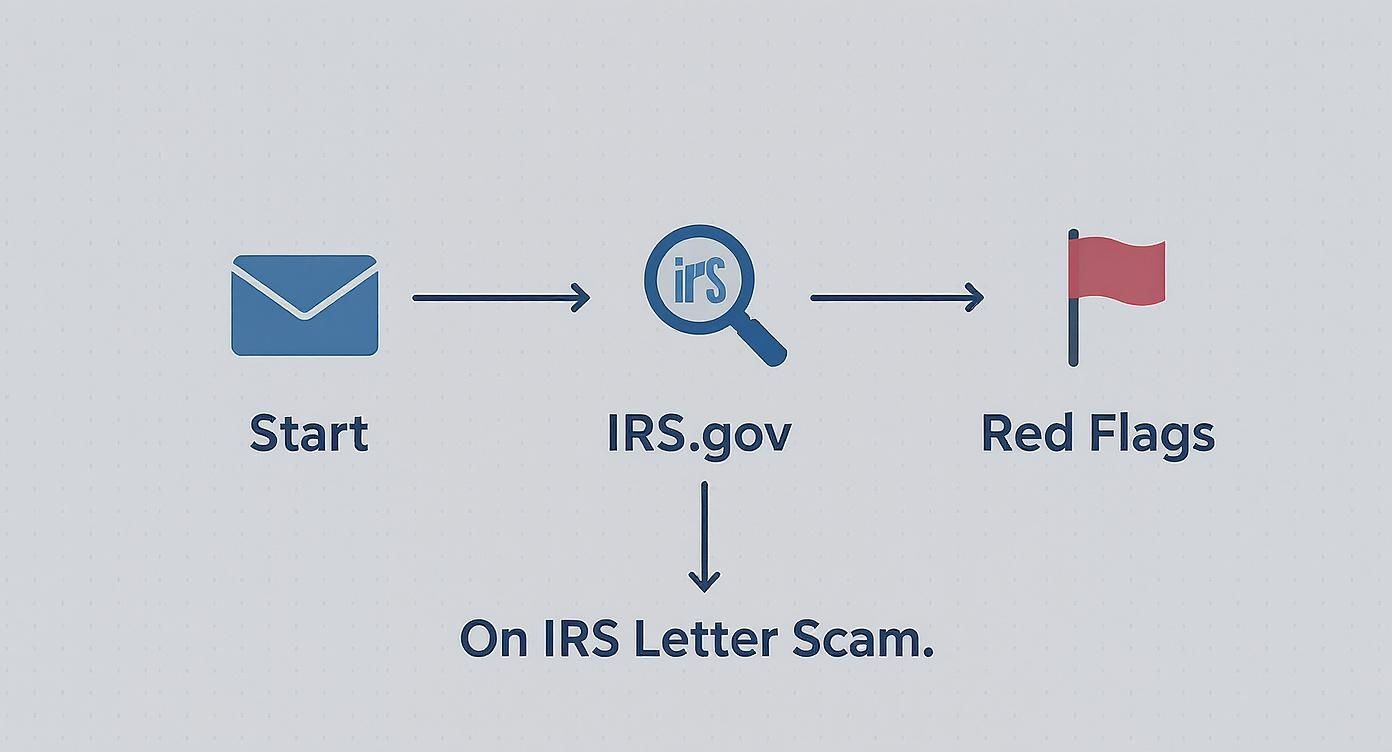
The key takeaway here is that you have two clear paths: one leads to confirming the letter is real, and the other helps you quickly identify common scam tactics.
Language and Tone That Scream “Scam”
Honestly, the tone of the letter is usually the biggest giveaway. A bogus IRS notice is almost always designed to make you panic. It uses aggressive, threatening language to bully you into acting fast, before you have a chance to think things through.
Keep an eye out for these emotional triggers:
- Over-the-top phrases in bold, like "FINAL WARNING" or "LEGAL ACTION PENDING."
- Wild threats of immediate arrest, deportation, or having your driver’s license revoked.
- A manufactured sense of urgency, demanding you call or pay within 24 hours.
The real IRS just doesn't operate like that. Their communication is formal, direct, and matter-of-fact. While they give you clear deadlines and instructions for appeals, they will never use fear to get a response. Their goal is tax compliance, not scaring you out of your wits.
Scammers create a false sense of crisis to bypass your critical thinking. The moment you feel pressured or frightened by a supposed government notice, your scam alert should be going off. The IRS gives you time to respond and always outlines your rights as a taxpayer.
Inspecting the Call to Action
Every piece of mail—whether real or fake—has a "call to action" that tells you what to do next. For scammers, this is where they reveal their entire game plan. A fraudulent letter will always push you toward a channel they control.
For instance, the letter might tell you to call a specific phone number to "resolve the issue immediately." That number won't connect you to an actual IRS agent; it goes straight to a criminal. They might also direct you to a convincing but fake website that mimics the official IRS.gov site, hoping to steal your login credentials or other personal information.
This table breaks down the key differences between what you'll see from the real IRS and the red flags that pop up in scam letters.
Official IRS Mail vs Scam Letter Red Flags
| Characteristic | Official IRS Communication | Bogus Letter Red Flag |
|---|---|---|
| Payment Method | Directs payment to the U.S. Treasury via check, direct debit, or an official online portal like IRS Direct Pay. | Demands payment via gift cards, wire transfers, cryptocurrency, or a Venmo-like app. |
| Contact Info | Directs you to IRS.gov or official, verifiable phone numbers published on their website. | Provides an unofficial 1-800 number or a look-alike website URL (e.g., "IRS-payments.com"). |
| Recipient Info | Correctly addresses you by your full name and often includes a partial Social Security Number (like XXX-XX-1234). | Uses a generic greeting like "Dear Taxpayer" or has no personal details at all. |
| Return Address | Comes from a legitimate IRS service center, which you can look up and verify on the official IRS website. | May have a P.O. Box address or a return address that doesn't match any official IRS location. |
Ultimately, the most important thing you can do is never use the contact information provided in a letter you're suspicious about. Instead, go directly to the official IRS website yourself to look up the notice number or find a legitimate phone number to call. This one simple habit is your strongest defense against these scams.
Digital Scams Impersonating the IRS
While a fake letter in your physical mailbox is still a classic scammer move, the real battleground has shifted online. These days, criminals are much more likely to slide into your inbox or text messages with bogus IRS communications, a tactic known as smishing. They’re banking on catching you off guard with a quick digital hook.
These messages are designed to look alarmingly official. They create a sense of urgency, often packing in malicious links that whisk you away to a surprisingly convincing (but fake) IRS website. Once you're there, the goal is to trick you into entering your most sensitive personal and financial details.
Here's the one thing you absolutely must burn into your memory: the IRS will never start a conversation with you through email, text message, or social media to ask for personal information. Period. This is a hard-and-fast rule. Any message asking for your Social Security number or bank account info is a scam. No exceptions.
Common Digital Tactics
Scammers are masters of emotional manipulation. They know that if they can spark a moment of panic or a jolt of excitement, you’re far more likely to click a link before your rational brain kicks in.
Here are a few of their greatest hits:
- The Surprise Refund: You get an email claiming you’re owed a surprise tax refund. The catch? You have to click a link and "verify" your banking information to get it.
- The Fake Tax Bill: A text message lands on your phone warning of a massive tax bill and threatening immediate legal action unless you click to pay up.
- The "Account Locked" Ploy: An email arrives saying your IRS online account is suspended. You just need to click a link to reactivate it, which, of course, leads to a fake login page designed to steal your credentials.
These tactics are so widespread and effective that email phishing and smishing are consistently at the top of the IRS's annual "Dirty Dozen" list of tax scams. Since the IRS doesn't use these methods for initial contact, you can and should treat any unsolicited message as a fraud. You can always check the latest tax scam warnings from the IRS to stay ahead of the curve.
Protecting Yourself from Online Fraud
Your best defense is a healthy dose of skepticism. Before you even think about clicking a link in a suspicious email, hover your cursor over it. This will reveal the actual destination URL. Scammers love to use URLs that are close but not quite right, like "irs-gov.com" instead of the official "irs.gov."
Never open attachments from an email that claims to be from the IRS. These files are often loaded with malware designed to scrape sensitive information right off your computer or phone. One wrong click can turn into a massive security nightmare.
These digital scams are frequently the gateway to full-blown tax-related identity theft. A criminal gets your info, files a bogus tax return in your name, and pockets your refund. Knowing what to look for is crucial, and if you're worried you've already been targeted, you can learn more about how to navigate IRS identity theft.
In the meantime, just delete these messages and report them. Don't even think about replying.
How to Verify and Report Tax Scams
If you’re holding a letter from the "IRS" that just feels wrong, trust your gut. Scammers are experts at creating convincing fakes, but the golden rule is simple: never use the contact information provided in the suspicious letter itself. You need to take control and use official channels to figure out what's real and what's a trap.
The best way to do this is to go straight to the source. Open a new browser window and manually type IRS.gov into the address bar. Don't click a link from an email or, worse, one printed on the letter you're worried about.
Once you're on the official IRS website, look for the search bar. You can type in the notice or letter number (like CP504 or LT11) that's usually printed in a corner of the correspondence. The IRS keeps a running list of every official communication they send out, so a quick search will show you a sample of the real notice and explain what it's for. This is the fastest way to confirm if what you have is legitimate. For a deeper look into a specific notice, our guide on decoding the IRS CP504 Notice can give you more context.
Taking Action by Reporting Fraud
It's tempting to just shred a fake letter and move on, but reporting it does more than just protect you. It helps the authorities connect the dots and shut these criminals down. Every report adds a piece to the puzzle, giving law enforcement the data they need to track, catch, and prosecute these fraudsters. Think of it as your contribution to the fight.
Here’s a breakdown of where to send your report, depending on how the scammers contacted you:
- Suspicious Emails: Got a phishing email pretending to be the IRS? Don't reply, don't click anything. Just forward the entire email as an attachment to phishing@irs.gov.
- Fraudulent Mail or Phone Calls: For a fake letter received in the mail, or for a threatening phone call from someone claiming to be an IRS agent, your report should go to the Treasury Inspector General for Tax Administration (TIGTA). You can easily file a report on their website or call their fraud hotline.
- General Fraud and Scams: The Federal Trade Commission (FTC) acts as the central hub for collecting all types of scam reports. Filing a complaint at ReportFraud.ftc.gov helps the FTC and its law enforcement partners build bigger cases against these criminal networks.
It might feel like you're just firing a report off into the void, but it's incredibly powerful. The data gathered by these agencies is what allows them to spot trends, warn the public, and ultimately dismantle the operations behind these scams. You become part of the defense system.
Your Verification and Reporting Checklist
When a potential scam lands in your inbox or mailbox, it’s easy to feel a surge of panic. Use this quick checklist to stay calm and take the right steps without putting your personal information at risk.
- Do Not Engage. I can't stress this enough. Don't call the number, visit the website, or reply to the email provided in the suspicious message. Treat all contact info on the document as a trap.
- Verify Independently. Go directly to IRS.gov by typing it into your browser. Search for the notice number there. If you feel you need to speak with an agent, only use a phone number you find on the official IRS website—never one from the letter.
- Report the Scam.
- Emails go to phishing@irs.gov.
- Mail and phone fraud go to TIGTA.
- File a general complaint with the FTC.
- Secure Your Accounts. If there's even a small chance your information was compromised, be proactive. Consider putting a fraud alert on your credit reports with the three major bureaus. You can also voluntarily opt-in to the IRS's Identity Protection (IP) PIN program, which adds a powerful layer of security to your tax filings.
What to Do After Receiving a Fake IRS Letter
That feeling in the pit of your stomach when you realize a letter is a fake is awful. It’s unsettling, to say the least. But in those first few moments, it's crucial to pivot from simply spotting the scam to actively defending your identity and your money.
Your first move should be to go on high alert with your financial accounts and credit reports. You can pull your credit reports for free once a year from all three major bureaus—Equifax, Experian, and TransUnion. Scour them for any accounts, inquiries, or activity you don't recognize. Catching something fishy early is your single best defense.

Taking Proactive Security Measures
Don't just watch your accounts; put up some roadblocks. A great first step is placing a fraud alert on your credit files. Think of it as a red flag for lenders, telling them to take extra precautions to confirm it's really you before opening a new line of credit. The best part? You only have to contact one of the credit bureaus, and they're legally required to inform the other two.
For ironclad, tax-specific security, I strongly recommend voluntarily signing up for the IRS Identity Protection (IP) PIN program. It's a game-changer.
- An IP PIN is a special six-digit number that only you and the IRS know.
- It functions like a secret password for your tax return. Without it, a scammer can't file a bogus return with your Social Security number.
- You’ll need to enter this PIN every time you file. If you don't, the IRS will flat-out reject the return.
The IP PIN is hands-down one of the most powerful tools the IRS provides for stopping tax-related identity theft. It flips the script, letting you play offense instead of defense by locking out criminals before they can do any damage.
When Scammers Have Already Used Your Information
The worst-case scenario is when a scammer beats you to the punch and files a fake tax return using your details. You usually discover this the hard way—when you go to e-file your own return, and it gets rejected because one has already been submitted under your Social Security number.
If you even suspect a fake IRS letter has compromised your personal information, you have to act fast. It's worth looking into the best identity theft protection services, as they offer the kind of deep monitoring and recovery help that can be invaluable in these situations.
Should you become a victim, the very first thing you must do is file IRS Form 14039, the Identity Theft Affidavit. This form is your official S.O.S. to the IRS. It tells them what happened and kicks off the long process of getting your tax identity back. I won't sugarcoat it: this can be a marathon, not a sprint. IRS processing times for these cases have recently averaged over 500 days. But filing that form is the non-negotiable first step to fixing your account and protecting your future filings.
Knowing When to Bring in a Tax Professional
You can usually handle a run-of-the-mill fake IRS letter on your own by reporting it and moving on. But some situations are just too big to tackle alone.
If you're untangling the mess of a serious identity theft case, or if you've received a legitimate but complicated IRS audit notice, that's your cue to call in an expert. Trying to navigate those high-stakes issues by yourself can go from manageable to overwhelming in a heartbeat.
A credentialed tax professional, like an enrolled agent or a tax attorney, doesn't just give advice—they can step in and represent you. This means they communicate directly with the IRS on your behalf, which is a game-changer when you're trying to sort out a confusing paper trail left by scammers. They become a critical buffer between you and the agency.
Don't Get Scammed While Looking for Help
Here’s the ironic part: you have to stay just as vigilant when hiring help as you do when checking your mail. Scammers have even developed a "new client scam" that specifically targets tax professionals. They'll pose as a potential client in distress, send an email with a malicious attachment, and try to compromise the tax preparer's entire system.
This tactic is so widespread and dangerous that it landed on the IRS Dirty Dozen list of tax scams.
When you're vetting a tax attorney or professional, always do your own homework. Check their credentials with your state's bar association or the IRS's own directory. A true expert will never pressure you into signing a contract or promise you a specific, guaranteed outcome.
Knowing when you need professional tax representation when you have a problem with the IRS is half the battle. Making that call can save you from a world of stress and costly mistakes down the line.
Common Questions About Fake IRS Letters
When you're trying to figure out what's real and what's a scam, a lot of questions pop up. Let's walk through some of the most frequent ones I hear from clients.
Will the IRS Ever Call Me First?
In a word, no. The IRS almost never picks up the phone to start a conversation with a taxpayer out of the blue. Their first move, nearly every single time, will be an official letter delivered by the U.S. Postal Service.
If your phone rings and the person on the other end claims to be from the IRS demanding money or information, you can be 99.9% sure it's a scam. Don't engage. Don't give them a single piece of information. Just hang up the phone. Afterward, you can report the fraudulent call to the Treasury Inspector General for Tax Administration (TIGTA).
Can I Deduct Losses from a Scam?
This is a tough one, and the answer is often frustrating for victims. Thanks to the Tax Cuts and Jobs Act (TCJA), the rules for deducting theft losses got much stricter for individuals for tax years 2018 through 2025. For the most part, you can only claim a deduction if the scam involved an investment or some other transaction you entered into with the hope of making a profit.
It's a hard pill to swallow, but under current law, money lost to personal scams—like a romance scam or a fake emergency call from a "grandchild"—is not deductible. This means many victims are left to bear the full financial burden without any tax relief.
What If I Ignored a Letter I Thought Was Fake but It Was Real?
It happens more often than you might think. With so many scams circulating, it's easy to be overly cautious and dismiss a real notice. If you discover a letter you ignored was actually legitimate, the key is to act fast.
Don't panic, but don't delay. The sooner you respond to the notice, the better your chances of minimizing any penalties and interest that might be piling up. If the letter is confusing or the situation feels overwhelming, this is the perfect time to bring in a tax professional. An experienced tax attorney can get on the phone with the IRS for you, figure out exactly what's going on, and help you get the issue sorted out.
Dealing with the IRS is stressful enough without having to worry about scams. At Attorney Stephen A Weisberg, we offer a FREE Tax Debt Analysis so you can understand your options before making any commitments. Get professional help with your IRS issues today.