Bank Levy Definition: What It Means and How to Stop One
Learn the bank levy definition, how federal and state levies freeze funds, the 21-day rule, exempt accounts, and immediate steps to release or stop one.

In this article
- What a Bank Levy Is
- How the Freeze Happens at the Bank
- What the bank holds
- What happens to other account assets
- Federal Levies Versus State Levies Compared
- Exempt and Protected Funds You Can Claim
- Trace the money before asserting protection
- Use the hold period deliberately
- Immediate Steps to Stop or Limit a Levy
- Start with the fastest available resolution
- Put a sustainable arrangement in place
- A Realistic 21-Day Timeline From Freeze to Release
- The first week
- The second and third weeks
- Your Action Checklist and Red Flags
- Week-one checklist
- When a Tax Attorney Is Worth the Call
- What representation should accomplish
Your debit card declines at the grocery store, your payroll transfer fails, or your mortgage payment bounces. Then you find the bank's notice explaining that an IRS or state tax authority has frozen money in your account. The immediate question is usually simple: what does “bank levy” mean, and how do you stop it before the money leaves?
The answer depends on which bank levy you're dealing with. For a U.S. taxpayer, it generally means a legal seizure of money held by a bank to satisfy an unpaid tax debt. It isn't the same as a lien, a lawsuit, or the separate UK Bank Levy, which is an annual charge imposed on certain banks and building societies. The U.S. process also includes a short but important correction window. Under IRS procedure, the bank holds levied funds for 21 days before sending them to the IRS, as explained in the IRS Internal Revenue Manual guidance on bank levies.
What a Bank Levy Is
Your account can look normal one moment and become unusable the next. A payment fails, available cash disappears, and the bank tells you that a taxing authority has issued a levy. In plain English, a bank levy is a legal collection action that lets the IRS or a state revenue agency take money in a bank account to satisfy an unpaid tax debt.
The levy generally follows a tax assessment, an unpaid balance, and notices warning that collection may proceed. It is an administrative tool. For a federal levy, the IRS generally does not need to file a separate lawsuit, but it must follow required notice and procedural rules before taking the funds.
Practical rule: A lien claims an interest in property as security. A levy takes property or money.
That distinction changes your response. A lien can affect the government's claim against property without removing cash from your account. A levy acts directly on funds or other property within the agency's reach. The IRS describes a bank levy as a seizure of money held by a bank or similar institution, with the funds frozen when the bank receives the levy. The bank levy overview for U.S. taxpayers explains the difference in practical terms.
The term creates a second source of confusion. In the UK, Bank Levy refers to a policy charge imposed on certain banks and building societies, based on specified balance-sheet equity and liabilities. It does not describe a freeze of an individual depositor's checking account. UK Bank Levy receipts were £1.3 billion in financial year 2024 to 2025, down 7.6% year over year, according to UK government banking-sector receipts data.
For a U.S. individual or small-business owner, the relevant definition is the IRS or state collection action. It arises from unpaid taxes and collection authority, not from a criminal accusation or a credit-reporting event. The bank may freeze money even when the account is needed for payroll, rent, or ordinary household bills, so the practical issue is often how quickly you can show hardship, ownership problems, or another legal basis for release.
For a broader comparison with creditor remedies, see how to garnish bank account CT. A tax levy and an ordinary civil garnishment can both restrict an account, but they follow different procedures and may offer different ways to challenge or release the funds.
How the Freeze Happens at the Bank
The bank levy process begins when the financial institution receives the government's levy, often through a federal levy form or a state equivalent. The bank looks at the account and identifies funds or rights to property belonging to the taxpayer at the time the levy is received.
The bank's job is mechanical, not investigative. It must honor the levy, freeze covered funds, and provide notice to the account holder. It isn't authorized to decide whether the tax assessment is correct, negotiate the debt, or release the money merely because the customer says the levy is unfair.
What the bank holds
Federal procedure gives the taxpayer a defined period to act. The bank holds the levied funds for 21 days before sending them to the IRS, as stated in the IRS levy guidance for individuals and businesses.
During that period, the account holder may try to:
- Pay the balance: Full payment can resolve the collection issue.
- Request a release: A hardship, procedural error, or ownership dispute may support release.
- Establish a payment arrangement: An accepted resolution can remove the immediate collection pressure.
- Prove another person owns the funds: This is especially important with joint or fiduciary accounts.
The levy reaches property or rights to property that belong to the taxpayer. That can include an account where the taxpayer has signature authority, even when other people can access the same account. A joint account therefore deserves immediate review. The account title alone doesn't answer who owns every dollar.
What happens to other account assets
The levy generally attaches to funds available when the bank receives it. It isn't a continuous sweep of every future deposit under that single action. If new balances appear later, the IRS may need to take additional collection action.
Other property held by the same institution can also require review, including credit balances, cash equivalents, and safe-deposit-box contents. A business owner should also check whether a levy affects operating cash, customer funds, or money held for contractors or other third parties. The IRS explanation of levies on bank accounts discusses these ownership and account-access issues in practical terms.
Federal Levies Versus State Levies Compared
Federal and state levies follow the same basic idea, but the deadlines, notices, appeal procedures, and protected-property rules can differ sharply. Treating a state notice as if it were an IRS notice is a common and expensive mistake.
For a federal levy, the IRS generally proceeds after a Notice and Demand for Payment and a Final Notice of Intent to Levy. The final notice typically gives the taxpayer a chance to request a Collection Due Process hearing before the IRS acts. After the bank receives the levy, federal procedure requires the bank to hold covered funds for 21 days before remitting them.
State authorities rely on their own tax codes and administrative procedures. A state levy may involve income tax, sales tax, payroll tax, unemployment-insurance contributions, or another legally enforceable obligation. Notice periods, exemption rules, post-service holding periods, and appeal rights vary by jurisdiction. A state agency may also use terminology that looks familiar but carries different deadlines.
| Feature | Federal IRS Levy | Typical State Tax Levy |
|---|---|---|
| Authority | Federal collection law and IRS administrative procedure | The state's tax code and collection regulations |
| Common triggers | Unpaid federal income, employment, or other assessed tax debts | State income, sales, payroll, unemployment, or related liabilities |
| Pre-levy notice | Required federal notices, including a Final Notice of Intent to Levy | Rules vary by state and type of liability |
| Bank hold after service | 21 days under federal procedure, according to IRS levy rules | Varies by state law and the issuing agency |
| Appeal path | Collection Due Process or other IRS collection remedies | State administrative appeal, tribunal, or agency process |
| Exemptions | Federal statutory protections and ownership claims | State-specific exemptions, with possible federal protections |
The practical lesson is to identify the issuer before choosing a response. The state tax levy guide can help frame the issue, but a taxpayer still needs to check the exact state notice and deadline. Exemptions and hardship procedures may exist in both systems, but filing the wrong form with the wrong agency won't preserve your rights.
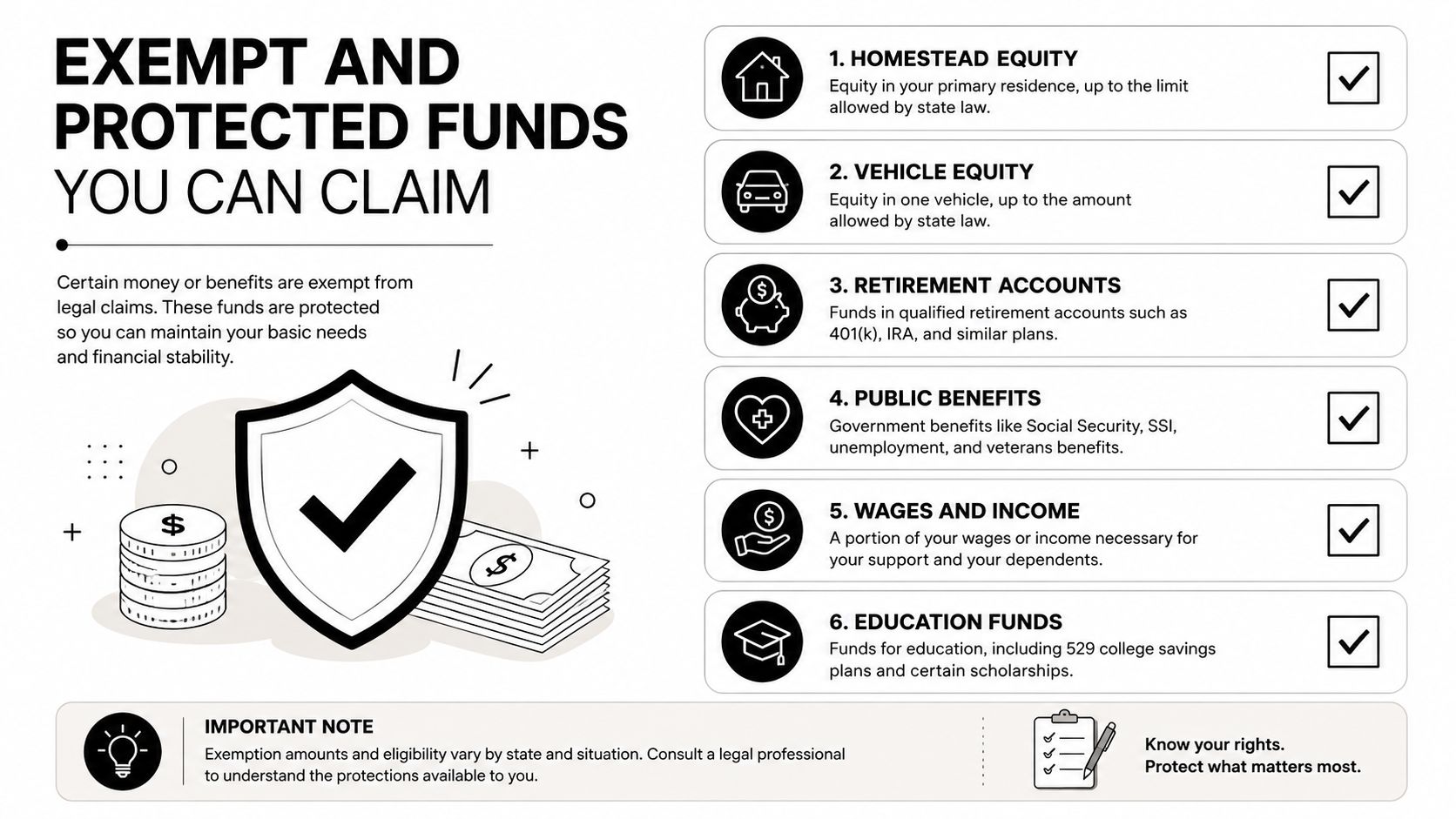
Exempt and Protected Funds You Can Claim
A levy doesn't automatically convert every dollar in an account into government property. Some funds may be exempt under federal law, and money belonging to another person may be outside the taxpayer's collectible interest.
Potentially protected categories can include certain Social Security and SSI payments, Veterans benefits, railroad retirement, military retirement, and qualifying child support payments. Protection depends on the specific benefit, the account circumstances, and the applicable law. The IRS recognizes exempt categories under federal levy rules, including Internal Revenue Code Section 6334 and related guidance.
Trace the money before asserting protection
Protected funds aren't always identified automatically. You need to show where the money came from and whether it remains traceable. A dedicated account for benefit deposits is easier to document than an account receiving business revenue, transfers from relatives, and household spending.
Commingling creates a serious evidentiary problem. Once protected deposits are mixed with ordinary funds, you may have to reconstruct transactions and prove which balance remains attributable to the protected source. Gather bank statements, deposit records, benefit award notices, and transaction histories immediately.
A third party can also assert ownership. For example, a customer's money held temporarily in a contractor's account, or funds belonging to a child held by a custodian, may require a separate ownership claim. A joint account doesn't automatically make every dollar available to satisfy one account holder's tax debt, but the non-liable owner must support the claim with records.
Use the hold period deliberately
The bank's 21-day hold creates time to present an exemption or ownership argument before funds are remitted. Don't assume the bank can resolve the dispute itself. Contact the issuing agency and ask what documentation it requires, then submit a clear written package.
An injured spouse issue is different from a general exemption claim. If a joint federal tax refund or liability involves a spouse who shouldn't bear the other spouse's obligation, IRS Form 8379 may be relevant. Because the form and the levy response address different problems, confirm which remedy matches the facts.
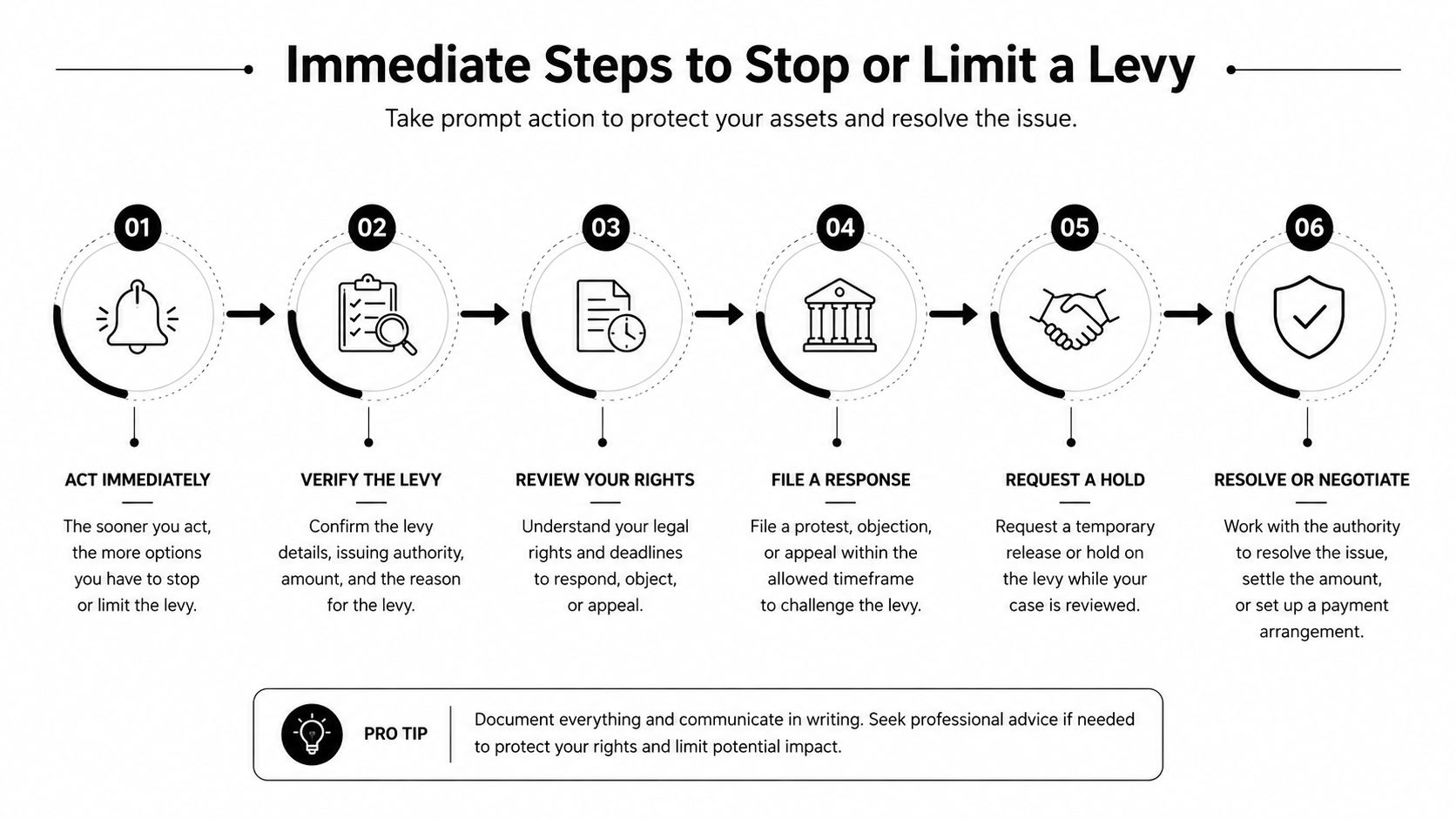
Immediate Steps to Stop or Limit a Levy
The most effective response is fast, organized, and directed to the issuing agency. The bank usually can't negotiate away the underlying tax debt, so spending the entire hold period arguing with a teller or branch manager wastes time.
Start with the fastest available resolution
If you can pay the full balance, confirm the payoff amount with the IRS or state agency and obtain written confirmation that the levy will be released. Full payment removes the collection basis, but you should still verify that the bank received the release instruction and that the account is usable again.
If payment isn't possible, request a hardship release. Explain exactly what the freeze prevents you from paying, such as housing, utilities, food, medical care, or business payroll. Support the request with bank statements, income records, bills, a foreclosure notice, a utility shutoff warning, payroll records, or medical documentation.
A hardship request works best when it proves a specific immediate consequence, not when it merely says the levy feels unfair.
Put a sustainable arrangement in place
A release without a longer-term solution may only postpone another levy. Depending on the facts, consider:
- Installment agreement: A structured payment plan can address the balance over time if you can meet the required terms.
- Offer in compromise: This may be appropriate when your financial condition makes full payment unrealistic and you meet the applicable eligibility requirements.
- Currently-not-collectible status: This can pause active collection when documented income and expenses show that payment would prevent basic living needs.
- Collection Due Process appeal: If you're within the applicable deadline from the Final Notice of Intent to Levy, Form 12153 may preserve appeal rights and allow you to challenge collection or propose a resolution.
A payment plan or settlement isn't guaranteed to release an already-served levy until the agency accepts the arrangement and issues the appropriate instruction. Ask for the release condition in writing.
Do not move money between accounts to hide it. That doesn't resolve the liability and can complicate ownership, disclosure, and collection issues. Call the agency, identify the assigned revenue officer or collection unit, and make a proposal supported by current financial information.
A Realistic 21-Day Timeline From Freeze to Release
Consider a composite example involving a small-business owner whose operating account is frozen after the bank receives an IRS levy. The owner notices the hold online, calls the bank, and obtains the levy information. The first task is to confirm the issuing office, the tax periods involved, the claimed balance, and the exact date the bank received the levy.
The first week
During the first several days, the owner gathers account statements, tax transcripts, current income information, payroll obligations, and proof that some deposits belong to customers rather than the business. The owner also checks whether any benefit deposits or third-party funds are traceable and prepares a hardship request if releasing the money is necessary to keep the business operating.
The bank continues to hold the covered funds. A properly documented exemption or ownership claim must reach the right decision-maker quickly. A branch employee generally can't decide the merits, so the taxpayer should follow the agency's submission instructions and keep proof of delivery.
The second and third weeks
During the next part of the hold period, the owner chooses a resolution path. That may involve applying for an installment agreement, developing an offer in compromise, requesting currently-not-collectible status, or filing a Collection Due Process request if the notice deadline remains open.

By the end of the hold, one of three things usually controls the account: the agency releases the levy, the bank receives instructions to remit the funds, or the taxpayer has established a documented path that prevents immediate enforcement. A release may take additional processing time at the bank, so ask when the instruction was transmitted and when the hold will be removed.
The important point isn't to predict what the agency will do. It's to use every day of the hold to produce a decision-ready file. Once the bank sends the funds, recovery is much harder than prevention.
Your Action Checklist and Red Flags
Treat the first day as a document-and-deadline exercise. Save the bank notice, download the online account activity, and write down the date the levy was received. Then identify whether the issuer is the IRS, a state tax department, or another government authority.
Week-one checklist
- Identify the issuer: Record the agency, contact number, levy amount, tax periods, case number, and assigned officer.
- Calculate the deadline: Mark the end of the bank's 21-day hold using the date the bank received the levy, not the date you happened to notice it.
- Separate the deposits: Highlight benefit payments, customer funds, trust money, and transfers that may belong to another person.
- Gather financial proof: Assemble recent bank statements, income records, rent or mortgage statements, utilities, medical bills, payroll obligations, and tax transcripts.
- Make the right calls: Speak with the bank's levy department, the IRS or state collection officer, and your payroll provider or employer if wage enforcement is also a concern.
- Send a written proposal: Choose payment, hardship release, ownership claim, exemption claim, or appeal based on the facts.
Red flag: A second levy, a joint account containing a non-liable person's money, or Social Security deposited into a mixed account deserves immediate professional review.
Don't rely on a verbal promise. Ask the agency to confirm the release, withdrawal, or payment arrangement in writing, and ask the bank when it received the instruction. Keep a timeline of every call, fax, upload, and confirmation number.
Your priority ladder is straightforward:
- Confirm the deadline and preserve the funds.
- Contact the issuing agency with proof, not just explanations.
- Submit the strongest available release or resolution request.
When a Tax Attorney Is Worth the Call
You may be able to handle a straightforward levy yourself when the balance is clear, you can pay it, or you qualify for a simple online installment arrangement. In that situation, the work is mostly confirming the amount, completing the required steps, and making sure the bank receives the release.
Professional help becomes more valuable when the levy affects a business account, a joint account, or money that belongs partly to someone else. It's also worth considering when you have self-employment income, a prior levy history, disputed tax periods, several unfiled returns, or possible fraud or trust-fund penalty exposure. Those facts can affect both the immediate release request and the long-term collection strategy.
What representation should accomplish
A tax attorney can communicate with the IRS or state revenue officer, review transcripts, prepare a hardship or ownership package, file a Collection Due Process appeal when appropriate, and negotiate a release tied to an accepted payment arrangement. The attorney should also explain what the proposed resolution costs, what information you must provide, and what happens if the agency rejects it.
The guide on when to hire a tax attorney can help you assess whether the complexity justifies representation. Ask during the first consultation whether the fee covers analysis, agency communication, forms, appeals, and follow-up with the bank, or whether each task is billed separately.
Tax Attorney Stephen A Weisberg offers a free Tax Debt Analysis before charging clients to determine whether he can help with IRS or state tax debt matters. He works with individuals, business owners, and professionals who need a levy reviewed or a collection plan developed.
If your account has been frozen, gather the bank notice and the levy date before you call. Visit Tax Attorney Stephen A Weisberg to request a Tax Debt Analysis and discuss whether a release, hardship request, appeal, or payment arrangement fits your situation.


