Bank Levy Attorney Guide: How to Stop an IRS Bank Levy
A bank levy attorney explains how IRS bank levies work, the 21-day rule, legal defenses, and immediate steps to release frozen funds before the IRS takes them.

In this article
- The Morning Your Bank Account Goes Silent
- What the bank is actually holding
- How an IRS Bank Levy Actually Works
- The procedural sequence
- IRS bank levy procedural timeline
- The 21-Day Window That Decides Everything
- What happens inside the window
- What a Bank Levy Attorney Needs From You on Day One
- Defenses and Tools Your Attorney Can Use
- Matching the remedy to the problem
- Three Real Scenarios and How They Resolved
- A personal account used for basic living costs
- A business account with mixed-purpose deposits
- A joint-return levy after divorce
- Fees, Retainers, and the Free Tax Debt Analysis
- What to Do Right Now If You Have Been Levied
Twenty-one days is the built-in holding period after an IRS bank levy reaches your bank. Your account is frozen, and that short window between the freeze and the transfer of funds is where a bank levy attorney works to obtain a release, challenge the levy, or arrange a resolution.
The call often starts with panic. A debit card declines at the grocery store, an ATM shows no available balance, and the bank's general service line redirects the account holder to a levy department. The representative explains that the IRS has issued a legal levy, while scheduled rent, utilities, payroll, and automatic payments remain pending.
The situation feels immediate because it is. The bank has received an IRS instruction to freeze funds already in the account, but the money may not yet have left the account. That distinction creates a narrow legal and practical opportunity. The attorney's job isn't just to “call the IRS.” It's to identify the procedural defect, financial hardship, ownership issue, exemption, or payment solution that can produce a release before the bank remits the funds.
The Morning Your Bank Account Goes Silent
A client may discover the levy before reading the IRS notice that caused it. The debit card stops working, online banking shows a hold, and the bank explains that funds are restricted under language authorizing a “levy upon all property and rights to property.” The account holder usually wants one answer: can the money still be saved?
An IRS bank levy is a legal seizure of funds sitting in a checking, savings, or money market account. It's different from a wage garnishment, which reaches earnings through an employer, and different from a federal tax lien, which establishes the government's claim against property without itself taking the funds. The levy is the collection action that immobilizes and potentially transfers money.
The freeze can disrupt ordinary banking before any funds reach the IRS. Automatic bill pay may fail, checks may be returned, direct deposits may create confusion, and the bank may restrict debit-card access while its levy department processes the hold. The operational detail matters because the bank freezes the account when it receives the levy, not when the taxpayer first notices the problem.
What the bank is actually holding
The levy generally reaches the funds present when the bank receives it. Later deposits aren't automatically captured by that specific levy, although the IRS may pursue additional collection action. That limitation can matter for both sides. It may reduce the immediate amount at risk, but it can also leave the taxpayer facing repeated levies if the underlying liability remains unresolved.
The IRS describes the bank levy process and its holding rule in its official bank levy guidance. A practical explanation of what clients experience when access disappears is also available in this discussion of an IRS bank account freeze.
Practical reality: The account may look frozen, but the case isn't necessarily over. The question is what can be accomplished before the bank's holding period ends.
A bank levy attorney first separates the emergency from the underlying tax controversy. The emergency is protecting the frozen balance. The broader engagement may involve unfiled returns, incorrect assessments, a payment arrangement, hardship status, innocent spouse relief, or business payroll exposure. Treating those as separate but connected problems prevents a client from spending the entire response call arguing about the total tax debt while the immediate funds remain at risk.
How an IRS Bank Levy Actually Works
The legal sequence usually begins with an assessment under Internal Revenue Code §6201. The IRS then sends a notice and demand for payment under §6303. If the liability remains unpaid and the statutory requirements are satisfied, the IRS sends a Final Notice of Intent to Levy and Notice of Your Right to a Hearing, commonly associated with Letter 1058 or LT11.
That final notice is a major defense point. It generally must be sent at least 30 days before the levy, creating a Collection Due Process opportunity under IRC §6330. A timely request can suspend levy action and allow the taxpayer to dispute the collection process, propose an installment agreement, present hardship, or raise certain challenges to the liability.
The procedural sequence
A bank levy doesn't normally begin with the bank. It begins with the IRS assessment, notices, and collection decisions that precede service on a financial institution. Once the IRS issues the levy, it sends the bank an instrument such as Form 668-A, and the bank freezes funds subject to the levy.
The bank's role is largely mechanical. It identifies the account or accounts covered by the levy, restricts the available funds, and holds them for the required period. If the IRS doesn't release the levy and no other legal protection applies, the bank sends the funds to the IRS after the holding period.
Certain funds may receive protection under IRC §6334 and related provisions, including some Social Security, veterans' benefits, and retirement-related funds. Those protections can be limited and may require documentation. A bank may not correctly classify every deposit without a clear explanation of the source and ownership of the money.
IRS bank levy procedural timeline
| IRS Action | Code Section | Taxpayer Deadline | Attorney Defense Window |
|---|---|---|---|
| Tax assessment | §6201 | Review the assessment and account history | Challenge errors, missing returns, or misapplied payments |
| Notice and demand | §6303 | Respond before enforced collection escalates | Confirm the liability and begin resolution |
| Final Notice of Intent to Levy | §6330 | Request a CDP hearing within 30 days | Preserve collection and potential judicial review rights |
| Levy served on bank | §6331 and §6332 | Act immediately after the freeze | Seek release, document hardship, or identify protected funds |
| Funds held by bank | §6332 | Resolve before the 21-day period expires | Obtain an administrative release or complete payment arrangement |
The IRS describes levy procedures in its levy program guidance. A practitioner also needs to inspect whether the IRS sent the required notices, used the correct address, applied payments properly, and followed the collection timeline. The bank levy process explained for taxpayers can help clients understand why the notice history matters.
The 21-Day Window That Decides Everything
The 21-day holding period isn't a courtesy extension. It's a statutory pause that gives the taxpayer a limited chance to prevent the transfer of frozen funds. The bank freezes the account as of the date and time it receives the levy, then must wait before surrendering the funds.
The IRS confirms that the bank must hold the funds for 21 days and surrender them after that period unless the levy is released. The precise timing makes every day consequential. A call placed without the documents may waste a day. A release request sent to the wrong IRS unit may waste another. The attorney has to work the bank and the IRS in the correct sequence.
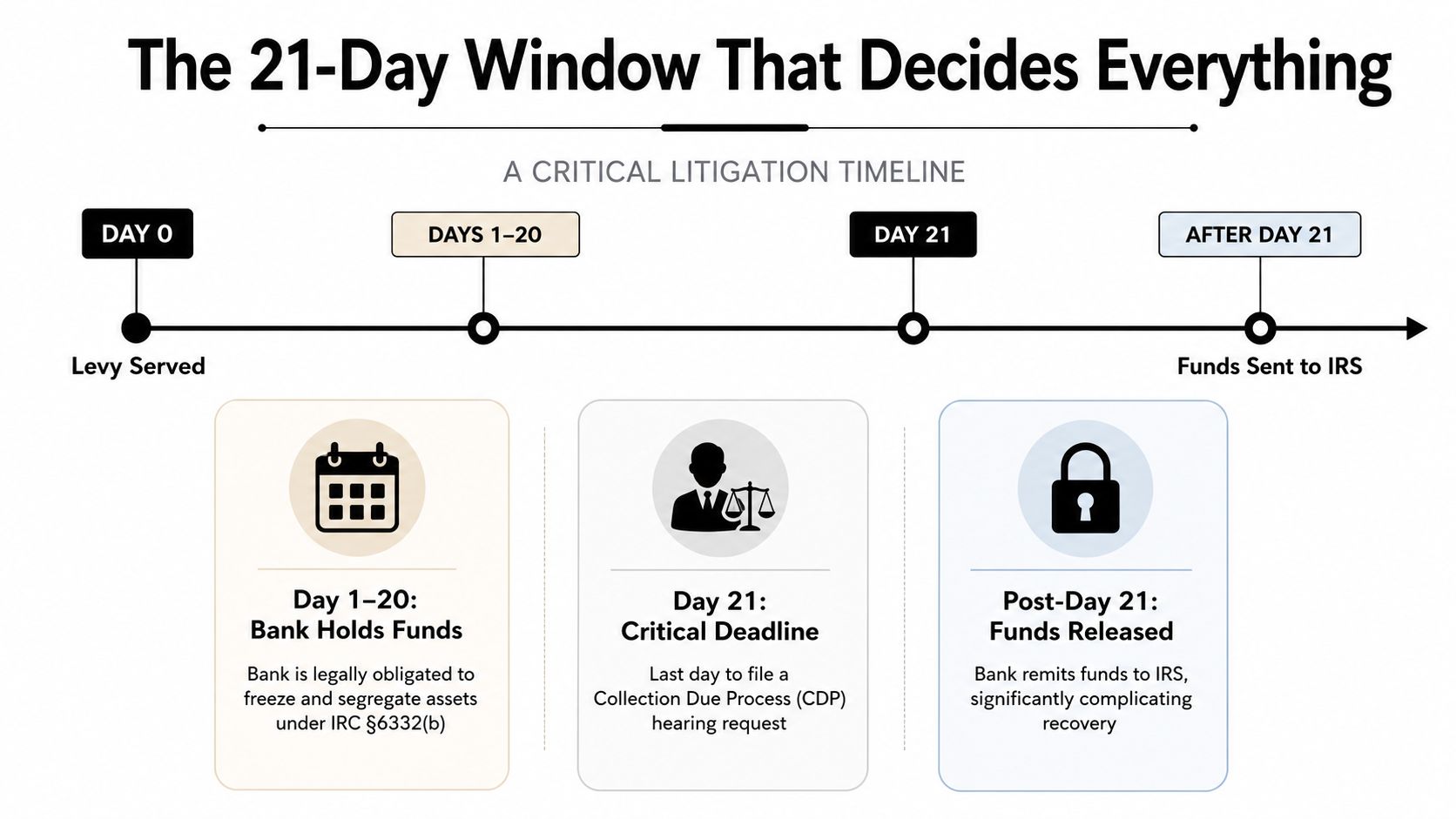
What happens inside the window
The first task is confirming the levy date, the bank's receipt date, the account affected, and the amount frozen. The attorney then contacts the IRS unit or Advisory function connected with the levy and requests a hold or release supported by facts, not general distress.
The available route depends on the file:
A CDP request may preserve suspension rights. If the 30-day period from the Final Notice hasn't expired, counsel may prepare and submit a Collection Due Process request.
A §6343 release request may address hardship. Financial statements, essential living expenses, medical records, housing threats, and evidence of account ownership can support the request.
A same-day resolution may be practical. The taxpayer may arrange an installment agreement, make a full payment, submit an offer strategy, or seek currently not collectible status where the facts support it.
Protected or third-party funds require tracing. Statements and deposit records can show that specific funds belong to another person or derive from a protected source.
The IRS's notice of intent to levy guidance helps explain the earlier warning stage, but once the bank has frozen funds, the response becomes an emergency collection matter.
The strongest levy response is usually a coordinated package, not a single urgent phone call. The IRS needs authority to release, the bank needs release instructions, and the taxpayer needs a credible resolution path.
What a Bank Levy Attorney Needs From You on Day One
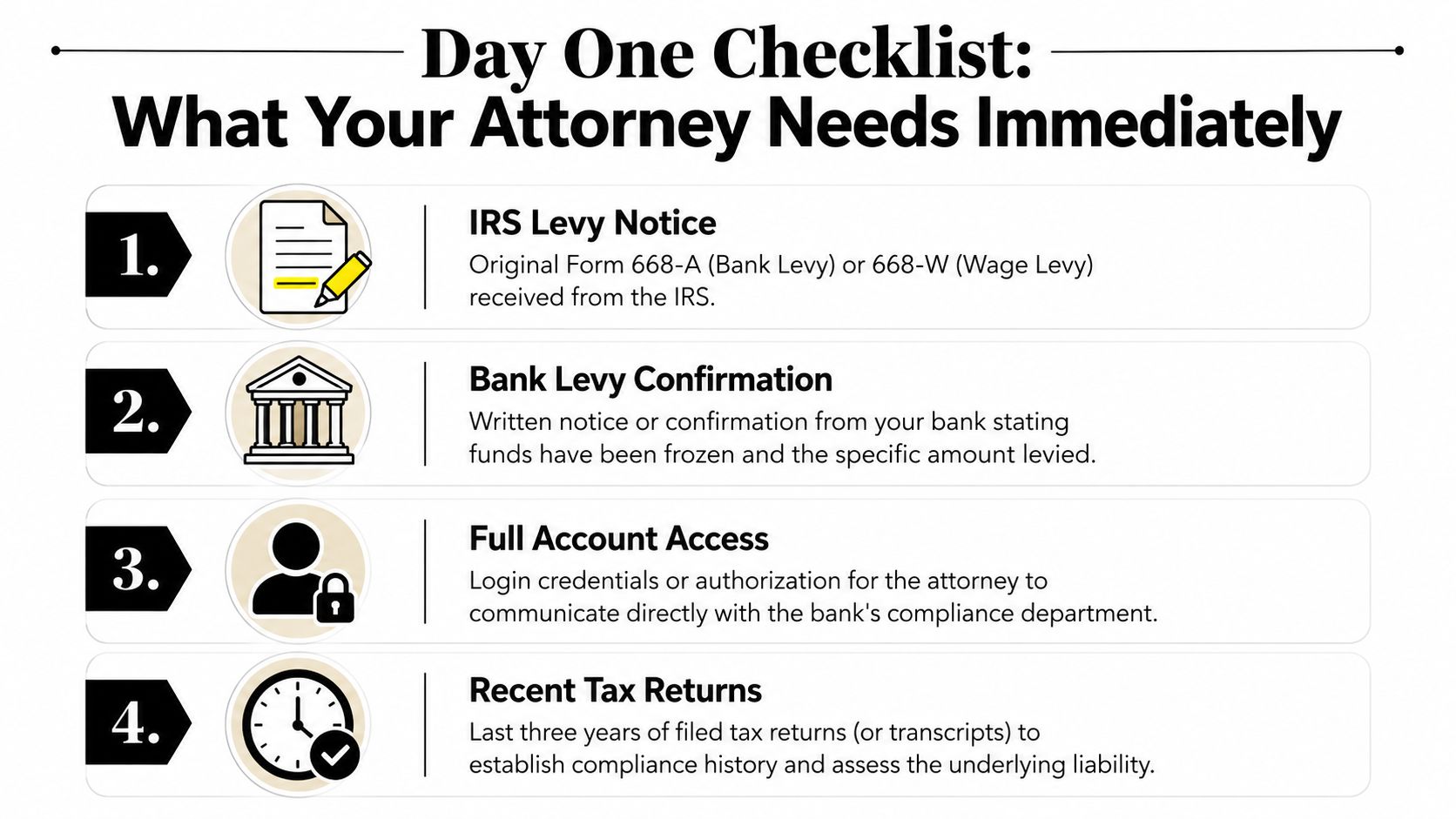
A lawyer can't build a defensible release request from a verbal description alone. The first call should lead to a document exchange that establishes what was levied, when it was levied, whose money is frozen, and what the IRS has already been told.
Start with the levy and bank records:
- IRS levy notice: Provide the original Form 668-A for a bank levy, or any related levy correspondence received from the IRS.
- Bank confirmation: Obtain the bank's hold letter or levy-department confirmation, including the receipt date, affected account, and frozen amount.
- Recent IRS notices: Gather CP504, LT11, Letter 1058, notices and demands, and correspondence for every tax period involved.
- Account statements: Send statements for the frozen accounts covering the recent operating history, including deposit descriptions and transfers.
- Tax records: Include account transcripts, wage and income transcripts, filed returns, amended returns, and proof that current filing obligations are satisfied.
- Financial hardship evidence: Collect pay records, essential expense records, medical bills, housing notices, utility warnings, and proof of dependents where relevant.
- Authorization documents: Prepare identity documentation and a signed Form 2848 so counsel can communicate with the IRS.
Write a short chronology while the dates are fresh. Note when each IRS notice arrived, when the bank first restricted access, whether a payment arrangement existed, and whether any deposit belonged to someone else. Include the bank's levy contact information rather than relying on a general customer-service number.
The Form 2848 instructions matter because an attorney needs valid authorization to obtain account information and communicate effectively with IRS personnel. A complete packet compresses the fact-gathering stage. That leaves more of the holding period for the work that can change the result, such as a release request, a CDP filing, or a documented payment solution.
Defenses and Tools Your Attorney Can Use
No single remedy fits every levy. The correct choice depends on timing, liability accuracy, cash flow, ownership of the funds, and the taxpayer's ability to pay.
A timely Collection Due Process request under IRC §6330 is often the most powerful procedural tool when the Final Notice window remains open. It can suspend collection activity and create an Appeals forum for discussing alternatives or challenging the process. It isn't automatically the best answer if the immediate issue is a bank account containing protected benefits or money belonging to another person.
A parallel levy release request under IRC §6343 may be more direct where the taxpayer can show economic hardship, an error, or a legal reason the levy should not continue. The request needs evidence. A bare statement that the account is needed for bills usually carries less weight than a clear household budget tied to essential expenses and supporting records.
Matching the remedy to the problem
| Tool | Trigger / Authority | Best Use Case |
|---|---|---|
| Collection Due Process hearing | §6330 and timely Final Notice response | Preserving procedural rights and presenting collection alternatives |
| Levy release | §6343 | Economic hardship, wrongfully levied funds, or a resolved liability |
| Installment agreement | IRS collection procedures | A taxpayer who can make sustainable periodic payments |
| Offer in compromise | §7122 | A taxpayer whose finances support compromise analysis |
| Currently not collectible | Collection hardship procedures | No present ability to pay necessary expenses |
| Innocent spouse relief | §6015 | A spouse seeking relief from joint liability based on statutory facts |
| Injured spouse allocation | Joint-return overpayment principles | Protecting a spouse's share of a refund or property interest |
| Trust Fund Recovery Penalty defense | Trust fund collection rules | Contesting personal responsibility for certain unpaid payroll taxes |
| Bankruptcy | Automatic stay and §507(a)(8) considerations | A broader insolvency case requiring bankruptcy analysis |
An installment agreement offers predictability but may require current compliance and financial disclosure. An offer in compromise can reduce the amount pursued in appropriate cases, but it demands careful eligibility and documentation. Currently not collectible status may stop active collection based on hardship, while interest and penalties can continue and the underlying debt remains.
Liability defenses deserve separate attention. Innocent spouse relief can change who is responsible for a joint balance. A business owner may need to challenge personal exposure to a Trust Fund Recovery Penalty rather than treating the company's payroll debt as automatically personal. Bankruptcy can create an automatic stay, but tax priority rules, including §507(a)(8), mean bankruptcy should be evaluated with a tax attorney and bankruptcy counsel together.
Confidentiality also matters when sensitive financial and family information enters the file. A general overview of key legal safeguards can help clients understand why communications, document handling, and the scope of representation deserve attention before engagement.
Three Real Scenarios and How They Resolved
Three levies can look identical on a bank screen and require entirely different legal strategies. The following are composite examples designed to show how the facts drive the response.
A personal account used for basic living costs
A single filer had unpaid income tax for two years, and the levy reached the checking account used for rent, utilities, and ordinary household expenses. Counsel filed a CDP request while also preparing a hardship release package with account statements and an essential-expense budget. The IRS released the levy in 11 days, and the underlying balance was addressed through an installment agreement over 36 months.
The important point wasn't merely that the client needed the money. The release request connected the frozen funds to necessary expenses and paired the hardship argument with a credible payment structure.
A business account with mixed-purpose deposits
An S-corporation owner faced a levy on the operating account. The statements showed that business receipts, payroll funds, and proceeds connected to a personal residence had been commingled. That created an accounting and tracing problem, not just a request for more time.
The attorney separated the payroll portion and supported a §6343 release request for those funds. The remaining balance was addressed through a partial-pay installment agreement while the owner pursued an offer strategy concerning potential trust fund exposure. The business still needed a longer-term accounting cleanup because commingling made every future collection conversation harder.
A joint-return levy after divorce
A divorced spouse received a levy connected to a joint return filed years earlier. The file required analysis of separation, knowledge, benefit, payment history, and the source of the account funds. Counsel pursued innocent spouse relief and injured spouse relief, and the levy was released while the §6015 determination proceeded.
The client ultimately qualified for full relief. In a different case, state property rules, the ownership of a joint account, protected benefit deposits, or delayed consultation could produce a different result. The levy itself doesn't tell you which path is available. The transcript, bank records, family facts, and timing do.
Fees, Retainers, and the Free Tax Debt Analysis
Emergency levy work is usually priced around urgency and complexity. A straightforward release involving one account and one clear hardship issue is different from a business case involving multiple periods, payroll taxes, commingled funds, and possible personal liability.
Common structures include:
| Fee Model | Typical Range | What It Covers | Best For |
|---|---|---|---|
| Emergency flat fee | $1,500 to $4,000 | Initial review, IRS contact, release package, and urgent follow-up | A defined levy-release problem |
| Hourly representation | $250 to $500 per hour | Attorney time for hearings, negotiations, and complex analysis | Matters whose scope is uncertain |
| Blended retainer | Varies by engagement | Initial flat-fee emergency work plus hourly or staged services | Cases that begin urgently and expand |
The fee figures above are practitioner ranges, not guarantees, and they don't predict the outcome. A retainer should state who handles IRS calls, whether transcript retrieval is included, how bank communications are managed, and what happens if the case moves into Appeals, an offer investigation, or litigation.
A Free Tax Debt Analysis should produce useful information before a client pays for full representation. It may include liability verification, a levy and lien search, transcript review, the Collection Statute Expiration Date, hardship screening, filing-compliance review, and a written roadmap of possible options. It shouldn't promise a release before counsel reviews the actual records.
Administrative support can help organize statements, notices, and transcript requests. Some firms use a virtual legal assistant for that work, while reserving legal strategy and IRS advocacy for licensed professionals.
Tax Attorney Stephen A Weisberg offers a Free Tax Debt Analysis to determine whether he can help and what course may fit before charging for resolution work. That approach lets a client compare the likely value of representation with the balance at risk and the complexity of the file.
What to Do Right Now If You Have Been Levied
Start with preservation, not improvisation. Don't spend down the frozen balance, move money between accounts to disguise its source, or give inconsistent explanations to the bank or IRS. Preserve every notice, statement, transaction record, and message connected with the levy.
Then identify the operational facts:
- Call the bank's levy department. Confirm when the bank received the levy, which account is affected, what amount is frozen, and where written confirmation can be sent.
- Collect the IRS correspondence. Look for the levy notice, Final Notice of Intent to Levy, tax periods, notice numbers, and stated balance.
- Build the hardship file. Gather recent statements, pay records, essential expenses, medical documentation, housing notices, and proof of protected or third-party deposits.
- Contact counsel quickly. Ask for a bank levy attorney experienced with CDP requests, §6343 releases, IRS negotiations, and account tracing.
Use a direct script: “My bank received an IRS levy, my funds are frozen, and I need an emergency review of the holding period, notice history, account ownership, and release options.”
Resolution depends on the facts, but the process is far more manageable when counsel receives the complete packet immediately. Ask for the Free Tax Debt Analysis before signing a broader engagement, and make sure the proposed fee covers the specific work your case requires.
Tax Attorney Stephen A Weisberg represents individuals, businesses, and owners facing IRS bank levies, hardship issues, and tax debt collection. Visit Tax Attorney Stephen A Weisberg to request a Free Tax Debt Analysis and discuss the next step before the bank's holding period ends.


