Back Tax Debt Relief: How to Resolve IRS Debt
Learn how back tax debt relief works, including installment agreements, offers in compromise, and when to hire a tax attorney. Get practical guidance

In this article
- When the IRS Comes Calling
- How IRS Collection Works and What Triggers It
- What to check before choosing a remedy
- Installment Agreements as Your Primary Relief Tool
- Choose a payment that clears the debt before the CSED
- Offers in Compromise and When They Make Sense
- Compare settlement with repayment
- Currently Not Collectible Status and Other Alternatives
- Small Business Tax Debt and Personal Liability
- When to Hire a Tax Controversy Attorney
- Your Action Plan for Resolving Back Tax Debt
You open the mail and see an IRS balance-due notice. The tax is more than you can pay today, and the added interest and penalties make the amount feel like it's moving out of reach. If you own a business, you may also be wondering whether the debt belongs to the business, to you personally, or to both.
Back tax debt relief isn't a single program or an automatic reduction. The right option depends on what you owe, your ability to pay, your filing compliance, and how the IRS can collect the balance. A payment plan may ease immediate pressure but cost more over time. A settlement may reduce what you pay, but only if the financial facts support it. Start by understanding the notices, the debt, and the collection deadline that applies.
When the IRS Comes Calling
A balance-due notice can be unsettling, especially when the amount is already difficult to manage. Say you receive a CP14 notice after filing a return. You can't pay the full balance, and you're tempted to set the notice aside until you have more money. That delay doesn't resolve the debt. Interest and applicable penalties generally continue while tax remains unpaid, and the IRS can move toward collection if the balance remains unresolved.
Back taxes may include unpaid income tax, employment tax, or other federal tax obligations. The amount the IRS is trying to collect can include the original tax, penalties, and interest. A lien can affect property interests and complicate transactions. A levy is more direct: it can reach assets such as funds in a bank account or wages, subject to legal requirements and procedures.
Act on the notice, not the fear. Read what the IRS is asking for, note any response deadline, and check whether the balance matches your records before choosing a payment or settlement option.
The IRS has several ways to address a balance, but relief isn't automatic. A taxpayer who can pay in full through available assets or manageable monthly payments may not qualify for a settlement. Someone who can't pay without sacrificing basic expenses may need a different approach. The same program can also be unsuitable even when a taxpayer appears to meet its entry requirements, particularly if the proposed payments don't account for ongoing interest and penalties.
The immediate task is to establish where things stand: which tax periods are involved, whether required returns have been filed, what notices have arrived, and whether enforcement has begun. Those facts shape the choices available. Acting early gives you more time to review options and respond appropriately, rather than making decisions under pressure after collection escalates.
How IRS Collection Works and What Triggers It
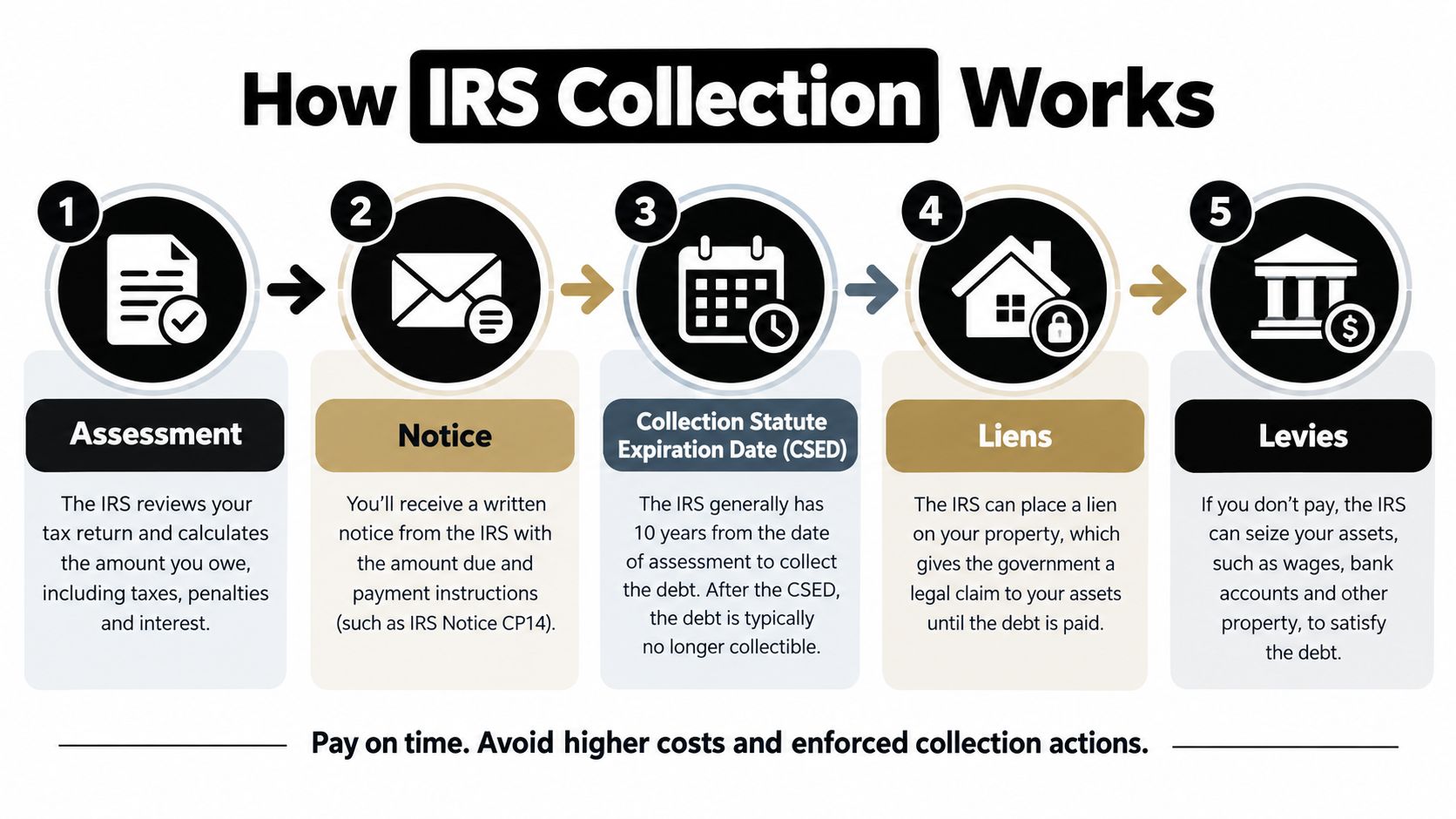
Federal collection generally begins after the IRS assesses a tax liability and sends notices demanding payment. The sequence matters: each notice tells you something about the status of the account and may explain what action the IRS expects. Don't assume every letter has the same effect or deadline. Read the notice itself and check what response rights it describes.
The collection timeline is also shaped by the Collection Statute Expiration Date (CSED). For federal tax debt, the CSED is normally 10 years from assessment, though circumstances can affect the calculation. That date matters because an installment agreement generally needs to pay the liability, including ongoing accruals, before the collection period expires. An agreement isn't a request to divide today's balance into equal payments. The IRS may consider whether the proposed amount will satisfy the debt in time. IRS guidance on installment agreements and collection deadlines explains the general framework.
What to check before choosing a remedy
- Assessment and balance: Confirm the periods involved and compare the IRS's figures with your filings and payment records.
- Notices and deadlines: Keep every letter and identify any stated response date or appeal procedure.
- Financial disclosures: If you don't fit a simplified payment category, the IRS may ask for a Collection Information Statement with supporting details about income, expenses, assets, and liabilities.
- Type of tax debt: Federal and state tax debts are separate matters. A federal arrangement doesn't resolve a state liability.
Business owners should treat employment-tax debt as a reason to examine the situation promptly. The liability may involve both the business and people who can be held personally responsible. The account's label alone doesn't establish who is legally liable.
If a refund has been intercepted and you're trying to understand the family-law context, this guide to what to do if a refund is intercepted may help clarify the issue. For collection matters involving direct IRS contact, it can also be useful to understand what an IRS revenue officer does.
Installment Agreements as Your Primary Relief Tool
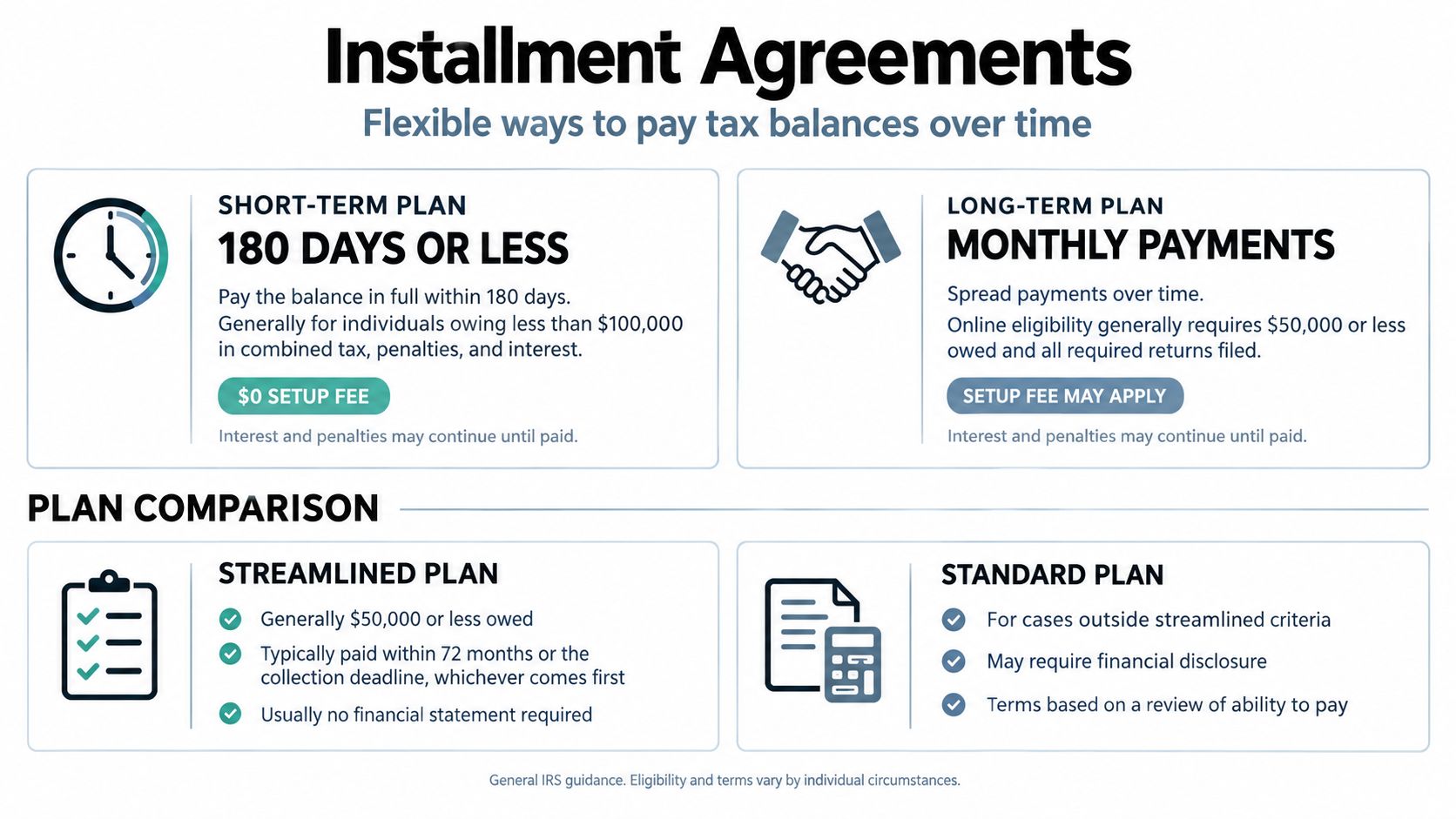
A taxpayer owes across three years, a Final Notice of Intent to Levy is on the desk, and paying in full today would break them. An Offer in Compromise won't clear the reasonable-collection-potential test on their numbers. The installment agreement exists for exactly this situation, and the IRS uses it at scale: 3,403,214 new agreements established in FY 2024, 1,902,125 taxpayers fully paid, an ending inventory of 4,642,420 agreements, and $16.107 billion collected from cases in installment-agreement status (IRS FY 2024 collection data).
Choose a payment that clears the debt before the CSED
Short-term payment plans can run up to 180 days. Long-term plans stretch further, with terms that depend on eligibility and the account. For many individuals, the IRS treats a Simple Payment Plan as available when assessed tax, penalties, and interest total $50,000 or less, provided the balance can be paid within the collection period. The IRS guidance on payment plan types and eligibility lays out the routes and conditions.
Simpler categories mean fewer financial disclosures. Outside them, expect full documentation of income, expenses, assets, and liabilities. Either way, the true test is math. Interest and failure-to-pay penalties keep accruing during the agreement, so a payment that feels affordable can still lose ground against a growing balance.
That is the core trade-off. A low monthly payment buys immediate relief from levies and garnishments, but it can stretch the agreement for years while the balance declines slowly or stalls. Price the payment against the projected balance at the CSED, not against this month's cash flow. If the number won't clear the debt in time, the plan needs adjusting or a different remedy.
Business owners face a second trap. An agreement covering the company's payroll-tax debt does not resolve any personal trust-fund liability assessed against the people involved. Confirm which liabilities, and whose, the agreement covers before signing.
Before applying, compare the proposed payment against household budget or business cash flow, and stay current on new filing and payment obligations, since fresh unpaid liabilities can default the agreement. For the mechanics of applying, see this walkthrough on how to set up a tax payment plan.
Offers in Compromise and When They Make Sense
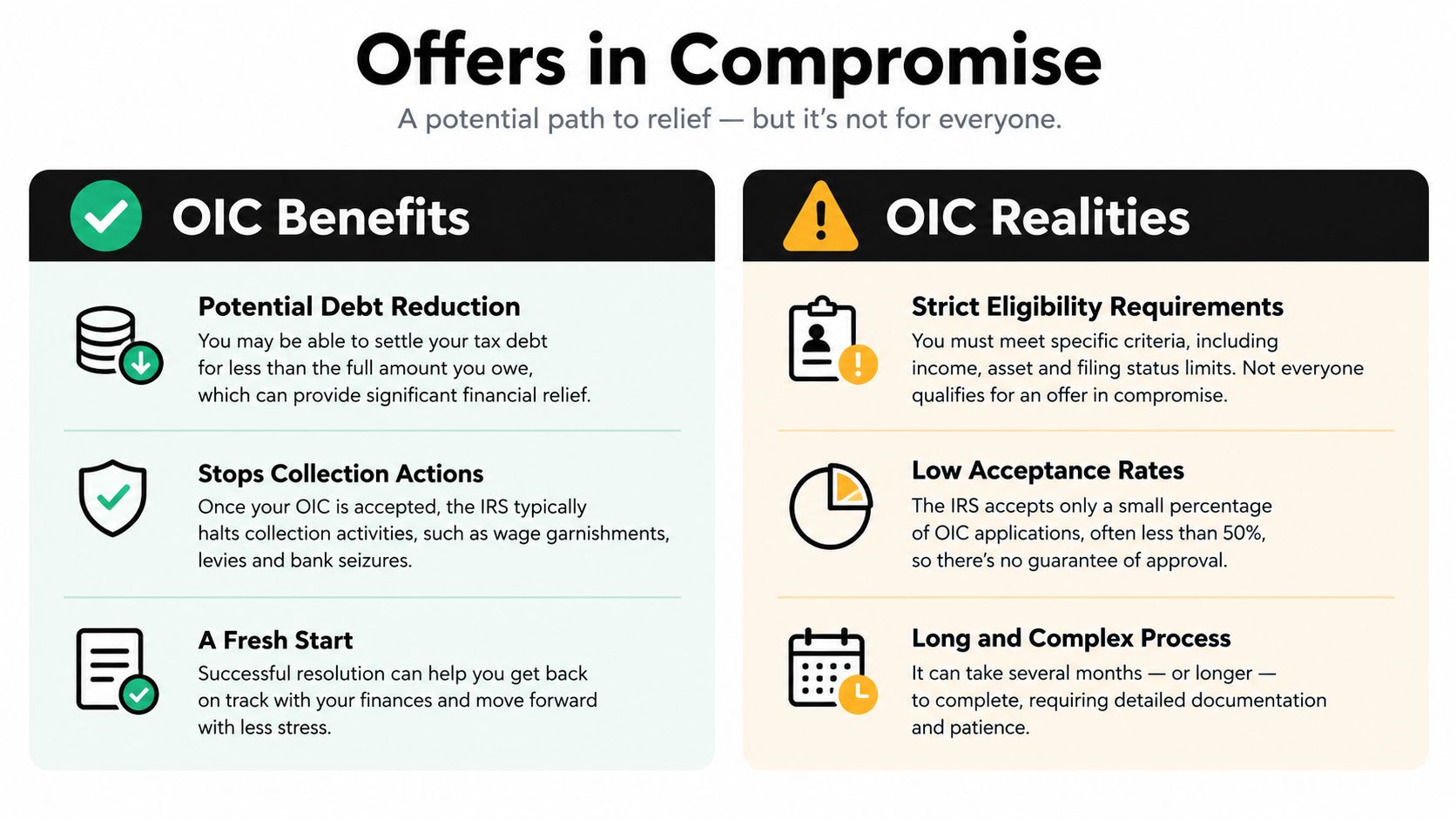
An Offer in Compromise (OIC) allows a qualifying taxpayer to settle eligible tax debt for less than the full amount owed. It isn't a routine discount or a starting point for negotiation. The IRS evaluates whether the proposed amount reflects what it believes it can collect, taking account of assets and future income. If available equity or sustainable monthly income could pay the full liability, an installment agreement may be a more realistic fit.
Acceptance data underline how selective the program is. In FY 2025, taxpayers submitted 38,797 offers, and the IRS accepted 5,464, approximately 14.1% of submissions. Accepted offers totaled $98.1 million (IRS collections, penalties, and appeals statistics). Those figures aren't a prediction for an individual case. They're a reminder that submitting an offer doesn't mean the IRS will accept it.
Compare settlement with repayment
An OIC may be worth examining when your documented reasonable collection potential is materially below the liability. That analysis involves verifying asset values, identifying allowable expenses, and estimating future disposable income. The offer should follow the financial evidence, not an assumed percentage reduction.
Before an offer is considered, taxpayers generally need to have filed required returns, received a bill for the liabilities included, and made required current-year estimated payments. The IRS may request a Collection Information Statement and supporting proof of financial circumstances. Missing filings or unsupported figures can undermine the application before the merits of the offer are even considered.
An installment agreement is generally the more practical route when you can pay the liability over time but cannot pay it all at once. An OIC is more plausible when the numbers show that full payment is not collectible under the applicable analysis. To prepare, first bring filing compliance current, then gather reliable records for your income, expenses, and assets. This guide to qualifying for an Offer in Compromise can help you understand what the IRS evaluates.
Currently Not Collectible Status and Other Alternatives
Currently Not Collectible (CNC) status fits cases where any payment would crowd out rent, utilities, food, or medication. It can stop levies and most collection contact for a time. The balance still exists, interest and many penalties keep accruing, refunds can still be offset, and the IRS can revisit the file when income improves.

The evidence matters more than the hardship story. Expect to document income, necessary living expenses, assets, and debts, then explain why even a modest payment creates hardship. I treat CNC as triage: useful when a client needs room to stabilize, dangerous when it becomes the plan. If the account stays unpaid while penalties and interest run, a manageable balance can turn into a harder problem, and a federal tax lien can still complicate credit, sales, or refinancing.
Penalty relief should be analyzed separately. Where facts support reasonable cause or a qualifying first-time abatement, ask for it with proof instead of assuming hardship alone removes penalties.
A partial payment installment agreement can be stronger than CNC when you can pay something consistently but cannot full-pay before the collection period ends. It is not a cheaper installment plan; the IRS reviews finances and may revisit terms as circumstances change.
Compare options on four points:
- Immediate cash flow: Can you make the proposed payment without missing essentials or new tax obligations?
- Balance trajectory: Will the debt go down, or will ongoing accruals absorb much of the payment?
- Compliance capacity: Can you stay current with future filings and payments?
- Review and default exposure: What must you disclose, and what happens if income or payments change?
As noted earlier, temporary delay and payment plans solve different problems. Choose CNC only when payment causes hardship; choose a partial plan when a sustainable payment beats watching the balance grow.
Small Business Tax Debt and Personal Liability
Business owners often treat the balance on an IRS notice as one problem with one solution. That assumption can be costly. The first question is who owes the tax: the business entity, the owner personally, or both. The answer depends on the type of tax and the facts, not just the name on the account or the structure shown on business documents.
Income-tax liabilities, employment-tax liabilities, and personally assessable trust-fund obligations can follow different rules and affect different assets. Payroll-tax cases deserve prompt review because a business's obligation and an owner's potential personal exposure aren't necessarily the same. A company payment plan does not, by itself, establish that an owner is protected from a separate assessment or collection action.
The IRS's Form 656-B distinguishes individual and business tax debts. It requires separate Offers in Compromise for each, with separate application fees and initial payments (IRS Form 656-B). That separation is a practical warning: don't assume one filing or agreement will resolve every related liability.
Start by matching each balance to the tax periods and tax type, then confirm which taxpayer is named on the assessment. If the IRS is pursuing a person for a business-related obligation, identify the legal basis and review the supporting documents before agreeing to a payment or settlement strategy. For payroll taxes, also check whether required returns and deposits are current. A resolution can break down if the business keeps accumulating unpaid obligations while negotiating about older ones.
Business structure matters, but it doesn't answer every collection question on its own. A sole proprietor, LLC member, or corporate officer may face different issues depending on the liability. Read more about the Trust Fund Recovery Penalty and personal exposure before treating company debt as separate from your personal finances.
When to Hire a Tax Controversy Attorney
A straightforward balance with filed returns and a payment you can sustain may not require an attorney. The case for professional help becomes stronger when you're facing a levy or lien, have payroll-tax debt, are dealing with multiple entities, or need to decide whether a settlement is supported by your financial records. A missed response deadline or incomplete disclosure can close off options or trigger more work later.
A tax controversy attorney can review notices, assess the collection posture, analyze the liability, and communicate with the IRS under an appropriate authorization. The value isn't a promise of a specific result. It's having someone who can connect the legal issue to the financial records and explain which resolution paths are realistic.
Be wary of guaranteed outcomes. No attorney or tax-debt firm can promise that the IRS will accept a particular offer or that collection will stop just because you hired a representative.
Ask who will handle your case, what work is included, what information they need before recommending a program, and how fees are structured. A credible adviser should explain the basis for a recommendation and distinguish between what the IRS may consider and what it must do. Be cautious if a salesperson promises to cut your balance before reviewing returns, notices, assets, and income.
A free Tax Debt Analysis can be a sensible first step when you don't know whether your balance is correct, which program might fit, or whether a business liability reaches you personally. It should help identify the issues and possible paths, not pressure you into an expensive engagement before the facts are reviewed. Tax Attorney Stephen A Weisberg offers attorney representation for individuals, businesses, and owners dealing with IRS and state tax issues, including back-tax debt resolution. Choose professional help for the work your situation requires, and get the scope and fees clear before proceeding.
Your Action Plan for Resolving Back Tax Debt
Start with records, not assumptions. Gather every IRS notice, your filed returns, proof of payments, and information about income, expenses, assets, and debts. If the matter involves a business, separate entity records from personal records and identify whether the balance relates to income tax, employment tax, or another obligation.
Then work through the decisions in order:
- Confirm the balance: Check the tax periods, assessments, payments, penalties, and interest reflected in the IRS account.
- Review filing compliance: Identify missing returns and any current-year filing or payment obligations.
- Map collection status: Record the latest notice, any response deadline, and whether the IRS has begun enforcement.
- Choose based on the financial facts: Compare full payment, an installment agreement, an OIC, CNC status, or a partial-payment arrangement.
- Keep future obligations current: A resolution is harder to maintain if new tax debt accumulates while you address the old balance.
If you need practical help understanding the mechanics of filing and paying, the FaxZen tax filing guide offers related information. For a tax debt decision, though, the key is to connect that general guidance to your specific notices, liabilities, and ability to pay.
Don't choose an option solely because it offers the lowest immediate payment. Ask whether it resolves the balance, what happens to the debt while you pay, and whether you can maintain current filing and payment obligations at the same time. If those questions aren't clear, get the account and financial picture reviewed before you commit.
Tax Attorney Stephen A Weisberg can review your IRS or state tax debt, examine your financial situation, and assess which resolution options may fit. Start with a free Tax Debt Analysis to understand where you stand before paying for representation, then visit Tax Attorney Stephen A Weisberg to discuss next steps.


