Your Audit Response Letter: A Strategic Guide for 2026
Learn how to draft a powerful audit response letter. This guide covers structure, samples, deadlines, and how to avoid critical mistakes like waiving privilege.
In this article
- Your Audit Notice Has Arrived Now What
- Stop reacting and start controlling the file
- What a strong opening move looks like
- The point of the letter is not to “tell your story”
- The Anatomy of an Effective Audit Response
- Start with the identifying information
- Write a short introduction that does real work
- Address each issue one by one
- Keep the tone controlled
- Include limits where they belong
- End the letter with control, not chatter
- Sample Responses for Common Audit Scenarios
- Schedule C income or expense dispute
- Small business document request for expenses
- Payroll tax discrepancy notice
- Proposed Trust Fund Recovery Penalty response
- Why generic wording can hurt you
- Assembling Your Evidence and Documentation
- Build the package around the notice
- Don't send a pile. Send a record set.
- What not to send
- Navigating Deadlines and Delivery Procedures
- Read the notice for the actual response date
- Request extensions the right way
- Use delivery methods you can prove
- Keep one master file
- Critical Mistakes and When to Call a Tax Attorney
- Privilege waiver is the issue too many people miss
- Other mistakes that damage the case
- When the matter is no longer a DIY project
That audit notice usually lands at the worst possible time. You're already busy, then a letter from the IRS or a state agency shows up asking for records, explanations, and a response by a hard deadline. Many individuals make the same mistake in the first hour. They treat the response like paperwork instead of strategy.
That's backwards.
Your audit response letter is often the first real chance to frame the facts, narrow the issues, and show the examiner that you understand the file better than they do. Done well, it can keep the audit focused. Done badly, it can expand the audit, lock you into a careless position, and expose information you never needed to hand over in the first place.
There's another problem that generic templates usually ignore. A sloppy response can create privilege problems. In some settings, what you disclose to an auditor or examiner can be argued to waive protections you assumed were still intact. If you're a business owner, a self-employed taxpayer, or a professional helping a client through an audit, you need to think about that risk before you send a single page.
Your Audit Notice Has Arrived Now What
You open the envelope, scan the first paragraph, and your eyes jump straight to the deadline. That reaction is normal. What matters next is whether you respond emotionally or strategically.

Stop reacting and start controlling the file
A lot of taxpayers think the fastest response is the best response. It usually isn't. A rushed letter tends to do one of three things:
- It admits too much: You try to sound cooperative and accidentally concede a factual point.
- It says too little: You send a vague denial with no supporting structure, which invites follow-up requests.
- It sends the wrong documents: You hand over records outside the actual issue and give the auditor new places to look.
That's why I don't view the first response as clerical work. I view it as positioning.
Practical rule: Your first response should answer the notice, support your position, and avoid volunteering new issues.
There's also a professional trap here. Many lawyers and advisers still act like audit responses are a nuisance rather than a risk-management task. That mindset causes sloppy drafting. One professional liability discussion notes the myth that audit responses are a “colossal waste of time,” and reports that 68% of law firms lack a designated partner overseeing audit letter drafts in its cited discussion of liability risks (FMG Law on audit response risk). I agree with the underlying point. If nobody owns the response, errors multiply.
What a strong opening move looks like
A good audit response letter does not posture. It doesn't pick a fight. It also doesn't grovel. It states the issue, responds to the specific request, and organizes the evidence so the examiner can follow it.
If you're trying to get your bearings before replying, it helps to review practical tax procedure resources alongside the notice itself. A broad library like the ClaimKit blog posts can be useful for understanding how claims, documentation, and formal responses are structured across compliance contexts. For IRS-specific preparation, start with this guide on how to prepare for an IRS audit.
The point of the letter is not to “tell your story”
That's another common mistake. People write pages of background that feel persuasive to them but don't address the adjustment or document request. Auditors don't need autobiography. They need a clean response tied to the notice.
Use the letter to do three things:
- identify exactly what notice or issue you are answering,
- state your position on each disputed item,
- direct the reader to the supporting documents.
If you do that early, you've already improved the odds that the audit stays manageable.
The Anatomy of an Effective Audit Response
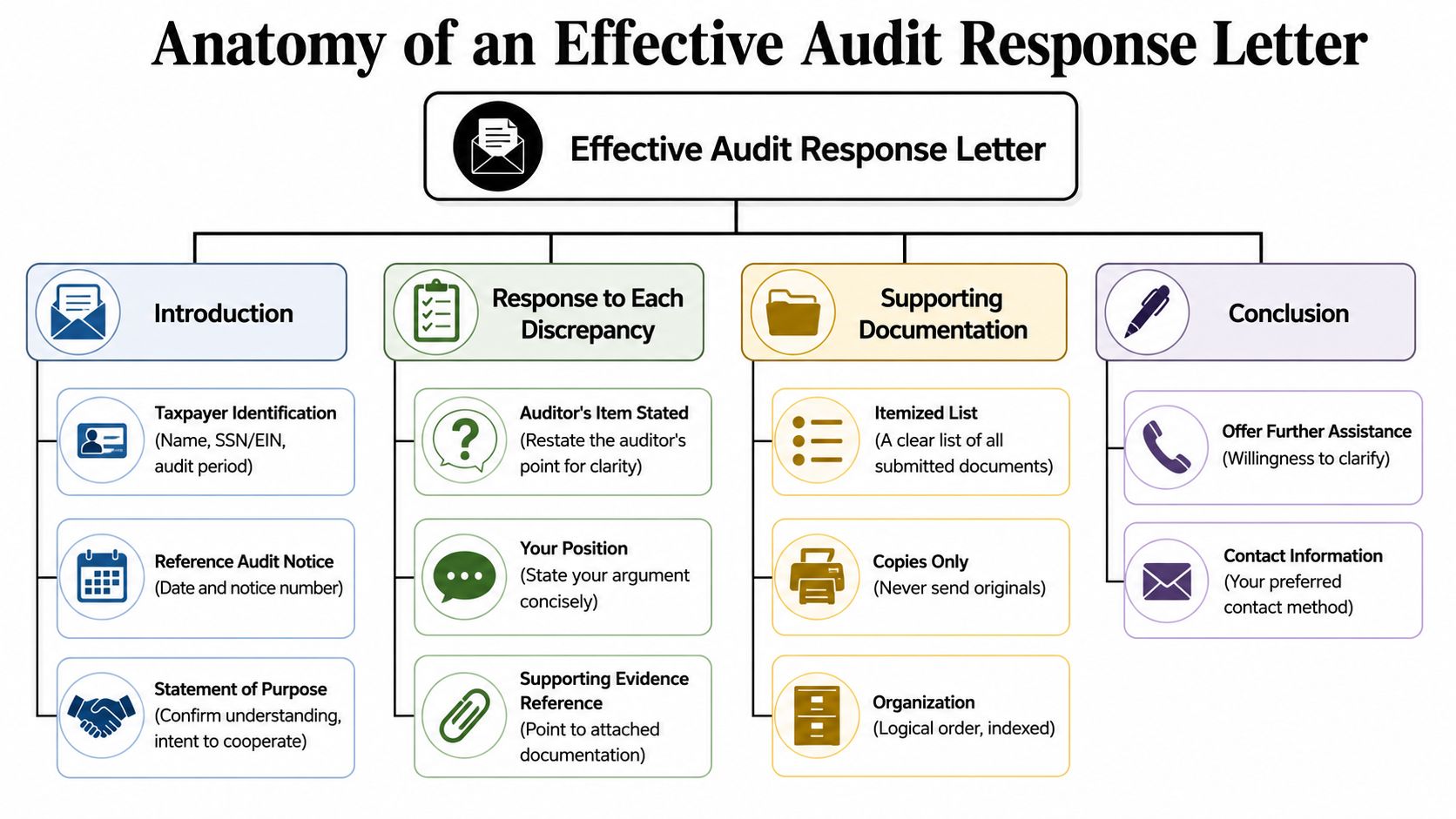
A strong audit response letter follows a simple logic. The examiner should be able to see who you are, what notice you are answering, what your position is, and where the supporting documents are located without hunting for any of it.
Start with the identifying information
At the top of the letter, include the taxpayer's full name, mailing address, taxpayer identification number as appropriate, and the tax period under examination. Then identify the notice date and notice number.
That sounds basic because it is basic. Yet missing identifiers are one of the easiest ways to slow the review and create unnecessary correspondence.
Put the agency's own reference number near the top of the first page. Don't make the reviewer search for the file.
Write a short introduction that does real work
Your opening paragraph should confirm that you received the notice and that the letter responds to the specific items listed in it. Keep the tone professional and measured.
A useful opening usually does four things:
- References the notice: Date, number, and tax period.
- States the purpose: You are responding to the audit inquiry or document request.
- Signals cooperation: You intend to provide the requested support for the items addressed.
- Defines scope: You are responding to the identified issues, not opening a free-form discussion.
If you need examples of how formal IRS correspondence is usually framed, this article on responding to IRS letters is a good companion piece.
Address each issue one by one
Many ineffective letters typically falter here. They lump everything together. Don't do that.
Use a point-by-point structure. For each issue, restate the examiner's concern in neutral terms, then give your answer, then identify the exhibit or records that support the answer.
A simple structure looks like this:
| Part | What to include | Why it matters |
|---|---|---|
| Auditor's item | A short restatement of the questioned item | Shows you understand the issue |
| Your position | A concise factual response | Prevents rambling |
| Document reference | Exhibit labels or page references | Makes review easier |
Keep the tone controlled
You don't need to sound defensive to be firm. In fact, defensive writing usually signals weakness. A better approach is calm precision.
Bad tone sounds like this: “The IRS is completely wrong and has ignored the obvious.”
Better tone sounds like this: “The records attached as Exhibits B through D support the deduction claimed and reconcile to the amounts reported for the period at issue.”
Include limits where they belong
The formal structure of attorney responses in the audit context comes out of the American Bar Association's Statement of Policy, officially published in December 1975, which requires attorneys to confirm that the response is solely for audit use and cannot be quoted or filed with a government agency without consent (ABA framework summarized here). Even if you are not sending a classic auditor response in a financial statement setting, the underlying discipline matters. State the purpose clearly. Limit the scope. Avoid loose language that can be reused outside the context you intended.
End the letter with control, not chatter
Your closing should be brief. Offer to provide clarification if needed, give a clear contact method, and list the attachments.
Don't add speculative commentary. Don't revisit arguments you've already made. And don't promise more than you intend to deliver.
A clean closing often includes:
- A contact line: Name, phone, email, or representative information.
- An attachment list: Every exhibit identified by label.
- A limited assistance statement: You'll respond to reasonable follow-up tied to the notice.
That's enough. A disciplined structure tells the auditor you're organized, prepared, and paying attention.
Sample Responses for Common Audit Scenarios
Templates are overrated. What matters is the wording choice in the specific dispute you're dealing with. The right sentence in a Schedule C audit is not the right sentence in a payroll tax case.
Schedule C income or expense dispute
An individual taxpayer gets a notice questioning deductions claimed on a Schedule C. The weak response says, “I've always reported my business truthfully and never had problems before.” That kind of language doesn't prove anything.
A better response sounds like this:
“This response addresses the adjustments proposed to the Schedule C deductions for the tax year identified in your notice. The expenses at issue were ordinary business expenses of the taxpayer's sole proprietorship and were paid in connection with client services performed during that period. Copies of the relevant invoices, payment records, and account statements are attached as Exhibits A through F.”
Why this works: it stays with the issue, ties the expenses to the business activity, and points the examiner to records. It does not overstate. It does not get emotional.
Small business document request for expenses
A small business receives a request for substantiation of travel, supplies, and contractor payments. The instinct is to dump every receipt in a box and send it all.
Don't.
A better letter might say:
“The company responds to Item 3 of the Information Document Request by producing records for the specific expense categories listed in the notice. The attached materials are organized by category and month. A document index is included so each payment can be traced to the corresponding ledger entry and bank record.”
That language does two useful things. First, it shows organization. Second, it effectively defines the production around the specific expense categories listed in the notice. That helps prevent a broad, shapeless review.
If one category has partial records, say so carefully and fill the gap with whatever reliable support you have. Don't pretend missing documents don't matter.
Payroll tax discrepancy notice
Payroll cases require precision because the numbers flow through returns, deposits, payroll reports, and employee records. Sloppy wording here creates headaches fast.
A sound response might read:
“The taxpayer responds to the payroll tax discrepancy identified in the notice by providing payroll registers, deposit confirmations, and amended reconciliation schedules for the quarter at issue. The discrepancy appears to arise from a reporting mismatch rather than an unpaid liability. The enclosed exhibits show the amounts reported, the amounts deposited, and the source of the variance.”
This works because it frames the issue as a reconciliation problem without conceding the government's interpretation. It also directs the reviewer to the exact categories of proof that matter.
Proposed Trust Fund Recovery Penalty response
A proposed Trust Fund Recovery Penalty is not a routine paperwork problem. It is personal. The government is looking at whether a particular owner, officer, or responsible person was both responsible and willful.
That response needs discipline. It should never read like a casual explanation emailed after hours.
Sample language:
“This submission responds to the proposed assessment and addresses the taxpayer's role, authority, and actions during the periods identified. The attached materials are provided to clarify the limits of the taxpayer's financial control, decision-making authority, and involvement in payroll tax compliance. Nothing in this response should be construed as adopting assumptions not supported by the records produced.”
That last sentence matters. In TFRP cases, people often adopt the agency's framing without realizing it. If the facts are disputed, keep them disputed unless the documents settle them.
Why generic wording can hurt you
Here are four phrases I almost never like in an audit response letter:
- “There have never been issues before.” Past silence doesn't prove current compliance.
- “I'm sure this is just a misunderstanding.” It sounds casual and unsupported.
- “I may have made a mistake.” Don't speculate against yourself.
- “Please let me know if you need anything else.” That can invite an open-ended fishing expedition.
A better closing sentence is narrower:
“If clarification is needed regarding the items identified in the notice, the taxpayer will respond through the contact information provided below.”
That keeps the door open without removing the frame.
Assembling Your Evidence and Documentation
Most audit response letters succeed or fail on the documents, not the adjectives. If the proof is disorganized, incomplete, or broader than necessary, you've made the examiner's job harder and your own position weaker.
Build the package around the notice
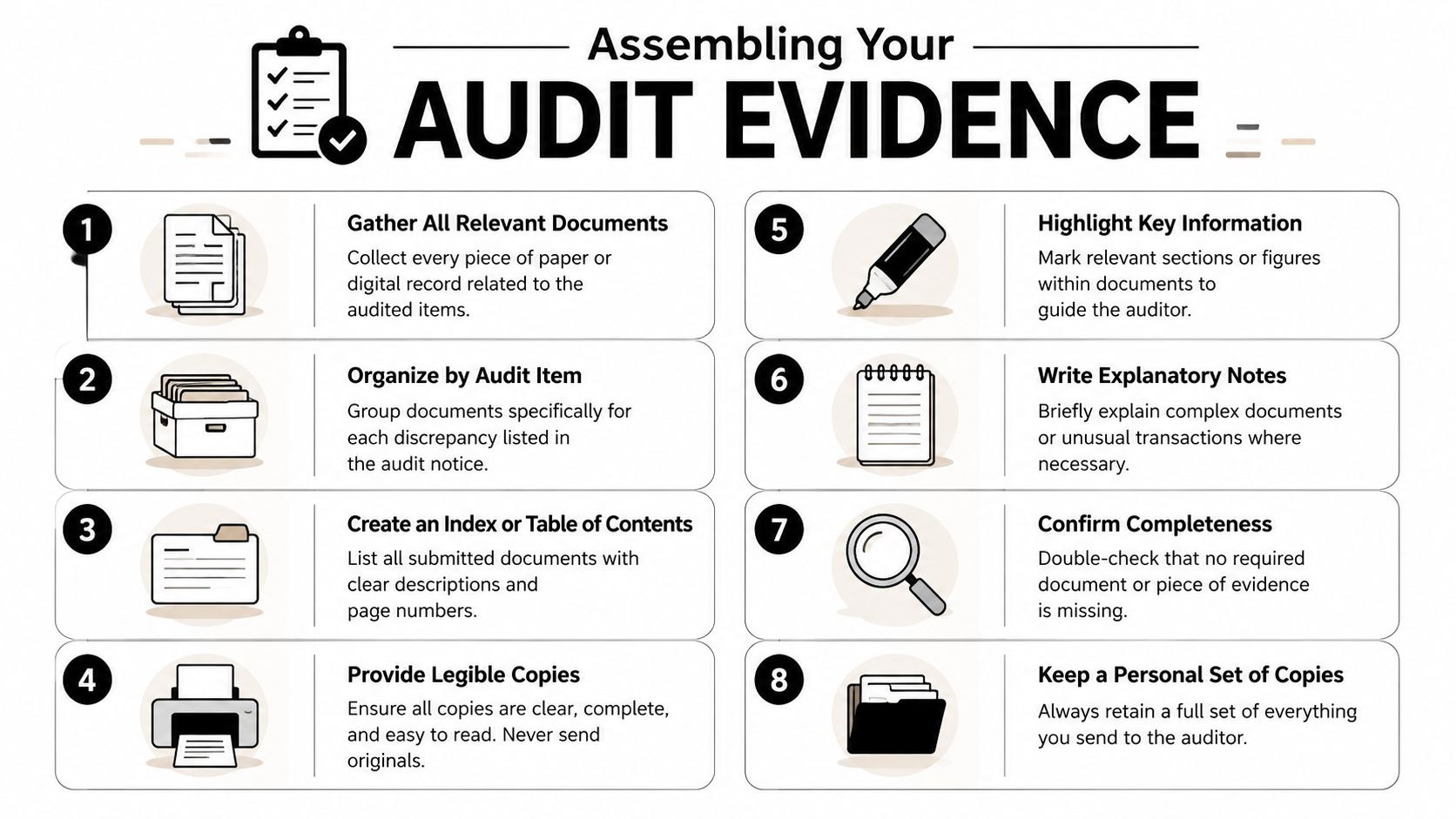
Start with the actual issue list from the notice or Information Document Request. Then create a matching set of folders, digital or paper, for each issue. If the notice questions meals, contractor payments, and gross receipts, those should be three separate evidence groups.
A reliable evidence package usually includes:
- An index: One page listing each exhibit and what it proves.
- Exhibit labels: Exhibit A, Exhibit B, Exhibit C, and so on.
- Clean copies: Never send originals.
- Brief notes where needed: Only to explain unusual records, not to argue every line.
If you need a practical refresher on expense support, especially for self-employed taxpayers, this guide on claiming business expenses effectively is useful as a documentation mindset check.
Don't send a pile. Send a record set.
There's a difference.
A pile says, “I hope something in here helps.” A record set says, “Here is the proof for Item 2, and here is where you'll find it.”
Use this sequence:
- the response letter,
- the exhibit index,
- the exhibits in the same order discussed in the letter.
The cleaner your package is, the fewer follow-up questions you usually create.
What not to send
Taxpayers get into trouble by overproducing. If the notice requests proof of a deduction, don't send years of unrelated account statements. If the issue is one payroll quarter, don't volunteer records for periods that weren't asked for.
One common mistake is trying to defend yourself with broad claims like “nothing like this has ever been reported before.” A Florida Bar discussion flags that as a high-risk pitfall and says the right approach is a thorough internal review and specific evidence, not unsupported assurances (Florida Bar guidance on audit response risks).
Here's the standard I recommend:
| Send it | Hold it back unless requested |
|---|---|
| Records that directly support the audited item | Unrelated years |
| Copies that are legible and complete | Originals |
| A short explanatory note for complex items | Narrative background with no evidentiary value |
If the IRS asks for return transcripts or verification records, know what you're ordering before you submit forms. This article on what Form 4506-T is helps clarify that process.
Navigating Deadlines and Delivery Procedures
A good response mailed late is still a bad result. Deadlines matter because the agency can move forward without your input if you miss them.
Read the notice for the actual response date
Don't guess. Don't assume you have “about a month.” The date is usually on the notice, and the response window depends on the notice type and the stage of the examination.
When the timing is tight, decide immediately whether you can produce a complete response by the deadline. If not, ask for more time early, not the day before.
Request extensions the right way
If you need an extension, keep the request short and specific. Identify the notice, the tax period, and the reason additional time is needed. Ask for a concrete extended date.
A weak extension request rambles about being busy. A good one says the records are being assembled and reviewed so the response can be accurate and complete.
Use delivery methods you can prove
For paper submissions, I strongly prefer USPS Certified Mail with Return Receipt Requested when that method is appropriate for the notice. It creates proof of mailing and proof of delivery. Keep the mailing receipt, the tracking record, and a full copy of everything sent.
If the notice permits a portal upload, fax, or another electronic submission method, save the confirmation page immediately. Download it. Print it. Keep it with the response package.
If you can't prove what you sent and when you sent it, you're relying on the agency's filekeeping. That's not where you want to be.
Keep one master file
Your master file should include:
- The notice itself
- The final signed response
- Every attachment and exhibit
- Proof of delivery or upload confirmation
- A log of any follow-up contact
That file becomes important if the case expands, gets reassigned, or moves into appeals. Good delivery procedure is boring. It also saves cases.
Critical Mistakes and When to Call a Tax Attorney
The biggest hidden risk in an audit response letter isn't bad grammar. It's giving up ground you can't recover.
Privilege waiver is the issue too many people miss
Generic templates focus on formatting. They rarely deal with privilege. That's a serious omission.
Many courts have held that audit response letters can waive attorney-client privilege, and a discussion of that risk reports that fewer than 15% of firms implement written policies governing these responses (ABI Journal on privilege waiver in audit inquiry responses). If you disclose legal assessments, internal communications, or litigation-sensitive material carelessly, you may be handing an opponent an argument you never intended to make available.
That's why any response touching legal analysis, potential liability, litigation exposure, or sensitive internal facts needs to be drafted with discipline. Scope matters. Audience matters. Wording matters.
Other mistakes that damage the case
Some errors are obvious. Others look harmless until they show up later in the file.
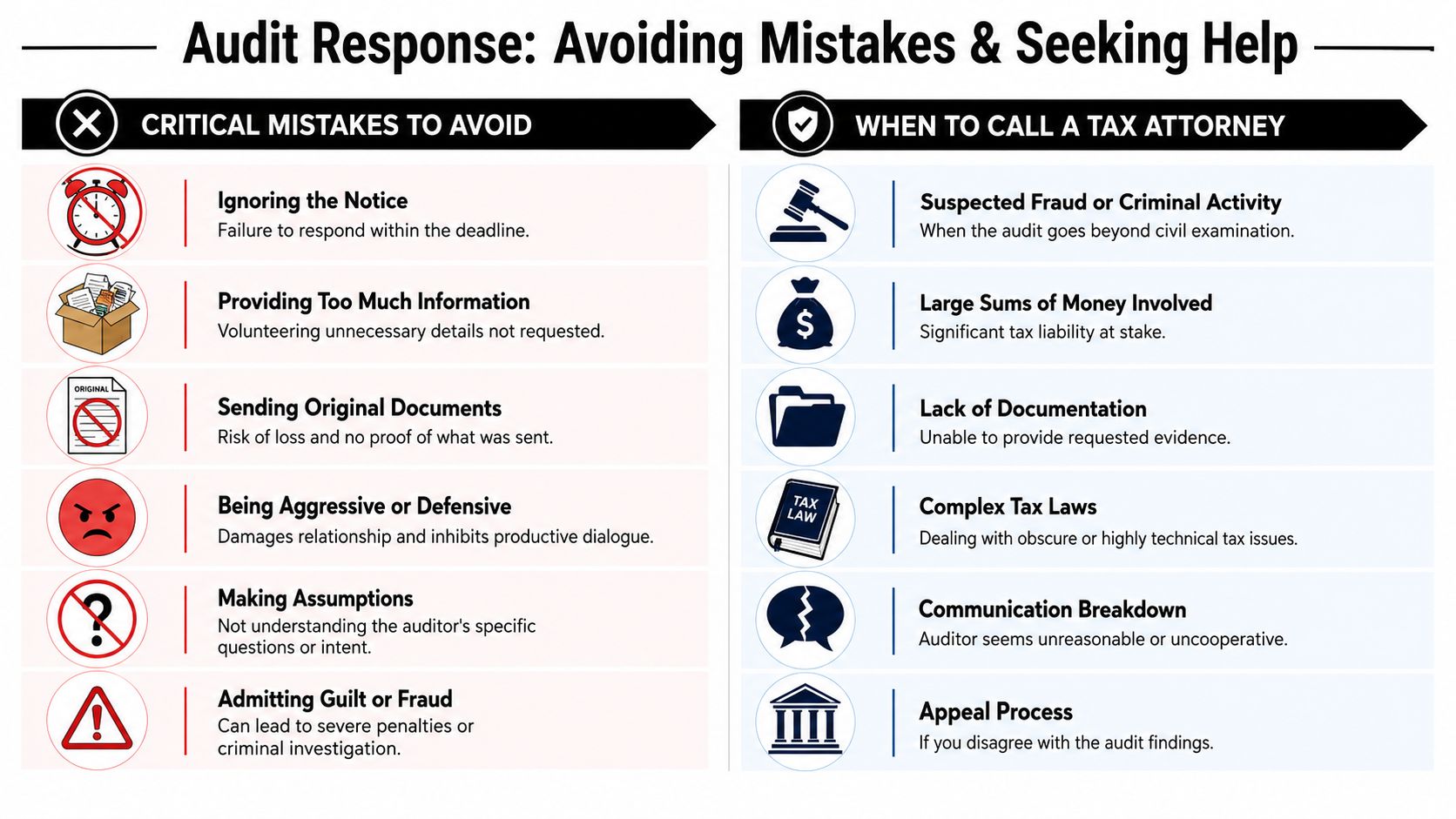
- Ignoring the notice: The agency may assess without your side of the record.
- Calling instead of writing: Informal phone statements can create confusion and admissions.
- Guessing at facts: If you don't know, find out before you respond.
- Sending too much: Extra records can widen the audit.
- Using aggressive language: It makes resolution harder and usually accomplishes nothing.
A calm, narrow, documented response beats a passionate, sprawling one almost every time.
When the matter is no longer a DIY project
Some audits stay administrative. Others don't. You should stop handling it alone when the stakes or complexity cross a line.
Call a tax attorney if the audit involves:
| Situation | Why legal help matters |
|---|---|
| Multiple years | Facts and positions can affect more than one period |
| Payroll tax issues | Responsibility and exposure can spread to individuals |
| A proposed Trust Fund Recovery Penalty | Personal liability is on the table |
| Potential fraud indicators | Civil and criminal risks can overlap |
| Large proposed assessments | Strategy matters as much as documentation |
If you're unsure whether the file has crossed that line, use practical decision criteria like those outlined in this article on when to hire a tax attorney.
A final point. Don't wait for panic to become your strategy. The right time to get legal help is often before the first bad sentence leaves your desk.
If you need help evaluating an audit notice, drafting an audit response letter, or dealing with IRS or state tax exposure, Attorney Stephen A Weisberg offers a practical starting point. He represents individuals, business owners, and professionals with clients facing audits, tax debt, payroll tax problems, and Trust Fund Recovery Penalty issues. He also offers a free Tax Debt Analysis to determine whether he can help and what the right next step is before charging for representation.


