When to Hire an Attorney for Tax Problems in 2026
Facing the IRS? Learn when you need an attorney for tax problems. This 2026 guide covers complex issues, resolution options, and finding the right legal expert.

In this article
- Confronting IRS Notices: Why You Might Need an Attorney
- When to Seek Professional Help
- What a Tax Problem Attorney Actually Does for You
- Diagnosing the Problem and Building a Strategy
- Taking Concrete Action to Protect You
- High-Stakes Tax Issues That Demand Legal Expertise
- Unresolved Business Payroll Tax Debt
- The Trust Fund Recovery Penalty (TFRP)
- When an Audit Risks Criminal Investigation
- Your Roadmap to Tax Resolution and Possible Outcomes
- Settling for Less with an Offer in Compromise
- Creating Manageable Payments with an Installment Agreement
- Removing Penalties with Penalty Abatement
- Choosing the Right Attorney: The W Tax Group Approach
- Our Transparent Free Tax Debt Analysis
- A Partner for Fellow Professionals
- Your Top Questions About Hiring a Tax Attorney, Answered
- How Much Does a Tax Attorney Cost?
- How Long Will This Take to Fix?
- What Happens Right After I Hire You?
An attorney for tax problems is more than just a lawyer—they're your advocate and your shield. Think of them as the expert who steps between you and the IRS or state, handling all the stressful communications, stopping aggressive collection actions, and mapping out the best strategy to resolve your tax debt for good. For high-stakes tax issues, bringing one on board isn't just a good idea; it's essential.
Confronting IRS Notices: Why You Might Need an Attorney

That thick envelope from the IRS in your mailbox can make your heart sink. The first impulse for many is to just set it aside, hoping it will somehow go away on its own. But from my experience, tax problems are a lot like a small crack in a foundation—if you ignore it, it only gets bigger and eventually threatens the entire structure of your financial life.
The good news? You’re not alone in this, and these problems absolutely have solutions. Millions of taxpayers get these notices every year, and a good number of them are facing situations too complex to handle without an expert. A tax attorney is your best ally, a seasoned guide through the maze of tax law who knows how to fight for you.
When to Seek Professional Help
Look, not every IRS letter is a five-alarm fire. A simple notice about a math error on your return is something you can likely handle yourself. But some situations are clear red flags, signaling that it’s time to call in a legal professional to protect your rights, your money, and your peace of mind.
You should seriously consider hiring a tax attorney if you're dealing with:
- A Significant Tax Debt: If you owe more than you could ever realistically pay back, an attorney can open doors to resolution programs like the Offer in Compromise that you might not even know about.
- Years of Unfiled Tax Returns: Falling behind on filing is a serious issue. An attorney can create a strategic plan to get you compliant and minimize the damage.
- An IRS Audit or Examination: The moment the IRS formally selects you for an audit, the game changes. You need professional representation to navigate the process and defend your returns.
- Threats of Levy, Lien, or Garnishment: If the IRS is threatening to seize your bank account, garnish your wages, or put a lien on your home, you need an attorney to intervene—fast.
The goal is to get you out of a defensive, fearful mindset and into a proactive one. A great tax attorney doesn't just react to the IRS; they build a protective strategy around your finances, giving you the breathing room needed to find a permanent solution.
An attorney immediately takes over all communication, so you no longer have to field calls from aggressive revenue officers. They dive into the details of your case, identify the most effective path forward, and argue on your behalf. A crucial first step is understanding what the government is even telling you; learning how to interpret the different types of IRS letters and notices can help you gauge the severity of your situation. This proactive approach turns a crisis into a structured, manageable process with a clear finish line.
What a Tax Problem Attorney Actually Does for You

When you hear "tax attorney," it’s easy to picture dramatic courtroom battles with the IRS. In reality, our work is far more practical. Think of a tax attorney less as a last-ditch litigator and more as your personal shield and translator in a complex, high-stakes conversation.
The very first thing we do is step between you and the tax agencies. We immediately file a Power of Attorney (Form 2848), which legally requires the IRS or state to contact us directly. All those stressful calls and intimidating letters stop coming to you. They come to us instead. This creates a critical buffer, giving you the space to breathe while we get to work.
Diagnosing the Problem and Building a Strategy
With communications handled, we shift into a detective role. We conduct a deep dive into your entire tax history to figure out what really happened. Was it a string of unfiled returns that snowballed? A simple mistake in how income was classified? Or a complex payroll tax issue that got out of hand? We need to find the root cause.
Knowing why you have a tax problem is the only way to figure out how to solve it. Based on this financial forensics, we build a legal strategy just for you. There's no one-size-fits-all solution here; your plan is designed around your specific circumstances, navigating the complexities of Tax Law to build the strongest case possible on your behalf.
Taking Concrete Action to Protect You
From there, we move from analysis to action. A good tax attorney doesn't just give advice; they take decisive steps to protect your finances and livelihood.
This often involves:
- Stopping Aggressive Collections: We get on the phone with revenue officers to halt wage garnishments and prevent them from levying your bank accounts. This is an immediate priority.
- Filing Delinquent Returns: We strategically prepare and file any past-due tax returns, which is the first step to getting you back into legal compliance.
- Negotiating a Final Resolution: We build the detailed legal and financial arguments needed to pursue powerful solutions, like an Offer in Compromise (OIC) or a manageable Installment Agreement.
- Fighting for Penalty Reductions: We assemble the evidence to argue for Penalty Abatement, showing the IRS you had a "reasonable cause" for the tax issue.
At its core, an attorney's job is to translate your financial reality into a language the IRS respects. We build a bridge between your personal hardship and the rigid tax code, fighting for a resolution that is fair, legal, and truly sustainable.
This level of professional help is more important than ever. With government debt projected to rise by trillions over the next decade, tax authorities are under intense pressure to collect every dollar possible. That pressure inevitably translates to more aggressive audits and collection tactics for everyday people and businesses. Facing that kind of scrutiny alone is a massive risk.
Hiring a tax attorney is an investment in professional expertise, but more importantly, it's an investment in your own security and peace of mind. To learn more about how this relationship works, you can read about the benefits of hiring a tax attorney and see how we provide the guidance needed to finally put your tax problems behind you.
High-Stakes Tax Issues That Demand Legal Expertise
Some tax notices are just minor headaches, easily fixed. But others are blinking red lights—serious situations that demand an experienced tax attorney, and fast. These aren't the kind of problems you can ignore or hope will just go away. They carry severe financial and legal consequences that can put your business, your personal assets, and even your freedom on the line.
When you're dealing with these issues, you need immediate, strategic legal help. It's not about a simple math error; it's about navigating a complex system where one wrong move can cause a cascade of new problems.
Unresolved Business Payroll Tax Debt
Of all the tax problems a business can face, unresolved payroll tax debt is one of the most dangerous. This is often called a 941 liability, and it refers to the money you withhold from your employees' paychecks for things like Social Security, Medicare, and federal income tax.
The IRS views these as "trust fund" taxes. Why? Because you're holding that money in trust for the government. When a business fails to turn those funds over, the IRS doesn't treat it like a normal debt—they see it as a form of theft and act with incredible speed and aggression. This is an absolute red-alert situation that requires an attorney.
The flowchart below helps visualize which tax issues are routine and which ones are high-stakes emergencies requiring a lawyer.
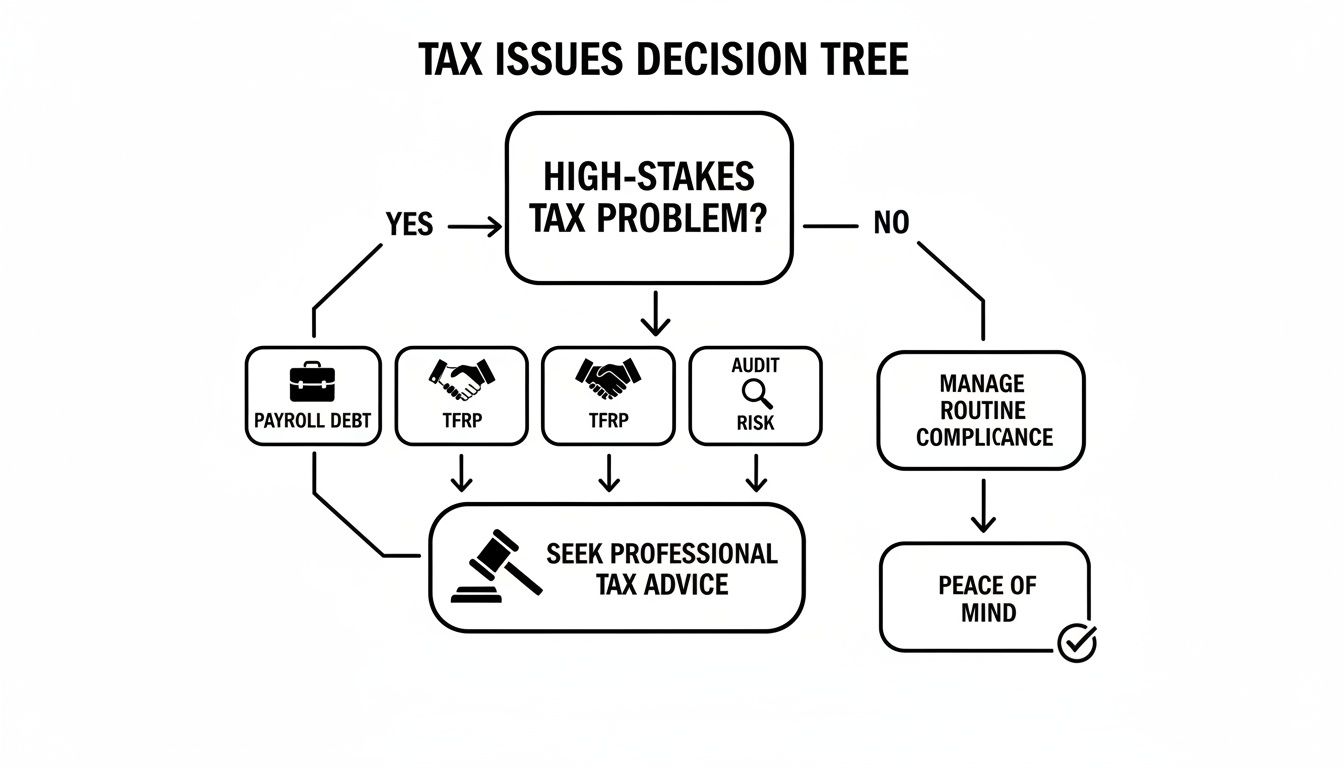
As you can see, problems like payroll tax debt and the Trust Fund Recovery Penalty fall squarely in the "get help now" category.
The Trust Fund Recovery Penalty (TFRP)
Tied directly to payroll tax debt is the Trust Fund Recovery Penalty (TFRP). This is the IRS’s nuclear option for collecting unpaid 941 liabilities. If the agency decides you were a "responsible person" who "willfully" failed to pay the taxes, they can hold you personally liable for the entire debt.
A "responsible person" isn't just the owner. This net can catch bookkeepers, directors, or any officer who had the authority to decide which bills got paid. The IRS can then go after your personal assets—your home, your savings, your car—to settle the business's debt.
Imagine you're a partner in a small business. Your partner, who handles the books, starts using payroll tax money to pay other vendors just to keep the lights on. Even if you had no idea it was happening, the IRS could still label you a responsible person and come after you for every penny. An attorney is crucial for fighting this TFRP assessment and shielding your personal finances from your company's tax troubles.
When an Audit Risks Criminal Investigation
Most IRS audits are civil matters. The goal is simply to figure out the correct tax and collect any unpaid balance, plus penalties and interest. But some audits take a sharp turn if the Revenue Agent starts to suspect fraud. At that point, they can refer your case to the IRS Criminal Investigation (CI) division.
A few red flags can trigger this kind of escalation:
- Patterns of Underreporting: Not just one mistake, but consistently understating your income year after year.
- Falsifying Documents: Creating fake invoices, receipts, or other records to get deductions you didn't earn.
- Using a Fake Social Security Number: Intentionally using false information to stay off the grid.
- Hiding Assets or Income: Using offshore accounts, shell corporations, or other complex schemes to hide money.
If you have any reason to believe your audit is heading in this direction, stop talking to the IRS and call a tax attorney immediately. Anything you say to an agent can be used against you. Your conversations with your attorney, however, are protected by attorney-client privilege. An attorney can take over all communications and build a defense to prevent a life-altering outcome. When the IRS suspects criminal activity, they often move aggressively to freeze assets, which is why it's critical to understand how to handle IRS levies on your bank accounts.
Your Roadmap to Tax Resolution and Possible Outcomes
When you’re staring down a serious tax problem, it can feel like you're completely stuck. But once you bring a tax attorney into the picture, a clear path forward starts to take shape. This isn't a random process; it's a structured journey. Think of it less like wandering in the woods and more like a doctor diagnosing an ailment and then prescribing a specific treatment plan for your financial health.
The very first thing we do is play detective. We conduct a deep dive into your entire tax history, your current financial situation, and what exactly led to the debt. Only after this thorough analysis can we confidently recommend the right strategy for you. There are several powerful tools we can use, and the right one depends entirely on your unique circumstances.
Settling for Less with an Offer in Compromise
Think of the Offer in Compromise (OIC) as the IRS's most significant settlement program. It's an agreement that allows a taxpayer to resolve their entire tax liability for a lower amount than what they originally owed. People often hear about "pennies on the dollar" settlements—that's the OIC, but it’s a tough program to qualify for.
The core of an OIC is proving to the IRS that you simply lack the financial ability to pay the full amount, either now or in the foreseeable future. Our job is to build a rock-solid financial case showing that what you're offering is the most the IRS could ever hope to collect. An OIC is a marathon, not a sprint. The process can easily take 6 to 24 months, but for those who are eligible, it delivers a true financial fresh start.
Creating Manageable Payments with an Installment Agreement
For many people, a structured payment plan is a much more realistic path forward. An Installment Agreement (IA) is exactly that—a formal plan to pay off your tax debt over time with predictable monthly payments you can actually afford. It's like turning a mountain of debt into a manageable molehill.
An experienced attorney won't just accept the first payment amount the IRS suggests; we negotiate terms based on what your budget can truly handle. There are a few different types:
- Guaranteed Installment Agreements: Generally a straightforward option for tax debts under $10,000.
- Streamlined Installment Agreements: A simplified process for debts up to $50,000, which can often be set up fairly quickly.
- Partial Payment Installment Agreements (PPIA): A more complex option where we can sometimes negotiate a monthly payment so low that you only pay back a portion of the debt before the collection statute expires.
The ultimate goal is to get you a payment that doesn't cripple you financially. A well-negotiated IA can be in place within 30 to 90 days, putting an immediate stop to aggressive collection notices and actions.
Removing Penalties with Penalty Abatement
Sometimes, the original tax bill wasn't the big problem—it’s the crushing weight of penalties and interest that made the debt spiral. In these cases, we can pursue Penalty Abatement. This is a formal request asking the IRS to remove specific penalties after they've already been applied.
Success hinges on showing you had "reasonable cause" for failing to file or pay on time. This isn't just any excuse; it has to be a legally recognized reason like a severe illness, a death in the immediate family, a natural disaster, or even getting verifiably bad advice from a tax professional. We gather the evidence and draft a legal argument to prove you shouldn't be punished for circumstances that were out of your control.
Penalty abatement isn't about making excuses; it's about presenting a valid, legally supported reason for your tax issue. Success can dramatically reduce your total balance owed, making the remaining debt far easier to resolve.
This strategy is often paired with an Installment Agreement to tackle the remaining balance. The timeline can range from a few months to over a year, but the savings can be substantial. It's worth noting that these financial pressures aren't just local. Many developing countries are facing their own tax and debt crises, with some spending over 10% of government revenue on interest payments alone. As a UNCTAD report on global financial pressures explains, this forces their tax agencies to become more aggressive, making expert legal help crucial for anyone caught in the crosshairs.
Choosing the Right Attorney: The W Tax Group Approach

When you start looking for an attorney to help with tax problems, you’ll quickly find that not all help is equal. The field is flooded with large, impersonal "tax resolution factories." These places often use high-pressure sales tactics, make promises that sound too good to be true, and treat you like just another case file. Your problem gets passed from one non-attorney salesperson to another.
We built The W Tax Group to be the complete opposite. We believe that solving a serious tax issue demands a direct, personal relationship with a seasoned attorney. Our founder, Stephen A. Weisberg, brings over a decade of dedicated experience to the table and works directly with every client. This ensures your case gets the focused legal mind it truly needs.
Our Transparent Free Tax Debt Analysis
Here’s what truly sets us apart: how we start. We don't hit you with a hard sales pitch or demand a huge retainer. Instead, we begin with a FREE Tax Debt Analysis. This isn't a sales call in disguise; it's a real diagnostic process where we invest our own time to figure out two crucial things: if we can help you, and how we would go about it.
During this no-obligation analysis, our team will:
- Go over the IRS or state notices you've received.
- Listen to the full history of your tax problem.
- Take a look at your current financial picture.
- Give you an honest, straightforward assessment of your options.
Only after this thorough review do we talk about moving forward. You’ll understand the exact strategy we recommend, the likely outcomes, and all the costs involved before you ever pay us a dime. It's a process founded on trust and transparency, so you can make a decision based on facts, not fear. For more on this, our guide on how to find a good tax attorney offers some great pointers.
We don't take every case. If our analysis reveals that another route is better for your situation, we will tell you so. Our reputation is built on providing real solutions, not just selling a service.
It's also wise to ask about a firm's technology. Using the best cloud-based law firm software options makes a big difference in efficiency and security, which is critical when your sensitive financial data is involved.
A Partner for Fellow Professionals
We don’t just help individuals and business owners. We've also become a go-to resource for other professionals who trust us with their clients. We regularly work with CPAs, accountants, and enrolled agents who are masters of tax preparation but don't specialize in high-stakes IRS disputes. When their client gets hit with a major audit, levy, or collection threat, they bring us in to handle the legal fight.
This teamwork is a win for everyone. Other professionals can keep their clients for the services they do best, while we step in to navigate the legal complexities. We also collaborate with:
- Bankruptcy Attorneys when their clients have tax debts that can’t be discharged through bankruptcy.
- Family Law Attorneys who are managing divorces tangled up by shared tax liabilities.
- Financial Advisors and Lenders whose clients need to clear up tax problems before a big deal or loan can close.
When you work with The W Tax Group, you aren't just hiring a firm. You’re getting a dedicated partner who puts your specific situation first to build a clear strategy for your financial recovery.
Your Top Questions About Hiring a Tax Attorney, Answered
Deciding to bring in a professional for your tax problems is a big move. It’s completely normal to wonder about the cost, how long it will all take, and what actually happens once you sign on. Let's walk through the most common questions we hear so you can feel confident about getting the right help.
How Much Does a Tax Attorney Cost?
This is usually the first thing on everyone’s mind. There’s no single price tag, and you should be cautious of any firm that offers a one-size-fits-all fee. The cost really depends on how complex your situation is, but most reputable tax attorneys use either a flat-fee or an hourly rate billed against a retainer.
At The W Tax Group, we eliminate the guesswork. We start with a free, detailed analysis of your tax situation to build a specific strategy. Only then do we provide a transparent, flat-fee quote before you ever have to commit. Think of it this way: the investment in a skilled attorney can often save you tens of thousands of dollars in taxes, penalties, and interest down the road.
How Long Will This Take to Fix?
The timeline for resolving a tax issue is tied directly to the solution we’re aiming for. Some things happen fast. We can often stop a wage garnishment or a bank levy in as little as 24 to 48 hours after you hire us. A straightforward Installment Agreement can typically be set up within 30 to 90 days.
More complex resolutions, however, are a marathon, not a sprint:
- Offer in Compromise (OIC): This is a powerful but slow-moving solution. You can expect the IRS to take anywhere from 6 to 24 months to fully review and approve an OIC.
- Penalty Abatement: Getting penalties removed can take a few months to more than a year, depending on the reason for your request and the evidence we need to gather.
A good attorney sets realistic expectations from day one. The goal isn't just to be fast; it's to find the best, most permanent solution for your specific financial picture.
What Happens Right After I Hire You?
The most immediate change is relief. The very first thing we do is file a Power of Attorney (Form 2848) with the IRS and any relevant state agencies. This is a legal document that instantly redirects all communication to our office.
That means the stressful phone calls and intimidating letters stop. You no longer have to talk to them. We handle everything from that point forward, giving you peace of mind while we dig into the details and build your case.
Ready to stop worrying about your taxes? The team at The W Tax Group begins with a completely free Tax Debt Analysis to give you a clear understanding of your options and a solid plan. Schedule your free consultation today and take the first real step toward resolving your tax debt for good.