Attorney Client Communication: What It Is and How It Works
Learn what attorney client communication really means, the privilege and ethics rules behind it, secure channels to use, and best practices

In this article
- What Attorney Client Communication Really Means
- The three questions that matter
- Privilege, Confidentiality, and the Duty to Update
- The lawyer's communication obligation
- Common Channels and Their Security Risks
- A practical comparison
- How Communication Flows in a Tax Controversy
- The matter follows the IRS calendar
- Different cases move at different speeds
- Best Practices for Clients and Attorneys
- What the attorney should establish
- What the client should do
- How Privilege Gets Lost in Everyday Conversations
- Common waiver points
- Coordinating With CPAs, EAs, and Other Professionals
- A payroll tax audit
- A Collections appeal
- A bankruptcy matter
- A family law dispute
- The default recipient checklist
- Practical Rules of Thumb to Remember
You receive an IRS notice after dinner, read the deadline twice, and draft a panicked email to your tax attorney. You attach the notice, copy your accountant and spouse, add a few unfiltered thoughts about your finances, and press send before asking whether the message is protected. That ordinary moment captures the challenge of attorney-client communication. Privilege isn't usually won or lost in a dramatic courtroom exchange. It can turn on who received an email, why a document was created, and whether a client used the right channel.
For tax debt, audits, payroll tax problems, and IRS appeals, communication also follows an external calendar. Notices, response dates, appeals, conferences, and settlement decisions create moments when the attorney and client must exchange accurate information quickly. The safest approach combines legal judgment with disciplined daily habits.
What Attorney Client Communication Really Means
Attorney-client communication is an exchange between a lawyer and client made to seek, provide, or receive legal advice. Your late-night email about an IRS notice may qualify, but the label alone doesn't decide the issue. The surrounding relationship, purpose, and handling of the message matter.
The three questions that matter
Start with the relationship. There must be an attorney-client relationship, or a communication made during a genuine consultation for legal services. An advertisement, a casual conversation with a lawyer you know, or an unanswered inquiry doesn't automatically create that relationship. The engagement letter usually clarifies when representation begins, what matters are included, and who the client is.
Next, examine confidentiality. A communication is more likely to receive protection when you and the attorney reasonably intend to keep it private. Forwarding the message to people who aren't involved in obtaining legal advice can create a problem. A private meeting, a restricted portal message, and a carefully addressed email all communicate a different level of control than a group text.
Finally, ask whether the purpose is legal advice. Describing an IRS notice and asking what response strategy makes sense is different from asking your attorney to prepare routine bookkeeping or give business advice unrelated to legal representation. Tax matters often involve accounting and operational facts, but the protected purpose remains the legal analysis built from those facts.
The privilege developed from a long-standing legal confidentiality doctrine with recognized origins in 16th-century England. An early reported case, Berd v. Lovelace, appeared in 1577, and the doctrine gradually shifted toward protecting the client's ability to speak candidly. By the mid-19th century, the privilege was widely understood to belong to the client rather than the attorney. The historical development of attorney-client privilege explains why candid disclosure remains central to the doctrine.
Practical rule: Tell your attorney the complete story, but use a communication method and recipient list that match the privacy you expect.
The term covers much more than a formal letter. It can include an intake call, voicemail, portal message, text about legal strategy, video conference, document review, or in-person meeting. If you're deciding whether to hire a tax attorney for an IRS problem, ask how the attorney handles confidential information before you begin sharing sensitive records.
Privilege, Confidentiality, and the Duty to Update
Clients often use privilege and confidentiality as if they mean the same thing. They overlap, but they perform different jobs.
Attorney-client privilege is an evidentiary protection. In general terms, it can prevent a confidential attorney-client communication made for legal advice from being compelled in a legal proceeding. The protection belongs to the client, who can generally decide whether to assert or waive it.
Confidentiality is broader. Under the professional rules, a lawyer's duty concerns information relating to the representation, not only communications that would satisfy every element of privilege. A lawyer must use reasonable care to prevent unauthorized access or disclosure, even when a particular item wouldn't be admissible as privileged evidence.
Think of the distinction this way:
- Privilege is the sealed envelope. It can restrict compelled disclosure of a qualifying communication.
- Confidentiality is the handling rule. It tells the lawyer not to pass the note to an unauthorized person.
- The duty to communicate is the delivery obligation. It requires the lawyer to keep the client informed well enough to make decisions.
The lawyer's communication obligation
ABA Model Rule 1.4 requires a lawyer to promptly tell the client when informed consent is needed, reasonably consult about the means of achieving the client's objectives, keep the client reasonably informed about the matter, comply promptly with reasonable information requests, and explain the matter enough for informed decisions. ABA Model Rule 1.4 provides the governing framework.
That standard doesn't require an attorney to predict every development or send constant commentary. It does require communication tied to meaningful events. An IRS notice, a missing document, a change in settlement posture, a government request, or an approaching response date should trigger an appropriate update.
Privilege doesn't guarantee that every message will remain protected. A client can waive protection by sharing a communication with an unnecessary third party, and a lawyer can still have confidentiality and communication duties regarding information that isn't privileged. Likewise, the lawyer's duty to keep the client informed doesn't make the client responsible for creating a perfect communication system alone.
Client experience adds another layer. One client-experience survey reported that 21% of clients felt reassured that their legal team cared about their experience or asked for feedback, while 80% said lawyers were easy to understand and 76% said they could ask all the questions they wanted. The survey discussion illustrates why clear explanations aren't enough by themselves. Clients also need proactive status updates, expectation-setting, and a safe way to raise concerns. If you're evaluating when to hire a tax attorney, ask how updates will work after the engagement begins.
Common Channels and Their Security Risks
The communication channel changes the practical risk. A phone call may keep sensitive details out of an email inbox, but it can leave a poor record unless someone documents the conversation. A portal may provide access controls and an organized file history, but it only helps if both sides use it consistently.
In an ABA-reported survey summarized by legal-industry coverage, 92% of lawyers said they had sent confidential or privileged communications or documents by email, and 49% said they did so at least once every day. The same source reported that only 26% of surveyed firms offered clients access to a secure client portal. The ABA survey summary shows the practical gap. Email is routine, while purpose-built secure portals remain less universal.
A practical comparison
The ratings below are qualitative. They reflect common workflow risks, not a legal conclusion that a particular message is privileged or unprivileged.
| Channel | Encryption | Provider Agreement | Forwarding Risk | Security Rating |
|---|---|---|---|---|
| In-person meeting | Depends on the setting | Usually controlled by the firm | Low, unless discussed afterward | Lower risk |
| Secure client portal | Commonly designed for protected access | Review the provider's terms and firm policies | Moderate, depending on downloads | Lower risk |
| Encrypted email | Encryption varies by service and configuration | Review provider and firm arrangements | Moderate to high | Moderate risk |
| Phone call | Network and device security vary | Usually not relevant in the same way | Moderate, because call details may be repeated | Moderate risk |
| Video conference | Depends on platform settings and meeting controls | Review provider terms | Moderate, with recording and screen-sharing concerns | Moderate risk |
| Standard email | Security depends on accounts and systems | Provider terms may not fit the matter | High, because forwarding and attachments are easy | Higher risk |
| Text messaging | Device, carrier, and app security vary | Often unclear | High, with screenshots and automatic backups | Higher risk |
| Voicemail | Access depends on the phone and mailbox | Usually limited control | Moderate, because others may hear it | Moderate risk |
Even encrypted email has weak points after delivery. A client can forward the thread to a spouse, copy a bookkeeper, save an attachment to a shared Dropbox folder, or use a work device that administrators can access. A portal isn't a magic shield either. Downloading a document and circulating it broadly can create the same confidentiality concern in a different form.
Firms should also control the physical lifecycle of devices and records. A resource on secure IT disposal for Chicago law firms can help offices think beyond sending messages, including what happens to retired computers, drives, and mobile devices. For deadline-sensitive matters, document transmission should also be coordinated with proof of delivery and recordkeeping, as explained in this guide to certified mail and IRS matters.
How Communication Flows in a Tax Controversy
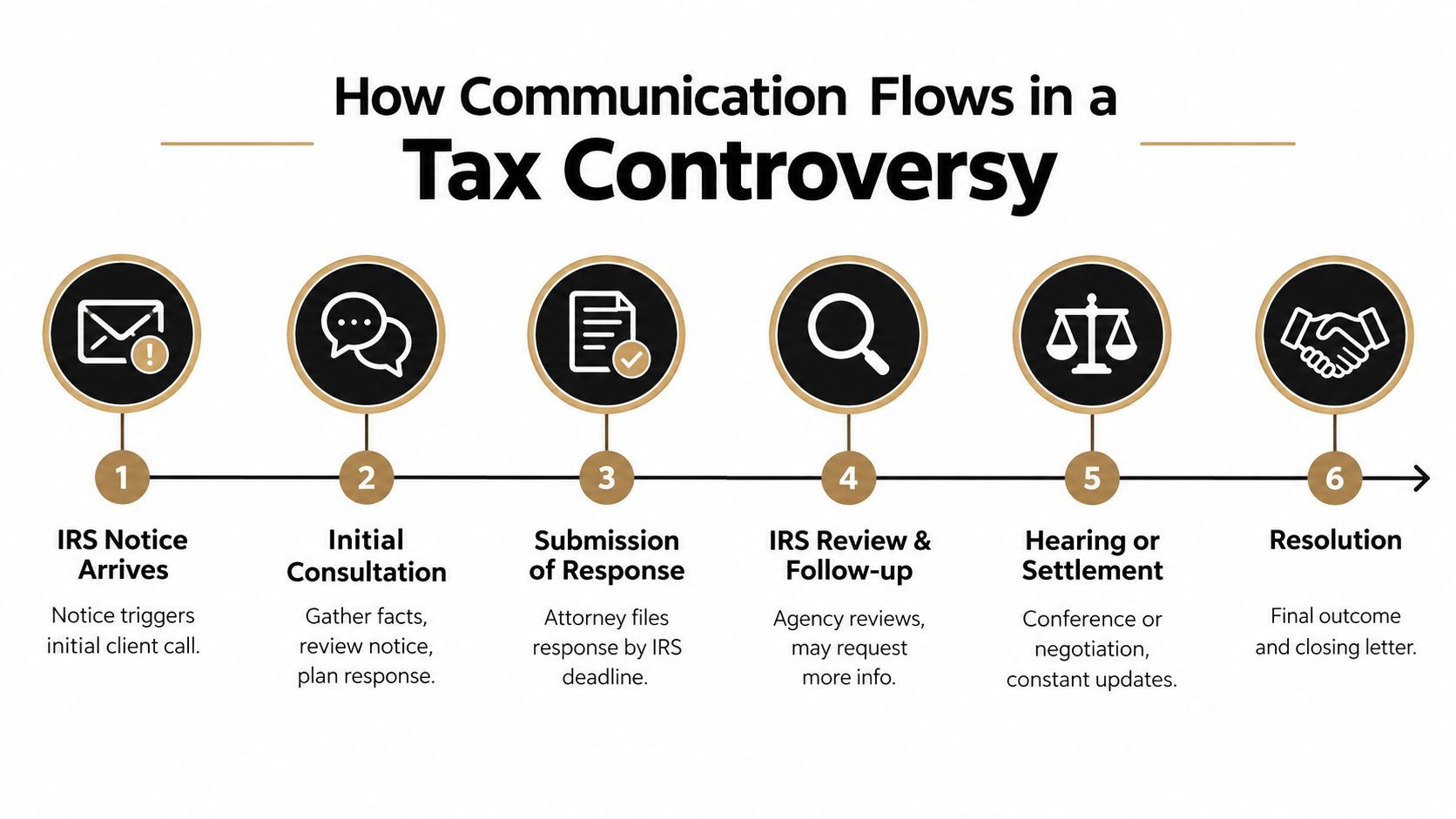
Tax controversy communication usually begins with a document, not a strategy meeting. The client receives an IRS notice, sends it to counsel through an agreed channel, and schedules an intake conversation. The attorney identifies the issue, confirms the scope of representation, gathers facts, and records every stated deadline.
The matter follows the IRS calendar
The next stage depends on the case. Counsel may request records through FOIA, prepare Form 2848, develop a response to an examination, communicate with Collections, or prepare a Tax Court filing. Each step creates a different client task. The client may need to explain a transaction, locate bank records, sign an authorization, review a factual statement, or approve a settlement position.
The attorney should communicate after substantive events, not only when the IRS produces a final answer. Useful touchpoints include:
- After IRS contact: Explain what the agency requested, what was provided, and what happens next.
- Before submission: Give the client enough time to review factual statements and identify omissions.
- When documents are missing: State exactly what is needed and why it affects the response.
- When strategy changes: Explain the alternatives, risks, and decisions requiring client approval.
- Before a deadline: Confirm the required action, signature, and delivery method.
Deadlines control the rhythm. A 30-day appeal window, a 90-day Tax Court petition period, and an examination response date can each require urgent communication, depending on the notice and governing rules. The exact deadline must be verified from the notice and applicable law. Silence can prevent the attorney from learning a critical fact, while a delayed attorney update can leave the client unable to make an informed choice.
Different cases move at different speeds
An active examination may generate frequent document requests and focused review periods. A Collections matter may involve financial statements, payment proposals, and conversations about ability to pay. A Tax Court case can require formal pleadings, discovery, motion practice, and carefully timed decisions.
That variation doesn't necessarily reflect attorney availability. It reflects the posture of the case. A client should ask how the firm will report inactivity, because “nothing new from the IRS” is still useful information when the client knows the file remains monitored. Form 2848 often plays a central role in directing IRS communications, so clients should understand how Form 2848 works before signing it.
Best Practices for Clients and Attorneys
A communication plan belongs in the engagement conversation, not in an emergency after a deadline is missed. The following checklist can be printed and discussed during the first meeting.
What the attorney should establish
- Primary channel: Identify whether the portal, encrypted email, telephone, or another method is preferred for documents and urgent questions.
- Response expectations: State how the office acknowledges messages and when clients can expect a substantive response. The exact window should appear in the engagement materials.
- Document process: Explain file naming, acceptable formats, portal uploads, and whether the office wants copies rather than originals.
- Update cadence: Tie updates to IRS notices, submissions, agency calls, missing information, and decisions that require consent.
- Emergency instructions: Give clients a clear method for flagging a notice with a short response period or an unexpected IRS contact.
- Recordkeeping: Maintain written summaries of important calls, saved portal messages, and a shared matter calendar.
What the client should do
Send the entire IRS notice, including pages that seem unimportant. Flag the date received, the response date, and any prior correspondence. Don't wait until you've organized every file before telling counsel that a notice arrived.
Consolidate related records before uploading them, but don't alter or destroy originals. Use the firm's designated system rather than mixing attachments across personal email, text messages, and workplace accounts. Confirm receipt of important submissions and ask the attorney to confirm what remains outstanding.
A useful habit: After every important call, write down the decision, the person responsible, the next deadline, and the document still needed.
Raise uncomfortable issues early. A billing question, a possible error, a change in business circumstances, or a disagreement about settlement strategy becomes harder to address after the client stops responding. Attorneys should make those conversations normal, direct, and documented. Clients should ask questions before approving a filing, not after the IRS relies on it.
Teams that handle substantial written work can also borrow practical knowledge worker communication tips for organizing messages, capturing action items, and reducing avoidable back-and-forth. The legal standard remains specific to the representation, but clear operational habits help both sides meet it.

How Privilege Gets Lost in Everyday Conversations
The most dangerous assumption is that adding a familiar person to an email is harmless. Privilege is narrow. The communication generally must be confidential, made for legal advice, and handled in a way that doesn't disclose it beyond the people needed for the legal relationship. Guidance from Southern Methodist University describes how sharing with third parties, including inadvertent disclosure, can jeopardize protection. This explanation of attorney-client privilege is especially useful because it focuses on everyday conduct rather than courtroom theory.
Consider a small-business owner whose attorney sends a draft analysis of payroll tax exposure. The owner forwards it to a bookkeeper “for context,” even though the bookkeeper isn't retained as part of the legal engagement. The forward may disclose the attorney's analysis outside the protected circle. Later, the owner copies a spouse on a strategy text, posts the issue in a business group chat, or discusses the advice during a meeting attended by an uninvolved employee. Each step expands access.
Common waiver points
- A CPA copied by habit: The CPA may be central to the client's finances, but that doesn't automatically make every CPA communication part of the attorney-client relationship.
- A family member added for convenience: Emotional support and financial involvement don't necessarily establish a legal need to receive privileged advice.
- A workplace device: Texting from a work-issued phone can expose content to an employer's systems or administrators.
- A casual forward: A client may think forwarding preserves context. It may instead create a new disclosure.
IRC Section 7525 provides a federal tax practitioner privilege in certain circumstances, but it has a narrower reach than attorney-client privilege. It shouldn't be treated as a substitute for legal representation or as a blanket protection for accounting communications.
Before adding anyone, ask the attorney whether that person is needed for the legal work, whether consent should be documented, and what information should be shared. Use a separate account for sensitive personal communications when appropriate, avoid group chats, and send the minimum necessary information through the approved channel.
Coordinating With CPAs, EAs, and Other Professionals
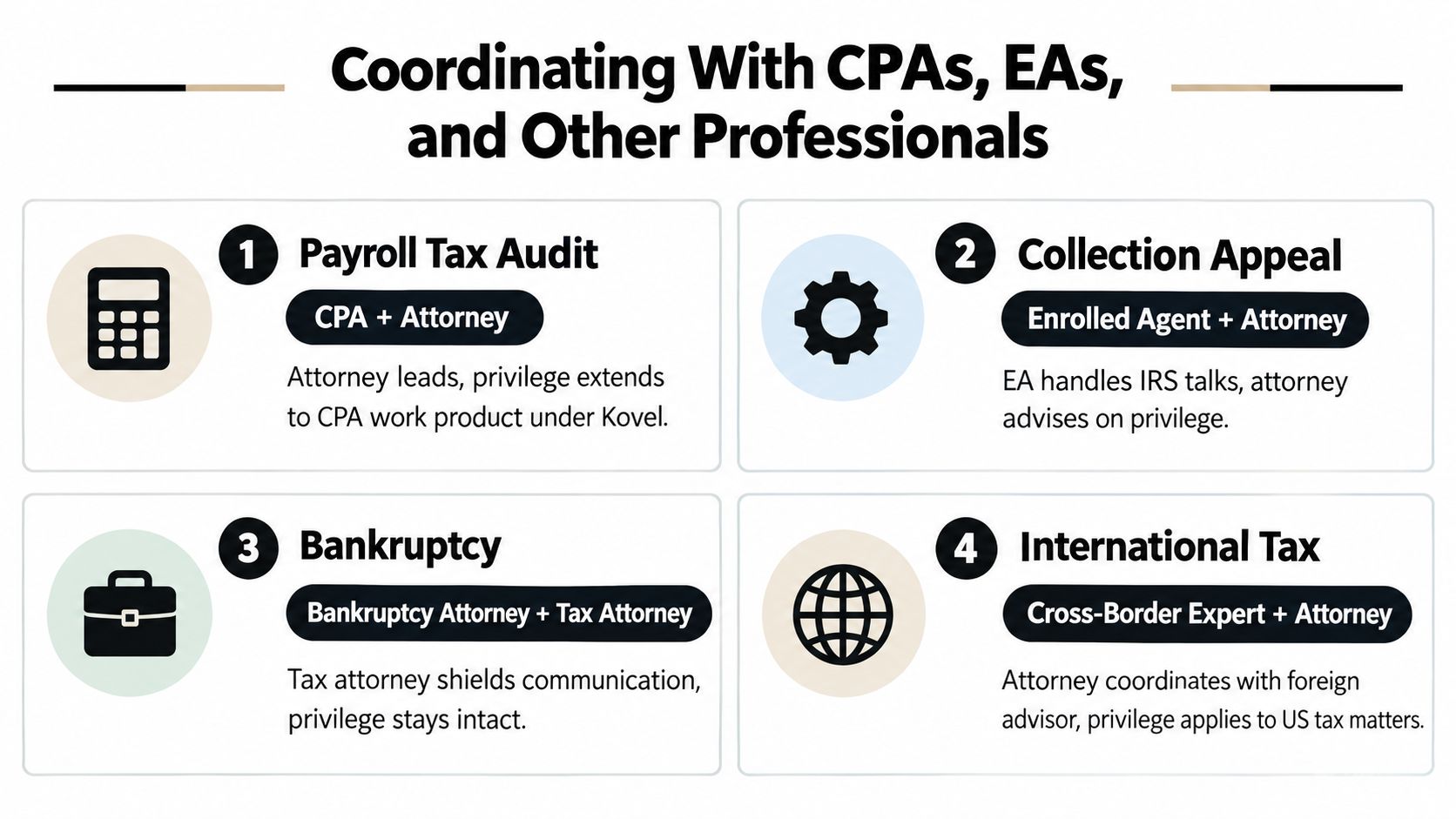
Coordination can be essential in tax cases, but necessity and consent should be clear. A third party's professional title doesn't automatically place that person inside the privilege circle.
A payroll tax audit
A business owner authorizes the tax attorney to work with the CPA who prepared payroll returns. Before the CPA joins, the client can write: “I authorize my attorney to share relevant information with my CPA for purposes of this payroll tax matter.” The attorney should define which records and conversations fall within that purpose.
A Collections appeal
An enrolled agent may handle routine IRS communications while the attorney advises on legal questions and privilege. The client should identify whether the EA is assisting the attorney's representation or acting separately for accounting or administrative work. That distinction helps prevent the client from assuming every EA message receives attorney-client protection.
A bankruptcy matter
A bankruptcy attorney and tax attorney may need to coordinate about dischargeability, priority, or collection consequences. The client should authorize a focused exchange and keep the communication limited to the issues both attorneys are handling. A broad forward of every email is harder to justify than a deliberate, matter-specific collaboration.
A family law dispute
A tax debt may affect marital property or the ability to complete a divorce. The tax attorney should share only relevant information with family counsel after the client gives informed authorization. The client should also understand that sharing advice with a separate legal team can affect privilege, even when both attorneys are helping with connected problems.

The default recipient checklist
Before copying a professional, identify:
- The legal purpose: What legal task requires this person's involvement?
- The authorization: Has the client clearly approved the relevant disclosure?
- The scope: Which facts, records, or advice are necessary?
- The role: Is the professional working as part of counsel's representation, or providing separate services?
- The record: Has the attorney documented the arrangement and its limits?
A joint-defense or common-interest arrangement may differ from a casual forward, but the label shouldn't be used casually. The attorney should evaluate the governing facts and document the intended relationship before the group begins exchanging strategy.
Practical Rules of Thumb to Remember
The late-night IRS email becomes safer when you slow down before sending it. Save the notice, note every date, and use the secure channel identified by your attorney. Send the facts counsel needs, state your questions plainly, and don't copy your spouse, accountant, bookkeeper, lender, or business partner unless the attorney has confirmed that person's role.
Use these rules in daily practice:
- Separate facts from assumptions. Tell counsel what the IRS notice says, what you did, and what records exist. Label guesses and incomplete information so the attorney can test them.
- Keep legal advice in the legal workspace. Use the client portal for sensitive documents when the firm provides one. Don't move a protected analysis into a general business thread just because another person wants background.
- Pause before forwarding. Read the recipient list, attachments, previous messages, and automatic signatures. A single unintended recipient can change the confidentiality analysis.
- Confirm the scope in writing. Ask whether the attorney represents you, your business, an entity owner, or a particular matter only. Tax issues often overlap, but representation doesn't expand automatically.
- Treat the IRS calendar as the master clock. A status update should account for the next response date, appeal opportunity, filing requirement, or agency request. If you receive a new notice, notify counsel immediately rather than waiting for a scheduled call.
- Document decisions. After a call, preserve the summary, assigned task, and deadline. If the attorney's summary differs from your understanding, raise the difference promptly.
- Don't use consumer AI for sensitive legal analysis without instructions. A public platform may not provide the confidentiality controls your matter requires. Ask counsel before entering IRS notices, account details, strategy, or identifying information into an AI tool.
- Keep difficult conversations open. Billing concerns, mistakes, changed facts, and disagreement about a proposed response should be communicated directly. Silence removes information the attorney may need to protect your position.
The most useful habit takes only a few seconds. Before hitting send, ask whether the message, recipients, attachments, and channel all match the privilege and confidentiality you're relying on.
Tax Attorney Stephen A Weisberg helps individuals, business owners, and professionals address tax debt, audits, and other IRS or state tax matters through direct attorney involvement and a free Tax Debt Analysis before paid resolution work begins. Visit Tax Attorney Stephen A Weisberg to learn how to start a confidential conversation and establish a communication plan for your tax matter.


