Arlington County Assessments: Appeals & Valuations 2026
Understand your Arlington County assessments. Our guide explains how values are set, key deadlines, and the process to appeal your valuation.
In this article
- Understanding Your Property Assessment
- What ad valorem means in practice
- The question to ask first
- How Arlington County Calculates Your Assessed Value
- What mass appraisal means for homeowners
- What changes year to year
- What commercial owners should focus on
- How to Look Up Your Assessment and Key 2026 Dates
- What to review in the notice
- The dates that matter
- How to use the portal wisely
- The Formal Appeal Process Step by Step
- Stage one with the department
- Stage two with the Board of Equalization
- What actually works at each stage
- The one rule you can't ignore
- How to Build a Strong Case for Your Appeal
- Evidence that tends to carry weight
- What owners often get wrong
- A practical framework for presentation
- Keep the appeal grounded
- When to Consult a Tax Attorney
- Small business owners with IRS debt
- Divorce cases and frozen property decisions
- Signs you shouldn't handle it casually
- Taking Control of Your Property Valuation
You open the notice, see that the county thinks your property is worth more than you expected, and your first reaction is usually the same as everyone else's: "How much is this going to cost me?"
That reaction is understandable, but it can push people into the wrong fight. In Arlington County assessments, the first question isn't whether the tax bill feels high. It's whether the county's value for your property is accurate. If the value is wrong, everything that comes after it starts from the wrong number.
For homeowners, that may mean paying tax on a value your home wouldn't command in a real sale. For small business owners, the issue can be more serious. Tax debt, cash flow pressure, title problems, and even divorce negotiations can make a local assessment appeal part of a much bigger legal strategy. The process is bureaucratic, but it isn't mysterious once you know what to look for and when to act.
Understanding Your Property Assessment
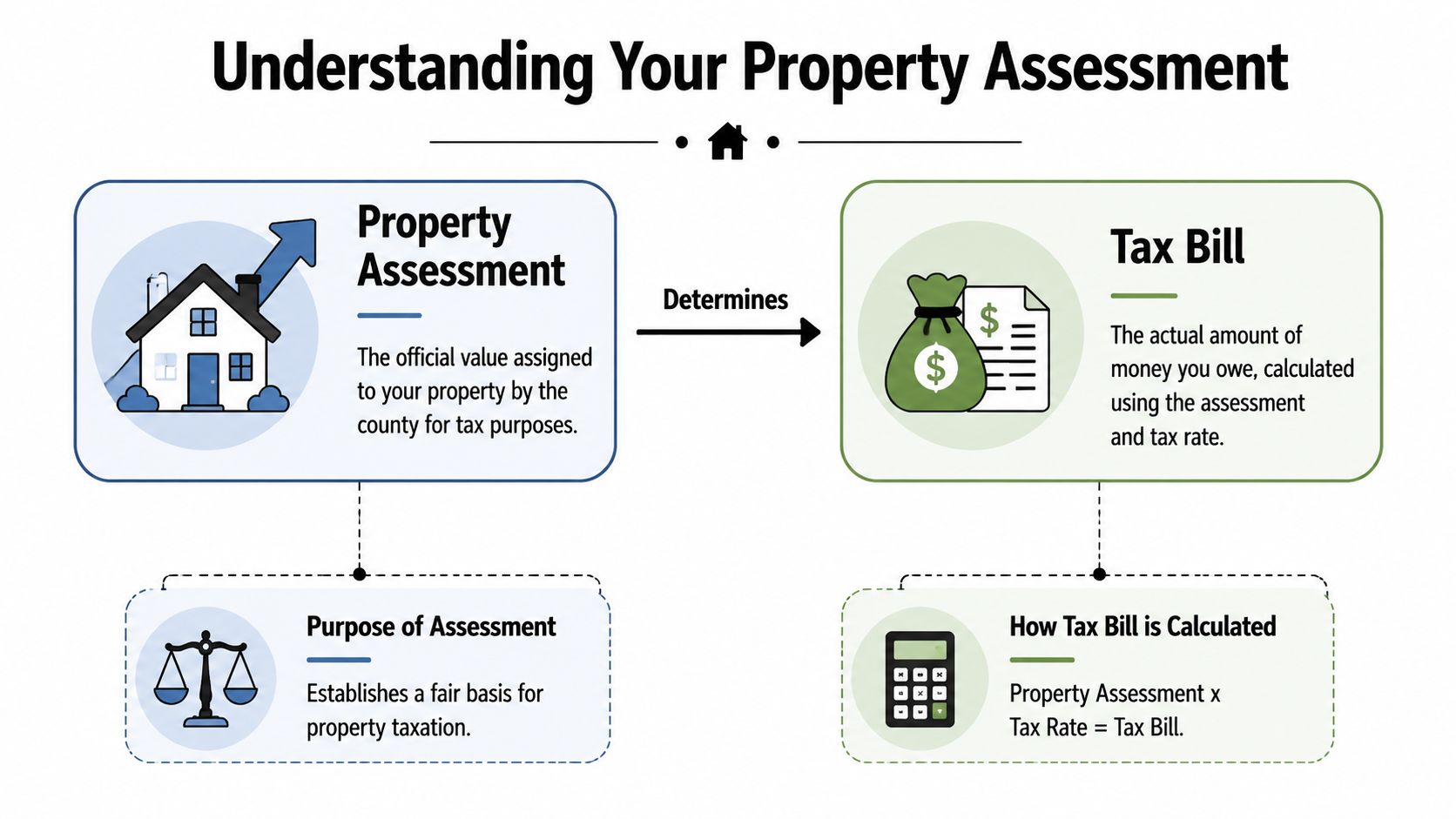
An assessment is not the same thing as your tax bill. It is the county's opinion of your property's fair market value for tax purposes.
A simple way to think about it is this. The assessment is the starting number on the worksheet. The tax bill is the result after the county applies the tax rate and any other applicable rules. If the starting number is wrong, the final bill may be wrong too.
What ad valorem means in practice
Ad valorem means the tax is based on value. Arlington isn't taxing your property because you own it. It's taxing it based on what the county says it's worth.
That distinction matters because many owners waste time arguing about affordability, fairness in a broad sense, or rising costs generally. Those concerns may be real, but they usually don't win an assessment appeal. What matters is whether the value assigned to your property reflects reality.
The question to ask first
Don't start with "My taxes are too high."
Start with these questions instead:
- Is the county describing the property correctly. Square footage, lot characteristics, use, and major features matter.
- Would this property sell for the assessed amount. That is the practical valuation question.
- Is the county relying on assumptions that don't fit this property. Mass systems are efficient, but they can miss property-specific problems.
Practical rule: An assessment appeal is usually strongest when you challenge facts, valuation logic, or property-specific conditions. It's weakest when you argue only that taxes feel burdensome.
If you work with clients in more than one jurisdiction, it can help to compare how local tax systems frame valuation issues. For example, this overview of tax guidance for West Chester business owners is useful because it shows the same core idea in another market: first understand the valuation mechanism, then address the tax consequences.
For readers who want broader context on valuation disputes and local tax issues, Arlington-specific concerns also fit within the larger category of property tax articles and updates.
How Arlington County Calculates Your Assessed Value
Arlington County uses a benchmark mass appraisal system for ad valorem taxation, and for commercial property it uses the income approach so that assessments reflect 100% of fair market value, according to the county's real estate assessment methodology.
That phrase, "mass appraisal," is important. The county isn't valuing each property the way a private appraiser might approach a single house for a refinance. Instead, it groups properties and applies standardized procedures and statistical testing to maintain uniformity across the county.
What mass appraisal means for homeowners
For residential owners, the practical takeaway is that your property was likely valued within a larger set of similar properties. That system promotes consistency, but consistency isn't the same as precision.
A county model can capture neighborhood movement well while still missing details that matter to your parcel or your house, such as deferred maintenance, an awkward layout, unusual location drawbacks, or data errors in the property record.
Here is how to consider it:
| Issue | What the county system does well | Where owners often find appeal points |
|---|---|---|
| Neighborhood trends | Captures broad market direction | May over-apply neighborhood strength to a weaker property |
| Property grouping | Keeps valuation methods uniform | Can flatten important differences between homes |
| Standardized records | Efficient for annual updates | Can contain factual mistakes that affect value |
What changes year to year
The county's published assessment results show that values move with the market, but not always at the same pace across property types. In the 2023 revaluation cycle, Arlington reported a 3.6% overall increase in assessed value, with residential values up 4.5% and commercial values up 2.6%, as described in the county's published 2023 assessment information [Source 1]. In the 2025 assessment cycle, the county reported a 2% overall increase, with residential values up 3.7% and commercial values up 0.1%, a lower rate than the 2.5% increase in 2024, according to the county's 2025 assessment materials [Source 2].
Those figures tell you something useful. Arlington County assessments aren't moving in a single straight line. Residential and commercial properties can behave differently, and a slowing countywide trend doesn't mean every individual property landed at the right number.
Standardized valuation systems are designed to be fair at scale. Appeals succeed when you show why your property doesn't fit the scale model cleanly.
For readers who want a clearer conceptual primer on site and parcel analysis, this guide to understanding land valuation techniques is a helpful companion. It isn't Arlington-specific, but it does reinforce the basic point that valuation turns on method, assumptions, and comparability.
What commercial owners should focus on
For commercial property, the county's use of the income approach matters because valuation turns on net income after operating costs, taxes, and insurance, capitalized at a market-based rate. That means your dispute may not be about appearance or neighborhood reputation at all. It may be about income assumptions, expense treatment, or whether the capitalization inputs fit the property.
Commercial owners often make a mistake here. They argue from intuition rather than from the math the county is using. If the county used an income model, the appeal needs to meet that model on its own terms.
How to Look Up Your Assessment and Key 2026 Dates
The fastest way to reduce anxiety is to pull the actual record and read the notice carefully. Arlington makes that possible through its online property search portal.
Use the county's property search website, locate your parcel, and open the Assessment Notice tab. The county states in its assessment FAQ that owners can view notices online through the property search system and that the tab is labeled "Assessment Notice" in the portal described on the county's real estate assessment FAQ page.
What to review in the notice
When you pull the notice, don't skim it. Read it like you're checking a contract draft.
Look for:
- Property identification details such as address and parcel information
- Assessment year information shown in the notice
- Physical data that may affect value, including features or measurements recorded by the county
- Any immediate mismatch between what the county appears to assume and what is physically there
The dates that matter
For Arlington County assessments, the deadlines are strict. The county states that property owners must file an Application for Review by March 2nd, and if they remain unsatisfied, they must file an Appeal from Real Estate Assessment with the Board of Equalization by April 15th. Missing those deadlines means the assessment becomes final under the county's published procedures.
If you're even considering an appeal, calendar both deadlines immediately. Don't wait to decide whether your evidence is perfect.
How to use the portal wisely
A few practical habits help:
- Download or save the notice early so you aren't scrambling later.
- Take notes on anything inaccurate while you're reading, not days afterward.
- Start gathering supporting documents right away if something looks off.
- Don't assume a phone call protects your rights. Filing deadlines control.
Owners often lose good cases because they spend too long debating whether the county "might work with them informally." Sometimes it does. But deadlines don't bend around uncertainty.
The Formal Appeal Process Step by Step
Arlington gives owners a defined path to challenge an assessment. The path is manageable if you treat it as a sequence rather than one intimidating event.
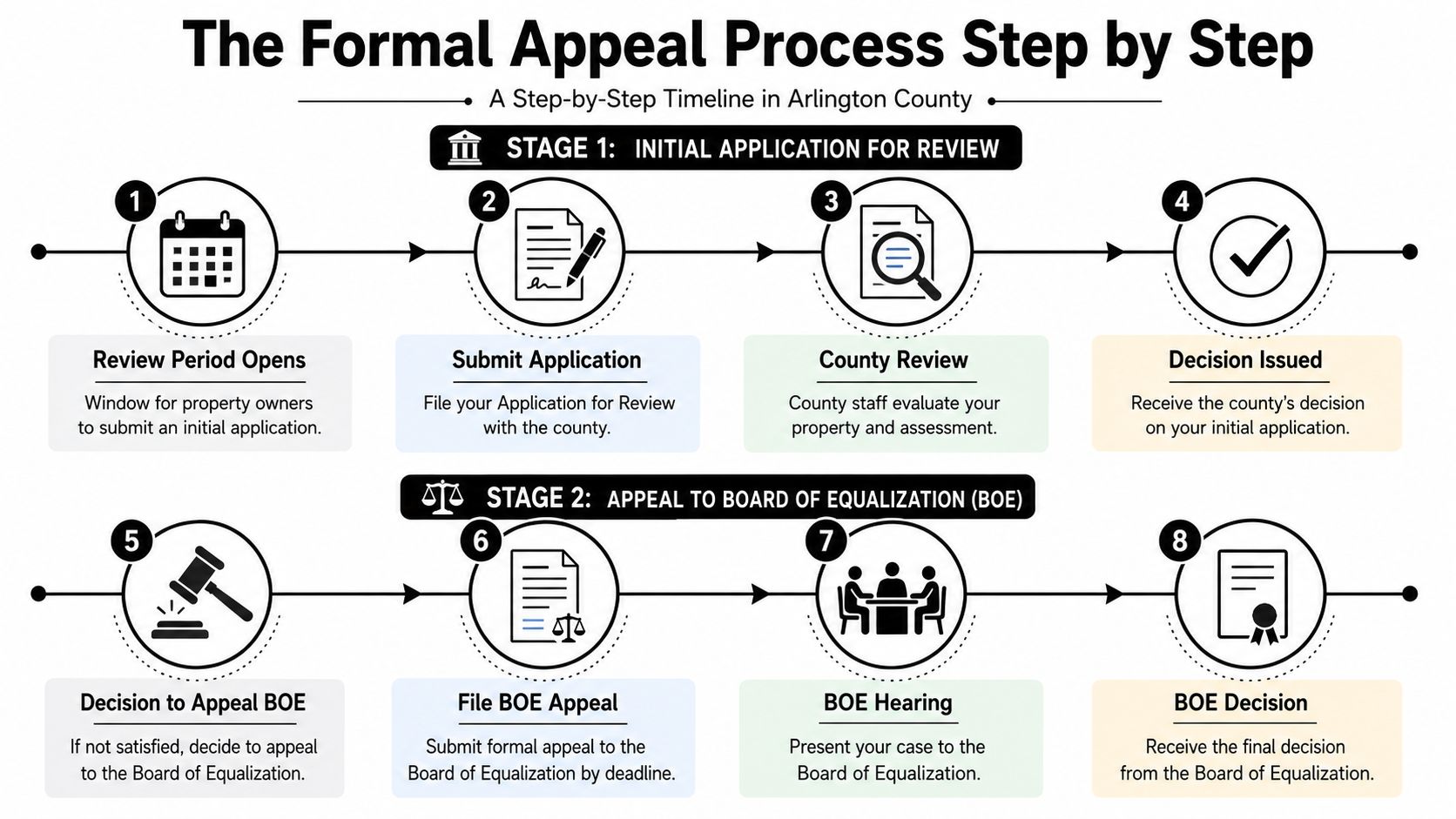
The county's process has two main stages. First comes the Application for Review with the Department of Real Estate Assessments. If that doesn't resolve the issue, the second stage is a formal appeal to the Board of Equalization.
Stage one with the department
The first filing is the county's Application for Review. According to Arlington's published procedure, it must be filed by March 2nd, either postmarked by that date or submitted online through the county process described in the FAQ.
After filing, an appraiser may schedule an appointment or otherwise review the property data with you. That step matters more than many owners realize. It is often the first real chance to correct factual assumptions before the dispute hardens.
A useful way to approach the review is to separate your points into categories:
- Record errors such as incorrect features or property data
- Condition issues that reduce value
- Comparable property concerns if your property doesn't line up with the county's assumptions
- Commercial valuation inputs if income-based assumptions are driving the number
Stage two with the Board of Equalization
If the departmental review doesn't solve the problem, Arlington allows a further appeal to the Board of Equalization. The county states that this filing must be made by April 15th to preserve recourse.
The Board hears objections to real estate assessments, and owners may appeal directly to the Board even without completing a formal departmental review if they choose that route under the county's procedures.
Some owners overinvest in arguing with the department and underinvest in preserving the Board deadline. That is backwards. Preserve the deadline first.
What actually works at each stage
The department review is often the best place to fix obvious factual issues. A wrong feature, wrong use classification, or mismatch in property condition can sometimes be addressed efficiently there.
The Board stage requires more discipline. By that point, you should assume the county will expect a coherent valuation argument, not just dissatisfaction.
This comparison helps:
| Stage | Best use | Common mistake |
|---|---|---|
| Application for Review | Correct data, raise specific valuation concerns early | Filing with vague complaints and no organized support |
| Board of Equalization appeal | Present a focused, evidence-backed challenge | Repeating the same objections without sharpening the proof |
If you want a broader overview of how property owners can frame an assessment challenge, this guide on appealing a tax assessment gives useful background on what makes an appeal persuasive.
The one rule you can't ignore
Missing the filing deadline usually ends the matter. Arlington's process is time-bound for a reason. The county needs finality, and the system gives it through strict cutoffs.
That means a mediocre appeal filed on time is often more useful than a stronger package you never submit. You can refine a live case. You usually can't revive a missed deadline.
How to Build a Strong Case for Your Appeal
A good appeal doesn't sound indignant. It sounds documented.
Most weak assessment challenges fail for the same reason. The owner may sincerely believe the value is wrong, but the file they submit doesn't give the county or the Board a concrete basis to lower it. The goal is to replace conclusion with proof.
Evidence that tends to carry weight
The strongest evidence usually falls into a few categories:
- Comparable sales that are actually comparable. Similar location, style, condition, and utility matter more than convenience.
- Photos of condition problems if the property has defects, deferred maintenance, or outdated features that affect value.
- Repair estimates or contractor documentation when needed work is more than cosmetic.
- Professional appraisal material when the valuation dispute is significant enough to justify it.
- Record corrections if the county's data about the property is wrong.
Not every appeal needs every category. A straightforward factual error case may be won with records and photographs alone. A more disputed valuation case may require a tighter package.
What owners often get wrong
Here are the patterns that don't help much:
- Using cherry-picked comps that look cheaper but aren't similar.
- Arguing from tax hardship alone instead of market value.
- Flooding the file with paper that doesn't connect to a clear valuation point.
- Submitting emotion without a narrative that explains why the assessment misses the property's real value.
A clean five-page package that proves one valuation point usually beats a disorganized stack of twenty pages.
A practical framework for presentation
If you're preparing materials, organize them in this order:
| Order | What to include | Why it helps |
|---|---|---|
| First | Short written summary | Tells the reviewer exactly what you want changed and why |
| Second | Key supporting documents | Makes your main proof easy to verify |
| Third | Photos or exhibits | Shows physical issues clearly |
| Last | Backup material | Preserves detail without burying the lead |
A short written narrative matters more than people think. It should say, in plain terms, what the county got wrong, what evidence supports your view, and what corrected value or corrected treatment you believe is appropriate.
For readers who want a broader framework on handling valuation disputes effectively, this resource on how to dispute a tax assessment is a useful complement.
Keep the appeal grounded
Use facts. Use chronology. Use the county's own logic where possible.
If the issue is condition, show condition. If the issue is bad data, prove the data is wrong. If the issue is valuation method, address the method. That discipline is what makes an appeal credible.
When to Consult a Tax Attorney
Many Arlington County assessments can be challenged directly by an owner. That is especially true when the dispute is limited to valuation, property condition, or a clear factual error.
Some cases are different. Once the assessment issue intersects with IRS debt, payroll tax exposure, ownership disputes, liens, divorce negotiations, or business distress, the local appeal stops being a standalone administrative matter. It becomes one piece of a larger strategy.
Small business owners with IRS debt
For small business owners, one overlooked problem is how federal tax trouble can distort the practical position of the property owner. The background material provided here states that an IRS Trust Fund Recovery Penalty can lead to inflated property assessments that the local assessor ignores, and it also notes that these cases can involve substantial financial pressure in ways ordinary assessment guides don't address, as discussed in the Ryan analysis on Arlington County assessments.
That doesn't mean the local assessor will automatically adjust value because the owner has IRS problems. Usually, it won't. The point is more strategic. If federal tax issues are affecting title, forced-sale risk, business operations, or the practical marketability of the property, the assessment challenge may need to be coordinated with the larger tax controversy.
Divorce cases and frozen property decisions
The same source notes that 45% of divorce cases involving business owners are delayed due to unresolved tax debt, with direct effects on the marital home's assessed value and the use of a proactive appeal as a legal tool in some circumstances.
Many people often receive poor advice. They are told to "wait until the divorce settles" before dealing with the assessment. That can be a mistake if the appeal deadline is approaching and valuation will influence negotiations, transfer decisions, or the equity discussion between spouses.
If tax debt is blocking a transfer, refinance, or settlement, the assessment issue isn't isolated. It needs to be timed with the larger legal problem.
Signs you shouldn't handle it casually
You should consider legal help when any of these are true:
- The property is tied to payroll tax or income tax debt and collection issues are active.
- A spouse, co-owner, or business partner disagrees about whether to appeal or how to value the property.
- The property is part of a larger negotiation involving settlement, sale, refinancing, or debt resolution.
- The county's valuation method requires technical rebuttal, especially for income-producing property.
- Missing the right argument could create problems elsewhere, including with creditors, family law counsel, or tax agencies.
If you need help evaluating whether your problem is really an assessment case, a tax controversy case, or both, this guide on finding a good tax attorney gives a practical framework.
Taking Control of Your Property Valuation
Arlington County assessments can feel impersonal because they are built through a countywide system. But your response to the assessment shouldn't be passive.
Start with the basics. Read the notice carefully. Check the property facts. Identify whether the disagreement is about data, condition, comparables, or valuation method. Then act before the filing window closes.
The deadlines matter because they preserve your rights. The evidence matters because that's what changes outcomes. And the surrounding legal context matters because some assessment disputes are really part of a broader tax or property problem.
For many owners, the right move is straightforward. File on time, stay organized, and make a concise, fact-based case. For others, especially business owners with IRS exposure or people in divorce-related property disputes, the assessment appeal can be a strategic tool that affects much more than the annual tax bill.
A county assessment is an opinion, not a commandment. If the opinion is wrong, challenge it properly.
If you need help with a property assessment issue that overlaps with IRS debt, business tax problems, or a divorce delayed by tax disputes, Attorney Stephen A Weisberg offers a practical, strategy-first approach. He represents individuals and business owners with tax debt and controversy matters, and he starts with a free Tax Debt Analysis to determine whether he can help and what path makes sense before charging for resolution work.