Are Vehicle Registration Fees Tax Deductible?
Find out: Are vehicle registration fees tax deductible? Learn the IRS rules, deductible portions, and how to maximize your tax savings this year.
In this article
- The Core Rule Differentiating a Tax from a Fee
- The three-part test
- Why this distinction matters
- What works and what doesn't
- Deducting Fees for Personal vs Business Vehicles
- Personal vehicles
- Business vehicles
- Mixed-use vehicles need allocation
- How State Registration Formulas Impact Your Deduction
- What to look for on a state notice
- State vehicle fee structures and deductibility
- Where taxpayers get tripped up
- How to Claim the Deduction and Maintain Proper Records
- Where to report it
- Records I'd want a client to keep
- Audit-proofing the file
- Common Questions on Vehicle Fee Deductions
- Does the SALT cap matter here
- I use the standard mileage rate for my business vehicle. Can I still deduct registration fees separately
- My state bill is confusing and doesn't separate the value-based portion. What should I do
- What if I already claimed the full registration bill by mistake
Vehicle registration fees are only tax deductible when the charge is based on the vehicle's value and assessed annually, and even then it's usually only the value-based portion that qualifies as a personal property tax. If you're looking at a renewal notice and wondering whether the whole bill is a write-off, the answer is usually no.
That's the point many taxpayers miss. The label on the bill doesn't control the federal tax result. The calculation method does. A registration statement can include a deductible tax component, a nondeductible administrative fee, and other charges all on the same page. If you claim the full amount without separating those pieces, you create an avoidable problem.
Business owners run into a second layer of confusion. Even when part of the registration charge is deductible, the route for claiming it depends on whether the vehicle is personal, business, or mixed-use, and whether you're using the standard mileage rate or actual expenses. That choice affects not just the deduction, but the records you need if the IRS asks questions later.
The Core Rule Differentiating a Tax from a Fee
You get a registration bill, see a state charge tied to your car, and assume it must be deductible. Sometimes that's right. Often it isn't.
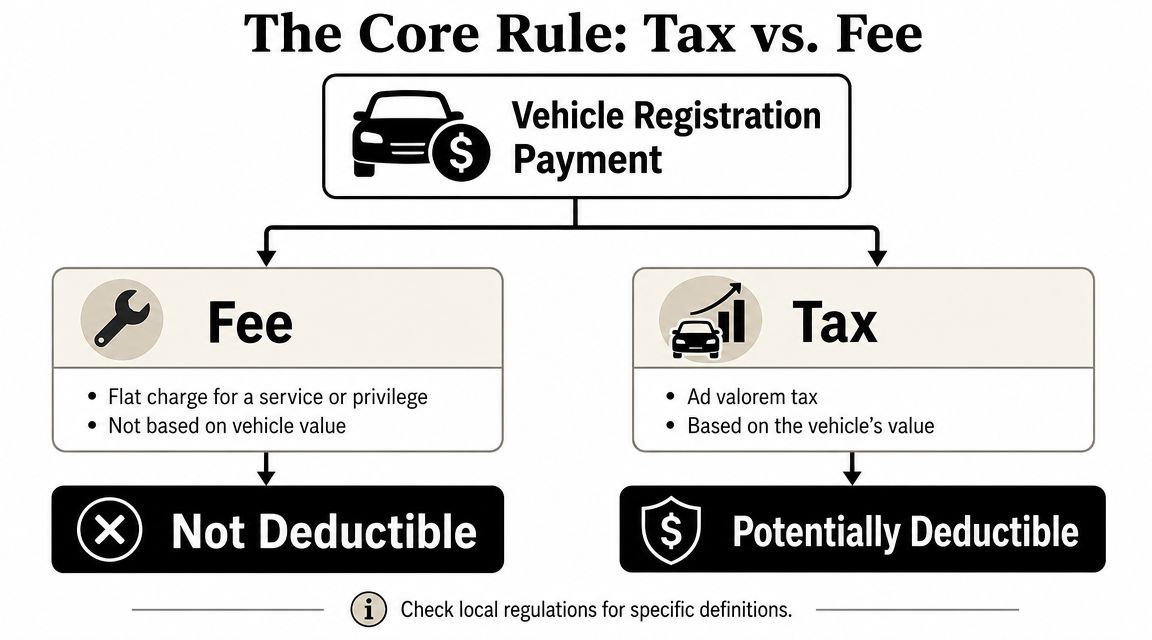
The federal rule is narrower than generally understood. A vehicle registration charge is generally deductible only if it functions like a personal property tax. TaxAct explains that the charge must be based on the vehicle's value and assessed annually, and that fees based on weight, model, year, or horsepower aren't deductible. Their example shows a yearly motor vehicle registration tax of 1% of value plus $0.50 per hundredweight. On a $1,500 vehicle with a $32 total charge, only $15 is deductible because that piece is tied to value, while the remaining $17 based on weight is not deductible, and the deductible amount is claimed on Schedule A, Line 5c (TaxAct guidance on auto registration and license fees).
The three-part test
A practical way to analyze any registration bill is to ask three questions:
Is it based on value?
If the state calculates part of the charge from the car's value, that part may qualify.Is it assessed annually?
The tax has to be annual in character, even if the state collects it in some other payment pattern.Is it a tax on personal property rather than a service charge?
Plate fees, filing fees, emissions fees, and similar add-ons generally don't become deductible just because they appear on the same bill.
Practical rule: If the formula changes with the vehicle's value, you may have a deduction. If it's a flat amount or tied to weight or age, you usually don't.
Why this distinction matters
Think about the difference between a county property tax on real estate and a flat city permit charge. One is tied to value. The other pays for an administrative function. Vehicle registration bills often combine both concepts.
That's why reading the line items matters more than reading the title of the notice. A state can call something a registration tax, license fee, or vehicle charge, but the IRS treatment follows how the amount is computed.
For taxpayers trying to sort out similar classification issues, the same principle shows up in other contexts where labels don't decide tax treatment. That theme appears in these discussions of non-taxable payments as well. The legal character of the payment drives the result.
What works and what doesn't
What works
- Separating the bill into components and identifying the value-based annual portion.
- Using the actual statement from the DMV or state agency as your reference point.
- Claiming only the qualifying amount rather than rounding up to the total paid.
What doesn't
- Deducting the full registration bill because part of it looks tax-like.
- Assuming every state vehicle charge qualifies.
- Relying on the name of the charge instead of the formula behind it.
Deducting Fees for Personal vs Business Vehicles
The deduction rules change once you move from a personal car to a business-use vehicle. In this context, many otherwise careful taxpayers make a filing mistake.
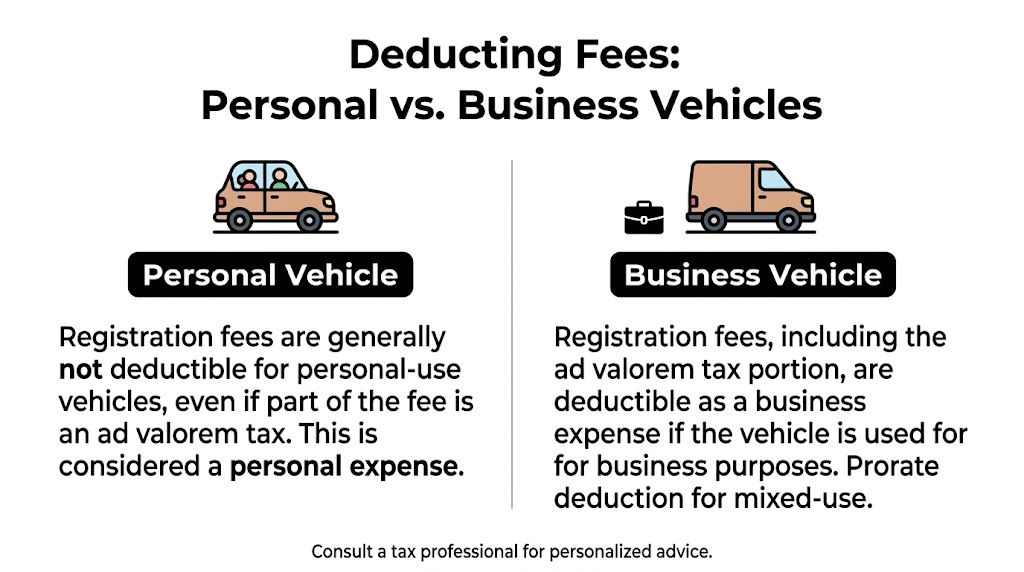
For self-employed taxpayers and business owners, Everlance notes that registration and license charges can be deductible under the actual-expense method for business vehicles, while the value-based personal property tax portion may also flow to Schedule A if it meets the annual value-based test. The key practical point is allocation. If the registration statement shows a total fee and only part is tied to vehicle value, only that part is potentially deductible, while the rest is excluded. Everlance also points to California's Vehicle License Fee as an example of a value-based amount that may qualify, while non-value charges do not (Everlance explanation of vehicle registration deduction rules).
Personal vehicles
For a personal-use vehicle, the path is narrower.
You generally claim the qualifying value-based annual portion as an itemized deduction on Schedule A. If you take the standard deduction, this particular personal deduction doesn't help you. That makes the registration issue less about whether some amount qualifies in theory and more about whether itemizing produces a meaningful benefit in your return as a whole.
The practical trade-off is simple. A technically deductible amount can still produce no tax benefit if you aren't itemizing.
A correct deduction that never makes it onto an itemized return has no value. Filing posture matters as much as the fee itself.
Business vehicles
The business side is different. If the vehicle is used in a trade or business, registration costs may be handled as part of vehicle expense deductions, but the method matters.
If you use the actual-expense method, you analyze the registration bill and include the deductible business portion under the actual-expense framework. If the vehicle is mixed-use, you also need a business-use allocation.
If you use the standard mileage rate, don't also try to separately deduct the same kind of operating cost through the actual-expense route. That mismatch is one of the first things I'd clean up when reviewing a return.
A business owner trying to organize vehicle costs alongside other write-offs may find it useful to simplify tax deductions with Senki, especially when categorizing expenses for contractor and sole proprietor work.
Mixed-use vehicles need allocation
A single-member LLC owner who uses one car for both client meetings and family errands can't treat the entire registration bill as a business expense. The same is true for sole proprietors and many S corporation owners using one vehicle across both settings.
Use a disciplined allocation approach:
- Start with the bill itself and identify any value-based component separately from flat or administrative charges.
- Apply business-use percentage only to the business-eligible portion under your chosen method.
- Keep mileage records consistent with the deduction method you selected.
For a broader look at deduction strategy for owner-operated businesses, this sole proprietor tax deductions guide is a useful companion.
How State Registration Formulas Impact Your Deduction
Federal law supplies the test. States supply the billing formula. That's why two taxpayers with similar vehicles can get different federal results.
TurboTax explains that the IRS treatment turns on whether the charge is value-based and annual, not on whether the state calls it a registration fee or tax. It also notes that a fee can still qualify if the state collects it in installments or every two years, so long as the underlying assessment is annual in character (TurboTax discussion of car registration deductions).
What to look for on a state notice
The most useful question isn't "Does my state tax cars?" It's "How does my state calculate this line item?"
A state notice usually falls into one of these patterns:
Value-based formula
A line item rises or falls with the vehicle's value. This is the category most likely to qualify.Weight or age formula
A state bases the charge on how heavy the vehicle is, how old it is, or another non-value factor. That usually doesn't qualify.Flat registration structure
Every similar vehicle gets roughly the same basic charge. That also usually doesn't qualify.
State vehicle fee structures and deductibility
| State Fee Structure | Example Calculation | Is it Federally Deductible? |
|---|---|---|
| Value-based annual charge | State computes a vehicle license tax as a percentage of value | Potentially yes, but only the value-based annual portion |
| Weight-based charge | State bases the amount on vehicle weight | Generally no |
| Flat registration fee | State charges the same amount for a class of passenger vehicles | Generally no |
The payment schedule can distract taxpayers. Annual assessment is what matters. A state can collect less often and still have an annual tax underneath.
Where taxpayers get tripped up
The trouble spot is the bundled bill. A state may combine a deductible value-based charge with plate, highway, emissions, or filing amounts. The federal deduction follows the formula for each line item, not the fact that everything was paid in one transaction.
That makes state-specific review essential. I'd rather see a taxpayer claim a smaller, documented deduction than force the full amount and have no defensible breakdown if examined.
How to Claim the Deduction and Maintain Proper Records
Once you've identified a qualifying amount, the filing step is straightforward. The recordkeeping is where people get careless.
Driversnote explains that vehicle registration fees are deductible only to the extent they function as a state or local personal property tax, meaning the charge must be value-based, annual, and claimed through itemized deductions on Schedule A rather than the standard deduction. It also stresses the need to isolate the deductible component from mixed-fee bills when states bundle value-based taxes with non-value charges (Driversnote overview of deductible vehicle registration fees).

Where to report it
For personal use, the qualifying amount goes on Schedule A, Line 5c as personal property tax, assuming you itemize.
For business use, report it through the business return or schedule that applies to the entity and expense method you're using. For sole proprietors, that usually means handling it within the vehicle expense framework on Schedule C if you're on actual expenses.
Records I'd want a client to keep
If I were reviewing this deduction for audit readiness, I'd want a clean file with the following:
- The renewal notice or registration statement showing each line item.
- Proof of payment, such as a bank record, credit card statement, or canceled check.
- Any state worksheet or agency explanation showing how the value-based amount was computed.
- Mileage or use records if the vehicle has mixed personal and business use.
- A copy of the filed return showing where the deduction was claimed.
If you're building a cleaner paper trail for deductions generally, this guide to essential records for legitimate tax savings is a practical checklist.
Audit-proofing the file
The best defense is consistency. The number on the return should tie to a specific line on the state document. If it doesn't, the deduction becomes harder to defend.
I also tell clients to avoid "helpful" handwritten estimates unless the state gives no usable breakdown. If the bill is unclear, request one. For broader expense documentation systems, this resource on how to track business expenses can help tighten the process. If a taxpayer is already in dispute over deductions or facing IRS scrutiny, Attorney Stephen A Weisberg handles tax debt and controversy matters that can include reviewing whether claimed vehicle-related expenses are properly supported.
Common Questions on Vehicle Fee Deductions
Does the SALT cap matter here
Yes. For personal returns, this deduction falls into the broader state and local tax category on an itemized return. So even if a portion of your vehicle registration qualifies, the practical benefit may be limited by the overall cap that applies to those taxes.
That means two things can be true at once. The fee can be legally deductible in character, and the return can still produce little or no extra tax benefit from claiming it.
I use the standard mileage rate for my business vehicle. Can I still deduct registration fees separately
Be careful. If you're using the standard mileage rate, you shouldn't casually pull vehicle costs back out and claim them again through the actual-expense route.
The safer approach is consistency. Pick the correct vehicle method, apply it correctly, and keep records that support that method. Mixing the two is where trouble starts.
My state bill is confusing and doesn't separate the value-based portion. What should I do
Get a breakdown from the issuing agency. Start with the DMV website, renewal notice instructions, or a state worksheet if one exists. If the statement still isn't clear, contact the state agency and request the formula or line-item explanation.
A deduction is only as good as your ability to substantiate it. If you can't show which amount was value-based and annual, you're in a weak position.
What if I already claimed the full registration bill by mistake
Fix it before the IRS does. If the return hasn't been filed, correct the entry. If it has been filed and the error matters, consider whether an amendment is appropriate after reviewing the overall return.
For taxpayers with unresolved filing issues, audit concerns, or questions that spill beyond a simple deduction entry, these tax FAQs are a useful starting point.
If your vehicle deductions, business-use records, or prior filings don't line up cleanly, Attorney Stephen A Weisberg handles IRS and state tax matters involving audits, tax debt, and deduction disputes. When the issue is no longer just "can I deduct this?" but "how do I defend what I filed?", getting a legal review early can prevent a small documentation problem from turning into a larger tax controversy.


