Are Survivor Benefits Taxable? Your 2026 Tax Guide
Are survivor benefits taxable? Learn 2026 IRS rules for Social Security, pensions, life insurance & VA benefits. Calculate & report taxes.

In this article
- Navigating Finances After a Loss
- Why people get tripped up
- The question to ask first
- The Rules for Taxing Social Security Survivor Benefits
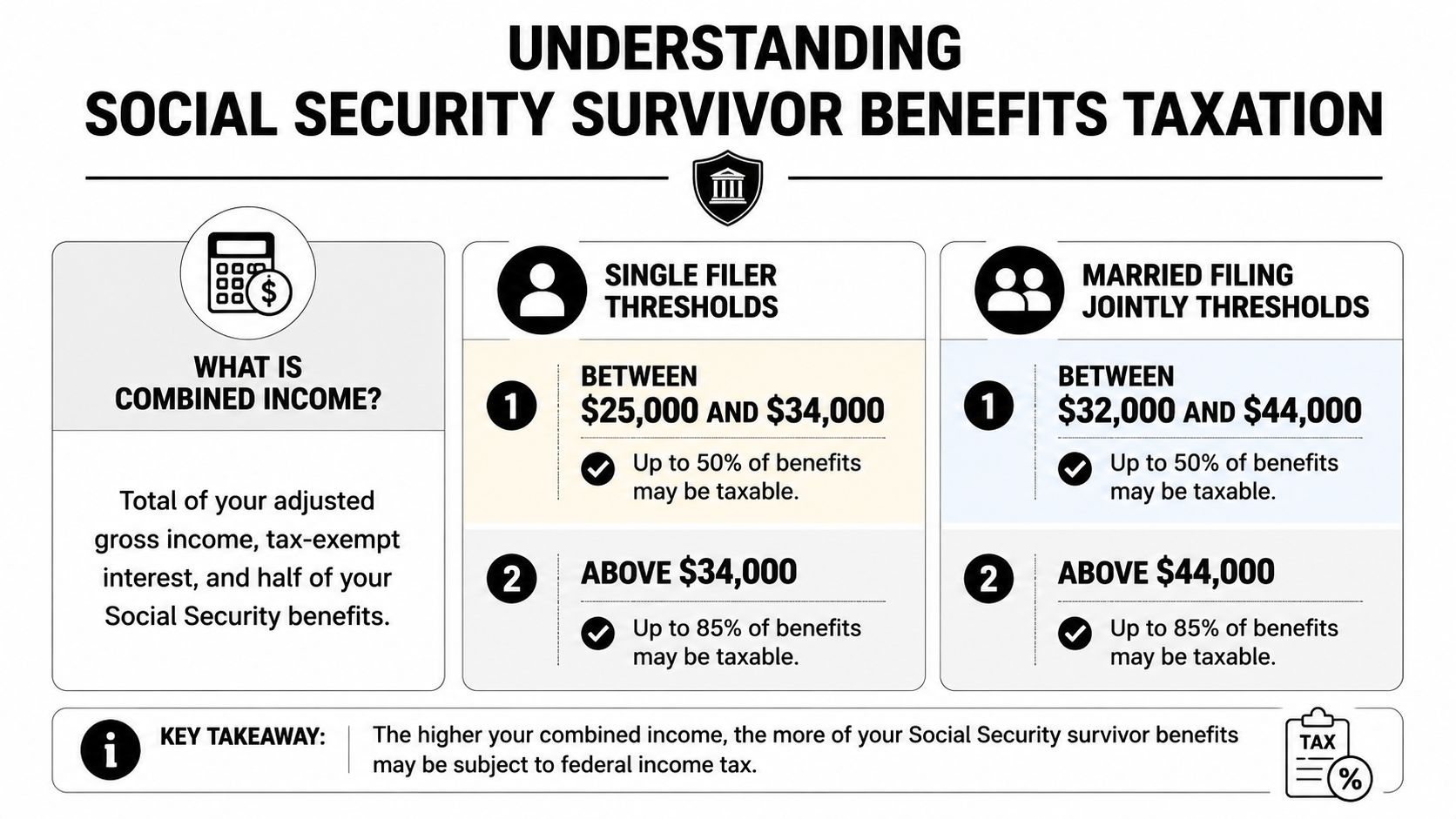
- What combined income means
- The threshold ranges
- A common single-filer trap
- Year-of-death returns need extra care
- What about children's survivor benefits
- Tax Treatment of Other Common Survivor Benefits
- Quick comparison by source
- VA benefits and life insurance
- Pension survivor benefits need closer review
- A practical sorting method
- How to Calculate and Report Taxable Benefits
- The mixed-source trap
- A workable process
- The forms you'll likely see
- Where reporting goes wrong
- Do Not Forget About State Income Taxes
- Why the state question matters
- How to approach it
- When state collection issues overlap
- Your Action Plan and When to Call a Tax Attorney
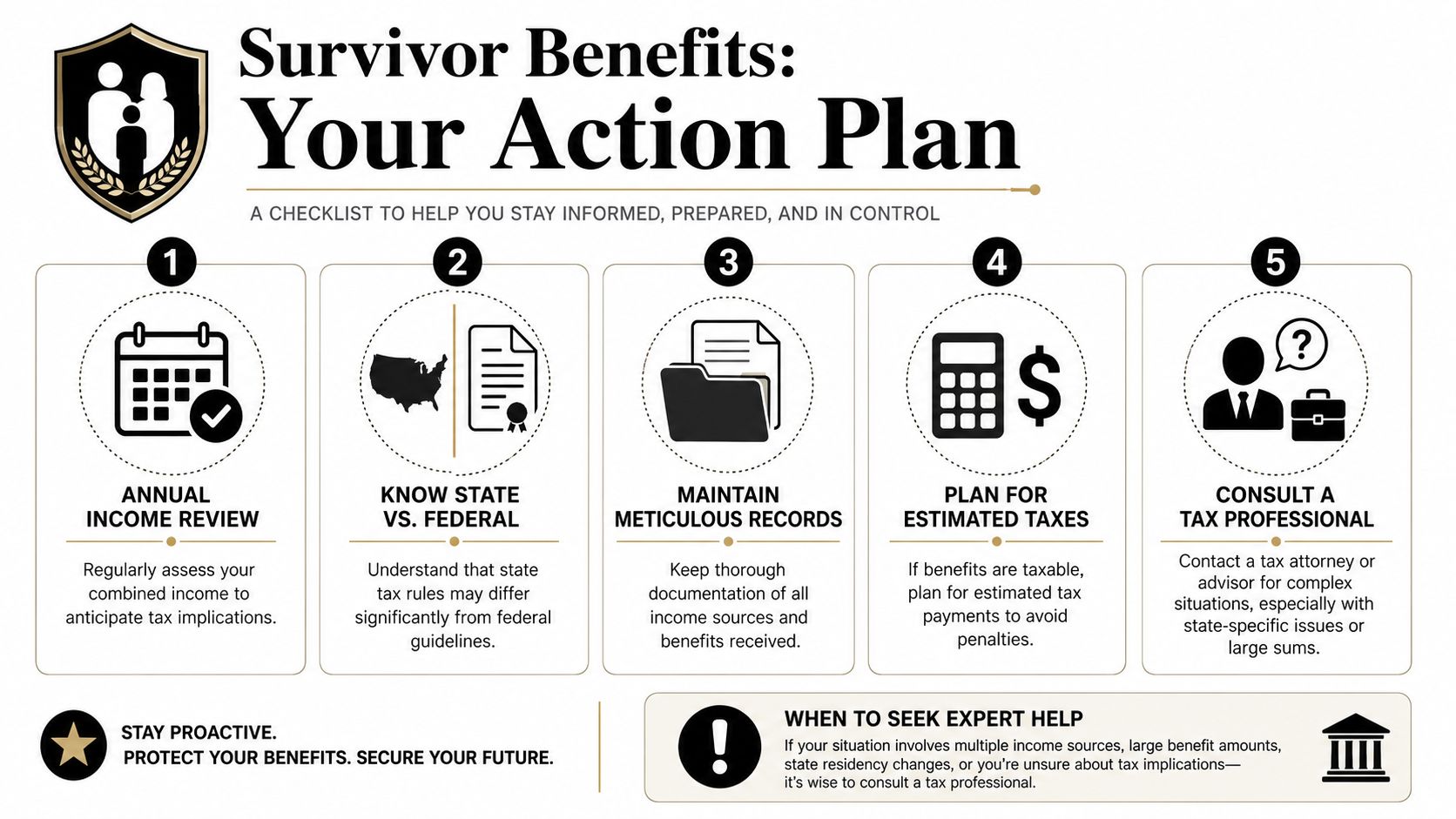
- A short checklist
- When a DIY return becomes risky
The tax question often arrives before you've had time to process anything else. A benefits letter shows up. A pension administrator asks you to complete forms. Social Security starts or changes payments. Then the practical concern lands hard: are survivor benefits taxable, and if they are, how much of this income do you get to keep?
That confusion is normal. “Survivor benefits” sounds like one category, but it isn't. A Social Security survivor payment follows one set of federal rules. A pension survivor annuity follows another. VA Dependency and Indemnity Compensation is treated differently. Life insurance usually falls into a different bucket again. The mistake I see most often is assuming one answer applies to all of them.
A harder version of the problem happens when the income comes from more than one source. Someone may receive Social Security survivor benefits, a pension based on a spouse's work history, and perhaps interest tied to life insurance proceeds. That mix can produce a tax result that feels inconsistent unless you separate each income stream and apply the right rule to each one.
Navigating Finances After a Loss
A recently bereaved spouse might sit at the kitchen table with three envelopes open at once. One is from the Social Security Administration. Another is from a former employer's retirement plan. The third is from a life insurance company. All three relate to the same loss. None follow the same tax rule.
That's why broad online answers are so frustrating. If someone asks, “Are survivor benefits taxable?” the honest answer is: sometimes, and it depends first on the source of the benefit and then on your overall income. A simple yes or no usually misleads people.
Some benefits are commonly taxed only under certain income conditions. Others are generally excluded from federal income tax. Others are taxed more like regular retirement income. The source controls the rule.
Why people get tripped up
The confusion usually comes from three assumptions:
- One name, one rule. People hear “survivor benefit” and assume every payment is taxed the same way.
- If part is capped, all of it is capped. That's not how mixed income works.
- If the payment replaced a deceased spouse's income, it must be tax-free. That feels logical, but tax law doesn't work on feeling.
Practical rule: Before you think about tax forms, identify each payment by source. Social Security, pension, VA benefit, and life insurance should never be lumped together as one category.
The question to ask first
Don't start with “Will I owe tax?” Start with this: What kind of survivor benefit am I receiving?
Once you answer that, the rest becomes more manageable. You can sort each payment into one of the main buckets:
- Social Security survivor benefits
- Pension survivor benefits
- VA survivor benefits such as DIC
- Life insurance death benefits and any related interest
That's the path to clarity. Not guessing, and not relying on the word “survivor” as if it answers the tax issue by itself.
The Rules for Taxing Social Security Survivor Benefits
A widow can receive one monthly deposit from Social Security and another from a survivor pension, then assume the Social Security portion is tax free because it is a survivor benefit. That is the mistake I see most often. Social Security survivor benefits have their own tax formula, but that formula does not operate in isolation. Other income can pull part of those benefits onto the tax return.
The federal question is whether your combined income is high enough to make part of the benefit taxable. IRS Publication 915 explains the calculation for Social Security and equivalent railroad retirement benefits, including survivor benefits, and the IRS says a child's benefits are tested under the child's own income, not the parent's, in Publication 915.
What combined income means
Combined income uses three pieces:
- Your adjusted gross income
- Your nontaxable interest
- One-half of your Social Security survivor benefits
That formula causes the mixed-source trap. A Social Security survivor check may look modest by itself. Add a taxable pension payout, IRA withdrawals, part-time wages, or investment income, and the Social Security piece can become partly taxable. That is why I tell clients to stop asking whether the Social Security benefit is taxable on its own. Ask what else is landing on the return that year.
The threshold ranges
For federal purposes, the familiar base amounts still apply. If you file as single, combined income above $25,000 can make part of the benefits taxable, and higher amounts can increase the taxable portion up to the Social Security cap. If you file jointly, the comparable thresholds begin at $32,000 and increase again at $44,000. The Social Security Administration summarizes these ranges in its page on income taxes and your Social Security benefit.
The practical problem is not the threshold itself. It is the interaction with other survivor income. A pension inherited from a spouse is often taxed more like ordinary retirement income, which can push combined income over the line. That is one reason survivors dealing with pension rights often need to understand both tax treatment and collection risk. Issues such as whether retirement payments can be reached by creditors are separate, but related enough that this guide on whether a pension can be garnished is worth reviewing.
A common single-filer trap
Assume you are filing single after your spouse's death. You receive Social Security survivor benefits and a survivor annuity from the decedent's employer plan. The annuity is taxable income in many cases. Once that annuity is added to your return, it can cause part of the Social Security survivor benefit to become taxable too.
That surprises people because they view the payments as serving the same purpose. Tax law does not. It tests each source under a different rule, then combines them on the same return.
Year-of-death returns need extra care
The filing status and timing in the year of death can change the result. A jointly filed final return may produce one outcome. A later single return for the surviving spouse may produce another, even if the monthly benefits look similar. The tax result changes because the thresholds and the rest of the income change.
That is also why broad summaries can be misleading. Resources like Foley Law on death benefits are useful for spotting the big categories, but the exact calculation turns on the source of each payment and how those sources interact on the return.
What about children's survivor benefits
Children's survivor benefits are usually tested under the child's own income situation. In many families, the child has little or no other income, so there is no federal tax in practice. The parent's earnings or pension income do not automatically make the child's Social Security survivor benefit taxable.
Check the child's income separately before assuming there is a problem. That avoids one of the most common filing mistakes after a family loss.
Tax Treatment of Other Common Survivor Benefits
A common mistake happens early. A surviving spouse deposits a VA payment, a pension survivor annuity, and an insurance check into the same account, then assumes the tax result will be similar because each payment arose from the same loss. The IRS does not group them that way. Each source keeps its own tax character, and that is exactly why mixed-source survivor income creates so much confusion later.
Quick comparison by source
| Benefit Type | Federal Tax Treatment | Key Considerations |
|---|---|---|
| Social Security survivor benefits | Potentially partially taxable | Depends on income and filing status |
| Pension survivor benefits | Typically taxed as ordinary income | After-tax contributions may affect the taxable portion |
| VA DIC | Non-taxable for federal income tax purposes | Excluded regardless of total income |
| Life insurance lump-sum death benefit | Generally tax-free | Interest earned on held proceeds is taxable |
VA benefits and life insurance
Some survivor payments are excluded from federal income tax from the start. According to AAFMAA's discussion of VA survivor benefit taxation, VA Dependency and Indemnity Compensation is not taxable for federal income tax purposes. The same general rule applies to a life insurance death benefit paid in a lump sum. If the insurer holds the money and later pays interest, the interest is taxable even though the underlying death benefit usually is not.
That distinction matters in practice. A tax-free life insurance payout does not make a taxable pension payment disappear. It also does not reduce the chance that Social Security survivor benefits become taxable once other income is added to the return.
Pension survivor benefits need closer review
Pension survivor benefits usually create the hardest tax questions outside Social Security. In many cases, they are taxed as ordinary income, and the payer reports them on Form 1099-R. If the decedent made after-tax contributions to the plan, part of each payment may be excluded from income under the IRS rules that allocate basis over time. If the pension was funded entirely with pre-tax dollars, the taxable portion is often the full amount.
Families often get tripped up. They hear that one survivor benefit is tax-free and assume the same rule carries over to the pension. It does not. A survivor annuity often works much more like retirement income than like an insurance payout.
Review the pension paperwork carefully. The gross amount, the taxable amount, and the code on Form 1099-R all matter. If broader collection issues are part of the picture, this article on whether a pension can be garnished addresses a separate but related risk that often comes up after the tax question.
A practical sorting method
Use a source-by-source review before entering anything into tax software:
- Match each payment to the payer. Social Security, a pension plan, the VA, and an insurance company follow different tax rules.
- Separate lump sums from monthly payments. A life insurance lump sum is usually treated differently from later interest or an annuity option.
- Pull the tax forms before making assumptions. Form SSA-1099, Form 1099-R, and insurer statements each point to different reporting rules.
- Watch for the mixed-source trap. A non-taxable VA payment may sit beside a fully taxable pension payment and a partially taxable Social Security benefit in the same household cash flow. The fact that the money serves one family need does not give it one tax treatment.
For a broader overview of how death-related payments are categorized, Foley Law on death benefits is a useful companion read.
Bottom line: VA DIC is generally federally non-taxable. Life insurance death benefits are usually tax-free unless interest is paid. Pension survivor benefits are often taxable as ordinary income, sometimes with a partial exclusion for after-tax basis. The trap is mixing these sources together and assuming one rule applies to all of them.
How to Calculate and Report Taxable Benefits
The calculation gets more complicated when more than one type of survivor income hits the same return. This often leads to avoidable mistakes, especially if people assume the Social Security cap somehow limits the taxation of everything else.
The mixed-source trap
If you receive both Social Security survivor benefits and a pension survivor benefit, you have two different tax rules working at once. According to MaxiFi's explanation of survivor benefits, Social Security benefits are capped at 85% taxable, while pension survivor benefits are taxed as ordinary income and can be 100% potentially taxable. The same source stresses that the 85% cap applies only to the Social Security portion, not to the combined total of all survivor income sources.
That's the trap.
A taxpayer sees “up to 85% taxable” and thinks no more than that can be taxed from all survivor income. Not true. The cap is source-specific. It protects only the Social Security side of the calculation.
A workable process
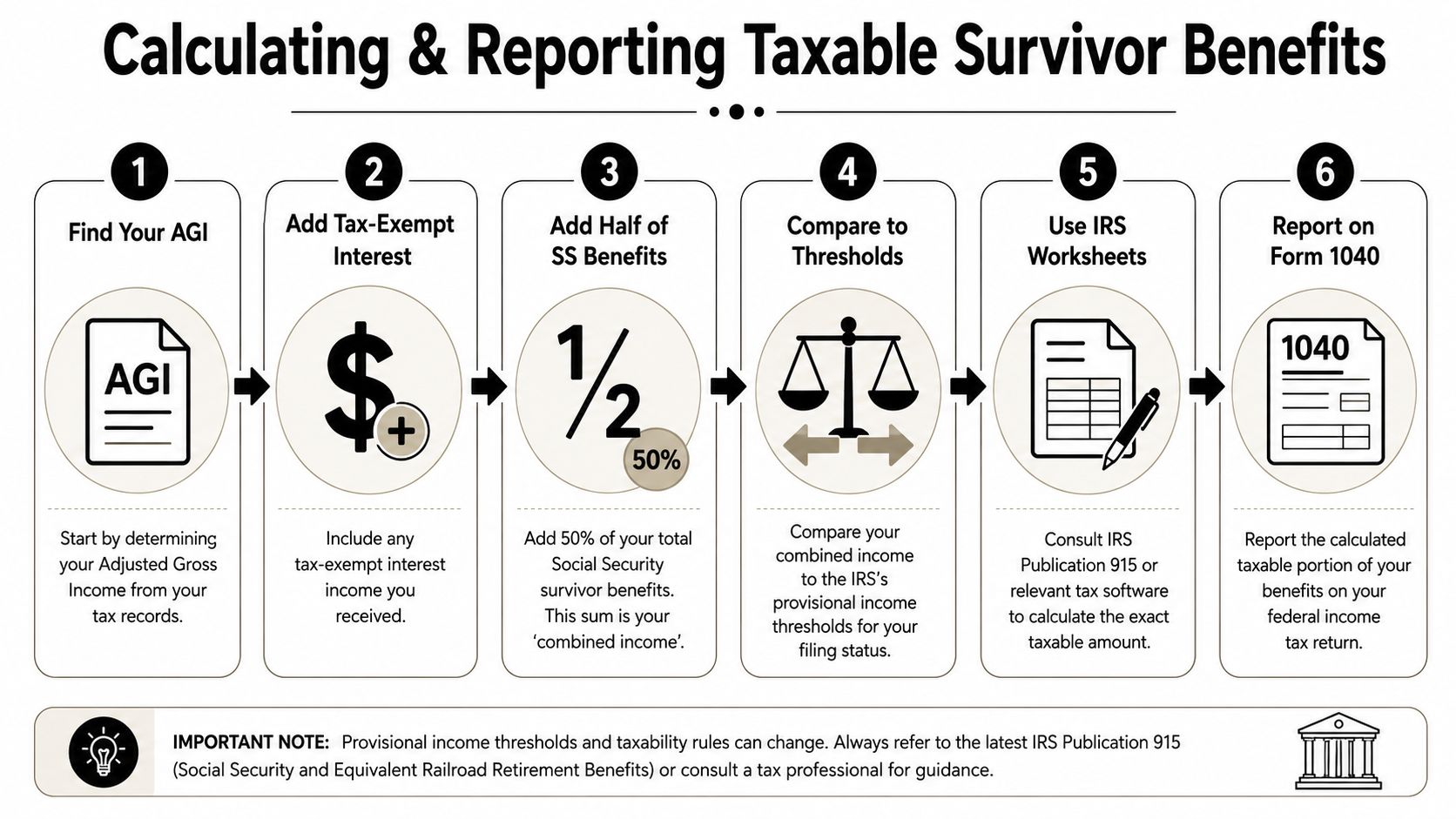
Use this sequence when you prepare the return:
- Identify every income source separately. Don't combine pension and Social Security numbers at the start.
- Find your adjusted gross income inputs. Include other taxable income that affects the Social Security calculation.
- Add tax-exempt interest if you have it.
- Add half of the Social Security survivor benefits to determine combined income for the Social Security rules.
- Calculate the pension's taxable portion separately. If the plan includes after-tax contributions, the taxable amount may differ from the gross amount.
- Report each item in the correct place on the return.
The forms you'll likely see
Those dealing with mixed-source survivor income will receive separate tax documents from separate payers. The labels matter.
- Social Security statement. This usually reports the annual Social Security benefit amount.
- Pension statement such as Form 1099-R. This generally reports retirement distributions and may show taxable and non-taxable portions.
- Life insurance interest reporting. If interest was credited while proceeds were held, that interest may be reported separately.
The point isn't to memorize line numbers. The point is to avoid entering one payment under another category. Tax software and IRS worksheets can handle the arithmetic if the data is entered into the right buckets.
Where reporting goes wrong
I've seen taxpayers underreport because they believe the pension becomes sheltered once Social Security reaches its cap. I've also seen overreporting when someone treats a non-taxable benefit as though it belongs in the Social Security formula.
Don't ask, “What is my taxable survivor income?” Ask, “Which parts are Social Security, which parts are pension income, and which parts are excluded entirely?”
For readers dealing with broader inheritance issues alongside survivor income, this guide to beneficiary tax considerations in Texas can help sort inherited assets from income-taxable benefit streams. If you want a practical worksheet-style framework for organizing all of the moving parts on a return, this step-by-step guide to calculate tax liability is a useful companion.
Do Not Forget About State Income Taxes
Federal treatment is only half the job. State law can change the outcome, and it can do so in ways that surprise people. A benefit that gets favorable treatment on the federal return may not be handled the same way by your state, and the reverse can also happen.

Why the state question matters
Some states don't impose an income tax at all. Others do, but they may exempt Social Security benefits. Some states tax retirement-related income under their own rules. That means the answer to “are survivor benefits taxable” may be different on your federal return than on your state return.
Taxpayers often get tripped up after using federal-only software prompts or reading a general article that doesn't mention state law. A return can be accurate federally and still wrong at the state level.
How to approach it
Use a simple state-tax review:
- Check whether your state has an income tax at all.
- Review whether your state follows the federal treatment of Social Security.
- Confirm how your state handles pension income and retirement distributions.
- Don't assume a federally excluded payment is automatically excluded by the state.
If you've moved after the death, the review becomes more important because residency and part-year filing can affect where income is reported. That can matter even when the benefit itself hasn't changed.
When state collection issues overlap
A state tax bill can become a collection problem if withholding was too low or if estimated payments were never adjusted after the survivor income began. In those situations, taxability is only the first issue. Collection exposure is the second. If that's already happening, this guide on how to stop state tax garnishment explains the practical options.
State returns reward caution. The federal answer may point you in the right direction, but it doesn't finish the job.
Your Action Plan and When to Call a Tax Attorney
If you're sorting this out in real time, don't try to solve the entire tax code in one sitting. Focus on the next correct step. The cleanest approach is to organize the income by source, match each source to its tax form, and then decide whether your return is straightforward or whether it has enough moving parts to justify help.
A short checklist
- Separate each benefit by source. Social Security, pension, VA, and life insurance shouldn't be merged into one label.
- Pull every year-end tax form before filing. Missing one reporting form creates more trouble than the tax itself.
- Review withholding and estimated taxes. Survivor income often changes cash flow faster than people adjust their tax payments.
- Check state treatment separately. Federal and state rules don't always line up.
When a DIY return becomes risky
You should strongly consider professional help if any of these apply:
- You receive income from multiple survivor sources. That includes the mixed Social Security and pension situation discussed above.
- You also have business income, investment income, or rental income. Those items can change the tax result quickly.
- You inherited assets and survivor income at the same time. People often mix up inheritance issues with income-tax issues.
- You're already behind with the IRS or a state tax agency.
- The payer documents don't seem to agree.
A tax attorney isn't only for a dispute. Sometimes the value is in preventing one. If you're looking for a way to vet counsel carefully, this guide on how to find a good tax attorney gives a practical framework.
The core takeaway is simple. Survivor benefits are not taxed under one universal rule. The source of the payment controls the first answer, and your overall income controls part of the rest. When those benefits come from more than one source, careful classification matters more than guesswork.
If you're dealing with survivor benefits, mixed-source income, or a tax filing that suddenly feels much more complicated than it used to, Attorney Stephen A Weisberg can help you assess the issue clearly and decide on the right next step. His practice focuses on resolving IRS and state tax problems for individuals and businesses, and he starts with a practical review of whether help is needed and what path makes sense.


