Am I Liable for My Spouse's Business Tax Debt Explained
Am I liable for my spouse's business tax debt? Learn when joint filing, entity type, and payroll taxes create exposure and how to protect yourself.

In this article
- Introduction When a Spouse's Business Debt Becomes Your Problem
- Why this question gets people stuck
- A plain-English way to think about exposure
- How Joint Filing Creates Shared Liability for Business Income
- What joint and several liability means in real life
- Why “I didn't earn the money” often doesn't solve it
- Where innocent spouse relief helps, and where it stops
- How Business Entity Type Changes Your Personal Exposure
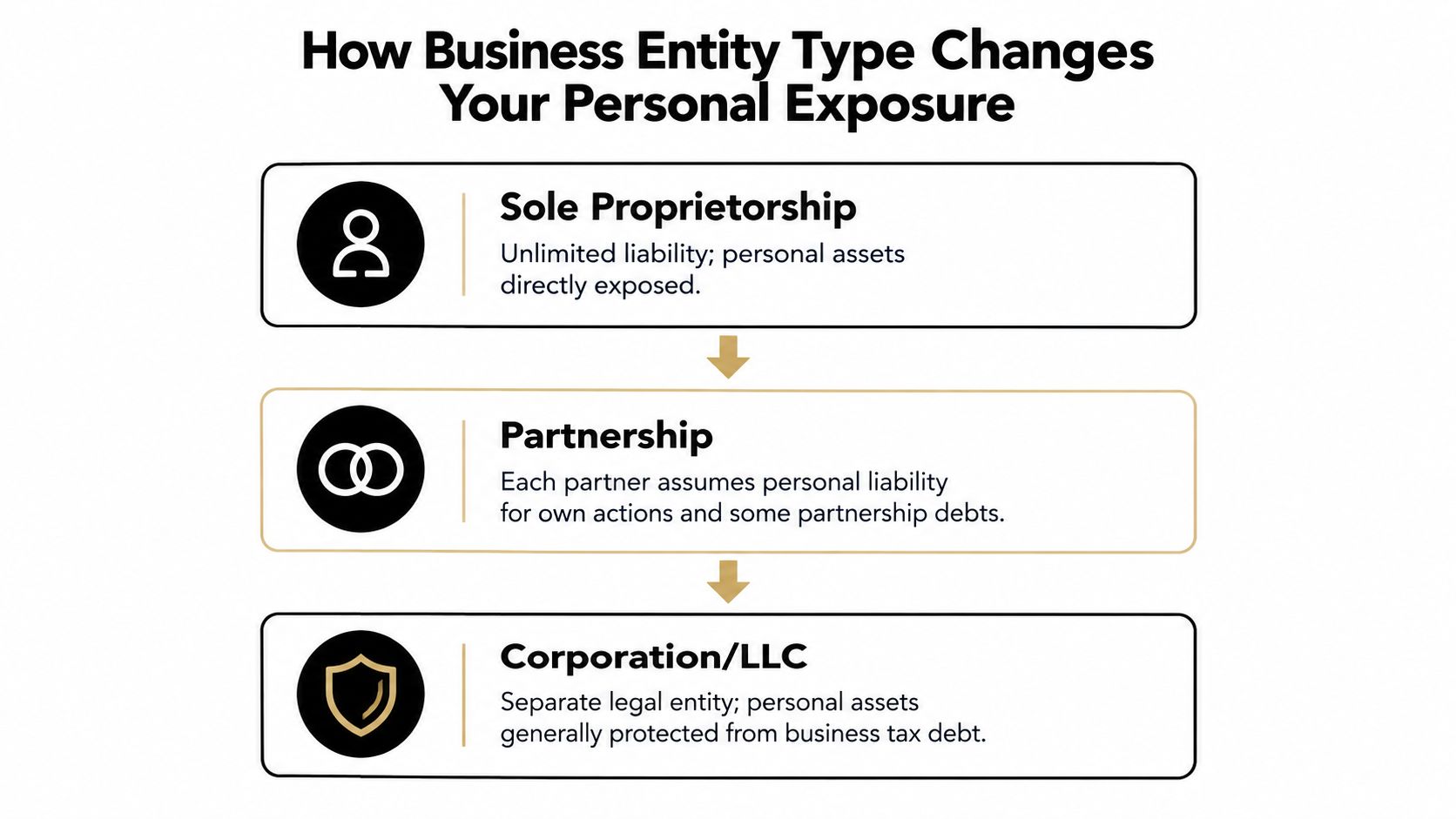
- Sole proprietorship and general partnership exposure
- LLCs and corporations usually change the picture
- Pass-through tax treatment is not the same as liability protection
- Hidden Ways You Can Become Personally Liable Anyway
- Personal Liability Triggers Beyond the Joint Return
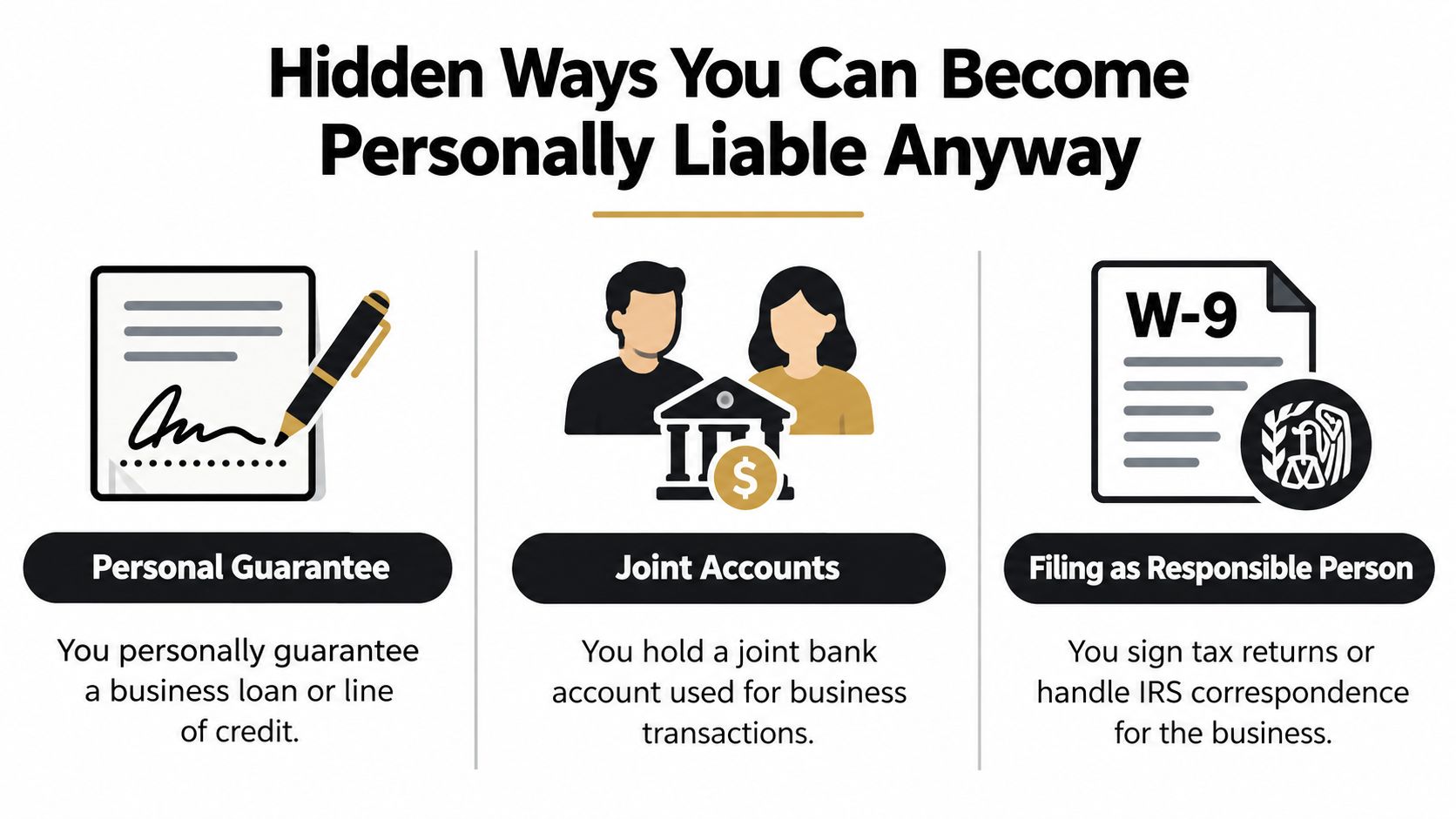
- Personal guarantees create direct liability
- Community property rules can affect what the IRS can reach
- Payroll tax responsibility is its own danger zone
- Signs You May Already Be Exposed to Collection
- Documents that tell you where the risk sits
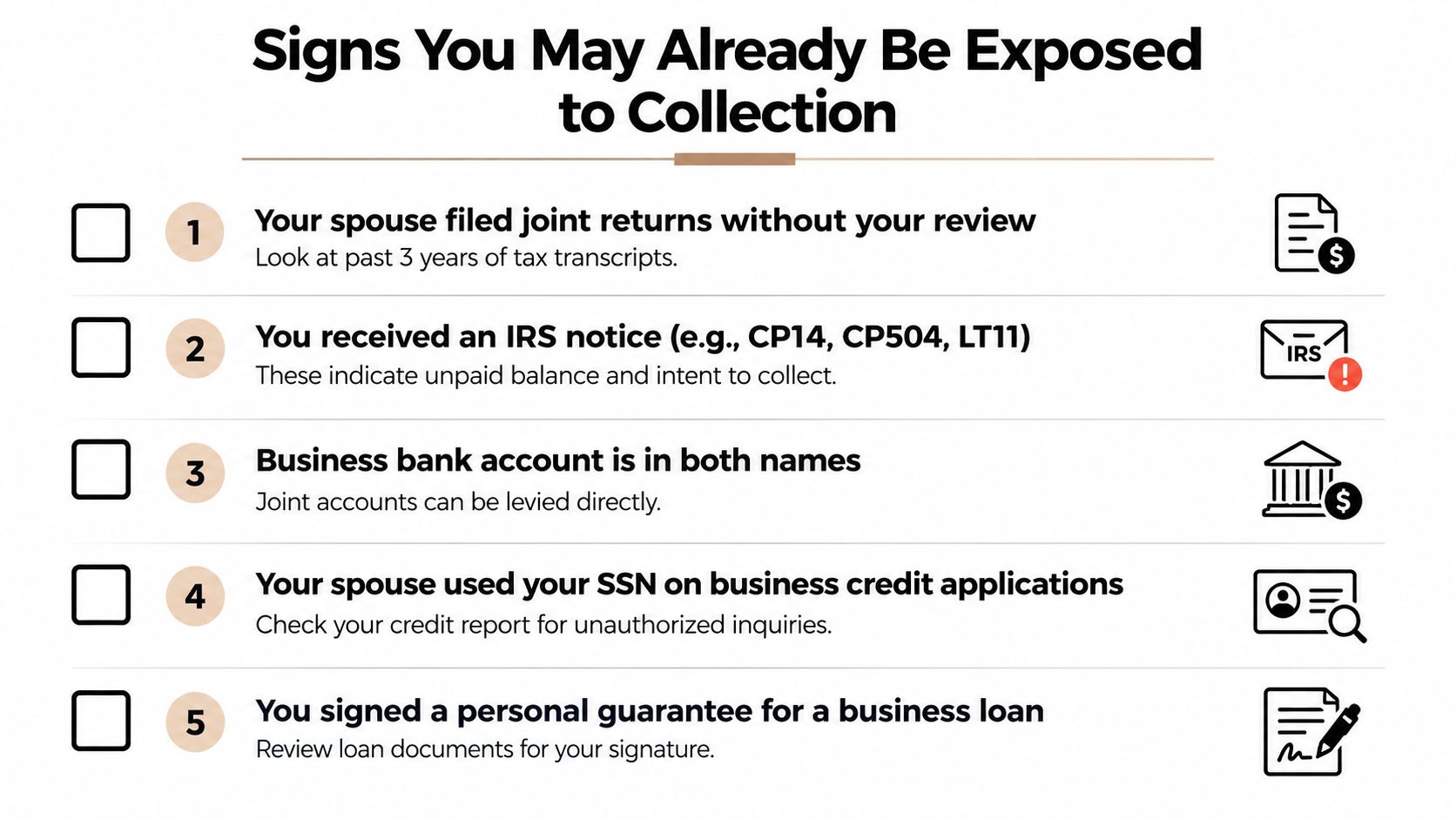
- Specific warning signs that deserve fast attention
- A short self-audit
- Steps to Protect Assets and Resolve Joint or Separate Exposure
- First steps that actually help
- Match the response to the trigger
- Protecting assets without creating a new problem
- Making Informed Decisions About Your Next Move
If you signed a joint federal tax return with your spouse, the IRS can pursue either of you for 100% of the tax due on that return, plus related interest and penalties. That exposure can include tax tied to a spouse's business income, and innocent spouse relief doesn't cover business taxes or trust fund recovery penalties.
That's the part that doesn't realize until an IRS notice shows up in the mail.
Usually, the worried spouse says some version of this: “I didn't run the business. I wasn't on payroll. I didn't sign vendor contracts. So why is the IRS writing to me?” It feels unfair because, in daily life, the business may have been entirely your spouse's project. But tax liability doesn't always follow household roles. It follows specific legal triggers.
The useful question isn't just, am I liable for my spouse's business tax debt. The better question is: what exactly created my exposure?
Sometimes the trigger is your signature on a joint return. Sometimes it's the type of business your spouse operated. Sometimes it's a personal guarantee you barely remember signing at a bank. And sometimes it's payroll tax responsibility, where the IRS looks past titles and asks who had authority over the money and chose not to pay the tax.
If you're trying to calm the panic and sort this out practically, it helps to treat this like a document problem before a disaster story. Gather the return, the notice, the business entity documents, and any loan papers. Couples who are still blending finances may also benefit from a broader practical guide for married couples so they can see where shared accounts and signatures create risk outside the tax issue itself.
Think of this article as a map. Not a generic warning, and not a lecture. A map of the main liability triggers:
- Joint return signature
- Business entity type
- Personal guarantee or shared account exposure
- Payroll tax responsibility
- Collection signs that tell you the risk is already personal
Introduction When a Spouse's Business Debt Becomes Your Problem
A spouse opens the mailbox and sees an IRS notice with a business name they recognize, but a tax issue they thought had nothing to do with them. They never hired employees, never sent invoices, never logged into the business bank account. Still, their name is on the tax return, and now they're wondering whether their wages, bank account, or refund are at risk.
That moment creates two kinds of fear. The first is financial. The second is confusion. People often assume the answer must depend on who operated the business day to day. In tax cases, that's only part of the story.
Why this question gets people stuck
Households often divide jobs. One spouse handles the business. The other handles the mortgage, school forms, or health insurance. That division feels sensible. But the IRS doesn't analyze your marriage the way your household does.
It asks narrower questions:
- Did you sign a joint return
- What type of business was involved
- Did you personally sign anything that made the debt yours
- Were you responsible for payroll taxes
- Has collection already moved from the business to you personally
The wrong starting point is “It wasn't my business.” The right starting point is “Which legal hook, if any, connects me to this tax debt?”
A plain-English way to think about exposure
Think of tax exposure like different doors into the same house. If one door is locked, another may still be open. An LLC might block one path. A joint return might open another. A lack of ownership might help on one issue, but not if you signed a guarantee or handled payroll.
That's why worried spouses often get mixed answers from friends and accountants. One person is talking about income tax on a joint return. Another is talking about payroll tax. Another is talking about corporate debt. Those are related topics, but they are not the same liability rule.
By the time you finish reading, you should be able to identify which category your issue falls into and which facts matter most. That alone can lower the temperature. When you know the trigger, you can stop guessing.
How Joint Filing Creates Shared Liability for Business Income
A spouse can have no ownership in the business, never speak to a customer, and still become responsible for the tax bill tied to that business income. The trigger is often much narrower than people expect. If you signed a joint return, the IRS starts there.
Under IRS rules, filing a joint federal return generally makes both spouses responsible for the full tax shown on that return, including related interest and penalties, as explained in IRS Publication 971. In plain English, the IRS can collect the whole balance from either spouse. It does not have to divide the debt into a business spouse share and a non-business spouse share.
What joint and several liability means in real life
Joint and several liability means the IRS can collect the full balance from either spouse, not half from each.
That surprises many couples because household roles feel relevant. One spouse ran the business. The other handled children, bills, or a separate job. For joint-return income tax, those facts may explain why the problem happened, but they usually do not change who is legally exposed once both signatures are on the return.
A useful way to frame it is this: the return combines the income calculation, and the collection rules attach to both signers. So if business income was underreported, deductions were overstated, or tax was left unpaid, the collection target can still be either spouse.
Why “I didn't earn the money” often doesn't solve it
Many worried spouses say some version of, “None of that income was mine.” For joint-return liability, that argument usually does not end the analysis.
The IRS explains in its Form 8857 materials that one spouse may be held liable for tax due on a joint return even if the other spouse earned the income. That is one of the main tradeoffs of filing jointly. A joint return can produce tax benefits, but it also ties both spouses to the resulting income tax debt.
Ownership of the business is a different question from liability on the return. That distinction matters. A spouse may have zero ownership interest in the company and still be fully exposed to collection on a joint income tax balance.
Where innocent spouse relief helps, and where it stops
Relief may be available, but only in specific situations. Innocent spouse relief under Internal Revenue Code section 6015 is aimed at certain joint-return income tax liabilities, not every debt connected to a spouse's business.
If you want a plain-language explanation of the rules, this overview of innocent spouse relief explains how that request works.
Practical rule: Innocent spouse relief may help with some joint-return income tax debts. It does not erase every business-related tax problem.
That last point prevents a lot of confusion. Joint-return income tax is one trigger. Payroll tax responsibility is a different trigger. Personal guarantees are another. Business entity type is another. If you are trying to pinpoint your own exposure, start by asking which trigger put your name on the debt.
How Business Entity Type Changes Your Personal Exposure
Entity type changes the answer because it changes whether the business and the owner are legally separate. If you're trying to figure out your household's risk, don't start with tax jargon. Start by asking what kind of business your spouse had.
Sole proprietorship and general partnership exposure
A sole proprietorship is the simplest example. There is no legal wall between the owner and the business. If your spouse operated that way, the business and the individual are basically wearing the same coat. Tax debt connected to that business is usually personal to the owner from the start.
A general partnership can also create broad personal exposure for partners. If your spouse was a partner, the partnership form may not provide the household comfort people expect from the word “business.”
LLCs and corporations usually change the picture
An LLC or corporation usually creates a separate legal entity. That legal separation can protect personal assets from many business debts, at least as a starting point. It's one reason small business owners choose those structures.
But “usually” matters. Entity protection is a shield, not invisibility. If records are sloppy, money is mixed together, or the owner treats the company account like a personal wallet, the protection can weaken. For a broader legal overview, this LLC liability protection guide gives a useful non-tax explanation of how limited liability works.
A spouse in a single-owner company often asks whether the LLC automatically protects the household. The answer is more careful than that. This discussion of single-member LLC liability protection helps frame where protection begins and where it can break down.
Pass-through tax treatment is not the same as liability protection
Readers often get tripped up. An S corporation or many LLCs may pass income through to the owners for tax reporting. That does not mean every business debt automatically becomes every spouse's personal debt.
Pass-through taxation tells you how income flows onto a tax return. Limited liability tells you whether creditors can break through the wall and reach personal assets. Those are different questions.
A business can be separate for liability purposes and still send income to a personal return for tax purposes.
That's why a spouse may have no ownership liability under state business law, but still face income tax exposure because they signed a joint return that reported the business income. The entity analysis and the return analysis have to be kept separate.
Hidden Ways You Can Become Personally Liable Anyway
Even when a business entity should provide some separation, there are side doors that can make the debt personal. These often surprise people because they don't look dramatic when they happen. A signature at a closing table. A shared account used “just temporarily.” A spouse helping with payroll because the office manager quit.
Personal Liability Triggers Beyond the Joint Return
| Trigger | Who Is at Risk | How Liability Attaches |
|---|---|---|
| Personal guarantee | A spouse who signed loan, credit, or payment documents personally | The signature creates direct personal responsibility |
| Community property rules | A spouse whose state property rules expose shared assets | Collection may reach property treated as marital or community property |
| Trust Fund Recovery Penalty | A person responsible for withholding, accounting for, or paying over employment taxes who willfully fails to do so | The IRS can assess personal liability separate from ordinary income tax |
Personal guarantees create direct liability
If you signed a business loan, line of credit, or certain settlement documents in your own name, you may have created personal exposure even if you never owned the company. This isn't really a tax doctrine at all. It's contract law meeting tax collection reality.
Banks often ask spouses to sign when household assets support the overall credit picture. Many people sign quickly because they believe they're just “helping with paperwork.” Later, if the business can't pay, the creditor may pursue the signer personally.
Community property rules can affect what the IRS can reach
State property law can matter too. In some states, the line between “my asset” and “our asset” is less sharp during marriage. That doesn't automatically make every spouse personally assessed for every debt, but it can affect collection against shared property.
This is one reason two people with similar marriages can get different practical outcomes in different states. The same IRS debt may collide with different property rules. That issue is technical and state-specific, so it's worth getting advice before moving money, retitling assets, or assuming your separate account is untouchable.
Payroll tax responsibility is its own danger zone
Payroll taxes are where people get blindsided. The IRS explains that the trust fund recovery penalty can be imposed on any person responsible for withholding, accounting for, or paying over the tax who willfully fails to do so, as described in the IRS innocent spouse overview.
That can include an owner, officer, bookkeeper, manager, or anyone else with enough control over financial decisions. Job title alone doesn't decide it.
If you signed payroll checks, authorized electronic payments, directed which bills got paid, or had the power to decide whether employees or the IRS got paid first, you may be in the zone where the IRS starts asking questions. This article on the Trust Fund Recovery Penalty gives a more focused explanation of that specific assessment.
Payroll tax exposure is separate from the “we filed jointly” problem. A spouse can avoid one issue and still face the other.
Signs You May Already Be Exposed to Collection
Once the issue moves from theory to actual IRS collection, timing matters. You don't need to understand every tax doctrine on day one. You do need to know whether the IRS is treating the problem as a business balance, a joint-return balance, or a personal assessment against you.
Documents that tell you where the risk sits
Start with paperwork, not assumptions.
- Pull the filed returns: Check whether you filed jointly or separately for each year involved. Don't rely on memory.
- Read the IRS notice carefully: The tax type and the name line matter. A notice tied to a joint Form 1040 is different from a payroll tax assessment notice.
- Review signature documents: Look for personal guarantees, bank resolutions, financing papers, and installment agreements.
- Check business access: If your name was on business accounts, payroll systems, or tax filings, that fact may matter.
- Look at ownership records: Articles, operating agreements, and corporate records can clarify whether you were an owner, officer, member, or none of the above.
Specific warning signs that deserve fast attention
Some facts should move your situation to the top of your to-do list:
- You received a collection notice at home: That can mean the IRS already sees you as a collection target.
- Your refund was offset: This often signals that a joint-return liability is active.
- You were asked about payroll duties: That may indicate a trust fund investigation.
- A bank account was frozen or threatened: Collection may already be personal. For a practical overview of that process, review this explanation of IRS levies on bank accounts.
- Your spouse says “I put your name on it just for convenience”: Convenience signatures cause real problems.
Don't throw away a notice because the business name looks unfamiliar or because your spouse says it's “just a company issue.”
A short self-audit
Before you call anyone, write down the answers to these:
- Which tax years are involved
- Were the returns joint or separate
- What entity type did the business use
- Did you sign any loan or tax documents
- Did you have any role in payroll or bill payment
- Has the IRS sent anything addressed to you personally
That list won't solve the case, but it will tell you whether you're dealing with likely joint-return exposure, entity-related questions, or payroll assessment risk.
Steps to Protect Assets and Resolve Joint or Separate Exposure
When people are scared, they often jump straight to asset transfers, new bank accounts, or verbal deals with the IRS. That usually makes things messier. Start with triage.
First steps that actually help
Take these in order:
- Verify the filing posture. Confirm whether the debt comes from a joint Form 1040, a business tax account, or a personal payroll assessment.
- Get transcripts and notices together. The account history often tells a clearer story than a stack of scattered letters.
- Separate facts from household narratives. “My spouse handled everything” may be emotionally true and legally incomplete.
- Stop signing new documents casually. A rushed signature can expand the problem.
- Preserve records. Keep emails, payroll access records, loan packets, and tax filings.
Match the response to the trigger
If the problem comes from a joint-return income tax debt, evaluate whether Form 8857 relief is realistic. Some spouses do qualify for relief, but it depends on the facts and the type of liability.
If the problem is a business tax or trust fund recovery penalty, innocent spouse relief isn't the tool. The work then shifts to issues like responsibility, willfulness, collection alternatives, account resolution, and proof of who controlled what.
For some households, filing separately going forward may reduce future joint exposure. That doesn't fix old liabilities, but it can prevent new ones from attaching the same way.
Protecting assets without creating a new problem
Be careful here. Lawful planning is one thing. Moving assets around after a tax problem appears can create far worse issues if the transfers look evasive or fraudulent.
Reasonable steps often include:
- Keeping current income and expenses documented
- Avoiding commingling business and household funds
- Using separate records for separate obligations
- Getting advice before retitling accounts or property
If the case is already active with the IRS, one practical option is to have a representative sort out which liability is yours, what relief is available, and whether collection can be paused while that analysis happens. Tax Attorney Stephen A Weisberg offers a free tax debt analysis for people dealing with IRS and state tax debt issues, including joint-return and business-related liability questions.
Making Informed Decisions About Your Next Move
The cleanest way to answer Am I liable for my spouse's business tax debt is to stop treating it as one question.
If you signed a joint return, your exposure may come from the return itself. If your spouse's company was a sole proprietorship or partnership, the underlying business structure may increase household risk. If you signed a personal guarantee or let your name be used on business financing, the problem may be contractual. If you had authority over payroll taxes, the issue may be a personal assessment based on responsibility and willfulness.
That's why two spouses can live in nearly identical households and still have very different outcomes.
Your next move should be document-driven. Pull the returns. Read the notices. Identify the entity. Check every signature. If payroll taxes are involved, take that seriously right away. If the issue is a joint-return income tax debt, explore whether relief under Form 8857 fits the facts. If it doesn't, focus on resolution and collection protection rather than hoping the IRS will sort it out on its own.
Calm analysis beats panic every time. The law here is specific, not mysterious. Once you identify the trigger, you can choose the right response instead of reacting to the loudest fear.
If you're dealing with IRS notices tied to your spouse's business and you need to know whether the debt is yours, Tax Attorney Stephen A Weisberg helps individuals, business owners, and spouses analyze joint-return liability, payroll tax exposure, and collection risk. You can visit Tax Attorney Stephen A Weisberg to learn more and request a free tax debt analysis focused on the facts that control your exposure.


