abatement of penalties reasonable cause - IRS relief steps
Learn about abatement of penalties reasonable cause and how to present your IRS case. Practical steps, tips, and relief strategies.
In this article
- What Does The IRS Consider "Reasonable Cause"?
- The Standard of "Ordinary Business Care"
- Common Situations That Qualify
- Common Types of IRS Penalty Relief
- Building Your Case for Reasonable Cause
- Death or Serious Illness
- Natural Disasters and Record Destruction
- Reliance on Erroneous Advice
- Building Your Case: Evidence and Your Written Request
- What Real, Powerful Evidence Looks Like
- How to Draft a Clear and Convincing Request Letter
- Don't Forget Form 843, Claim for Refund and Request for Abatement
- Getting Your Request to the IRS and Navigating What Comes Next
- What Happens After You Mail It?
- What to Do If Your Initial Request Is Denied
- Getting Ready for Your Appeals Conference
- Common Mistakes and When to Get Professional Help
- Frequent Errors That Weaken Your Case
- Knowing When to Call a Tax Professional
- Frequently Asked Questions About Penalty Abatement
- How Is Reasonable Cause Different From First-Time Abatement?
- How Long Does the IRS Take to Respond?
- Can I Request Abatement if I Haven't Paid the Tax Yet?
Getting hit with an IRS penalty can feel like a final, unchangeable judgment. But it's often not the end of the road. If you've found yourself unable to meet your tax obligations due to circumstances truly outside of your control, you might be able to get those penalties waived through what’s known as abatement for reasonable cause.
This isn't some secret loophole. It's a formal relief process built into the tax code for responsible taxpayers who, despite their best efforts, simply couldn't comply.
What Does The IRS Consider "Reasonable Cause"?

The entire concept of "reasonable cause" is the IRS's way of acknowledging that life doesn't always go according to plan. It’s their mechanism for waiving penalties for things like failing to file, pay, or deposit taxes on time when a taxpayer has a legitimate reason.
At the heart of every reasonable cause request is a single, critical question: Did you exercise ordinary business care and prudence, yet were still unable to follow the tax laws?
This is the standard the IRS applies. There’s no magic formula here; it’s what’s known as a "facts-and-circumstances" test. An IRS agent will look at your entire situation—your compliance history, the details of what happened, and what you did to try and fix it. They are trying to distinguish between a genuine hardship and what they call "willful neglect," which is basically just ignoring your responsibilities.
The Standard of "Ordinary Business Care"
So, what does it actually mean to prove you acted with "ordinary business care and prudence"? It means showing you took the same common-sense steps a reasonably responsible person would take in a similar situation. You have to convince the IRS that your failure wasn't just due to carelessness.
Here are the kinds of things they’ll look at to make that determination:
- The Timeline: When did the event happen? How did that specific event directly stop you from filing or paying on time? A clear cause-and-effect relationship is crucial.
- Your Actions: What did you do to get back on track once you could? Acting quickly to file your returns or make payment arrangements shows good faith and is a huge factor in your favor.
- Your Track Record: Do you have a history of filing and paying on time? If this penalty is an outlier in an otherwise clean record, it strengthens your argument that something unusual happened.
The most important factor is the taxpayer’s effort to report the proper tax liability. Your actions before, during, and after the non-compliance event all contribute to the narrative you present to the IRS.
Common Situations That Qualify
While every case is judged on its own merits, I've seen the IRS grant penalty relief for reasonable cause in many different scenarios. Some of the most common ones involve:
- Death or a serious, incapacitating illness affecting you or a member of your immediate family.
- A fire, flood, natural disaster, or other disturbance that destroyed your home, business, or critical records.
- The inability to get the records you needed to file, despite your best efforts.
- Bad advice from a competent tax advisor (like a CPA or attorney), but only if you gave them all the necessary information and they still made a mistake.
One thing to be very clear about: simply not knowing about a tax law is almost never an acceptable excuse. However, if the law was brand new, unusually complex, or you were acting on incorrect official advice you received directly from the IRS, you may have a very strong case. Knowing these distinctions is key, and our firm often shares insights on what it takes to build a successful case for penalty abatement through IRS reasonable cause.
And this isn't a long shot. The potential for relief is very real. In a recent fiscal year, the IRS handed out $73.6 billion in civil penalties but ended up abating $50.9 billion of that amount. A significant portion of that relief was granted based on reasonable cause arguments, showing that when taxpayers can prove they acted responsibly, the IRS is willing to listen.
To give you a clearer picture, here's a quick comparison of the main penalty relief options available.
Common Types of IRS Penalty Relief
This table breaks down the primary avenues for IRS penalty relief, which can help you figure out which strategy might be the best fit for your circumstances.
| Relief Type | Eligibility Criteria | Common Penalties Covered |
|---|---|---|
| Reasonable Cause | Circumstances beyond your control prevented compliance despite ordinary business care. | Failure to File, Failure to Pay, Failure to Deposit, Accuracy-Related Penalties. |
| First-Time Abatement | Clean compliance history for the past 3 years; filed all required returns; paid or arranged to pay tax due. | Failure to File, Failure to Pay, Failure to Deposit penalties for a single tax period. |
| Statutory Exception | A specific provision in the law allows for penalty relief (e.g., incorrect written advice from the IRS). | Varies depending on the specific statute cited. |
Understanding these different paths is the first step toward resolving your penalty issue. While an administrative waiver like First-Time Abatement is often the simplest route, a well-documented reasonable cause request can provide relief in far more complex situations.
Building Your Case for Reasonable Cause

Successfully getting a penalty waived for reasonable cause comes down to telling a convincing, fact-based story. It’s not enough to just say something went wrong; you have to prove it with a clear timeline and solid evidence. Trust me, the IRS has heard every excuse in the book, so your argument needs to be firmly rooted in specific, recognized circumstances.
We're going to move past the generic definitions and dig into the real-world situations the IRS actually accepts as valid grounds for relief. Knowing these categories is the essential first step to framing your request and gathering the documents you'll need to build a rock-solid case.
Death or Serious Illness
One of the most powerful reasons for penalty relief is a death or serious illness that affected you, your spouse, or an immediate family member. The crucial part here is showing how this event directly kept you from handling your tax obligations. For instance, if you were the primary caregiver for a terminally ill parent, your time and focus were understandably diverted from your financial paperwork.
Simply stating the fact isn’t enough. You need to provide concrete evidence that links the illness or death to your failure to file or pay on time.
- Hospitalization records that show admission and discharge dates.
- A letter from a physician detailing the illness's severity and the care timeline.
- A death certificate for the immediate family member.
- Proof of your caregiver role, like a Power of Attorney for healthcare or documents showing you took time off work.
The IRS will look very closely at the timing. If the death or the worst part of the illness happened right around a tax deadline, your case for reasonable cause becomes significantly stronger.
Natural Disasters and Record Destruction
Another compelling argument comes from events completely outside your control, such as a fire, flood, hurricane, or another disaster. If an incident like this destroyed your home, business, or—most importantly—your financial records, the IRS is usually pretty understanding.
Your job is to demonstrate that the event made it impossible to comply. Just living in a disaster area won't cut it; you have to show a direct impact on your ability to file or pay.
The IRS is looking for a direct causal link. If a flash flood destroyed your office and all your tax documents a week before the filing deadline, that’s a clear and persuasive argument for reasonable cause.
The evidence you present should be official and specific. Think along these lines:
- Insurance claims that detail the property and records you lost.
- Police or fire department reports documenting what happened.
- Photographs of the damage.
- Official declarations of a federal disaster area for your location.
Reliance on Erroneous Advice
This one is a bit more nuanced but is a common basis for a reasonable cause claim. You can argue for relief if you relied on incorrect advice from a competent tax professional, like a CPA or tax attorney. Be warned, though: the burden of proof is high.
You must be able to prove three things:
- The advisor was competent and had the right expertise.
- You gave the advisor all the necessary and accurate information.
- You relied on their advice in good faith.
This defense isn't just limited to human advisors; it can also apply to tax software. A recent case, Huang v. United States, showed that a taxpayer’s reliance on TurboTax—which incorrectly told them foreign gifts didn't need reporting—could be a plausible argument for reasonable cause.
Here’s a look at the IRS's own criteria for this type of relief.
This official guidance confirms you must show you tried to follow the law but couldn't because of circumstances beyond your control. That's the core of any good reasonable cause argument. As you build your case, understanding how to avoid tax penalties with a comprehensive playbook for compliance can provide valuable insight.
Remember, the IRS won’t grant relief if you held back key information from your advisor or if the advice was so obviously wrong that any reasonable person would have questioned it. Proving your case here often requires a signed statement from the advisor admitting their error.
Building Your Case: Evidence and Your Written Request
Your request for penalty relief is only as good as the proof you provide. A well-written letter is a must, but it's the hard evidence—the actual documentation—that gives your story credibility with the IRS. This is where you move from just saying what happened to proving it.
Think of it as building a timeline that leaves no room for doubt. Vague claims like "I was sick" are easy for an agent to dismiss. You need specific, dated evidence that draws a direct line between your difficult circumstances and your inability to file or pay on time.
What Real, Powerful Evidence Looks Like
You have to think like you're building a legal case, because in a way, you are. Every claim you make in your letter needs to be backed up by an official document. The IRS is an agency of records, and they respond to tangible proof, not just heartfelt appeals.
Whenever possible, your evidence should come from a third party. Records from hospitals, courts, police departments, or other official sources carry far more weight than a personal letter you write yourself.
Here are some examples of evidence that gets results:
- Medical Records: Hospital admission and discharge papers, letters from doctors on official letterhead detailing a serious illness, or records of ongoing treatments that prove you were incapacitated.
- Official Certificates: A death certificate for a spouse, parent, or child whose passing threw your life into chaos.
- Legal or Insurance Documents: Police or fire department reports and insurance claims that document a disaster like a fire, flood, or theft that destroyed your records.
- Professional Correspondence: The specific, dated letter or email from a tax advisor containing the incorrect advice you relied on. It's even stronger if you can get a statement from them acknowledging the error.
- Bank or Travel Records: Flight itineraries or bank statements that can prove you were physically out of the country or otherwise unable to access records during a critical period.
For accountants and tax pros managing these requests, using efficient document management software for accountants can be a game-changer. It helps you organize and present all this documentation so the IRS agent can easily follow the story you’re telling.
How to Draft a Clear and Convincing Request Letter
Your letter is the roadmap that guides the IRS agent through your pile of evidence. Keep the tone professional, respectful, and laser-focused on the facts. This isn't the place for emotional pleas, blaming others, or long, rambling stories. Let the documents do the talking.
A successful penalty abatement letter almost always follows this simple, effective structure.
- The Opening: Get straight to the point. State who you are, the tax year and form in question, the exact penalty you want removed, and that you're requesting relief based on reasonable cause.
- The Timeline: This is the heart of your letter. Walk the agent through the events chronologically. Start just before the problem to show your good compliance history, detail the event that caused the failure, and then explain the steps you took to get back on track as soon as you could.
- The "Why": Connect the dots for the agent. Explicitly explain how the events you just described made it impossible for you to meet your tax obligations, even though you were trying to exercise ordinary care.
- The Proof: As you mention each event, reference the specific document you’ve included. For example, "As shown in Exhibit A, the hospital admission records confirm I was incapacitated from..."
- The Closing: Briefly restate your request and thank the agent for their time and consideration.
Pro Tip: Keep it concise. An IRS agent reviews dozens of these cases every day. A letter that is clear, well-organized, and easy to scan is far more likely to get a "yes" than one that's confusing or overly long.
Don't Forget Form 843, Claim for Refund and Request for Abatement
In most situations, your letter will be attached to Form 843, Claim for Refund and Request for Abatement. This is the official cover sheet that gets your request into the right hands at the IRS.
Filling it out correctly is crucial. On Line 5a, you’ll check the box for "Reasonable cause" or "Other" and then simply write "See attached statement." Your detailed letter provides the full story.
When you can clearly show your situation fits the IRS criteria, your chances are surprisingly good. For instance, between 2018 and 2021, the IRS abated 74% of penalties by count and 84% by dollar value for certain international information returns. According to the Taxpayer Advocate Service, this was largely because taxpayers submitted well-documented reasonable cause statements. These findings on foreign information penalties prove that a thorough, evidence-based request has a very strong chance of success.
Getting Your Request to the IRS and Navigating What Comes Next
You've done the hard work of building your case, gathering the proof, and writing a clear, persuasive letter. Now it's time to get it in front of the IRS. This isn't just about dropping a form in the mail; it's about making sure your request lands in the right hands and understanding the journey ahead.
Always, and I mean always, send your Form 843 and the entire supporting package via certified mail with a return receipt. This is non-negotiable. It gives you concrete proof of the date the IRS received your request, which is your best defense if they ever claim it was lost or late.
The whole process can really be boiled down to three main phases: gathering your proof, writing the request, and getting it submitted.
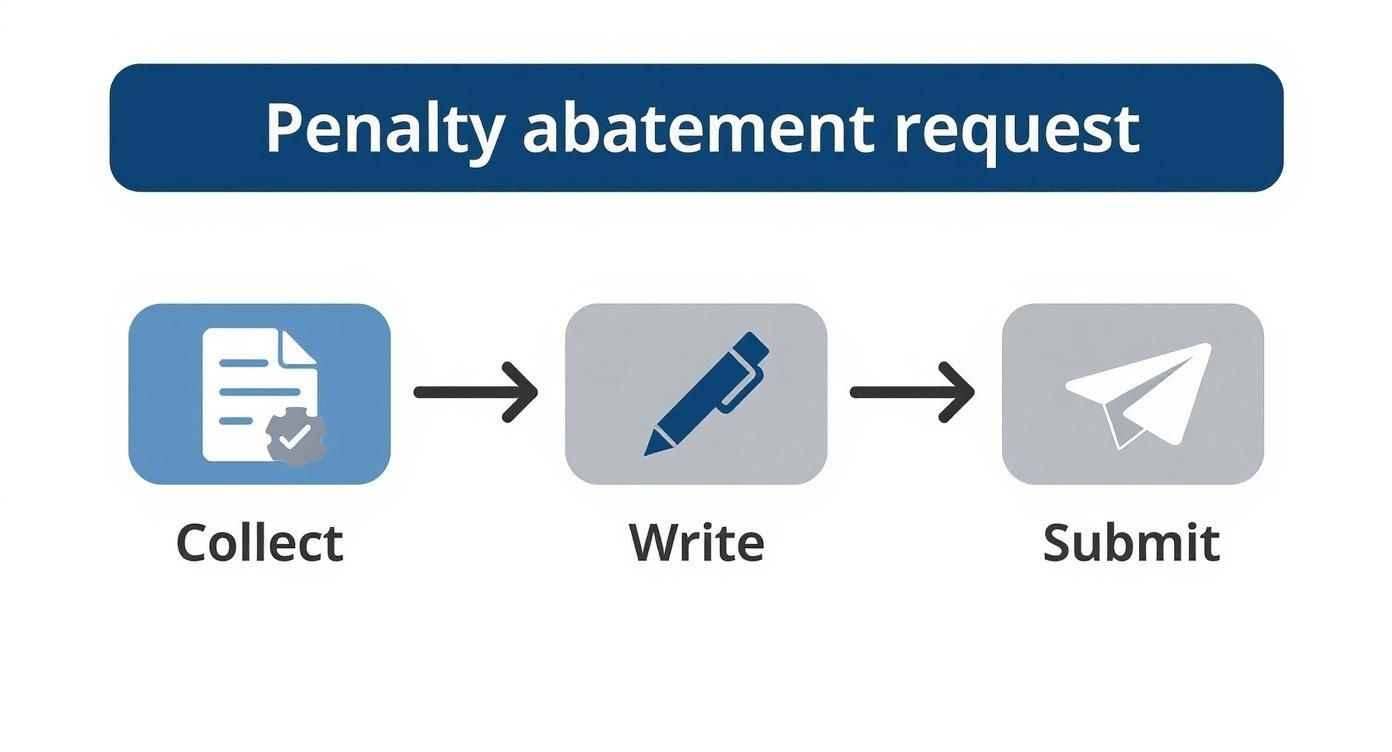
This simple breakdown shows how each stage builds on the last. A solid outcome depends on giving each part the attention it deserves.
What Happens After You Mail It?
Once your package is sent, the waiting begins. And you'll need some patience. The IRS typically takes 60 to 120 days to review and respond to a penalty abatement request. If your situation is particularly messy or the penalties are substantial, don't be surprised if it stretches to six months or even longer.
While you wait, you will almost certainly continue to receive automated notices about the penalty and any interest piling up. Try not to panic—this is just the IRS system running on autopilot. Once your request is approved, these will stop.
If you’ve hired a tax pro to handle this, they’ll be the ones fielding these communications. A key part of that process is properly completing an IRS Form 2848, Power of Attorney and Declaration of Representative, which is the official document that authorizes them to speak to the IRS on your behalf.
What to Do If Your Initial Request Is Denied
It’s disheartening to get a rejection letter, but I can tell you from experience: this is often not the end of the road. Plenty of good cases get an initial "no," sometimes for fixable issues like a missing document or a story that wasn't explained quite clearly enough. The appeals process is your chance for a do-over.
When the IRS denies your reasonable cause argument, you have a legal right to challenge them.
You typically have just 30 days from the date on the rejection letter to file an appeal. If you miss that window, you could forfeit your right to be heard, so it's critical to act fast.
The appeal sends your case to the IRS Independent Office of Appeals, a completely separate division. Their entire purpose is to resolve tax disputes without dragging everyone to court, and you'll get a fresh set of impartial eyes on your situation.
Getting Ready for Your Appeals Conference
Winning an appeal often comes down to the appeals conference, which is usually a discussion over the phone with an Appeals Officer. This isn't an interrogation; it's a conversation. It’s your opportunity to directly explain your side of the story to someone empowered to make a new decision.
Here’s how to prepare for that crucial call:
- Dissect the Denial Letter: The IRS has to tell you why they denied you. Read their reasoning carefully. That’s your roadmap for what you need to strengthen in your argument.
- Get Your Documents in Order: Have your evidence in a neat, organized file. Use tabs or a clear index so you can instantly pull up any document the officer asks about.
- Polish Your Story: Stick to the facts. Walk the officer through your timeline, connecting each event directly to a piece of evidence. Keep it calm and logical.
- Understand "Hazards of Litigation": This is a key concept in appeals. Appeals Officers can settle a case based on the risk that the IRS might lose if you took them to Tax Court. If your argument is solid and well-documented, you can subtly point out that risk, which can be a very effective negotiating tool.
Overturning a denial is absolutely achievable with a well-prepared and thoughtfully presented appeal. For a deeper dive into the specifics, check out our complete guide on how to appeal an IRS decision. Dealing with the IRS can be a grind, but knowing the rules of the game gives you the power to see your request through to the end.
Common Mistakes and When to Get Professional Help
Trying to get a penalty waived for reasonable cause can feel like walking a tightrope. One little misstep—a weak argument, a missed deadline—and you can find your request quickly denied, sending you right back to the beginning. Let's talk about the common pitfalls I see all the time, so you can sidestep them completely.
Probably the most frequent mistake is submitting a flimsy argument. Just telling the IRS you didn't know about a major tax deadline isn't going to fly; they expect everyone to know the basics. A far better approach? Demonstrating that you were genuinely confused by a brand-new, convoluted piece of tax law that had even seasoned professionals scratching their heads. That has a real shot.
Frequent Errors That Weaken Your Case
Another classic blunder is sending in an incomplete or poorly documented request. Every single claim you make needs to be backed up with solid, independent proof. An IRS agent isn't going to be swayed by an emotional story; they need to see hard facts.
Here are some of the most common ways people sabotage their own requests:
- Missing Critical Deadlines: The IRS is a stickler for timelines. If your request is denied, you generally have just 30 days to file an appeal. If you miss that window, you've likely lost your chance for a second look.
- Submitting Weak Evidence: Your argument is only as strong as the paper trail you provide. A note from a friend saying you were stressed is worthless. Hospital admission records proving you were incapacitated? That's the kind of proof that works.
- Fundamentally Misunderstanding the Criteria: Arguing that you were simply "too busy" is a non-starter. You have to prove that circumstances completely outside your control made it impossible to comply, even though you were trying to be responsible.
A winning reasonable cause argument tells a clear, chronological story backed by irrefutable proof. Your goal is to show the IRS that you acted responsibly but were derailed by events you couldn't have avoided.
Solid support makes all the difference, especially with complex penalties. Take penalties related to foreign gifts, for example. The IRS abated over $179 million a year between 2018 and 2021, wiping out 78% of those penalties by dollar value. Recent findings on foreign gift filing penalties show this high abatement rate came from taxpayers providing rock-solid evidence of reasonable cause.
Knowing When to Call a Tax Professional
Look, you can absolutely handle a simple, straightforward penalty abatement request on your own. But some situations just scream for professional help. Trying to navigate a complex case without experience can cost you dearly in both time and money. The IRS has its own culture and procedures, and a tax attorney knows how to speak the language.
Think seriously about hiring a professional in these scenarios:
- The Penalties are Substantial: If you're looking at tens of thousands of dollars in penalties, the stakes are just too high to DIY. The fee for good representation is often a small fraction of what you stand to save.
- Your Case Involves Complex Issues: Is your argument based on tricky legal points, reliance on bad professional advice, or international tax rules? You need an expert. Don't go it alone.
- Your Request Has Been Repeatedly Denied: If the IRS has already said no and your next step is the Independent Office of Appeals, it's time to bring in an advocate. An experienced attorney can frame your case in terms of "hazards of litigation"—a powerful concept that often convinces an Appeals Officer to settle.
A tax professional does more than just fill out paperwork. They analyze your entire situation, pinpoint the strongest argument for abatement of penalties reasonable cause, and manage every interaction with the IRS. To get a better feel for when to bring in an expert, check out our guide on why you need professional tax representation for IRS problems. Making that call can be the difference between getting a waiver and facing years of financial stress.
Frequently Asked Questions About Penalty Abatement
When you're trying to get a penalty removed, a lot of questions pop up. Here are some straightforward answers to the questions I hear most often from clients trying to navigate the abatement of penalties for reasonable cause.
How Is Reasonable Cause Different From First-Time Abatement?
This is a great question, and the distinction is critical. Think of the First-Time Abatement (FTA) program as a one-time "free pass" from the IRS. It's an administrative waiver they grant if you've kept your nose clean for the prior three years—no penalties, all returns filed, all taxes paid. It doesn't require a sob story, just a solid compliance history.
Reasonable cause is a different beast entirely. It's not about your past record; it's about your story. You have to build a compelling case, supported by evidence, that shows specific circumstances beyond your control made it impossible for you to file or pay on time.
To put it simply:
- First-Time Abatement: Relies on your history of good behavior.
- Reasonable Cause: Relies on your story of a specific, justifiable hardship.
How Long Does the IRS Take to Respond?
This is the million-dollar question, and the answer is... it depends. When you're dealing with the IRS, patience is key. A typical timeframe for an initial response to an abatement request is anywhere from 60 to 120 days.
Of course, that window can get a lot wider if your situation is complicated or if the IRS is simply swamped, which is common.
If you hit the four-month mark and haven't heard a peep, it's time to follow up. You can call the IRS or, if you're getting nowhere, the Taxpayer Advocate Service might be able to help. This is why sending your request via certified mail is so important—that receipt is your proof of when the clock started ticking.
Don't be surprised if a complex case or one involving a large penalty takes six months or longer. It happens. Set your expectations realistically and be prepared to follow up professionally if things seem stalled.
Can I Request Abatement if I Haven't Paid the Tax Yet?
Yes, absolutely. You don't have to pay the underlying tax liability before you ask for the failure-to-pay penalty to be waived. The IRS evaluates your reasonable cause argument for the penalty separately from the tax bill itself.
But there's a big "however" here. While your penalty abatement request is being reviewed, interest keeps piling up on the unpaid tax. It doesn't stop.
A smart move is to get on an installment agreement to start chipping away at the tax debt. This shows the IRS you're acting in good faith and stops more failure-to-pay penalties from stacking up while you make your case for reasonable cause.
At Attorney Stephen A Weisberg, we understand that facing IRS penalties can be overwhelming. We provide a FREE Tax Debt Analysis to determine exactly how we can help before you ever pay a fee. If you need expert guidance to build a strong case for penalty relief, contact us today.


