9465 form instructions: A Practical IRS Guide
9465 form instructions: A clear, line-by-line guide to eligibility, filing requirements, and setting up an IRS payment plan.
In this article
- Understanding Form 9465 and Its Purpose
- Who Benefits Most from Filing
- Setting Realistic Expectations for the Process
- Form 9465 At a Glance
- First, Do You Even Qualify for an IRS Payment Plan?
- What are the Key Approval Thresholds?
- What if You Owe Between $10,000 and $50,000?
- When You Have to Show Your Financial Cards
- Navigating Form 9465 Line by Line
- Part I: Your Basic Information
- Part II: The Heart of Your Request
- Choosing Your Payment Method
- Tucking It in With Your Current Tax Return
- Mailing the Form on Its Own
- Using the Online Payment Agreement Tool
- What to Do If Form 9465 Is Not the Right Fit
- The Online Payment Agreement vs. Form 9465
- When Your Debt Is Too Large for a Simple Plan
- If You Truly Cannot Afford to Pay
- Comparing Your Tax Debt Relief Options
- Got Questions About Your IRS Payment Plan? Let's Clear Things Up.
- What’s the Fee for Setting Up an IRS Payment Plan?
- Do Interest and Penalties Stop Once My Plan is Approved?
- Okay, My Request Was Approved. Now What?
- Can I Adjust My Payment Plan Later On?
If you're staring at a tax bill you can't pay all at once, Form 9465 is your first line of defense. It’s the official IRS form for requesting a monthly payment plan—basically, it's how you tell them, "I want to pay what I owe, but I need to do it over time." Taking this step can stop more serious collection actions, like wage garnishments or bank levies, dead in their tracks.
Understanding Form 9465 and Its Purpose
Getting a large bill from the IRS is stressful, but it's a situation countless Americans face every year. The IRS knows that life can throw you a curveball—a sudden job loss, unexpected medical bills, or a surprisingly high tax bill for your small business can put you in a tough financial spot. This is exactly why Form 9465, the Installment Agreement Request, exists.
Don't think of it as an admission of defeat. Instead, see it as a proactive move to take control of your finances. Filing this form shows the IRS you're serious about settling your debt, and they look far more kindly on that than on someone who just ignores the problem. This simple act of communication can halt aggressive collection efforts and give you the breathing room you need.
Who Benefits Most from Filing
While anyone who owes federal taxes can request a payment plan, Form 9465 is especially helpful for people in a few specific situations:
- Self-Employed Individuals and Freelancers: Gig workers and small business owners often have fluctuating income, making it easy to get hit with a large self-employment tax bill. An installment agreement provides a manageable way to pay that debt without crippling your business's cash flow.
- Taxpayers with a One-Time Income Spike: Did you sell some stock, receive an inheritance, or get a big bonus that bumped you into a higher tax bracket? Form 9465 helps you manage the resulting tax liability without having to liquidate assets.
- Families Facing Unexpected Financial Hardship: A job loss or a major medical crisis can wreck even the most well-thought-out budget. This form allows families to stay on top of their tax obligations while navigating a difficult period.
This isn't a niche solution; it's becoming more and more common. In fiscal year 2022 alone, over 1.2 million taxpayers set up installment agreements, marking a 15% increase from the previous year. This highlights just how essential this tool is for everyday taxpayers.
Setting Realistic Expectations for the Process
Filing Form 9465 is just the first step. After you submit it, the IRS will review your request. For smaller debts, approval is often pretty straightforward. In fact, about 70% of applications are for debts under $10,000, which often qualify for guaranteed or streamlined approval as long as you meet the other criteria.
Let's take a look at the very top of the form, where you'll put in your basic personal information.

Getting this part right is crucial. It ensures the IRS can correctly identify you and apply the payment plan to the right tax account.
It's also critical to remember what an installment agreement isn't. It doesn't reduce the amount of tax you owe. Interest and penalties will continue to pile up on your unpaid balance until it's paid off completely. Because of this, your best move is always to propose the highest monthly payment you can genuinely afford to minimize those extra costs over time. If you need help figuring out the right approach, see our ultimate guide to IRS back taxes payment plan strategies.
Key Takeaway: An IRS installment agreement is a formal payment plan, not a debt forgiveness program. You will still be responsible for the full amount owed, plus any accruing interest and penalties. The goal is to make the debt manageable, not to make it disappear.
Form 9465 At a Glance
To quickly break it down, here's a simple summary of what Form 9465 is all about.
| Aspect | Description |
|---|---|
| Official Name | Form 9465, Installment Agreement Request |
| Primary Use | To formally request a monthly payment plan for federal taxes owed. |
| Eligibility | For taxpayers who cannot pay their tax liability in full immediately. |
| Submission | Can be filed with your tax return, separately, or through an online application. |
| Key Benefit | Prevents aggressive IRS collection actions like levies and wage garnishments. |
| Important Note | Interest and penalties continue to accrue on the unpaid balance until it's paid off. |
This table helps you see the core function and limitations of the form at a single glance. It's a powerful tool, but one you need to use with a clear understanding of the process.
First, Do You Even Qualify for an IRS Payment Plan?
Before you dive into filling out Form 9465, let’s make sure you’re eligible. Taking a few minutes to check this now can save you a ton of time and frustration down the road. The IRS has some firm rules, and if you don't meet them, your application is dead on arrival.
The absolute biggest deal-breaker is having unfiled tax returns. The IRS won't even look at your payment plan request if you're not caught up on your filings. Think of it as a show of good faith—you have to get current before they'll work with you on paying off old debt.
What are the Key Approval Thresholds?
The amount you owe is the single biggest factor that determines how the IRS will handle your request. They have different tiers, and knowing which one you fall into gives you a good idea of what to expect.
If you owe a relatively small amount, the process is surprisingly straightforward. Let's say you're a freelance writer who owes $8,000 after a good year. Because the debt is under $10,000, you’re likely in line for what the IRS calls a "guaranteed" installment agreement.
As of 2023, the IRS will automatically approve your plan if you owe $10,000 or less (that’s tax, penalties, and interest combined). The only other catches are that you have to have filed all your returns and you can't have defaulted on a payment plan in the last five years. You can see the full breakdown on the IRS instructions page for Form 9465.
What if You Owe Between $10,000 and $50,000?
Things are a bit different if you owe more. Picture a small marketing agency that owes $35,000. This amount puts you into the "streamlined" installment agreement category. Approval isn't technically guaranteed, but it's very likely if you check all the boxes.
Here’s what the IRS looks for in this bracket:
- Total Debt: Your combined balance of tax, penalties, and interest must be under $50,000.
- Payment Timeline: You have to propose a plan that pays off the full debt within 72 months (that’s six years).
- Filing Compliance: Just like with smaller debts, all your past-due tax returns must be filed.
For that $35,000 debt, you’d need to propose a monthly payment of at least $487 ($35,000 divided by 72). As long as you can commit to that and meet the other criteria, the IRS usually approves these plans without asking for a deep dive into your personal finances.
Expert Tip: When you propose a monthly payment, always offer the highest amount you can genuinely afford without hardship. It might be tempting to lowball it, but paying the debt off faster gets the IRS out of your life sooner and saves you a considerable amount in accumulating interest and penalties.
When You Have to Show Your Financial Cards
The game changes once your tax debt climbs over $50,000. If you owe more than that, or if you can't pay a smaller debt off within the 72-month window, the IRS is going to want a much closer look at your finances.
This is where things get more involved. You’ll be required to submit a detailed financial statement so the IRS can determine your "ability to pay." They want to see exactly what's coming in and what's going out before they agree to a payment amount.
To do this, you’ll have to fill out a Collection Information Statement. For most people, this means completing Form 433-F. For help navigating this more complex form, check out our guide on completing Form 433-F. It forces you to lay out all your assets, income, and monthly living expenses, giving the IRS a complete financial picture. Based on that data, they'll calculate a monthly payment they believe is affordable for you—which might be very different from the number you had in mind.
Navigating Form 9465 Line by Line
Alright, let's walk through the form itself. At first glance, any government form can feel a bit overwhelming, but Form 9465 is more straightforward than it looks. I’ll break down what each line means in plain English so you can fill it out correctly the first time.
Part I: Your Basic Information
This first section is all about getting the fundamentals right. Think of it as the foundation of your request. It asks for your name, Social Security Number (SSN), address, and which tax years you're dealing with.
This part seems easy, but it's a minefield for small mistakes that can cause major delays. The most common hiccup I see is a simple name mismatch.
The name you put on Line 1a has to be an exact match to what the IRS has on file for you. If you recently married and changed your name but haven't updated it with the Social Security Administration, stick with the name on your last tax return.
The same goes for joint filers. Make sure both names and SSNs are listed in the same order as they are on your Form 1040. Any little discrepancy can trigger the IRS system to kick back your request, and you’ll be stuck starting all over again.
- Lines 1a and 1b: Your full name and SSN (or ITIN). Please, double-check these for typos.
- Line 2: If you're filing jointly, this is where your spouse’s name and SSN go.
- Line 3: Your current mailing address. This is critical—it's where the IRS will send every piece of mail about your agreement.
- Line 4: The tax form (usually 1040) and the tax year or years you need the payment plan for.
Part II: The Heart of Your Request
Now we're getting to the core of the form. This is where you lay out your situation for the IRS: how much you owe, what you can realistically pay each month, and how you intend to pay it. Honesty and a realistic assessment of your finances are your best friends here.
Line 5: The Total Amount You Owe
Here, you'll enter the total tax you owe. If you’re submitting Form 9465 with this year’s return, the number comes right off your Form 1040. If you’re setting up a plan for a past-due balance, grab the total from the most recent notice the IRS sent you.
Line 6: Your Proposed Monthly Payment
This is the big one. You need to propose a monthly payment you can genuinely afford. Don't just pull a number out of the air. Sit down and take a serious look at your monthly budget—what comes in versus what must go out for things like rent, utilities, and groceries. Proposing a payment you can't keep up with is a surefire way to default on the agreement, which puts you in a much tougher spot.
The IRS generally wants to see a payment that will clear your entire debt within 72 months, or six years. If your proposed payment is too low to hit that mark, they might reject your plan or, more likely, ask you to provide a complete financial statement to justify it.
For instance, if you owe $12,000, the IRS is looking for a payment of at least $167 per month ($12,000 ÷ 72 months). If you propose paying just $100, be prepared for them to ask for more financial details. If you're struggling to figure out a reasonable number, using an IRS installment agreement calculator can be a helpful starting point.
Line 7: Your Preferred Payment Due Date
You have some control here. You can pick a payment date between the 1st and the 28th of the month. My advice? Choose a date that’s a day or two after you get paid. This simple trick helps ensure the money is always in your account when the payment is due. If you leave this blank, the IRS will just assign you a date.
Choosing Your Payment Method
The last part of this section is about how you’ll get the money to the IRS each month. Your choice here can even impact the setup fees you'll have to pay.
Direct Debit (Lines 8a-8d): This is the method the IRS prefers, and frankly, it’s the best option for most people. You provide your bank account info, and they automatically pull the payment each month. It's set-it-and-forget-it, which dramatically lowers your risk of missing a payment. As a bonus, it also comes with a lower setup fee.
Payroll Deduction (Line 9): Another solid option is having your employer take the payment directly out of your paycheck. To set this up, you'll also need to fill out and attach Form 2159, Payroll Deduction Agreement.
Check or Money Order: If you don't choose one of the automated methods, you’re on the hook for mailing a payment every single month. This option has the highest setup fee and puts all the responsibility on you to remember to pay on time.
Taking your time with these sections is the single best thing you can do to get your request approved smoothly. Double-check every number, be honest about your financial situation, and you'll give yourself the best shot at getting your payment plan locked in without any frustrating back-and-forth.
You’ve done the hard work of filling out Form 9465. Now, the final step is getting it into the IRS’s hands correctly. A simple mistake here could get your request rejected, which only delays the process and adds to your stress.
Let's walk through the three ways you can file, because the right one really depends on your specific situation. Are you dealing with a tax bill from the return you're filing right now, or is this for a balance from a previous year? Each path is a little different.
Tucking It in With Your Current Tax Return
If you know you’re going to owe on the tax return you're about to file, you can just attach Form 9465 right to the front of your paper-filed Form 1040. It’s like sending the IRS a complete package: here's my return that shows what I owe, and here's my request for how I plan to pay it.
This is the most direct route, but it comes with a big catch—it only works if you're filing a paper return. If you e-file, you can’t attach the form. Your tax software will likely prompt you to use the IRS's online system instead.
Mailing the Form on Its Own
This is the go-to method if you’re trying to manage a debt from a prior tax year. Maybe you just got a CP14 notice or another bill in the mail for a balance you couldn't pay off last year. In that case, you'll need to mail Form 9465 all by itself.
When you mail it, don't just drop it in a blue box and hope for the best. I always tell my clients to follow these steps:
- Always Use Certified Mail. This is not optional. Paying a few extra dollars for USPS Certified Mail with a return receipt gives you a legal, time-stamped paper trail proving the IRS got your form. If anything gets lost in their shuffle, that receipt is your saving grace.
- Double-Check the Address. The IRS has different mailing addresses depending on where you live. Don't guess. Pull up the official IRS instructions for Form 9465 and find the exact address for your state.
- Make a Full Copy. Before that envelope leaves your sight, make a complete copy of the signed form and any other documents you’re including. Keep it with your tax records.
Expert Tip: A cardinal rule when dealing with the IRS: never, ever send original documents unless they specifically ask for them. Send copies and keep your originals filed away safely. This little habit can save you a world of headaches.
Using the Online Payment Agreement Tool
Honestly, for most people, the quickest and easiest way to get this done is by using the IRS's Online Payment Agreement (OPA) tool. It’s the digital version of Form 9465, and the big win here is that you often get an instant answer on whether your plan is approved. No more waiting by the mailbox for weeks.
Think of your paper Form 9465 as the perfect cheat sheet for the online application. You'll need all the same information: how much you owe, what you can pay each month, and your bank details for setting up a direct debit. The OPA tool just gets you to the finish line much faster.
So, which method should you choose? It really boils down to speed versus proof. The online tool is incredibly efficient, but certified mail gives you that physical paper trail. For most taxpayers who owe less than $50,000, I usually recommend the OPA tool. It's built for speed and convenience, and it gets you an answer right away.
What to Do If Form 9465 Is Not the Right Fit
While an installment agreement is a solid strategy for managing tax debt, it isn't a one-size-fits-all solution. Depending on your specific financial circumstances, another path might make more sense. It's crucial to understand these alternatives to make an informed decision that truly resolves the problem, rather than just kicking the can down the road.
Sometimes, the simplest alternative is the best one. The IRS has made it much easier to set up a payment plan directly through its website, which can be a game-changer for many taxpayers.
The Online Payment Agreement vs. Form 9465
The IRS Online Payment Agreement (OPA) tool essentially accomplishes the same goal as Form 9465, but it’s often much faster and more efficient. For many people, especially those with straightforward situations and a total tax debt under $50,000, the OPA is clearly the better choice. You can often get immediate confirmation of your agreement, letting you skip the weeks of waiting that come with mailing a paper form.
Of course, Form 9465 still has its place. You might just prefer the paper trail, or perhaps your situation is more complex and requires you to attach the form to a current-year paper tax return you're filing by mail. The key is to figure out which method aligns best with your needs for speed, proof of submission, and your overall filing process.
This graphic breaks down the main ways you can request a payment plan.
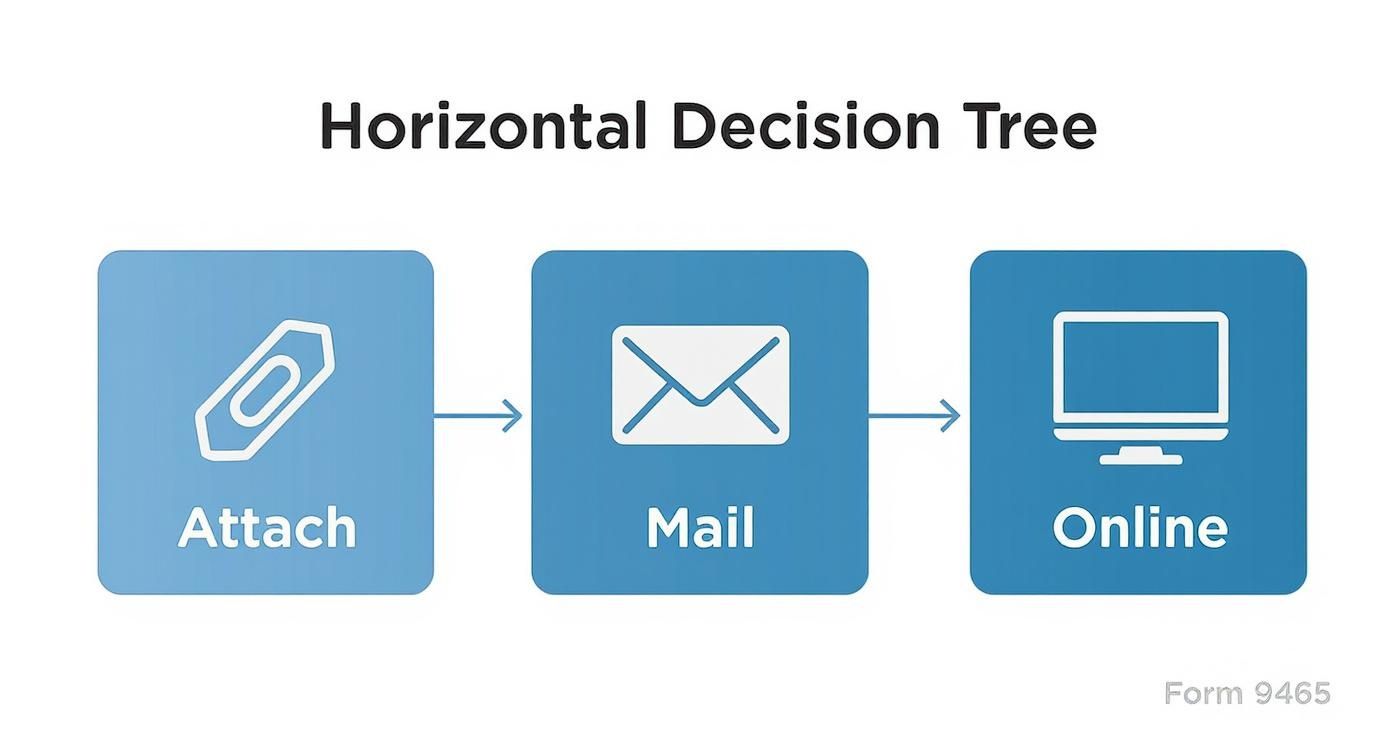
As you can see, while paper options exist, the online route is usually the most direct path to getting an agreement in place.
When Your Debt Is Too Large for a Simple Plan
If your total tax bill tops $50,000, or if you can't realistically pay your debt within the standard 72-month timeframe, the IRS will need to take a much deeper look into your financial health. This is where Form 433-F, the Collection Information Statement, comes into play.
Be prepared—filing Form 433-F is a much more involved process. You’ll have to provide a detailed breakdown of your entire financial life, including:
- Income: From every source, like wages, self-employment, and investments.
- Assets: Bank account balances, vehicles, real estate, retirement funds, and anything else of value.
- Living Expenses: The IRS has national and local standards for what it considers allowable living expenses for necessities like housing, food, and transportation.
The IRS uses this information to calculate your "reasonable collection potential"—the amount they believe you can afford to pay each month after covering your necessary living costs. This final number may be higher or lower than what you would propose on your own.
Important Takeaway: When you submit a Form 433-F, the IRS—not you—gets the final say on your monthly payment amount, and they base it on a strict, formulaic analysis of your finances.
If You Truly Cannot Afford to Pay
What happens when your financial situation is so severe that even a small monthly payment feels impossible? In cases of genuine financial hardship, the IRS offers other relief programs that go beyond a simple payment plan.
One such option is an Offer in Compromise (OIC). An OIC allows certain taxpayers to settle their tax liability with the IRS for less than the full amount they owe. This isn't a simple negotiation; the OIC program has very strict eligibility requirements and a notoriously low acceptance rate. The IRS will only approve an OIC if it's convinced it represents the most money it can realistically expect to collect from you. For a deeper dive, you can learn more about the Offer in Compromise program in our complete guide.
Another possibility is being placed in Currently Not Collectible (CNC) status. This is a temporary measure where the IRS agrees to pause collection efforts because you can't afford to pay your basic living expenses. It’s critical to understand that CNC status doesn't make the debt disappear—it just hits the pause button on collections. Interest and penalties will keep piling up, and the IRS will review your financial situation periodically to see if your ability to pay has improved.
Comparing Your Tax Debt Relief Options
Navigating IRS debt solutions can feel overwhelming. To help clarify your choices, this table compares the most common options based on who they're best for and what's required.
| Option | Best For | Key Requirement | Complexity |
|---|---|---|---|
| Online Payment Agreement (OPA) | Taxpayers with debt under $50,000 who can pay it off within 72 months. | Compliance with all tax filings. | Low |
| Form 9465 Installment Agreement | Those who prefer a paper trail or need to attach the request to a paper tax return. | Same as OPA: debt under $50,000 and full payment within 72 months. | Low |
| Form 433-F (for large debts) | Individuals with debt over $50,000 or who need more than 72 months to pay. | Full financial disclosure (income, assets, expenses). | Medium to High |
| Offer in Compromise (OIC) | Taxpayers with significant financial hardship who cannot pay their debt in full. | Proving that the offer is the most the IRS can expect to collect. | High |
| Currently Not Collectible (CNC) | Individuals who cannot afford basic living expenses, let alone a tax payment. | Demonstrating severe financial hardship. | Medium |
This comparison should give you a clearer picture of the landscape. Your specific numbers—your total debt, income, and assets—will ultimately point you toward the most viable solution.
Got Questions About Your IRS Payment Plan? Let's Clear Things Up.
Even after you've sent in your Form 9465, it's natural to have a few lingering questions. What happens next? How much is this really going to cost? What if my financial situation changes down the road?
Let's tackle the most common questions head-on so you can move forward with confidence.
What’s the Fee for Setting Up an IRS Payment Plan?
Yes, there's a one-time setup fee, but how much you pay depends on how you apply and how you plan to make your payments.
- Direct Debit (Online): If you set up your plan online and agree to automatic withdrawals from your bank account, the fee is just $31.
- Other Methods (Online): Prefer to pay by check or money order but still apply online? The fee goes up to $130.
- Mail-in or Phone: For anyone who mails in Form 9465 or sets up a plan over the phone, the standard fee is $225.
The IRS clearly incentivizes automated payments. Opting for a direct debit not only saves you a good chunk of money on the setup fee but also pretty much guarantees you'll never miss a payment.
A Quick Tip for Low-Income Filers: If your income falls below certain thresholds, you might qualify to have these fees reduced or even waived completely. It's definitely worth checking the current low-income taxpayer guidelines to see if you're eligible.
Do Interest and Penalties Stop Once My Plan is Approved?
This is a huge point of confusion for many people, and the answer is no. An installment agreement does not freeze interest and penalties.
The good news is that the failure-to-pay penalty rate gets cut in half, dropping from 0.5% to 0.25% per month. But it doesn't vanish entirely, and interest continues to compound on your outstanding balance every single day.
Think of it exactly like a credit card balance—even when you're making monthly payments, interest keeps getting tacked on. This is precisely why it's so important to pay as much as you can comfortably afford each month. The faster you pay it down, the less you'll hand over to the IRS in the long run.
Okay, My Request Was Approved. Now What?
Once the IRS gives your plan the green light, you'll get an official notice in the mail. This letter is your confirmation, and it will spell out the exact terms: your monthly payment amount, the due date, and how to make payments.
Two things are absolutely critical at this stage. First, make that first payment on time. Missing it can put your brand-new agreement in default immediately. Second, you must continue to file all your future tax returns on time and pay any new tax liabilities in full. Getting behind on new taxes is one of the quickest ways to have your agreement terminated.
Can I Adjust My Payment Plan Later On?
Life is unpredictable, and the IRS understands that. If your financial situation takes a hit—maybe you lose your job or face an unexpected medical bill—you can absolutely contact them to renegotiate your agreement. It's often possible to lower your monthly payments temporarily to get you through a rough patch.
On the flip side, if you come into some extra money, you can always pay more than the minimum or pay off the entire balance early. There are no prepayment penalties. This flexibility is a core part of how these agreements are designed to work.


