Form 941 vs 940 A Clear Guide for Employers
Struggling with Form 941 vs 940? This guide clarifies key differences in payroll taxes, filing deadlines, and deposits to ensure your business stays compliant.

In this article
- At-a-Glance Comparison Form 941 vs Form 940
- Core Differences Summarized
- Understanding Form 941: The Quarterly Payroll Tax Return
- Who Is Required to File Form 941
- The Quarterly Filing Schedule
- Form 940: The Annual FUTA Tax Return
- Who Actually Needs to File Form 940?
- The FUTA Tax Rate and Wage Base Explained
- Your Annual Filing Deadline
- Comparing Filing Frequencies and Deposit Schedules
- Form 941 Deposit Schedules: Monthly vs. Semi-Weekly
- Form 940 FUTA Deposit Rules
- Filing vs. Deposit Schedules: A Critical Distinction
- Real-World Deposit Scenario
- Common Filing Mistakes and How to Avoid Penalties
- Miscalculating Tax Liability
- Confusing Filing Deadlines with Deposit Schedules
- The Trust Fund Recovery Penalty: A Personal Risk
- When to Call in a Payroll Tax Attorney
- Red Flags That Mean You Need Legal Help
- Attorney vs. CPA: Knowing Who to Call in a Crisis
- Frequently Asked Questions About Forms 941 and 940
- Can I File Form 941 and Form 940 Together?
- What if I Have No Employees for a Quarter?
- Do I File These Forms for Independent Contractors?
When you're running a business with employees, payroll taxes can feel like a maze of forms and deadlines. Two of the most common—and commonly confused—are Form 941 and Form 940. Getting them straight is crucial, as they serve completely different purposes and follow different schedules.
At its core, the distinction is about frequency and function. You'll file Form 941 every quarter to report the income, Social Security, and Medicare taxes you've withheld from employee paychecks. On the other hand, Form 940 is an annual affair used to report your federal unemployment (FUTA) tax liability.
Think of it this way: Form 941 is your regular, quarterly reconciliation for employee withholdings, while Form 940 is your once-a-year report for an employer-only tax.
At-a-Glance Comparison Form 941 vs Form 940

As an employer, you're on the hook for a few different payroll taxes, and the IRS uses these two forms to keep everything organized. I've seen countless business owners mix them up, leading to late filings, penalties, and a lot of unnecessary stress. The key is remembering they cover separate tax obligations on entirely different timelines.
Form 941 is all about the "trust fund" taxes. This is the money you withhold from your employees' wages for the government, plus your own matching employer share. Form 940, in contrast, is exclusively for a tax you, the employer, pay to fund the federal unemployment system. It's never withheld from an employee's pay.
Core Differences Summarized
To make it easier, here's a quick table breaking down the main distinctions. Getting these details right is the first step in mastering your payroll compliance. If you need a refresher on the whole process, this guide on how to do payroll for small business is a great resource.
| Feature | Form 941 (Quarterly Return) | Form 940 (Annual Return) |
|---|---|---|
| Tax Type | Reports federal income tax withholding, Social Security, and Medicare taxes (FICA). | Reports the Federal Unemployment Tax (FUTA). |
| Who Pays | Taxes are a shared responsibility: paid by the employee (via withholding) and the employer (matching FICA). | The tax is paid only by the employer. |
| Filing Frequency | Filed four times per year (quarterly). | Filed just once per year. |
Key Takeaway: The most critical difference, from a compliance standpoint, is who's responsible for the tax. Form 941 involves money you hold in trust for your employees and the government, making the penalties for mishandling it extremely severe. Form 940, while still important, reports a direct business tax paid by the company.
Understanding this foundation is everything. You can find more details in our complete guide to small business payroll taxes to ensure you have all your bases covered. Now, let’s dig into the specifics of each form.
Understanding Form 941: The Quarterly Payroll Tax Return

Think of Form 941, the Employer's QUARTERLY Federal Tax Return, as the workhorse of your payroll tax responsibilities. For nearly every business with employees, this form is a non-negotiable part of your quarterly accounting routine. Its main purpose is to report the federal income tax you’ve withheld from your employees' paychecks.
But it does more than that. It’s also where you report the taxes you’ve paid under the Federal Insurance Contributions Act (FICA), which is the money that funds Social Security and Medicare. This means you’re handling two distinct tax components.
On this single form, you reconcile both the portion you withheld from your employees and your own matching employer share. Because of this dual responsibility, keeping accurate books and filing on time is absolutely critical.
Who Is Required to File Form 941
The rule of thumb for Form 941 is simple: if you pay wages to an employee, you have to file it. This applies to almost all employers, no matter how big or small your business is. The exceptions are few and far between.
Even if you didn't have any employees for a particular quarter, you still likely need to file. If you have an active EIN and have filed in the past, the IRS expects you to submit a "zero return" to confirm you had no payroll. Skipping this step can trigger automated notices and, eventually, penalties.
Crucial Insight: The IRS refers to the money reported on Form 941 as "trust fund taxes." That’s because you are literally holding your employees’ tax money in trust before you hand it over to the government. Mismanaging these funds is taken extremely seriously by the IRS, and it can even lead to the business owner being held personally liable for the debt.
The IRS keeps a close eye on these filings, partly because of the sheer volume. Form 941 is one of the most common employment tax returns, with an estimated 23.9 million returns filed each year. In fact, the Form 941 series makes up about 80 percent of all employment tax filings, making it a major focus for IRS compliance checks. You can dig into the numbers yourself in the IRS's projection data.
The Quarterly Filing Schedule
Unlike the annual Form 940, Form 941 operates on a strict quarterly calendar. This frequency demands diligent record-keeping all year long to ensure every submission is accurate. For a deeper dive, check out our guide on navigating FICA taxes and your payroll obligations.
Here are the hard deadlines you need to have circled on your calendar every year:
- Quarter 1 (January - March): Due April 30
- Quarter 2 (April - June): Due July 31
- Quarter 3 (July - September): Due October 31
- Quarter 4 (October - December): Due January 31
Missing these dates can trigger immediate penalties for failing to file, which grow based on how much tax you owe and how late you are. This is a key difference in the 941 vs 940 comparison—the quarterly rhythm of Form 941 requires constant attention, while Form 940 is a once-a-year event.
Form 940: The Annual FUTA Tax Return
Think of Form 941 as the regular, quarterly check-in for your payroll taxes. Form 940, on the other hand, plays a completely different part. This is your annual Federal Unemployment Tax (FUTA) Return, and it’s all about a tax paid exclusively by you, the employer. It’s a critical piece of the federal and state system that provides a safety net for workers who find themselves unemployed.
The single most important thing to remember is that FUTA tax is never withheld from an employee's paycheck. This is a tax on your business, calculated on the wages you pay out. That fact alone sets it miles apart from the trust fund taxes you report on Form 941.
Getting this right is at the heart of the 941 vs 940 discussion. It affects your cash flow, your tax planning, and your overall liability as an employer.
Who Actually Needs to File Form 940?
Unlike Form 941, which applies to nearly every employer, the filing requirements for Form 940 are a bit more specific. You’ll need to file if your business passes either of these two tests during the year:
- The Wage Test: You paid $1,500 or more in total wages to your team in any single calendar quarter.
- The Employee Test: You had at least one employee working for some part of a day in 20 or more different weeks of the year. Don't forget to count full-time, part-time, and temporary workers.
If you hit either of those benchmarks, filing Form 940 is on your to-do list. While there are some unique rules for agricultural or household employers, these two tests cover almost every small business out there.
The FUTA Tax Rate and Wage Base Explained
The way FUTA tax is calculated is pretty unique and actually comes with a big opportunity to save money. On paper, the official FUTA tax rate is 6.0%. In reality, very few businesses ever pay that full amount.
The secret is the FUTA tax credit. The IRS gives you a credit of up to 5.4% if you pay your state unemployment taxes in full and on time. This is their way of rewarding you for staying on top of your state-level duties, and it drops the effective federal rate down to a much more manageable 0.6%.
Key Insight: FUTA tax only applies to the first $7,000 you pay each employee during the year. As soon as an employee earns more than that, you stop paying FUTA tax on their wages for the rest of the year. This is a huge detail for budgeting and financial forecasting.
Unlike the quarterly rhythm of Form 941, Form 940 is an annual return filed just once by January 31st. With FUTA tax only applying to the first $7,000 paid to each employee, its taxable wage base is dramatically different from the income and FICA taxes on Form 941. You can find more practical details about the annual FUTA return and its requirements to stay compliant.
Your Annual Filing Deadline
Another big difference when comparing 941 vs 940 is how often you file. You have to wrestle with Form 941 four times a year, but Form 940 keeps it simple with a single, annual deadline.
You must file your Form 940 by January 31 of the year after the one you're reporting on. This one-and-done deadline gives you a clear finish line for your yearly payroll tax responsibilities. But be careful—mixing up this date with your quarterly 941 deadlines is a classic mistake that can cost you.
Comparing Filing Frequencies and Deposit Schedules
One of the biggest tripwires for employers isn't just knowing the difference between Form 941 and Form 940—it's understanding the critical distinction between filing a return and depositing the tax. Think of it this way: filing is when you report what you owe, while depositing is when you actually send the money to the IRS.
These two actions often run on completely different timelines. While Form 941 gets filed quarterly and Form 940 annually, the taxes themselves are typically due far more often. Your deposit schedule is dictated by your total tax liability, not the form's final due date, and getting this wrong is a fast track to penalties.
This flow chart breaks down the basic annual rhythm for Form 940, from paying wages to filing the return.
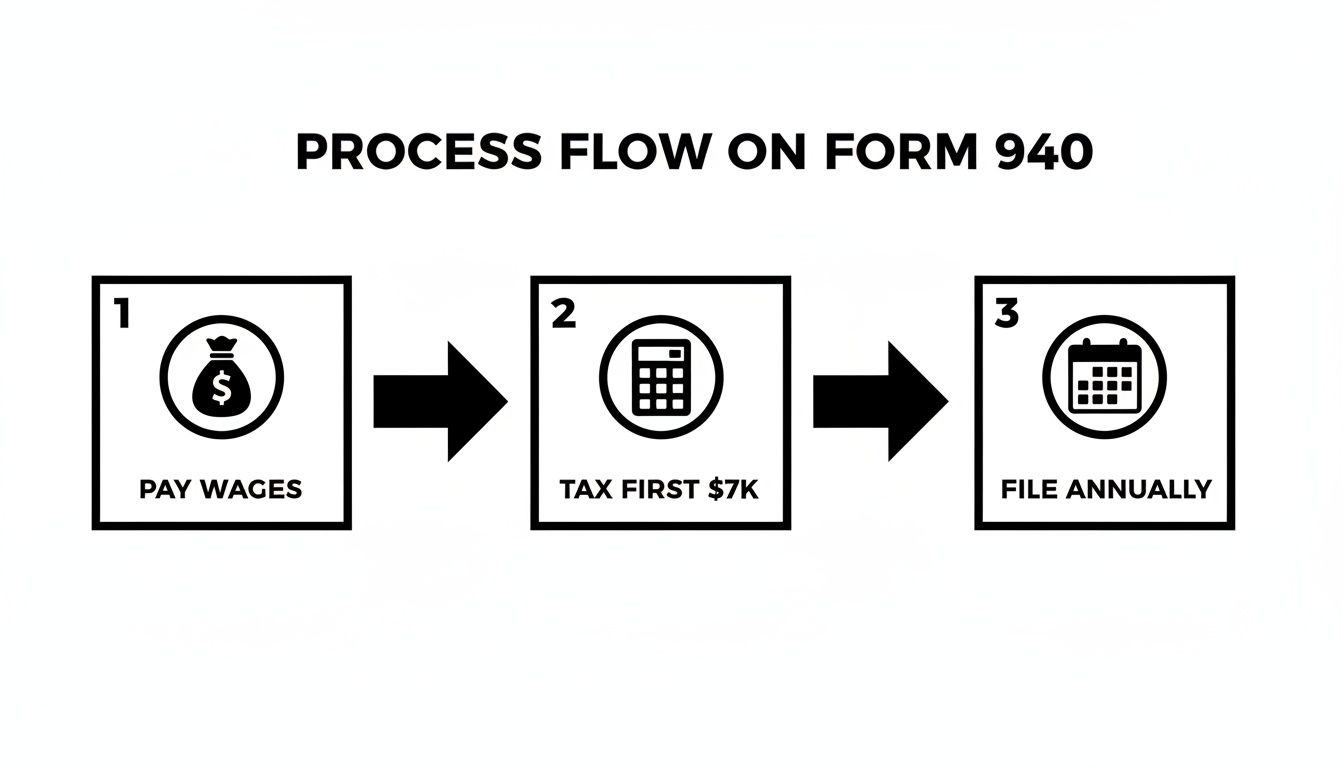
As you can see, even though FUTA tax is calculated all year long, the final reporting is just a single event.
Form 941 Deposit Schedules: Monthly vs. Semi-Weekly
For the taxes reported on Form 941 (federal income tax, Social Security, and Medicare), the IRS will assign you a deposit schedule based on your tax liability during a "lookback period." You'll be either a monthly or semi-weekly depositor.
- Monthly Depositor: Most small businesses fall here. You must deposit your payroll taxes by the 15th day of the month after the month you paid the wages.
- Semi-Weekly Depositor: If you have a larger payroll, the rules are tighter. Taxes from paydays on Wednesday-Friday are due by the following Wednesday. Taxes from paydays on Saturday-Tuesday are due by the following Friday.
So, how does the IRS decide? They look at the total tax you reported on Form 941 during a four-quarter period. If you reported $50,000 or less, you’re a monthly depositor. If you reported more than $50,000, you’re a semi-weekly depositor. It's on you to check your status each year, because it can change as your business grows.
A business might file Form 941 just four times a year but could be on the hook for making tax deposits 12 times (monthly) or even over 90 times (semi-weekly) annually. Missing these deposits triggers penalties, even if your quarterly form is filed perfectly on time.
Form 940 FUTA Deposit Rules
FUTA tax, reported on Form 940, has its own unique deposit rules that add another layer of compliance. You have to calculate your FUTA liability every single quarter to see if a deposit is due.
The rule is pretty simple: if your accumulated FUTA tax liability for a quarter tops $500, you have to deposit it by the last day of the month following the end of that quarter.
If your liability is $500 or less, you don't have to deposit it yet—you just roll it over to the next quarter. You keep rolling it over until the total cumulative amount finally exceeds $500.
Filing vs. Deposit Schedules: A Critical Distinction
It's one thing to know when to file, but it's another to know when to pay. The table below breaks down the crucial difference between filing the return and depositing the funds for both forms.
| Requirement | Form 941 (FICA & Withholding) | Form 940 (FUTA) |
|---|---|---|
| Filing Frequency | Quarterly. Due by the last day of the month following the end of the quarter. | Annually. Due by January 31st of the following year. |
| Deposit Frequency | Monthly or Semi-Weekly. Determined by a lookback period liability (over/under $50,000). | Quarterly. Required only if cumulative FUTA liability exceeds $500. |
| Common Mistake | Assuming tax is only due when the quarterly return is filed. | Forgetting to calculate liability quarterly and getting hit with a large, unexpected bill at year-end. |
As you can see, the schedules are completely independent. This is why staying on top of your deposit requirements is just as important as meeting your filing deadlines.
Real-World Deposit Scenario
Let's see how this works for a small business:
- Q1 FUTA Liability: $300 (This is less than $500, so no deposit is needed. You carry this amount forward.)
- Q2 FUTA Liability: $300 (Your cumulative liability is now $300 + $300 = $600. This is over the $500 threshold.)
In this scenario, the business must deposit the full $600 by July 31st. Because the deposit rules are tied to these thresholds, you absolutely have to stay on top of your FUTA calculations every three months.
For a deeper dive into these timelines, check out our guide on quarterly tax payment deadlines. A little diligence here goes a long way in preventing a surprise tax bill and keeping you safely in compliance.
Common Filing Mistakes and How to Avoid Penalties
Knowing the rules for Form 941 and Form 940 is one thing. Applying them correctly when you're busy running a business is another story entirely, and that's where small mistakes can turn into big problems. Even a minor slip-up on your payroll tax filings can snowball into serious penalties and attract unwanted attention from the IRS.
Many business owners, for instance, get tripped up by the deadlines. They might confuse the single annual due date for Form 940 with the quarterly rhythm of Form 941, causing them to file late. Others miscalculate their tax liability or, even more commonly, forget to make their tax deposits on time. They assume the money isn't due until the return is filed, but that's a costly misunderstanding.
Miscalculating Tax Liability
It's amazing how often simple math errors or a basic misunderstanding of taxable wages can cause issues. With Form 940, a frequent mistake is messing up the FUTA credit. If you pay your state unemployment taxes on time, you earn a major credit that drops your effective FUTA tax rate to just 0.6%. Forgetting to take this credit means you're just giving the government extra money.
Form 941 calculations have their own set of traps. Errors here often pop up with Social Security and Medicare taxes, especially if you have high-earning employees who cross the annual Social Security wage base limit. A quick double-check before you hit "submit" can save a lot of headaches later.
- Tip for Form 940: Before you apply that 5.4% FUTA credit, confirm that every penny of your state unemployment tax has been paid on time.
- Tip for Form 941: Use good payroll software or lean on a sharp accountant to reconcile your total wages, tips, and the specific taxable wages for Social Security and Medicare.
Confusing Filing Deadlines with Deposit Schedules
This is probably the single most dangerous—and most common—mistake employers make. Filing the form is just the report; depositing the tax is the payment. You could file your quarterly Form 941 perfectly on time and still be hit with penalties because you failed to make the required monthly or semi-weekly deposits during the quarter.
The same logic applies to FUTA tax. An employer might think they can just pay their whole FUTA bill when they file Form 940 in January. But if their FUTA liability crept over $500 in any previous quarter, a deposit for that quarter was already due. The IRS tracks deposit timeliness and filing timeliness separately, and the penalties for late deposits add up fast.
The Trust Fund Recovery Penalty: A Personal Risk
While penalties for late FUTA payments on Form 940 are no joke, the consequences for mishandling Form 941 taxes are in a completely different league. The money you report on Form 941—the employee's income tax, Social Security, and Medicare withholdings—are legally considered "trust fund taxes." You're simply holding that money for your employees to pass on to the government.
If you fail to hand it over, the IRS can invoke the Trust Fund Recovery Penalty (TFRP).
The TFRP is a powerful tool the IRS uses to hold individual people personally liable for a business's unpaid payroll taxes. This means the IRS can go after the personal assets of owners, directors, and even bookkeepers who had the power to make the payments but willfully failed to do so.
This penalty essentially pierces the corporate veil, turning a business debt into a personal financial nightmare. All of a sudden, your own bank accounts, your home, and other personal assets are on the line to cover the company's tax bill. The stakes couldn't be higher, which makes accurate and timely Form 941 compliance non-negotiable. If this is a situation you're facing, you can learn more about how the Trust Fund Recovery Penalty works and what you can do to protect yourself.
Avoiding these costly errors really comes down to having a solid process. Create a system for double-checking everything, put both deposit and filing dates on your calendar, and never, ever mix payroll tax funds with your business's operating cash. When you treat these obligations with the gravity they demand, you can steer clear of penalties and keep your business on good terms with the IRS.
When to Call in a Payroll Tax Attorney
While your CPA is an absolute lifesaver for preparing and filing your payroll taxes, their job is very different from a tax attorney's. Think of it this way: a CPA helps you stay organized and compliant on the front end. But once the IRS flags a serious problem and opens a formal dispute, you've moved from an accounting issue to a legal one.
It’s crucial to know when a simple mistake crosses the line into a serious tax controversy. A small math error on a return can usually be fixed with an amendment. But when you're facing major problems with Form 941 or Form 940, the stakes are much higher, and you need a legal advocate to protect your business and, more importantly, your personal assets.
Red Flags That Mean You Need Legal Help
If you find yourself in any of these situations, it's time to stop what you're doing and find a tax attorney. Waiting will only make things worse and limit your options down the road.
You get an IRS audit notice in the mail. Let's be clear: a formal payroll tax audit isn't a friendly check-in. It’s a deep dive into your records by an IRS agent looking for discrepancies. An attorney steps in to manage all communication with the agent, defend your filings, and make sure your rights are protected every step of the way.
The tax debt has piled up. If you've missed several Form 941 or Form 940 filings and now owe a significant amount of money, an attorney can negotiate with the IRS on your behalf. They know how to navigate programs like an Offer in Compromise or an Installment Agreement to get your debt under control.
The IRS mentions the Trust Fund Recovery Penalty (TFRP). This is the big one. When the IRS brings up the TFRP, they are trying to make you personally liable for the unpaid trust fund taxes from Form 941. This means your personal bank accounts, your home, and your investments are now on the line. You absolutely need an attorney to fight the "willfulness" and "responsibility" claims the IRS must prove to impose this penalty.
The second the IRS threatens to hold you personally responsible for business tax debt, it’s no longer just a business problem—it’s a personal legal crisis. An attorney provides a shield that your CPA simply can't.
Attorney vs. CPA: Knowing Who to Call in a Crisis
Understanding the difference in their roles is key when you're under pressure. Your CPA is your financial quarterback, the expert who prepares your books and files your returns. A tax attorney is your legal defender and negotiator.
Your CPA can certainly help you pull together the documents for an audit. But conversations with your attorney are protected by attorney-client privilege, which means they're confidential. This is a critical advantage that doesn't exist with a CPA. When you're in a tough spot with the IRS, you need to be able to speak freely to build a defense without worrying that your own words could be used against you.
When the IRS shifts from asking questions to taking action, an attorney becomes your most important line of defense.
Frequently Asked Questions About Forms 941 and 940
Even after you get the hang of the 941 vs 940 basics, real-world situations can throw a wrench in the works. Let's tackle some of the most common questions business owners ask, so you can handle these oddball scenarios confidently and stay on the right side of the IRS.
Can I File Form 941 and Form 940 Together?
That’s a common question, but the answer is a firm no. These forms report completely different taxes on completely different schedules, so they must always be filed separately.
Think of it this way: Form 941 is your quarterly check-in with the IRS for trust fund taxes—the income, Social Security, and Medicare taxes you withhold from employee paychecks. Form 940, on the other hand, is your once-a-year report for FUTA, the unemployment tax paid only by the employer. Trying to combine them would be like mixing up your personal and business expenses; it just creates a mess that will definitely get the IRS's attention.
What if I Have No Employees for a Quarter?
This is a great question because the answer is different for each form. If you've been filing Form 941, you can't just stop. The IRS expects to hear from you every quarter, so you must file what’s known as a "zero return" to show you had no payroll.
To get out of this quarterly obligation, you have to formally tell the IRS you've permanently stopped paying wages and want to close your payroll tax account. For Form 940, it's simpler. You only need to file it for a calendar year if you actually met the wage or employee thresholds at some point during that year.
Key Takeaway: With Form 941, the filing requirement doesn't stop until you officially tell the IRS it's over. For Form 940, your payroll activity for the year dictates whether you file.
Do I File These Forms for Independent Contractors?
Absolutely not, and this is a critical distinction to get right. Forms 941 and 940 are strictly for wages paid to employees.
Payments made to independent contractors have their own reporting form, typically the Form 1099-NEC. Misclassifying an employee as a contractor is one of the biggest red flags for the IRS. It can lead to a world of pain, including hefty back taxes, steep penalties, and interest charges for all the employment taxes you should have been paying. Always be certain about how you classify your workers before you even think about which forms to file.
Navigating complex payroll tax issues can be stressful, especially when facing an audit or significant tax debt. Attorney Stephen A Weisberg offers a FREE Tax Debt Analysis to assess your situation and determine the best path forward before you ever pay a fee. Start your free analysis today at weisberg.tax and gain clarity on your IRS problems.


