5 Year Rule
5 year rule - Confused by the 5-year rule? Our guide clarifies rules for Roth IRAs, home sales, and tax debt to understand your options & when to get advice

In this article
- The Confusing World of Tax Timing Rules
- Why the phrase causes so much trouble
- The practical way to think about it
- The Roth IRA Five Year Rule for Withdrawals
- Contributions and earnings are different buckets
- The confusion gets worse when people mix this up with other five-year rules
- The Home Sale 2 Out of 5 Year Rule
- Two separate clocks are running
- Married couples need to check the details carefully
- Common mistakes that cause expensive surprises
- Tax Debt Timelines The Rules You Really Need to Know
- The Collection Statute Clock
- What expiration actually means
- Bankruptcy has its own timeline
- How to Determine Which Rule Applies to You
- A quick diagnostic
- What documents answer the question
- The hidden trap
- Real-World Examples of the 5 Year Rules
- Elena and the Roth withdrawal
- Brian and Mia selling their home
- Andre and the “old” IRS debt
- When to Stop Googling and Call a Tax Attorney
- Situations where DIY gets risky fast
- Why legal analysis matters here
You heard someone say, “Just wait out the 5 year rule,” and now you're trying to figure out what they meant. Your Roth IRA? The house you sold? That old IRS balance that's been following you around for years?
That confusion is normal. In tax law, “5 year rule” sounds like one clean concept. It isn't. It's a label people use for several unrelated timing rules, and that shortcut causes real mistakes. I've seen people assume a retirement rule applies to tax debt, or treat a home sale rule as if it were some general IRS waiting period.
The problem isn't that taxpayers aren't paying attention. The problem is that tax law is full of clocks, and each clock starts in a different place, runs under different rules, and affects different money. If you start the wrong clock, you can make a costly decision with confidence.
The Confusing World of Tax Timing Rules
A common version of this starts like this: someone is planning a withdrawal from a Roth IRA, a neighbor says there's a 5 year rule, and then a family member says there's also a 5 year rule for selling a house. Meanwhile, the same person has an IRS debt and wonders whether there's a similar rule there too.
There usually isn't just one misunderstanding. There are three. First, people assume “5 year rule” means the same thing everywhere. Second, they assume the clock always starts when they opened an account, bought a property, or filed a return. Third, they assume time alone fixes the problem.
That last one is where people get hurt.
Why the phrase causes so much trouble
Tax rules often get shortened in conversation. That's helpful until shorthand replaces the actual law. “Five year rule” may refer to Roth withdrawal timing. It may refer to the home sale rule people loosely describe that way, even though it's really a 2 out of 5 year rule. And when people are under pressure from the IRS, they often use the phrase for tax debt timelines even though the important debt rules usually involve different clocks altogether.
Tax timing rules work more like separate kitchen timers than one wall clock. You have to know which timer applies before you decide what to do next.
This is also why careful tax advice matters. Professionals who advise taxpayers are expected to follow standards like modern Circular 230 requirements, because giving casual answers about deadlines, eligibility, and IRS procedures can create consequences that last much longer than the conversation itself.
The practical way to think about it
When you hear “5 year rule,” stop and ask:
- What asset or problem are we talking about. Retirement money, a home sale, or tax debt?
- What starts the clock. A contribution year, your period of residence, or an IRS assessment?
- What happens if I get it wrong. Tax on earnings, loss of an exclusion, or continued IRS collections?
Once you sort the category, the rule usually becomes much easier to understand.
The Roth IRA Five Year Rule for Withdrawals
A common real-life mistake looks like this. Someone is 60, needs cash, and assumes every dollar in a Roth IRA can come out tax free because they are past retirement age. Then they learn too late that age is only part of the rule. The other part is time.
The Roth IRA five year rule is mainly about earnings, not the money you originally put in. According to IRS Publication 575, for earnings to come out tax free, your first Roth IRA contribution must start a five-tax-year period. If you take out earnings before that period is satisfied, the withdrawal may be taxable, and in some cases it may also trigger an additional early distribution tax.
A helpful way to organize this is to treat your first Roth contribution year like the date stamped on the file. Once that date exists, it becomes the reference point for your Roth IRAs generally. Opening a second Roth IRA at a new brokerage does not start a fresh five-year clock for regular Roth IRA withdrawal purposes.
The timing also trips people up because the law counts by tax year, not by anniversary date. If your first Roth IRA contribution was designated for 2021, the five tax years are 2021, 2022, 2023, 2024, and 2025. A qualified distribution based on that clock can begin in 2026, assuming the other requirements are met.
That difference matters more than people expect.
Many taxpayers remember the month they funded the account. The tax rule is looking at the contribution year attached to that deposit. If you made the contribution in early 2022 but designated it for 2021, the clock still starts with 2021.

Contributions and earnings are different buckets
A Roth IRA works like an account with separate layers, even though you see one balance on the screen.
- Contributions are generally the easiest dollars to withdraw because you already paid tax on that money before it went into the Roth.
- Earnings get the special tax-free treatment only if the Roth rules are satisfied.
That is why the sentence, “I can take money out of my Roth anytime,” is only partly true. It may be correct for contributions. It can be completely wrong for earnings.
Practical rule: Before taking money from a Roth IRA, identify whether the distribution is coming from contributions or from growth inside the account.
The confusion gets worse when people mix this up with other five-year rules
This area overlaps with Roth conversion rules, and taxpayers often lump all of it together under the label “the 5 year rule.” That shorthand causes the same kind of confusion you see with tax debt cases, where people use “five year rule” to describe deadlines that are controlled by different IRS clocks. The label is familiar. The legal rule underneath it may be something else entirely.
If you are comparing Roth withdrawal questions with broader retirement account collection concerns, this article on whether the IRS can take your 401(k) and what protections may apply helps put those issues in context.
The practical next step is simple. Find the year of your first Roth IRA contribution, then separate the amount you want to withdraw into contributions versus earnings. Once those two facts are clear, the tax answer gets much easier, and much safer, to evaluate.
The Home Sale 2 Out of 5 Year Rule
A homeowner sells a house, hears there is a “5 year rule,” and assumes the answer will be simple. Then the questions start. Do the five years begin when they bought the home, when they moved out, or when they listed it for sale? Does owning the property matter more than living in it? If there is an IRS lien or other tax trouble in the background, people often mix those issues together and call all of it a “5 year rule,” even though they are completely different timing rules.
For a main home sale, the rule is narrower and more precise. Under IRS Publication 523, you generally qualify for the full exclusion only if you both owned and used the home as your primary residence for at least 24 months (730 days) during the 5-year period ending on the date of sale. That same IRS guidance explains that the exclusion can shelter up to $250,000 of gain for single filers and up to $500,000 for married couples filing jointly. For a joint return, one spouse can satisfy the ownership test, but both spouses must satisfy the use test to claim the full $500,000 exclusion.
Two separate clocks are running
Clients often get tripped up because they hear “2 out of 5 years” and treat it as one requirement. It is really two separate tests applied to the same five-year window.
Ownership answers, “Did you own it long enough?” Use answers, “Did you live there long enough as your main home?”
A house can satisfy one test and fail the other. Someone may hold title for years while renting the property out. Someone else may live in the home for years but have a title problem that affects whether the ownership requirement is met. The IRS looks for enough qualifying time inside the five-year lookback period. The time does not have to be one continuous block, which helps people who moved out and then back in.
Married couples need to check the details carefully
This issue shows up at closings more often than people expect. A couple may assume that filing jointly automatically means they get the larger exclusion. The rule is more exact.
| Requirement | Joint return rule |
|---|---|
| Ownership | One spouse must satisfy it |
| Use | Both spouses must satisfy it for the full exclusion |
That distinction matters. If only one spouse lived in the home long enough, the couple may not qualify for the full joint exclusion even if both names are on the return.
Common mistakes that cause expensive surprises
The five-year window is measured backward from the sale date. It does not start when you first thought about selling, and it does not pause because life got busy.
The exclusion applies to gain, not to the full sale price. Many taxpayers hear “exclude up to $250,000” or “$500,000” and mistakenly apply that to the gross proceeds.
There is also a separate limit on how often you can claim the exclusion. If you used the home sale exclusion on another property during the prior two years, that can block or reduce your ability to use it again. This is one reason taxpayers should resist lumping every timing issue into one vague “5 year rule.” The label sounds familiar, but the legal question may be completely different.
If a sale also involves IRS collection issues, title concerns, or a recorded tax lien, the timing analysis gets more complicated in practice. This article on selling a home even when there's an IRS lien explains how a transaction can still move forward, and why tax resolution advice often matters as much as estate paperwork.
Tax Debt Timelines The Rules You Really Need to Know
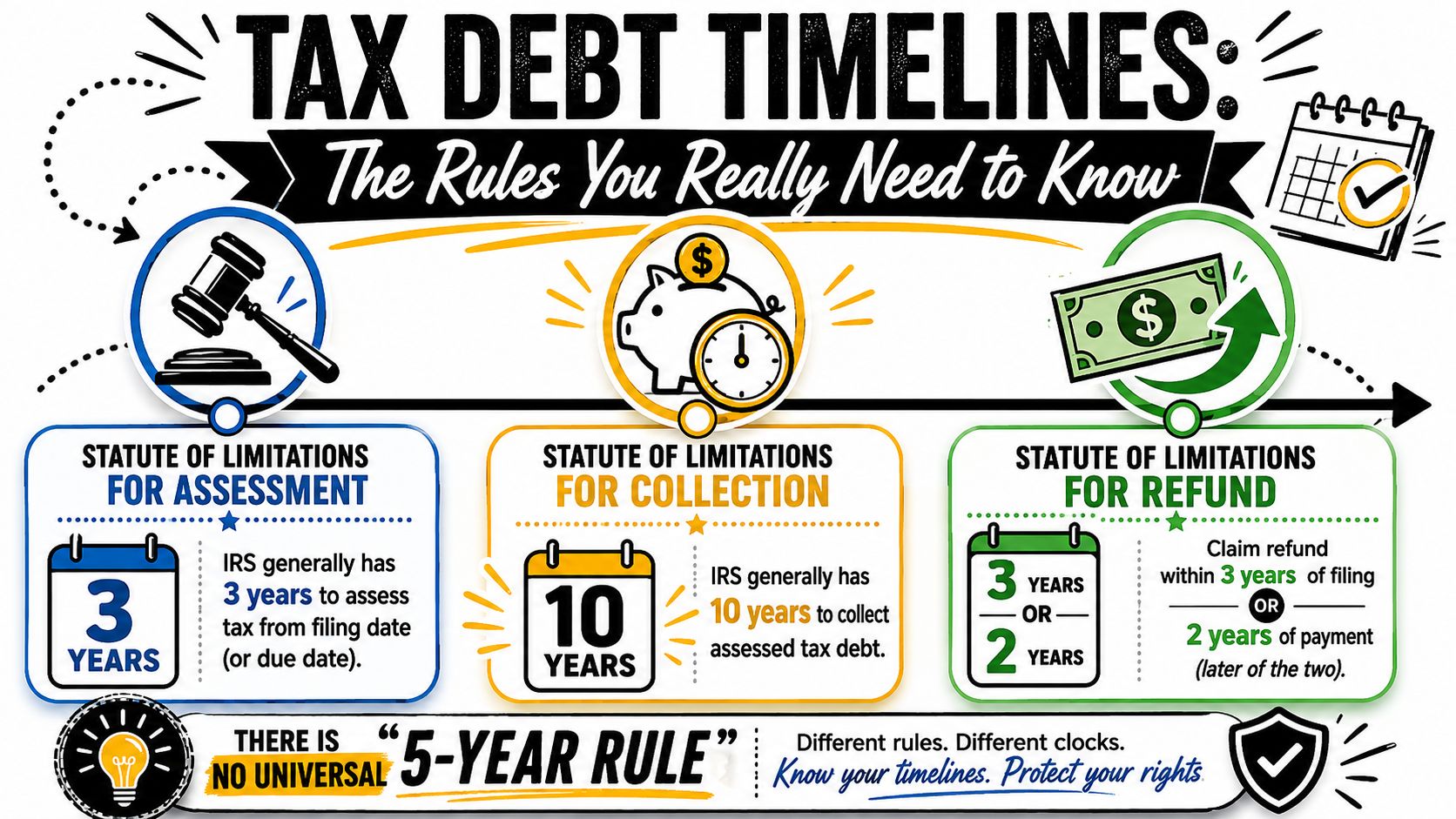
A common version of this problem looks like this. Someone owes older IRS debt, has heard a friend mention a “5 year rule,” and assumes there must be a date when the balance becomes uncollectible. In tax resolution, that label usually points people in the wrong direction.
Federal tax debt is usually governed by a different clock. The date that often matters most is the Collection Statute Expiration Date, or CSED.
The Collection Statute Clock
The IRS generally has 10 years from the date of assessment to collect a federal income tax debt under the CSED, as explained in this discussion of the IRS collection statute expiration date. That starting point causes a lot of confusion. The clock usually begins when the IRS formally assesses the tax, not when the return was due and not only when you remember filing it.
That distinction is practical, not academic. If you are trying to decide whether the IRS is close to the end of its collection period, using the wrong start date can throw off the analysis by months or longer.
Some events also pause the running of that period. Lawyers call that tolling. A stopwatch is the right comparison here. Time runs, then a legal event hits, the stopwatch stops, and later it starts again. Bankruptcy, an Offer in Compromise, a Collection Due Process hearing, some installment agreement activity, and extended time outside the United States can all affect the collection period. That is why “this debt is old” is not enough information to answer the question.
What expiration actually means
Once the CSED expires for a particular assessment, the IRS loses its administrative collection power on that balance. Wage levies, bank levies, and similar collection action on that expired period must stop. Penalties and interest tied to that expired balance also stop accruing, as noted earlier.
But each tax year stands on its own.
That is one of the biggest misconceptions taxpayers bring into consultations. A person may have one year that is at or near expiration and another year that is still fully collectible. Looking only at the oldest notice can create a very false sense of relief.
If you want a closer explanation of how these deadlines are calculated, this guide to the statute of limitations for IRS debt walks through the issue in more detail.
Bankruptcy has its own timeline
Another source of confusion is bankruptcy. People often call it a “5 year rule” problem because they know age matters, but the actual test is different.
For discharge of some income tax debts in bankruptcy, practitioners often refer to the 3-2-240 rule, described by Plunkett Cooney's summary of bankruptcy dischargeability for federal tax debt. In simplified form, the return generally must have been due at least 3 years before the bankruptcy filing, filed at least 2 years before filing, and the tax must have been assessed at least 240 days before filing. That source also notes that payroll taxes and trust fund recovery penalties are not dischargeable.
The practical lesson is straightforward. A tax debt can be too new for bankruptcy discharge but still be years away from the end of the IRS collection statute. Or the opposite problem can appear. A debt may be old enough to raise bankruptcy questions while the IRS collection clock has been paused so many times that collection is still active.
That is why experienced tax resolution work starts with dates, document history, and tax type, not with the phrase “5 year rule.”
How to Determine Which Rule Applies to You
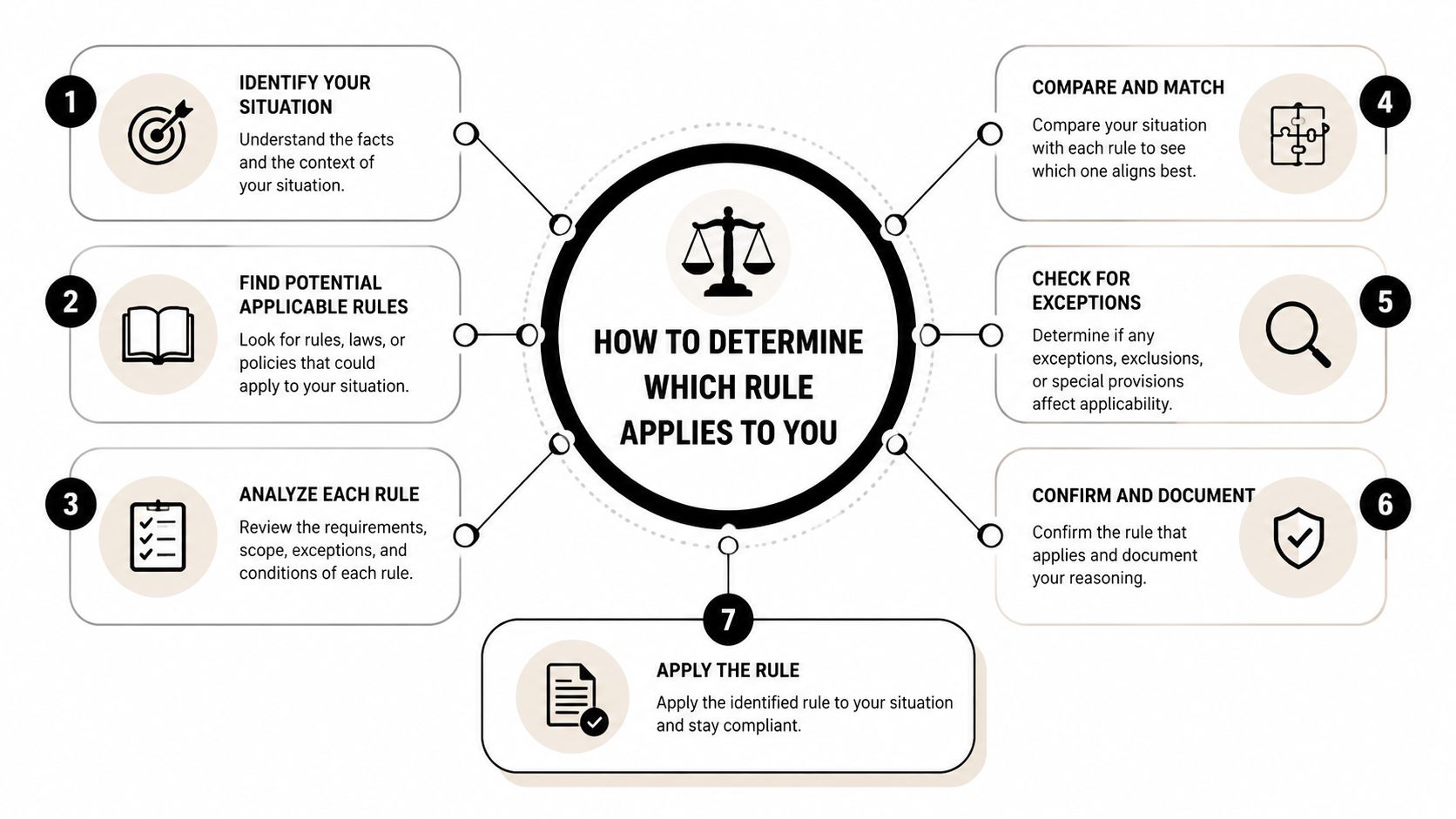
What's needed isn't more tax vocabulary, but a clear way to identify which timeline applies.
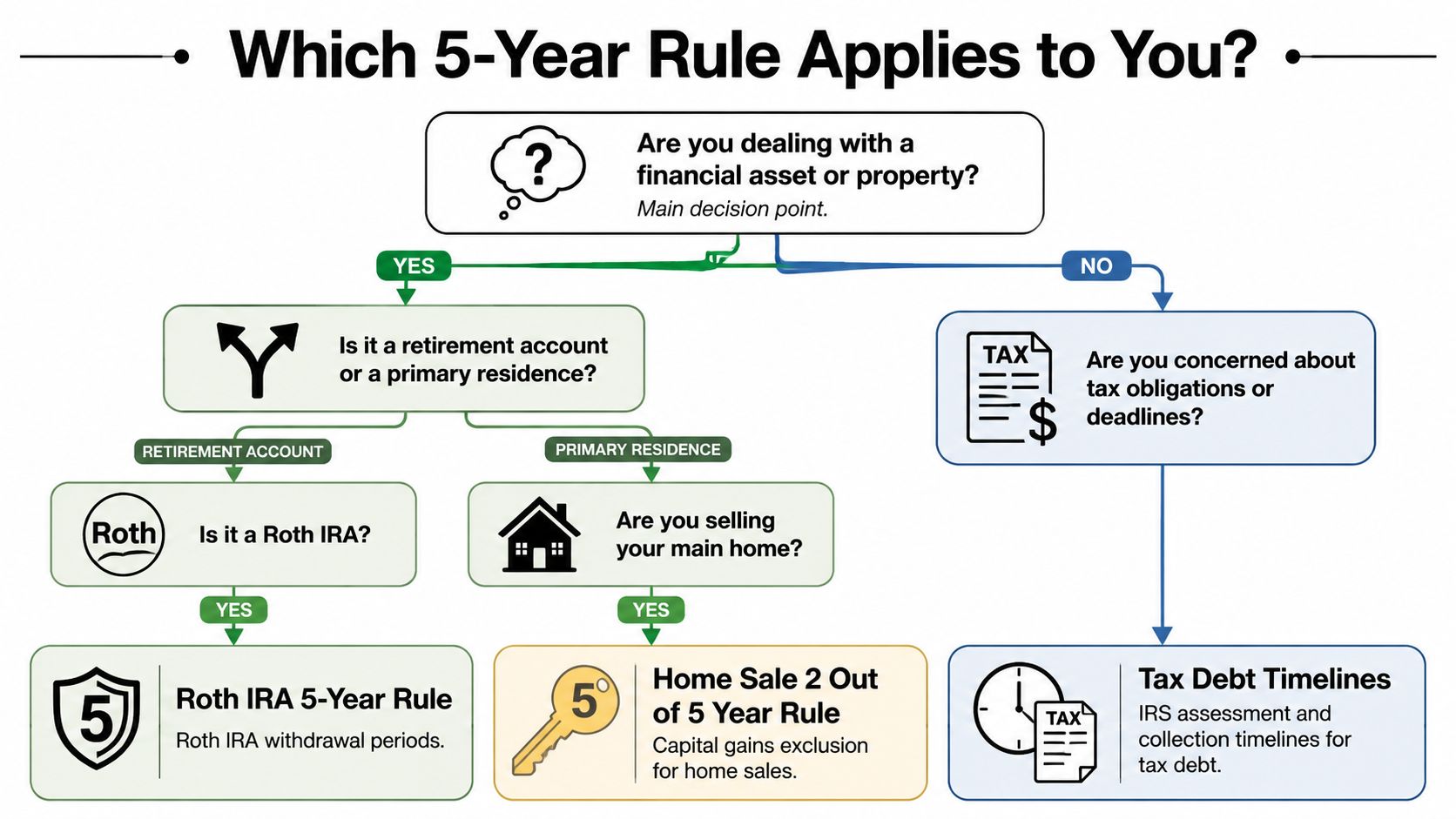
Start with the money or event in front of you. If you're touching retirement funds, that's one branch. If you sold a home, that's another. If the IRS is sending notices or threatening collection, you're in an entirely different analysis.
A quick diagnostic
Ask yourself these questions in order:
- Are you withdrawing from a Roth IRA. If yes, the issue is usually whether earnings are coming out before the Roth timing requirement has been met.
- Did you sell or plan to sell your main home. If yes, check the ownership and use requirements within the relevant five-year lookback period.
- Are you dealing with IRS debt. If yes, stop using “5 year rule” as your working term. You likely need to know the assessment date, whether the collection clock was paused, and whether bankruptcy timing rules are relevant.
What documents answer the question
Different rules require different paperwork.
| Situation | Most useful starting document |
|---|---|
| Roth IRA withdrawal | Account records showing first Roth contribution year |
| Home sale | Closing documents and residence timeline |
| IRS debt | IRS account transcripts and notice history |
That document-first approach saves time because memory is often wrong on dates. Tax outcomes turn on dates.
The hidden trap
The biggest mistake isn't ignorance. It's applying a correct rule to the wrong problem.
A taxpayer may correctly understand that a house rule looks back over five years, then assume an old IRS debt works the same way. It doesn't. Another may know there's a five-year Roth requirement and then assume every retirement account follows the same timing pattern. They don't.
If your issue involves multiple categories at once, such as a home sale during IRS collections or retirement withdrawals during a tax debt workout, you need the rules lined up side by side, not separately.
Real-World Examples of the 5 Year Rules
A client says, “I thought the five-year rule handled this.” That sentence can describe a retirement withdrawal, a home sale, or an IRS collection problem. The phrase sounds precise, but in practice it often hides the underlying issue. Dates matter, but the wrong set of dates leads to the wrong answer.
Elena and the Roth withdrawal
Elena is retired and assumes her Roth IRA is fully tax-free because she is over retirement age. Age helps, but it is only one part of the rule. Her first Roth contribution was made later than she remembers, so the account has not met the required timeline for tax-free treatment of earnings.
Her question needs to become more specific. She needs to know the year her first Roth contribution started the clock, and she needs to separate contributions from earnings. A Roth timeline works a lot like a ticket with two checkpoints. One checkpoint is age or another qualifying event. The other is time. If only one checkpoint has been cleared, the result can change.
Brian and Mia selling their home
Brian bought the house before he married Mia. Mia moved in later. They plan to file a joint return and assume that filing jointly automatically gives them the larger exclusion.
That assumption misses how the rule works in real life.
The ownership and use tests are separate. One spouse may satisfy the ownership requirement while both spouses still need enough qualifying use to claim the full joint benefit. Their answer depends on a calendar, not a label. Closing papers, move-in dates, and periods of actual residence often settle the question faster than memory does.
Andre and the “old” IRS debt
Andre has federal tax debt and keeps calling it a “five-year rule” problem because the balance has been hanging over him for years. That label points him away from the deadlines that control his options. For IRS collection, the practical questions are the assessment date, whether the collection clock was suspended, and whether the tax is income tax or a different kind of tax.
He also wonders whether bankruptcy will erase the debt because it feels old. Age by itself does not decide that. Bankruptcy analysis for income taxes uses separate timing tests that taxpayers often confuse with general collection deadlines. As noted earlier, those bankruptcy rules are not the same thing as the IRS collection statute, and they are not a generic five-year cutoff. The distinction matters even more for business owners, because payroll tax liabilities are treated very differently from ordinary income tax debt. That is one reason good records matter, and even a basic primer on understanding business tax accounting can help you spot why “tax debt” is not one single category.
Andre's example shows the mistake that sends many people down the wrong path. They use one phrase for several unrelated legal clocks. A tax attorney sorts those clocks by tax type, filing history, assessment history, and collection activity. If your situation sounds like Andre's, review these signs that it may be time for professional help with IRS tax problems.
When to Stop Googling and Call a Tax Attorney
Online explanations are useful for vocabulary. They're less useful when your facts are messy, your documents are incomplete, or the IRS is already taking action.
You can usually handle basic education on your own. You should stop and get legal advice when timing is no longer an abstract question. It becomes real when money is about to move, a sale is closing, or the IRS has started collecting.
Situations where DIY gets risky fast
- You have more than one issue at once. A Roth withdrawal, a home sale, and IRS debt in the same year create interactions that basic articles won't sort out.
- You don't know your dates. If you can't identify assessment dates, filing dates, or the first Roth contribution year, you're making decisions without the key facts.
- The debt includes business taxes. Taxpayers often assume all tax debt behaves like income tax debt. It doesn't. If you run a business, even a simple guide to understanding business tax accounting can help you see how recordkeeping and tax type affect the analysis.
- You're counting on time alone. Waiting only works if you're tracking the correct legal clock and know whether anything paused it.
- The IRS is already active. Levies, garnishment threats, lien issues, and collection notices change the urgency.
Why legal analysis matters here
A tax attorney doesn't just tell you what the rule says. The attorney matches the rule to your exact facts, your exact dates, and the type of tax involved.
That matters because one wrong assumption can cost you a valid exclusion, trigger unnecessary tax on retirement money, or cause you to misread an IRS collection deadline. If you're wondering whether your issue has crossed the line from general research to legal strategy, this article on when to hire a tax attorney is a useful checkpoint.
If your tax question starts with “I think” and ends with a date, it's probably time to verify the date before acting on the idea.
The phrase “5 year rule” sounds simple. In practice, it's shorthand for several unrelated rules, and none of them should be applied by guesswork.
If you're dealing with a Roth IRA timing question, a home sale issue, or IRS debt that may involve collection deadlines or bankruptcy analysis, Attorney Stephen A Weisberg offers a practical place to start. He focuses on tax controversy and tax debt matters, and his site explains that he begins with a free tax debt analysis to determine whether he can help and what options may fit your situation.


