What the 4464c letter irs Means for Your Refund: A Clear Guide
Learn why you received a 4464c letter irs, what triggers it, and how to respond to resolve the review and safeguard your tax refund.
In this article
- What the IRS Letter 4464C Actually Means
- IRS Letter 4464c at a Glance
- Why This Letter Is a Protective Measure
- Key Takeaways from the Letter
- Common Triggers That Flag a Tax Return for Review
- Mismatched Income and Withholding Information
- Significant Changes and Unusually Large Claims
- Potential 4464c Triggers for Business vs Individual Filers
- What Happens During the 60-Day Review Period?
- The IRS Cross-Referencing Process
- Managing Your Expectations for the Timeline
- Your Action Plan for Responding to a 4464c Letter
- Step 1: Read and Understand the Request
- Step 2: Gather Your Documents if Requested
- Step 3: Track Your Refund Status
- What to Do if the 60 Day Window Passes
- Check for Digital Updates First
- How to Make a Productive Call to the IRS
- When to Contact a Tax Attorney for Help
- The 60-Day Period Is Long Gone
- The IRS Requests a Mountain of Documents
- When to Seek Professional Guidance
- Got Questions About IRS Letter 4464-C? We've Got Answers.
- Is a 4464-C Letter the Same as an Audit?
- Should I Amend My Tax Return After Getting This Letter?
- Will This Hold Up My State Tax Refund?
- How Is This Different from a CP05 Notice?
Seeing an envelope from the IRS in your mailbox is enough to make anyone's heart skip a beat. But if the document inside is an IRS Letter 4464C, take a deep breath. This isn't a bill, and it's definitely not an audit notice.
Think of it as the IRS hitting the pause button. It simply means your tax return needs a second look to confirm everything is accurate before they cut you a check for your refund. It's a routine check designed to fight fraud and make sure the right amount of money gets to the right person.
What the IRS Letter 4464C Actually Means

When that IRS letter arrives, it’s natural to jump to the worst conclusion. But a 4464c letter irs notice is more of a yellow light than a red one. This letter comes from a specific department—the IRS's Integrity & Verification Operations (IVO)—and its job is to tell you one thing: your return needs a little extra review before your refund is released.
It's a lot like a quality control check on a factory line. Before a product gets boxed up and shipped, it undergoes a final inspection. In the same way, the IRS is double-checking that the numbers you reported for your income, tax credits, and withholdings all line up with the data they have on file from employers, banks, and other institutions.
This isn’t an accusation. It's a proactive step the IRS takes to protect everyone involved—you and the government—from costly errors or outright fraud.
To quickly break down what this letter means for you, here’s a simple table.
IRS Letter 4464c at a Glance
| Key Aspect | What It Means for You |
|---|---|
| Purpose of Letter | A notification that your tax return is under review to verify its accuracy. |
| Is It an Audit? | No. It is a pre-refund verification, which is much less intensive than an audit. |
| Action Required? | Usually, no immediate action is needed. The IRS will contact you again if they require more information. |
| Refund Status | Your refund is temporarily delayed, typically for up to 60 days, while the review is completed. |
| Common Triggers | Discrepancies in reported income, withholdings, or eligibility for certain tax credits. |
This table should help you see that while the letter causes a delay, it’s a standard procedural step and not usually a cause for alarm.
Why This Letter Is a Protective Measure
At its core, the 4464C letter is all about preventing fraud. With stolen identity refund fraud costing taxpayers and the government billions—over $5.2 billion in fiscal year 2019 alone—these reviews are a critical line of defense. By pausing to verify the details, the IRS is actively working to ensure a criminal isn't trying to cash in on a fake return filed using your stolen information.
You can learn more about the different kinds of notices the IRS sends out by reading our guide on IRS letters and notices.
The 4464C letter is fundamentally a communication tool. The IRS is telling you, "We've received your return, but we need some extra time—up to 60 days—to cross-reference a few details before we can send your refund."
This review might feel frustrating, especially when you're counting on that refund. But remember, its ultimate purpose is to protect your financial identity and keep the entire tax system secure.
Key Takeaways from the Letter
Once you understand what this letter is really about, you can trade that initial panic for a bit of informed patience. Here’s a quick rundown of what the notice signifies:
- A Refund Delay: The most immediate impact is that your refund will be held for up to 60 days while the IRS completes its review.
- No Immediate Action Required: Most of the time, you don't need to do anything but wait. If the IRS needs documents or clarification, they will send a separate letter asking for specific information.
- Not an Audit: This is a key distinction. A verification check is a targeted review of specific items on your return. A full-blown audit is a much more comprehensive examination of your financial records.
- A Focus on Accuracy: The review is usually centered on matching key figures like the income reported on your W-2s and 1099s, the amount of federal income tax withheld, and your eligibility for certain tax credits.
Knowing that the 4464c letter irs is just a procedural step helps you manage your expectations and be ready for what comes next—which, in many cases, is simply your refund arriving a bit later than planned.
Common Triggers That Flag a Tax Return for Review

It’s completely natural to wonder, "Why me?" when a Letter 4464-C from the IRS lands in your mailbox. It feels personal, but the truth is, your return wasn't singled out by an agent poring over documents. Instead, it was most likely flagged by a sophisticated automated system.
This system is the IRS's digital watchdog, constantly scanning millions of returns for anything that looks out of the ordinary. Think of it like your credit card company's fraud alert. If you suddenly make a huge purchase in another state, you’ll probably get a text to confirm it's really you. The IRS system works the same way—if your tax return contains information that deviates from your history or typical patterns, it gets flagged for a closer look.
This review isn't an accusation of wrongdoing. It's simply a pause—a verification step to make sure everything is accurate before your refund is sent out. This protects both you and the U.S. Treasury from errors or potential fraud. Understanding what these systems look for is the first step in figuring out what might be under scrutiny on your return.
Mismatched Income and Withholding Information
One of the most common reasons for a review is a simple mismatch between the income you reported and the data the IRS received from third parties. For small business owners and independent contractors, this is a frequent snag.
Every client who pays you more than a certain amount has to file a Form 1099-NEC detailing those payments. The IRS computers then cross-reference the total income from all 1099s filed under your name with the gross receipts you reported on your Schedule C.
If those numbers don't line up perfectly, a red flag goes up. Even a small discrepancy can be enough to put your refund on hold and trigger a review. The same logic applies to W-2s and the payroll tax withholdings your employer submitted.
The IRS Letter 4464-C often catches small business owners off-guard, especially if they have existing payroll or income tax debts. This notice can pause refunds for up to 60 days while the IRS thoroughly matches your reported figures against their records. During the filing surge in tax year 2020, the IRS Integrity and Verification Operations (IVO) issued thousands of these letters weekly, recovering an estimated $4.8 billion in potentially fraudulent refunds that year alone.
Significant Changes and Unusually Large Claims
In the world of IRS automated systems, consistency is king. Any sudden, dramatic change from your previous filing patterns can easily set off an alarm. Knowing these patterns is key to understanding what triggers a tax audit or a less formal review.
Here are a few common changes that tend to catch the system's attention:
- Reporting a Large Business Loss: Business losses happen, but a huge loss on a Schedule C—especially if it's your first year in business or it wipes out a lot of other income—is a classic trigger.
- Claiming New or Large Credits: Taking a substantial business credit for the very first time, like for R&D or energy-efficient upgrades, will almost certainly lead to verification. The system just wants to confirm you meet the complex requirements.
- A Sudden Spike in Your Refund: If your refund this year is drastically bigger than in past years, the IRS is going to want to know why. It could be for a perfectly valid reason, but it still warrants a second look.
Potential 4464c Triggers for Business vs Individual Filers
While some red flags are universal, certain triggers are more common for specific types of filers. A freelancer's tax return looks very different from a large S-Corp's, and the IRS systems are programmed to spot anomalies in both.
| Trigger | Business Filer (LLC, S-Corp) | Individual/Sole Proprietor |
|---|---|---|
| Income Discrepancy | Mismatch between revenue on Form 1120S/1065 and 1099-K merchant card payments. | Discrepancy between reported Schedule C income and the total from all 1099-NEC forms. |
| Deduction Patterns | Unusually high deductions for meals, travel, or entertainment compared to industry averages. | Large home office deduction or claiming 100% business use of a vehicle. |
| New, Large Credits | First-time claim for R&D tax credit or Work Opportunity Tax Credit (WOTC). | A significant jump in the Earned Income Tax Credit (EITC) or claiming the American Opportunity Tax Credit for the first time. |
| Sudden Loss | A large net operating loss that contrasts sharply with previous years of profitability. | Reporting a substantial loss on a Schedule C that offsets all other W-2 or household income. |
Ultimately, whether you're a business or an individual, the core principle is the same: the IRS wants to see consistency and numbers that make sense.
To get ahead of potential issues, maintaining strong year-end tax readiness is a game-changer. When your books are well-organized, you can easily justify any significant changes on your return if the IRS comes asking. That preparation can make what would be a stressful review process much, much smoother.
What Happens During the 60-Day Review Period?
Getting a 4464c letter from the IRS can feel like your tax return just vanished into a bureaucratic black hole for 60 days. It’s natural to wonder what’s actually happening behind the scenes. Are they tearing your return apart? Are you being audited?
Relax. It's usually much less dramatic than that. Think of it less like a deep investigation and more like a high-tech game of "spot the difference."
The IRS is essentially taking the numbers you reported—your income, the taxes withheld, the credits you claimed—and running them against the mountain of data they've already collected from third parties like your employer or clients. It’s a sophisticated, automated cross-referencing process, not a sit-down with an agent and a pile of your receipts.
This is all part of the IRS's massive effort to clamp down on fraud. Since their Return Review Program (RRP) kicked off in 2010, these automated checks have become incredibly powerful. By 2022, their Integrity & Verification Operations (IVO) unit was flagging over 1.5 million potential identity theft cases a year. The 4464-C letter is a key tool in this process, used to pause what they call "questionable refunds" (often over $1,000) for about 3 to 8 million taxpayers annually. You can find more discussions about IRS verification programs and their impact on taxpayers on the Intuit forums.
The IRS Cross-Referencing Process
So, what are they actually looking for during these 60 days? Their systems are laser-focused on a few key areas, trying to find any inconsistencies between your return and the information they have on file.
Here's a breakdown of the main checkpoints:
- Income Verification: Did the income you reported match what others reported paying you? For freelancers, they're comparing your Schedule C income to the totals on all the Form 1099-NECs your clients filed. For employees, it's a simple match between your return and the W-2 your employer sent them.
- Withholding Confirmation: They check that the federal tax you claimed was withheld lines up exactly with the figures submitted by your employer or other payers. A simple typo here is one of the most common triggers for a review.
- Credit Eligibility: The IRS pays extra attention to refundable credits, especially the Earned Income Tax Credit (EITC). They’ll verify your dependent's information against Social Security Administration records to make sure everything is in order.
The 60-day review isn’t an accusation. It's simply a procedural pause. The IRS’s automated system just needs a moment to confirm that the numbers you provided match the data they already have from employers, clients, and banks.
If the system flags a potential mismatch, the IRS might take another step and contact the third party directly. For instance, they could call your employer to double-check the withholding on your W-2. This doesn't mean you're in hot water; it's just them doing their due diligence.
Managing Your Expectations for the Timeline
The letter says the review can take up to 60 days, but that's the maximum, not the standard. Sometimes the process is surprisingly fast.
If all your information lines up perfectly, the system gives a quick green light, and your refund could be on its way in just a few weeks. It's worth keeping up with the IRS's digital transition for refunds and notices to see how you might get updates in the future.
But things can also drag on. If the IRS uncovers a significant discrepancy or needs more information from you, that 60-day clock can pause or even restart. Knowing this can help you set realistic expectations and save you a lot of stress. For now, the best strategy is often the hardest: be patient and let the review run its course.
Your Action Plan for Responding to a 4464c Letter
Getting a Letter 4464-C from the IRS can be unnerving, but it's not a signal to panic. In most cases, your next steps are surprisingly simple. The absolute worst thing you can do is ignore it, but a frantic, immediate response is rarely necessary either. Think of this letter as a pause button, giving you a moment to review and prepare.
First things first, read the letter—every single word. You'll find that many of these notices are purely informational. They're just letting you know your return is under a 60-day review and often state very clearly that you don't need to do anything at all. If that’s your situation, your main job is to wait.
However, if the IRS needs something from you, the letter will spell it out. This is your cue to shift from waiting patiently to gathering documents. A clear plan can turn a moment of anxiety into a straightforward, manageable task.
Step 1: Read and Understand the Request
Your first and most important job is to become an expert on your specific 4464-C letter. Is it a generic "heads-up" notice, or is it a direct request for documentation? The language will be very clear on this point.
A key mistake people make is treating all IRS notices the same. A standard 4464-C letter simply says, "We're reviewing your return... you don't need to do anything right now." A request for information is a different beast—it's a much more direct communication, often arriving in a follow-up letter.
If your letter is the standard informational version, your plan is simple. File it somewhere safe and keep an eye on your refund status online. There's really no need to call the IRS or send anything unless they follow up with another letter asking for specifics.
Step 2: Gather Your Documents if Requested
If the IRS does ask for more information, they'll tell you exactly what they want to see. Your task is to collect clean, easy-to-read copies of those documents. A golden rule here: never send your original documents. There's a good chance you won't get them back.
Here’s a quick checklist of the usual suspects the IRS might ask for:
- Proof of Income: This means copies of all your W-2s from employers and any 1099 forms (like the 1099-NEC or 1099-K) if you're a freelancer or have other income sources.
- Proof of Withholding: Your W-2s and 1099s also show how much federal income tax was withheld. The IRS is basically playing a matching game, comparing your figures to what they have on file.
- Records for Tax Credits: Did you claim major credits like the Earned Income Tax Credit (EITC) or the American Opportunity Tax Credit? You may need to prove your eligibility with things like birth certificates for your kids, school enrollment records, or receipts for childcare.
- Business Expense Records: For small business owners, a large loss on your Schedule C can sometimes trigger a review. Be ready with bank statements, receipts, or mileage logs that back up the deductions you claimed.
Once you have everything, make copies and organize them in a logical way. Remember, a clear, well-organized response makes the IRS agent's job easier, and that can only help speed things along.
This decision tree gives you a good visual of what happens behind the scenes during this review process.
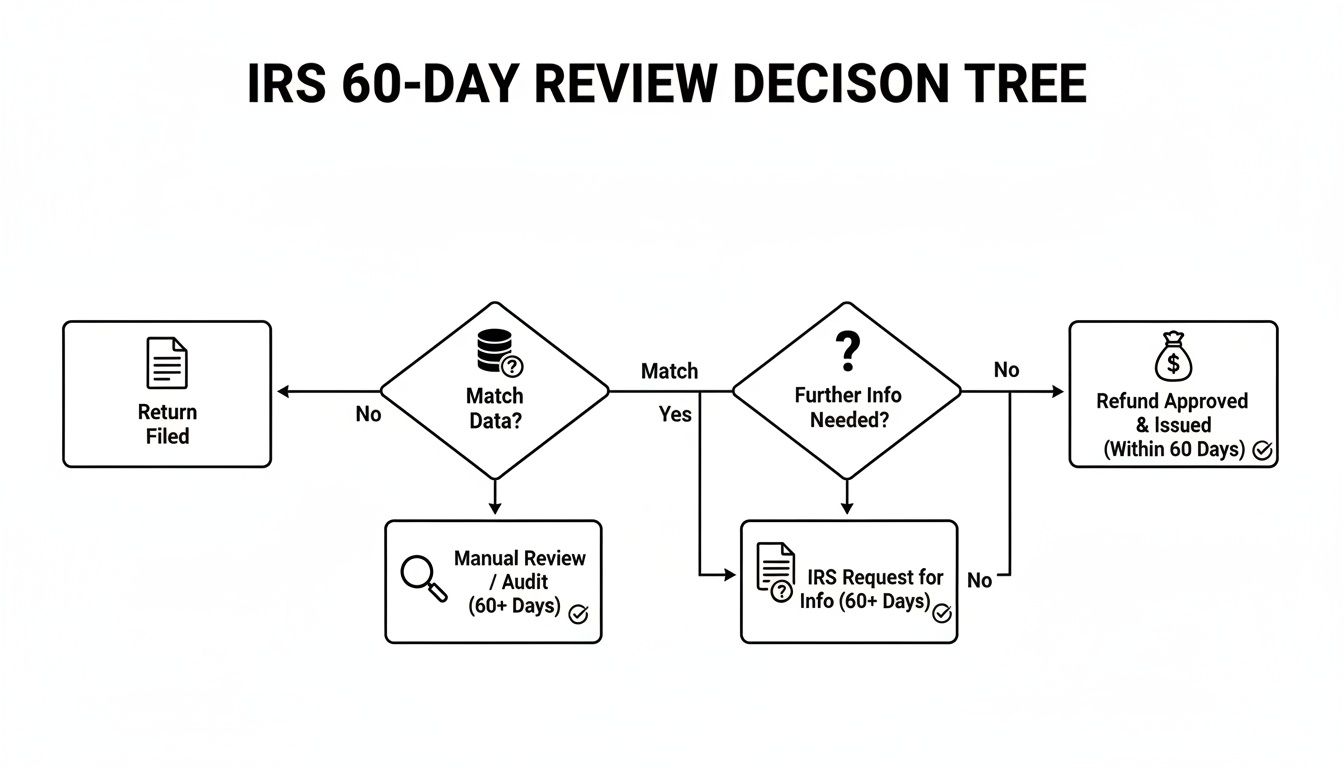
As you can see, the review is really just a data-matching step. It’s designed to confirm your return's accuracy before the IRS sends out your refund.
Step 3: Track Your Refund Status
While you're waiting for the review to wrap up, the IRS Where's My Refund? tool is your best friend. There's no need to check it obsessively—the system only updates once every 24 hours, so a quick look each day is plenty.
Here's a decoder for the status messages you might see during a review:
- Return Received: This just confirms your return is in their system and waiting in line to be processed.
- Refund Approved: This is the one you want to see! It means the review is over, everything checked out, and your refund is on its way.
- Tax Topic 152: Seeing this message can be confusing, but it’s a generic code that often appears when a return needs a closer look, including cases that lead to a 4464-C letter. It's not necessarily a bad sign, just an indication that your return isn't a simple, straight-through case.
Try to resist the urge to call the IRS before the 60-day period mentioned in the letter is up. The phone agents usually won't have any more information than what you can see online, and the letter itself asks you to wait. Following these simple steps will help you navigate the process calmly and effectively.
What to Do if the 60 Day Window Passes
That 60-day mark on your calendar has come and gone. You've been checking your mailbox and your bank account, but still... nothing. It’s completely normal for patience to start wearing thin and for a little anxiety to set in at this point.
If you’ve been waiting for an update on your 4464C letter IRS review and have only been met with silence, it’s time to switch gears. The passive waiting game is over; it's time for some proactive follow-up.
Don't jump to the worst-case scenario. This kind of delay doesn’t automatically signal a major problem. IRS backlogs are a real thing, and some tax returns are just plain complicated, requiring extra time. That said, you shouldn't just wait around forever. Let's walk through a few measured steps you can take to get some real answers about your refund.
Check for Digital Updates First
Before you brace yourself for a potentially long phone call with the IRS, start with a quick digital check. Your first stop should always be the IRS's official "Where's My Refund?" tool.
It won't give you the nitty-gritty details of the review, but it's the fastest way to see if your status has changed. If your refund has finally been approved or if another notice has been sent out, this is where you'll see it first.
Waiting past the 60-day mark without any word is a clear signal to escalate your inquiry. While the IRS asks for patience, prolonged silence means it's your turn to ask questions and seek a status update on your delayed refund.
If the online tool is still stuck on a generic "processing" message or mentions Tax Topic 152, and that 60-day window is officially closed, it's time to pick up the phone.
How to Make a Productive Call to the IRS
Let's be honest: calling the IRS can be a test of patience. But if you go in prepared, you can make the call much more effective. When the 60-day period from your 4464C letter IRS has passed, find the phone number printed directly on that letter. Using that specific number should connect you to the department actually handling your case.
To make the call go as smoothly as possible, get your documents in order before you dial. You'll want to have these items handy:
- Your 4464C Letter: The agent will almost certainly ask for information directly from this notice.
- A Copy of Your Tax Return: You’ll need it to verify your identity and answer any specific questions about the return being reviewed.
- Your Social Security Number: This is a must-have for the agent to pull up your account.
When you get someone on the line, stay calm and be direct. Explain that the 60-day review period has expired and you're simply calling for an update. The agent should be able to tell you one of a few things:
- Good news: Your refund has been approved and is scheduled for release.
- More waiting: The review requires additional time, and they might give you a new estimated timeframe.
- An escalation: Your case needs to be moved to a different agent or department for further action.
This phone call is often a turning point. If you’re met with vague answers, or if the IRS representative can't give you a clear update, it’s often a sign that you might need to bring in a professional. Getting an experienced tax expert involved can be the most effective way to cut through the red tape and get things moving again.
When to Contact a Tax Attorney for Help
Most of the time, getting an IRS Letter 4464C just means you need to be patient. But there are definite moments when sitting back and waiting is the wrong move. If things start feeling more serious than a simple review, it’s time to get an expert on your side.
Deciding to hire a professional isn't admitting defeat—it's a smart, strategic move to protect your money and your rights. Some situations are just too complex or carry too much risk to go it alone. Spotting these red flags early can save you a world of stress, time, and money down the road.
The 60-Day Period Is Long Gone
The most glaring sign you need help is when that initial 60-day window slams shut with no word from the IRS. If you've called them only to get the runaround or be told to "just keep waiting," your file could be gathering dust in a bureaucratic black hole.
This is where a good tax attorney cuts through the red tape. They know how to contact the IRS for you, get past the frontline agents, and speak directly to someone who can actually pull up your file and give you a real status update. That professional push is often exactly what’s needed to get a stalled case moving again.
When your refund is held hostage by endless delays and vague answers, an attorney becomes your champion. They make sure your case gets the attention it deserves instead of being lost in the shuffle.
The IRS Requests a Mountain of Documents
If the IRS follows up your 4464C letter by asking for a boatload of documents, things have just escalated. This isn't just a simple verification anymore; it's starting to look and feel like a full-blown audit. This is especially true if you’re a business owner being asked to produce years of expense reports or detailed payroll records.
Trying to tackle a request like this on your own is a huge risk. An attorney can help you get your response organized, make sure you're only sending what’s absolutely required, and frame the information in a way that satisfies the IRS without opening you up to even more questions. The benefits of hiring a tax attorney really shine in these high-stakes scenarios.
When to Seek Professional Guidance
Sometimes, your specific situation just naturally makes a 4464C review more serious. Recognizing these triggers early can stop a small delay from spiraling into a massive financial problem.
You should seriously think about calling a tax professional if any of these apply to you:
- Your Finances are Complicated: The review involves tricky business income, payroll taxes, or substantial investment gains.
- You Have Other Tax Problems: You're already juggling back taxes, unfiled returns, or other unresolved issues with the IRS.
- The Delay is Causing Financial Hardship: Your frozen refund is putting a real financial strain on you, your family, or your business.
As you consider your options, remember the limitations of AI in providing legal advice. While new technology is a great resource, it’s no substitute for the experience and strategic thinking of a real attorney, especially when you’re up against an institution as complex as the IRS.
Got Questions About IRS Letter 4464-C? We've Got Answers.
Getting an official-looking envelope from the IRS can be nerve-wracking, and the jargon inside often just adds to the confusion. If you've received a Letter 4464-C, you probably have a few immediate questions. Let's clear things up with some straightforward answers.
Is a 4464-C Letter the Same as an Audit?
This is the big one, so let's get it out of the way: No, it's not an audit. That's a huge relief, right?
Think of a 4464-C letter as a "pause" button, not a "panic" button. The IRS is basically doing a quick quality-control check before they cut your refund check. They're just double-checking a few things, like the income or tax withholding you reported, to make sure everything lines up.
An audit is a different beast entirely. It's a much deeper, more formal dive into your financial records for a tax year and is a far more involved process. A 4464-C is simply a pre-refund verification.
Should I Amend My Tax Return After Getting This Letter?
My advice is almost always to hold off. Don't rush to file an amended return (Form 1040-X) just because you got this letter.
Why? Because your return is already in a specific review queue. Throwing an amended return into the mix is like changing your order after the kitchen has already started making it—it just creates confusion and almost guarantees a longer delay.
The only exception is if you've found a glaring, significant error on your original return. Even then, it's a smart move to talk to a tax professional before you do anything. They can help you navigate the best course of action.
Will This Hold Up My State Tax Refund?
Usually, no. Your federal taxes and your state taxes are handled by two completely separate government agencies that don't really talk to each other about these kinds of reviews.
A hold on your federal refund because of a 4464-C letter shouldn't have any direct effect on when you get your state refund. If your state refund is delayed, it’s because the state tax agency has its own, unrelated verification process going on.
How Is This Different from a CP05 Notice?
It's easy to mix these two up, since both a Letter 4464-C and a CP05 notice tell you your refund is on hold for a review. They come from different corners of the IRS and signal slightly different things.
- CP05 Notice: This notice is typically more targeted. It often focuses specifically on verifying income, withholding, or certain tax credits you claimed, like the Earned Income Tax Credit or the American Opportunity Tax Credit.
- 4464-C Letter: This one is a bit broader. It comes from the IRS's Integrity & Verification Operations unit and signals a more general check to confirm the overall accuracy of your return before they send out the money.
Knowing the difference helps you understand what the IRS is looking at and what to expect as they work through their process.
If that 60-day window has come and gone with no word, or if the IRS is now asking for documents you can't make sense of, you don't have to figure it out alone. Attorney Stephen A. Weisberg offers a FREE Tax Debt Analysis to map out exactly how he can help, all before you ever pay a fee. Get your free analysis and find a path forward today.