2024 Federal Mileage Rate: A Guide for Businesses
Get the official 2024 federal mileage rate of 67 cents/mile. Learn when to use the standard vs. actual expense method, see examples, and get expert audit tips.

In this article
- Your Guide to Business Vehicle Deductions
- The two decisions that matter most
- Understanding the 2024 Mileage Rates
- What the business rate actually covers
- What counts as business mileage
- Standard Rate vs Actual Expense Method
- Why many owners choose the standard rate
- Why some owners still use actual expenses
- The long-term consequence of the first choice
- How to Calculate Your Mileage Deduction
- A straightforward example
- What this looks like in real life
- Where owners usually go wrong
- Recordkeeping Employer Reimbursements and Audit Risk
- What an examiner wants to see
- Reimbursements don't have to match the IRS rate
- Risk management beats cleanup
- Practical Takeaways for Business Owners
The 2024 federal mileage rate for business use is 67 cents per mile. That's the number most business owners need, but knowing the rate is only the first step if you want a deduction that holds up under IRS scrutiny.
A lot of people reach tax time with the same problem. They know they drove for work, they know they spent money on the vehicle, and they know some deduction should be available. What they don't have is a clean mileage log, a clear method choice, or confidence that what they claim is defensible if the IRS asks questions later.
That's where mistakes happen. Not because the rate is complicated, but because vehicle deductions sit at the intersection of tax rules, recordkeeping, and judgment calls. If you're self-employed, run a small business, or reimburse employees for using their own cars, the main issue isn't just what the rate is. The main issue is how to use it in a way that lowers tax exposure without creating avoidable audit risk.
Your Guide to Business Vehicle Deductions
You sit down to do taxes, open a drawer full of gas receipts and repair invoices, and realize the problem isn't the car. It is whether you can prove which miles were business miles.
Business vehicle deductions create trouble for otherwise careful owners because the rule looks simple from a distance. In practice, the exposure usually comes from mixed-use driving, incomplete logs, and method choices that were made for convenience instead of documentation. I see the same pattern often. A business owner remembers the client meetings, forgets the commuting trips, and assumes the IRS will accept a reasonable estimate. That is a weak position in an audit.
For many sole proprietors and single-member LLCs, the mileage method is attractive because it cuts down on receipt tracking. But simplicity is not the same as safety. The standard rate only helps if the miles behind it are contemporaneously tracked and properly classified.
The two decisions that matter most
Before claiming a vehicle deduction, make two decisions early and treat them separately:
- Method choice: Decide whether the standard mileage method or the actual expense method fits your facts and your records.
- Proof choice: Set up a mileage log and supporting documents that would make sense to a revenue agent who has never met you.
Those choices affect more than the size of the deduction. They affect how easy the return is to defend.
The standard mileage method usually works well for owners who want a cleaner process and have consistent business driving. The actual expense method can produce a better result for some high-cost vehicles or heavy-use situations, but it asks for more discipline and more paper. The right answer depends on operating costs, business-use percentage, and how reliably you separate personal, commuting, and business trips.
A smaller deduction with clean records often beats a larger deduction built on guesswork.
If you are reviewing vehicle write-offs alongside the rest of your tax position, this guide to small business tax deductions is a useful companion, because vehicle issues often overlap with home office, accountable plan, and entity-level planning.
Understanding the 2024 Mileage Rates
A business owner drives all year, totals the miles in December, and assumes the deduction is straightforward. The rate is the easy part. The harder question is whether those miles were classified correctly and whether the method you chose will hold up if the return is examined.
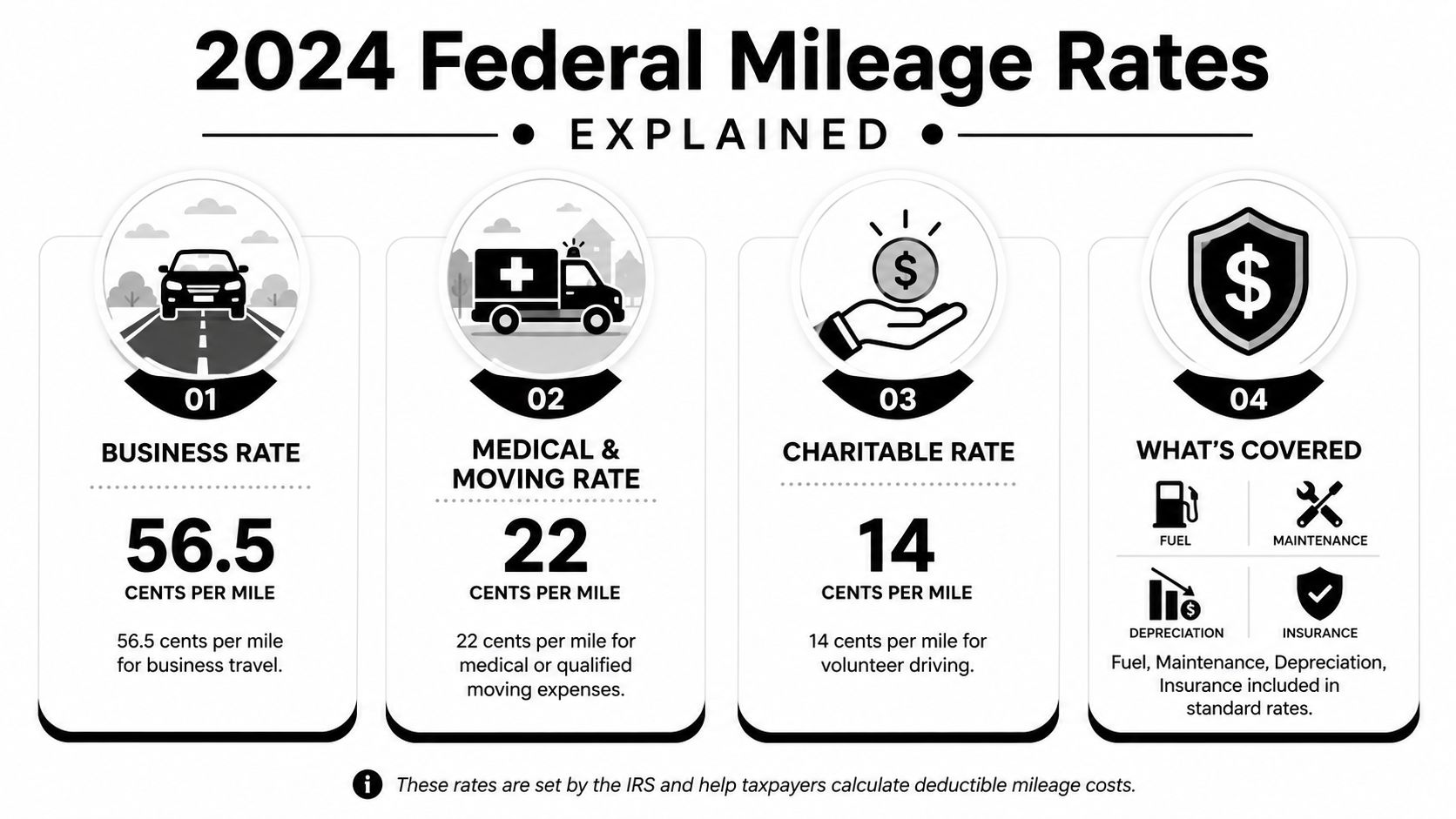
For 2024, the standard business mileage rate is 67 cents per mile, effective January 1, 2024. The prior year rate was 65.5 cents per mile. One detail that matters more than many owners realize is that part of the standard rate is treated as depreciation. That affects basis, future gain calculations, and method-related reporting. If you later need to deal with depreciation adjustments or method reporting, review the Form 4562 instructions for vehicle depreciation issues.
What the business rate actually covers
The standard mileage rate is a bundled allowance for operating a vehicle for business. It is meant to stand in for the usual ownership and operating costs that would otherwise have to be tracked separately under an actual-expense approach. That makes it administratively cleaner, but it does not make the deduction automatic.
The rate applies based on qualified business use, not on whether the vehicle is powered by gasoline, diesel, or electricity. Owners sometimes overfocus on the car and underfocus on the trip. From a tax risk standpoint, the trip is what matters.
That distinction is where problems start.
What counts as business mileage
Business mileage generally includes trips to meet clients, visit job sites, pick up supplies, make a business bank deposit, or travel between work locations during the day. Those trips usually have a clear business purpose that can be explained in a log without much difficulty.
Commuting is different. Driving from home to your regular office or other regular work location is usually personal, even if you own the company. I see this mistake often with sole proprietors and owner-employees who assume every drive connected to work is deductible. That assumption creates audit exposure quickly because commuting is one of the first categories an examiner will test.
A practical way to evaluate a trip is to ask a narrow question. If a revenue agent points to one line in the mileage log, can you explain where you went, why you went there, and how that trip directly related to the business?
| Trip type | Likely treatment |
|---|---|
| Driving to a client meeting | Business mileage |
| Picking up inventory or supplies | Business mileage |
| Traveling between work locations | Business mileage |
| Daily drive from home to regular office | Personal commuting |
A mileage deduction usually rises or falls on trip-by-trip credibility, not on the annual total.
Specific beats vague. “Met client at project site” is useful. “Business errand” is weak.
Standard Rate vs Actual Expense Method
This is the decision that deserves more attention than the rate itself. In practice, the better method is the one that produces a valid deduction without creating a documentation problem you can't manage.
Why many owners choose the standard rate
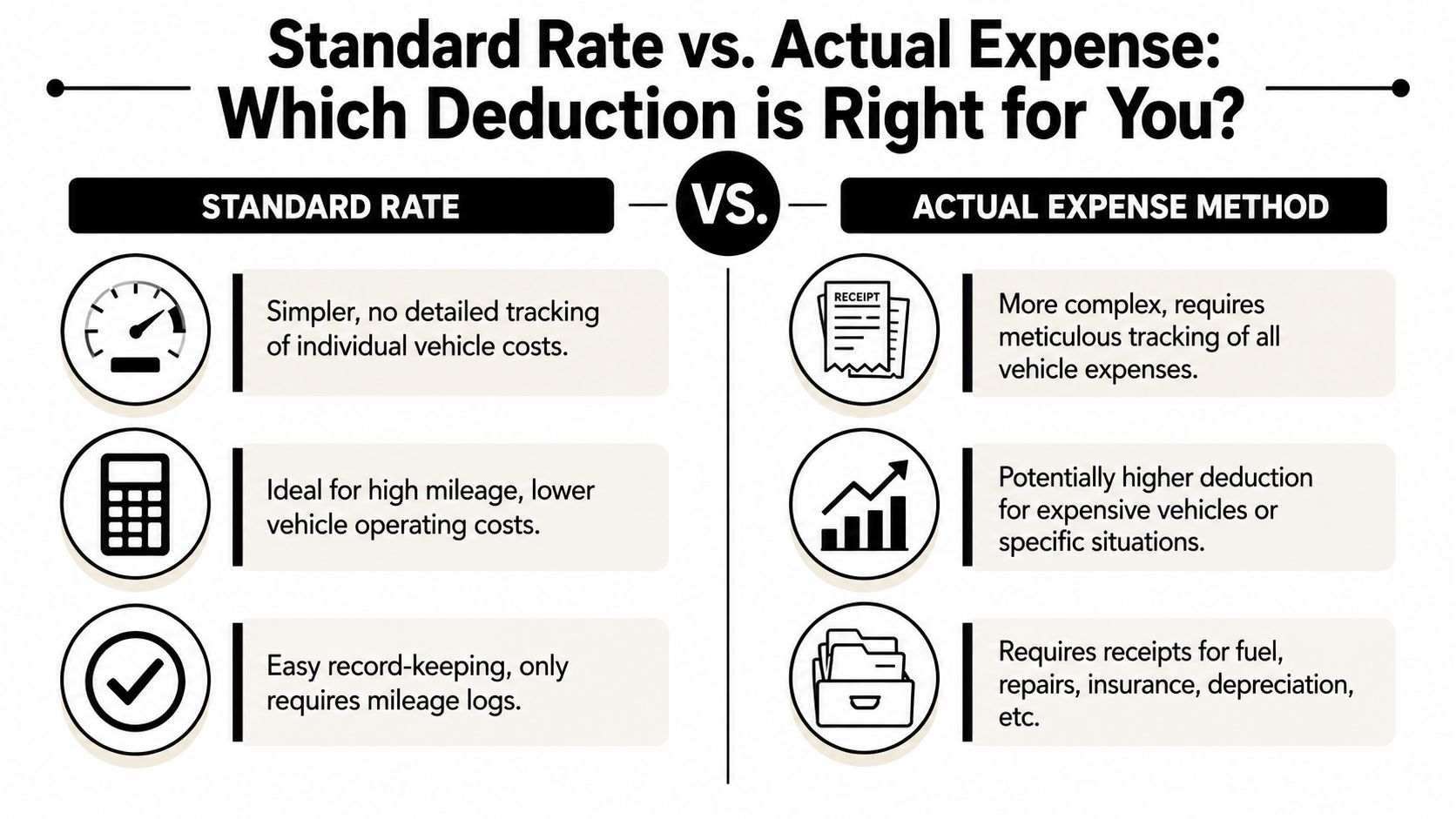
The standard mileage method is popular because it reduces bookkeeping. If your records clearly show business miles, the calculation is straightforward. You don't have to separately total fuel, repairs, insurance, and similar operating costs just to arrive at the deduction.
That simplicity matters. I've seen plenty of situations where a business owner had a decent handle on mileage but almost no organized support for actual vehicle expenses. In that setting, the standard method often works better because it's easier to maintain consistently and easier to defend later.
It's often a good fit when:
- Mileage is well tracked: You keep a reliable log with dates, destinations, and business purpose.
- The vehicle isn't unusually expensive to operate: Your facts don't suggest that a receipt-heavy actual-expense approach is likely to justify the added hassle.
- You want a cleaner audit trail: Fewer categories of documents usually means fewer opportunities for inconsistencies.
Why some owners still use actual expenses
The actual expense method can make sense when the vehicle is costly to operate or your business use facts are unusual enough that the standard rate may not reflect the true expense picture. But this method asks much more from you.
You need disciplined records. Not rough estimates. Not partial statements. Actual support.
That usually means keeping and organizing documentation for fuel, maintenance, insurance, repairs, and other vehicle costs, then applying business-use allocation properly. It can produce a strong result in the right case, but it also creates more points where an IRS examiner can test your numbers.
Attorney's view: The actual expense method can be perfectly legitimate, but it's far less forgiving when records are incomplete.
The long-term consequence of the first choice
This part gets overlooked. The first-year method choice can affect what flexibility you have later with that same vehicle. Business owners often make the decision casually, then discover later that changing course isn't as simple as they assumed.
That's why the method decision shouldn't be based only on what seems easiest in the moment. It should be based on the vehicle, your expected business use, and whether you'll realistically maintain the documentation the method requires year after year.
A practical comparison looks like this:
| Method | Usually works best when | Main weakness |
|---|---|---|
| Standard mileage | You want simpler compliance and strong mileage logs | May not capture every cost pattern |
| Actual expense | You can document all vehicle costs carefully | Recordkeeping burden is much heavier |
If you're evaluating depreciation and related reporting issues alongside vehicle deductions, the discussion often overlaps with Form 4562 reporting rules, especially when the vehicle sits inside a broader business asset strategy.
How to Calculate Your Mileage Deduction
A business owner drives all year, assumes the deduction will be easy, and then runs into trouble because the log does not hold up. The calculation itself is simple. The defensible part is proving which miles were business miles.

A straightforward example
Take a freelance consultant who drives to client offices, networking events, and office supply stores. She keeps a running mileage log during the year and totals her qualifying business miles at year end.
Under the standard mileage method, the deduction is her qualifying business miles multiplied by $0.67. For many sole proprietors and single-member LLCs, that deduction is reported with other business expenses on Schedule C.
The process is straightforward:
- Identify business trips separately from personal trips.
- Exclude commuting miles.
- Multiply qualifying business miles by $0.67.
- Report the deduction with the rest of the business expenses.
The tax result rises or falls on step one. If the trip classification is weak, the arithmetic does not save the deduction.
What this looks like in real life
Suppose the consultant's records show where she went, when she went, and the business reason for each trip. That usually gives her a clean standard mileage deduction with very little extra work.
Suppose instead that she has a spreadsheet built from memory in December, with rounded mileage and vague notes like "client work." That is the kind of record that invites questions. In an audit, the issue is rarely whether the rate was applied correctly. The issue is whether the trips were documented well enough to support the deduction in the first place.
Owners who want a cleaner process should set up a repeatable system for tracking business expenses and mileage records. Good systems reduce year-end reconstruction, and they also make it easier to separate vehicle costs from other deductions.
Where owners usually go wrong
The common failures are factual and procedural, not mathematical.
- Blended trips. If a day includes both personal errands and business stops, the business portion needs to be identified clearly.
- Late reconstruction. Logs built after the fact are harder to defend than notes made close to the trip date.
- Rounded entries. Repeated entries with the same mileage figures can look manufactured.
- Weak business purpose descriptions. "Meeting" is less helpful than "met supplier about inventory order."
I tell clients to calculate with the audit file in mind. If an examiner reviewed the log six months later, would the trip make sense without extra explanation? That standard keeps owners out of trouble.
If your current process for receipts, notes, and supporting documents is loose, guidance on ensuring compliance for expense notes can help tighten the recordkeeping around the mileage log itself.
A mileage deduction is often worth taking. It is only worth taking aggressively if the records are good enough to defend.
Recordkeeping Employer Reimbursements and Audit Risk
Tax compliance transitions from theory to exposure. A mileage deduction or reimbursement policy may look fine on paper, but weak records can collapse the entire position.
What an examiner wants to see
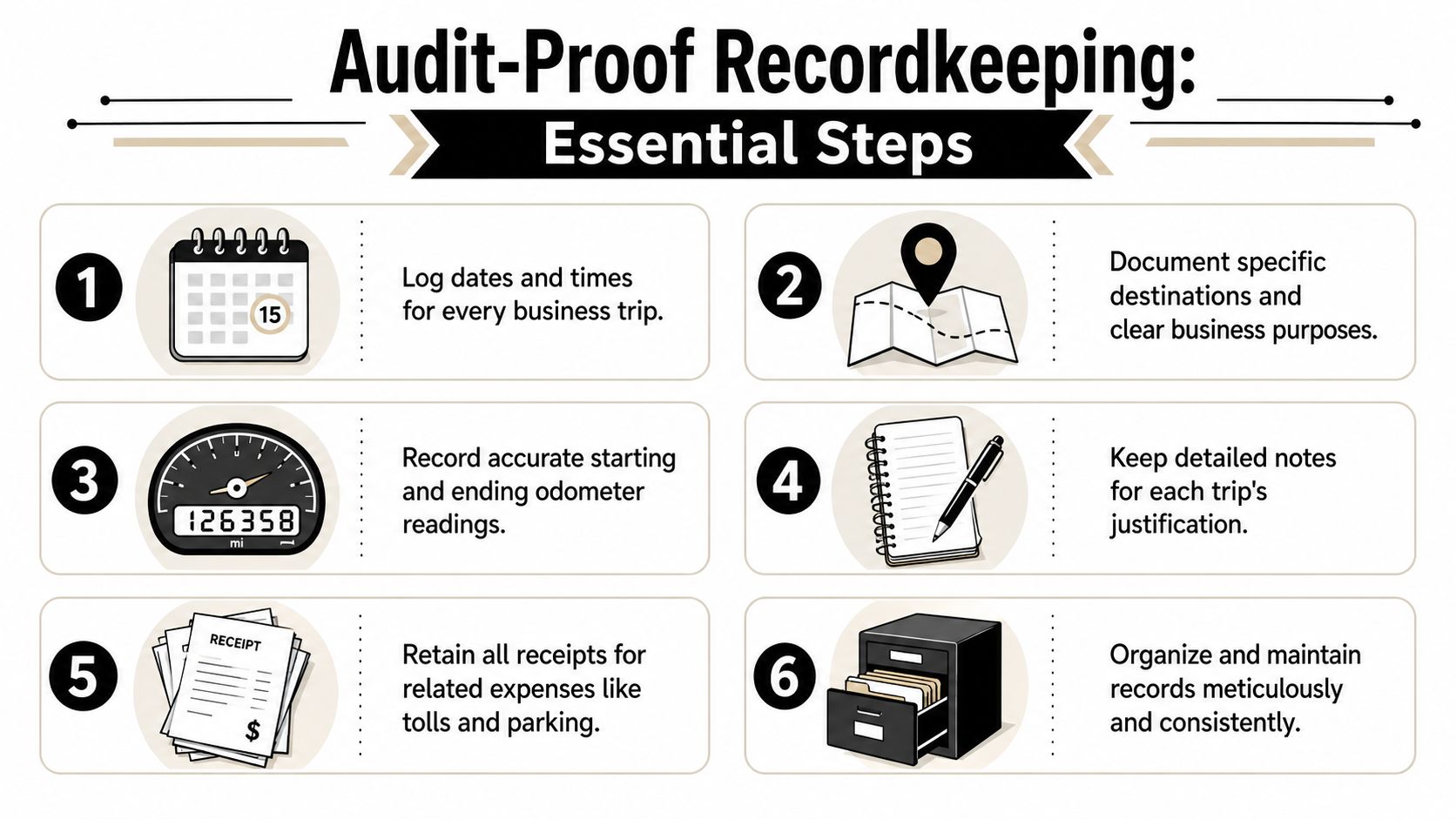
For mileage, the strongest records are contemporaneous. That means the log is created close to the time of the trip, not built at year end from memory. A defensible log should show the date, destination, business purpose, and miles driven for each business trip. Parking and tolls should also be retained if you're claiming them where appropriate.
A weak log usually has one of three problems. It's incomplete, it's vague, or it was reconstructed after the fact with suspiciously uniform entries. Any of those can invite deeper questions.
If your current system for receipts and notes is disorganized, guidance on ensuring compliance for expense notes can help tighten the process before small recordkeeping gaps become bigger tax problems.
Reimbursements don't have to match the IRS rate
This point matters for employers and small business owners who reimburse workers for using their own vehicles.
Employers can legally reimburse employees at a rate lower than the IRS standard of 67 cents per mile without violating the FLSA, because the U.S. Department of Labor confirmed that a “reasonable rate” can be permissible. The critical distinction is that the IRS mileage rate functions as the maximum for non-taxable reimbursement, not a required payment floor, as discussed in this analysis of the DOL position on mileage reimbursement.
That creates a strategic choice. Some employers assume they must always reimburse at the IRS rate. That isn't necessarily true. But cutting the rate without a sound policy can still create wage-and-hour issues or employee-relations problems, especially if the reimbursement practice effectively shifts business costs onto low-wage workers.
Use a reimbursement policy because it's defensible, not because it's cheap.
Risk management beats cleanup
From an audit perspective, mileage issues often become credibility issues. If the IRS thinks the records were built backward, or if the reimbursement arrangement is informal and inconsistent, the problem can spread beyond the vehicle deduction itself.
A sound approach usually includes:
- A consistent logging method: App, spreadsheet, or written log. What matters is consistency.
- Clear trip descriptions: “Client meeting” is better than nothing. “Client meeting at lender office” is stronger.
- A written reimbursement policy: Employers should document how mileage is submitted, reviewed, and paid.
- Expense system discipline: Mileage records should align with calendars, invoices, and job records where possible.
For businesses trying to tighten the full documentation process, this guide on how to track business expenses fits naturally with mileage compliance because scattered expense systems tend to produce scattered mileage proof too.
Practical Takeaways for Business Owners
A business owner drives all year, claims a healthy mileage deduction, and then gets asked six months later to prove where those miles came from. The rate matters, but the main issue is whether the deduction will survive scrutiny.
For that reason, the best takeaway is simple. Make mileage decisions based on defensibility, not convenience.
Choose your deduction method on purpose. The standard method can save time and reduce administrative drag. Actual expenses can produce a better result in the right fact pattern, especially for higher-cost vehicles or heavy business use. But the better method on paper is not always the better method in an audit if the records are weak, incomplete, or inconsistent with the rest of the return.
Treat mileage logs the same way you would treat signed contracts or payroll records. If an entry is vague, entered late, or unsupported by calendars, invoices, route history, or client files, the IRS can question more than the vehicle deduction. In practice, mileage problems often signal broader recordkeeping issues, and that can expand the scope of an exam.
Employee reimbursement requires a separate analysis. Tax compliance is only part of the job. A reimbursement practice also has to fit your payroll process, your written policies, and, in some cases, state wage-and-hour rules. A policy that saves money in the short term can create disputes with employees or create exposure that costs more to fix later.
This is also a planning issue, not just a tax reporting issue. Owners who build mileage procedures into budgeting, job costing, and reimbursement workflows usually make better decisions across the business. That broader connection is part of strategic financial planning for growth, because weak documentation in one area often shows up as missed deductions, poor forecasting, or cleanup costs later.
Before year-end, review your method, your logs, and your reimbursement policy while there is still time to correct gaps. A practical small business tax checklist can help you catch issues before they turn into notices, disallowed deductions, or expensive reconstruction work.


