Navigating The 1120 Late Filing Penalty For Your Business
Confused by the 1120 late filing penalty? This guide explains IRS rules, abatement options, and how to protect your C-Corp from costly fees.

In this article
- Understanding The Form 1120 Late Filing Penalty
- Who Is At Risk For This Penalty
- Key Aspects Of The 1120 Late Filing Penalty
- How The IRS Calculates Penalties And Interest
- A Practical Example of the Penalty Calculation
- The Debt Amplifier: How Interest Makes Things Worse
- Understanding Failure To File Vs. Failure To Pay
- The Costly Difference Between Filing and Paying
- Comparing The Two Main Corporate Tax Penalties
- What Happens When Both Penalties Apply
- How To Get IRS Penalties Removed
- Arguing Reasonable Cause for Penalty Removal
- Qualifying for First-Time Penalty Abatement
- Your Step-By-Step Plan For Resolving Tax Penalties
- Step 1: File All Overdue Returns Immediately
- Step 2: Pay What You Can Toward The Tax Bill
- Step 3: Choose Your Abatement Strategy
- Step 4: Formally Request Penalty Abatement
- Step 5: Know When To Engage A Professional
- Common Questions About The 1120 Penalty
- What If My Corporation Files Late With An Extension?
- Can I Get A Penalty Removed If My Accountant Made A Mistake?
- Is There A Penalty For Filing Late If No Tax Is Owed?
- How Long Do I Have To Request Penalty Abatement?
When it comes to corporate taxes, few things can sting quite like the 1120 late filing penalty. This isn't just a slap on the wrist; the IRS levies this charge against C Corporations that don't file their Form 1120 tax return on time. The penalty is based on a percentage of the unpaid tax and, crucially, it grows every month your return is late, making it a problem that gets expensive fast.
Understanding The Form 1120 Late Filing Penalty

Think of it this way: the penalty for paying your tax late is like a standard late fee, but the penalty for filing late is more like a high-interest credit card. It’s designed to escalate quickly and can become a major financial headache if you let it slide.
The IRS created this penalty to send a clear message: filing your tax return on time is a core business obligation. They see filing the return and paying the tax as two separate duties. This is a critical distinction because, as many business owners discover the hard way, the failure-to-file penalty is far more severe than the failure-to-pay penalty.
Who Is At Risk For This Penalty
Simply put, any C Corporation that has to file a Form 1120 is on the hook. This is true whether your company owes a mountain of tax, broke even, or even ended the year with a net loss. While the penalty calculation depends on the tax you owe, the legal requirement to file exists no matter your company's profitability.
Of course, you can't be late if you know your deadline. Getting a firm handle on the 1120 due date for C corporations is the first and most important step to avoiding this mess altogether. Blowing past this deadline, or the extended one if you filed Form 7004, is precisely what triggers the penalty clock.
The IRS formula is straightforward but punishing: the penalty is based on how much tax you haven't paid and how many months have passed since your due date. This structure means every single day of delay costs your company real money.
If a corporation has let this slip for multiple years, the problem compounds well beyond just penalties. Our guide on tackling unfiled tax returns digs into the broader strategies needed for these more complex situations.
To help you get a quick grasp of the fundamentals, here’s a breakdown of what every business owner needs to know.
Key Aspects Of The 1120 Late Filing Penalty
| Concept | Brief Explanation | Why It Matters To You |
|---|---|---|
| Penalty Trigger | Failing to file Form 1120 by the deadline. | This is the action that starts the penalty clock, regardless of whether you can pay the tax. |
| Calculation Basis | A percentage of the unpaid tax on the return. | The more tax you owe, the higher the penalty will be. A zero-tax liability generally means no penalty. |
| Growth Rate | The penalty accrues monthly, with a maximum cap. | The liability snowballs over time, making delays very costly for your business's cash flow. |
| Extension Nuance | An extension to file is not an extension to pay. | Filing Form 7004 gives you more time to submit paperwork, but tax is still due by the original date. |
This table covers the basics, but understanding these points is crucial for protecting your company's bottom line from unnecessary IRS fees.
How The IRS Calculates Penalties And Interest
Trying to figure out IRS penalty math can feel like you're staring at a black box. But once you understand the logic, the formula for the 1120 late filing penalty is actually quite simple. The IRS calculates it based on a percentage of your unpaid tax, and it grows for each month—or even part of a month—that your return is late.
That structure means being just a few days late can cost you.
The penalty is a steep 5% of the unpaid tax for every month or partial month the return isn't filed. The IRS does cap this, but the ceiling is high at a maximum of 25% of your total unpaid tax. The clock starts running the day after your filing deadline (including extensions) and only stops once the IRS physically receives your return.
This progressive calculation can quickly turn a manageable tax bill into a serious corporate debt.
A Practical Example of the Penalty Calculation
Let's walk through a real-world scenario to see just how fast these penalties can escalate.
- Your C-Corporation's Tax Bill: $20,000
- Filing Delay: 3 months late
Here’s the breakdown of how the IRS will calculate what you owe for failing to file on time:
- Calculate the Monthly Penalty: $20,000 (unpaid tax) x 5% = $1,000 per month.
- Calculate the Total Penalty: $1,000 (monthly penalty) x 3 months = $3,000.
In this situation, a three-month delay on a $20,000 tax bill adds another $3,000 in late filing penalties. Your immediate debt to the IRS is now $23,000, and that’s before we even talk about interest. This simple example shows how every day of inaction digs a deeper financial hole. To learn more about building a solid defense, you can avoid tax penalties with our comprehensive compliance playbook.
The Debt Amplifier: How Interest Makes Things Worse
The pain doesn’t stop with the failure-to-file penalty. On top of that, the IRS charges interest, and this is where a bad situation can truly snowball. Think of interest as a debt amplifier—it applies not just to your original tax bill, but to the penalties, too.
Interest is charged on the original unpaid tax and on the accrued penalties. This compounding effect means you are essentially paying interest on top of your penalties, creating a cycle that can rapidly increase your total debt to the IRS.
The IRS sets the interest rate quarterly, calculating it as the federal short-term rate plus 3%. While that might not sound like much, it compounds daily and adds up fast.
Let's go back to our example:
- You owe the original $20,000 in tax.
- You've racked up $3,000 in late-filing penalties.
- Interest will now be calculated on the new, higher total of $23,000.
This compounding is precisely why a single missed deadline can trigger a cascading financial problem. It highlights why you absolutely must file your corporate return as quickly as possible—even if you can’t pay—to stop the more severe late-filing penalty from growing and to shrink the balance that interest is calculated on.
Understanding Failure To File Vs. Failure To Pay
Many business owners get these two terms mixed up, often using "Failure to File" and "Failure to Pay" as if they mean the same thing. In the eyes of the IRS, they are two very distinct issues, and confusing them can be an expensive mistake. The 1120 late filing penalty is tied directly to one of these, and it's by far the more damaging of the two.
I often tell clients to think of it like their annual car inspection. The "Failure to File" penalty is like skipping the inspection entirely. The state has no idea if your car is even road-worthy, so they hit you with a harsh fine to force you to show up. On the other hand, the "Failure to Pay" penalty is like getting the inspection done on time but not having enough cash to cover the fee. You did the most important part, so the ticket you get is much more manageable.
The Costly Difference Between Filing and Paying
Where this really hits your bottom line is in the penalty rates themselves. The difference is staggering.
The Failure to File penalty clocks in at 5% of the unpaid tax for each month (or even part of a month) that your return is late. This penalty keeps growing until it hits a cap of 25%. In sharp contrast, the Failure to Pay penalty is only 0.5% of the unpaid tax per month, though it also maxes out at 25%.
That's a tenfold difference in the monthly hit. A 5% penalty versus a 0.5% one can blow a huge hole in your company’s finances, especially if the delay drags on. This is precisely why the IRS is much more concerned with getting your tax return than getting your money immediately. Your return gives them the data they need to assess your tax liability in the first place.
The most important rule for any business owner facing a cash crunch is to always file your Form 1120 on time, even if you cannot pay the tax owed. Filing the return stops the aggressive Failure to File penalty from starting, saving your company a significant amount of money right away.
Just by taking that one step, you move out of the brutal 5% monthly penalty zone and into the much more forgiving 0.5% category. It is the single most effective move you can make to control the financial damage of a looming tax deadline.
Comparing The Two Main Corporate Tax Penalties
To see the difference in black and white, it helps to put the two penalties side-by-side. This quick comparison makes it crystal clear which one the IRS treats with more urgency.
| Attribute | Failure-to-File Penalty | Failure-to-Pay Penalty |
|---|---|---|
| Trigger | Not submitting Form 1120 by the due date. | Filing Form 1120 on time but not paying the tax due. |
| Monthly Rate | 5% of the unpaid tax. | 0.5% of the unpaid tax. |
| Maximum Penalty | 25% of the unpaid tax. | 25% of the unpaid tax. |
| Urgency | Extremely high. This penalty grows 10x faster. | High, but less severe than the filing penalty. |
While the 1120 late filing penalty is a major focus, it's just one piece of the compliance puzzle. Remember that the IRS looks at your business's entire tax picture. Neglecting other responsibilities, like handling payroll compliance issues, can trigger a whole different set of audits and enforcement actions.
What Happens When Both Penalties Apply
So, what happens in a worst-case scenario where a company doesn't file and doesn't pay? The IRS has a special rule for this situation. For any month where both penalties are applicable, the Failure to File penalty is reduced by the amount of the Failure to Pay penalty.
Here’s how that math works out:
- The standard Failure to File penalty is 5% per month.
- The Failure to Pay penalty is 0.5% per month.
- When both apply, the IRS assesses a combined penalty of 5% per month. This is made up of a 4.5% penalty for failing to file and a 0.5% penalty for failing to pay.
This rule prevents the total monthly penalty from going over 5%. But it also shows you what the IRS prioritizes. Even when a business drops the ball on both duties, the failure to file is still the main driver of the penalty. No matter how you look at it, the path to minimizing your 1120 late filing penalty always starts with getting that return submitted.
How To Get IRS Penalties Removed

That pit in your stomach when you open an IRS notice and see a massive penalty? It's a common feeling, but don't panic. That notice isn't necessarily the end of the story. The IRS provides official pathways for businesses to request penalty removal, a process known as penalty abatement.
Knowing your options is the first step toward erasing a costly 1120 late filing penalty. Your two main lifelines are arguing "Reasonable Cause" and qualifying for "First-Time Penalty Abatement." Both programs recognize that sometimes, life gets in the way of running a business perfectly. But here’s the catch: the IRS puts the ball in your court. It's up to you to build a compelling case.
Arguing Reasonable Cause for Penalty Removal
A "Reasonable Cause" argument is your chance to explain to the IRS what went wrong. You need to show that you acted with ordinary business sense and care but were still unable to file your return on time due to circumstances beyond your control.
Simply saying you forgot or got too busy won't cut it. The IRS is looking for genuinely disruptive events that made compliance impossible.
Here are a few classic examples that often qualify:
- Serious Illness or Death: The person responsible for filing—or a member of their immediate family—was incapacitated or passed away.
- Natural Disasters: Your office or records were destroyed by a fire, hurricane, flood, or another disaster.
- Inability to Obtain Records: You tried repeatedly to get the documents needed for your return but couldn't, and you can prove it.
- Official Misinformation: You relied on incorrect advice given to you by an IRS employee or found in an official publication.
You have to be specific and bring receipts—literally. If a key person was in the hospital, provide dated medical documentation. If a flood wrecked your office, have the official reports and insurance claims ready to go. The more proof you have to back up your story, the better your odds. For many businesses, successfully navigating these waters is the core of effective penalty abatement.
Qualifying for First-Time Penalty Abatement
The First-Time Penalty Abatement (FTA) program is an incredibly useful tool, and it's often the easiest path to relief. Think of it as a one-time "free pass" from the IRS for businesses with an otherwise spotless record. It's an administrative waiver designed to reward taxpayers who are normally on top of their obligations.
The real beauty of the FTA is that you don't have to prove why you were late. If your corporation has a great compliance history, the IRS can forgive the penalties for one tax period, no questions asked about the reason.
To get this relief, your corporation must check three boxes:
- Filing Compliance: You've filed all your required returns (or filed for an extension). You can't have any missing tax forms.
- Payment Compliance: You've paid all your taxes or have set up an official plan to pay them, like an installment agreement.
- Clean Penalty History: For the last three years, you haven't been hit with any other significant penalties for the same type of return.
If this was your first misstep after years of doing things right, the IRS is often willing to waive the Failure to File, Failure to Pay, and Failure to Deposit penalties. You can request it by calling the number on your IRS notice or by sending a formal letter explaining that you meet the FTA criteria. It’s a simple but powerful way to fix a one-off mistake.
Your Step-By-Step Plan For Resolving Tax Penalties
Knowing the rules for penalty relief is one thing, but actually getting the IRS to grant it is another challenge entirely. When you’re staring down an 1120 late filing penalty, you need a clear, methodical plan. This isn't the time for guesswork or panic.
Following a proven set of steps is the only way to regain control of the situation and give yourself the best possible shot at a favorable outcome. Let's walk through exactly what you need to do, one step at a time.
Step 1: File All Overdue Returns Immediately
This is the most critical first step, and it's non-negotiable. You have to file any and all overdue Form 1120 returns right now. Do it even if you don’t have the money to pay the tax that’s due.
Why? Because filing is the only way to stop the bleeding. The aggressive Failure to File penalty just keeps getting bigger every month you wait. Think of it like a leaky pipe—the first thing you do is shut off the water. By filing, you’re stopping that nasty 5% per month penalty in its tracks and containing the problem before it gets any worse.
This simple flowchart shows how this first action kicks off the entire resolution process.
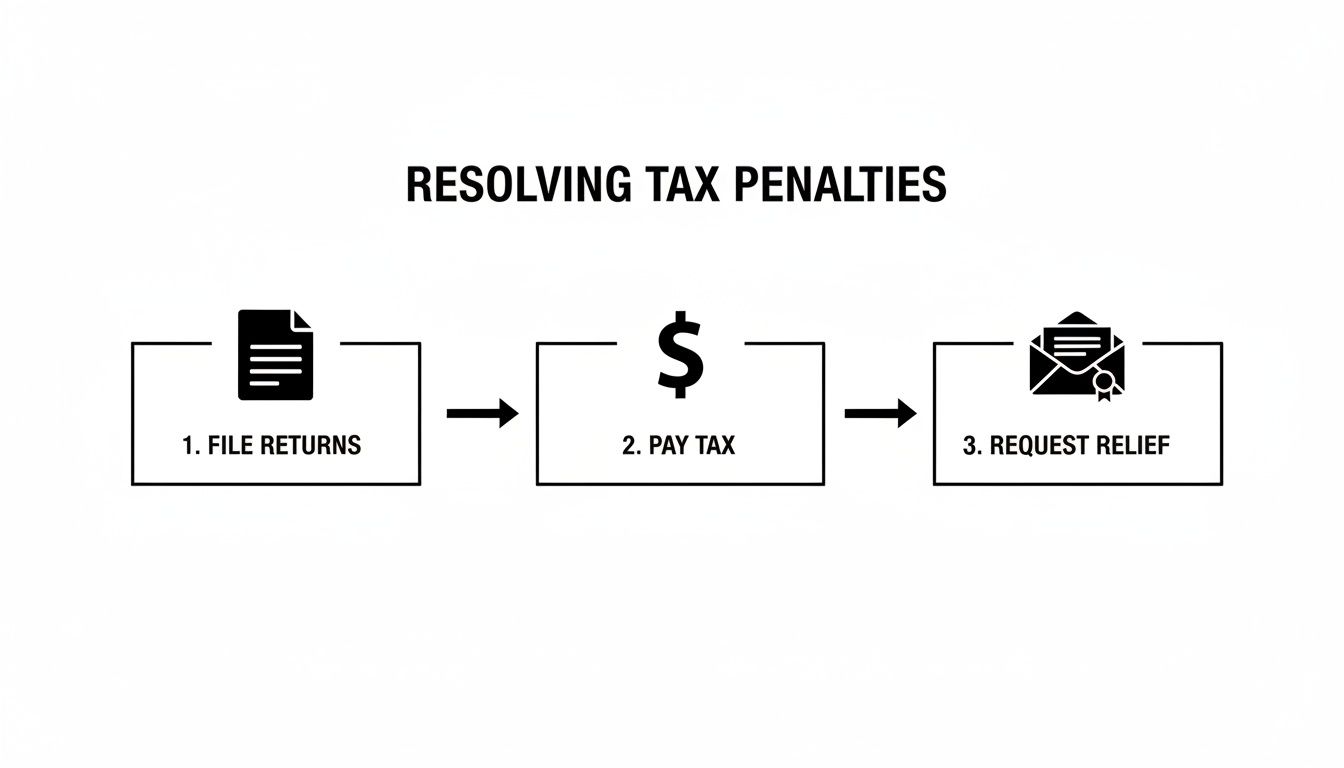
As you can see, everything starts with getting that return on file. Without it, the IRS doesn't have an official record of what you owe, which means you have absolutely no foundation to stand on when asking for relief.
Step 2: Pay What You Can Toward The Tax Bill
Once the returns are in, turn your attention to the tax bill itself. Pay whatever your corporation can reasonably afford as soon as possible. This move is smart for two big reasons.
First, it immediately starts to chip away at the interest that’s piling up daily. Second, it shrinks the ongoing Failure to Pay penalty, which is calculated at 0.5% of the unpaid tax each month. Even a partial payment helps and shows the IRS you’re acting in good faith. If paying it all at once is out of the question, you can look into how to set up a payment plan with the IRS to handle the rest.
Step 3: Choose Your Abatement Strategy
With the immediate damage contained, it's time to get strategic. Look at your corporation’s specific situation and figure out which path to penalty removal makes the most sense. You have two main options:
- First-Time Abatement (FTA): Has your company kept its nose clean for the past three tax years? If your compliance history is good, this is almost always the easiest and quickest way to get relief.
- Reasonable Cause: Was there a serious, unavoidable event that kept you from filing or paying? Things like a death in the family, a major illness, or a natural disaster could qualify. If so, you’ll need to start gathering documentation to prove it.
Picking the right strategy is crucial, as it determines exactly how you'll frame your request to the IRS.
Step 4: Formally Request Penalty Abatement
Now it’s time to officially ask the IRS to wipe away the penalties. You can do this with a formal written request that lays out exactly why you believe you qualify. A detailed letter often works, but using Form 843, Claim for Refund and Request for Abatement, is the more official route.
When you write your request, be direct and stick to the facts. If you're arguing for Reasonable Cause, make sure you attach copies of all your supporting documents, like hospital records or insurance reports, to back up your story.
Step 5: Know When To Engage A Professional
This last step is incredibly important: be honest with yourself about whether you’re in over your head. If your case involves a large tax debt, several years of unfiled returns, or a complex argument for Reasonable Cause, it's probably time to call in a professional.
A seasoned tax attorney has been through this process hundreds of times. They know how to navigate the IRS bureaucracy, build the strongest possible case, and negotiate on your behalf to secure the best outcome. Don't be afraid to ask for help.
Common Questions About The 1120 Penalty
Even when you understand the basic math behind the 1120 late filing penalty, the real world always throws curveballs. Business owners constantly run into "what if" scenarios that can create a ton of anxiety.
Getting clear answers is the best way to move forward with confidence. Let's dig into some of the most common questions I hear from clients to clear up any lingering confusion.
What If My Corporation Files Late With An Extension?
This is a classic—and costly—misunderstanding. Filing Form 7004 gives your corporation more time to file the paperwork, but it does not give you more time to pay the tax you owe. Your tax bill is still due by the original deadline.
If you file your return after the extended deadline passes, the failure-to-file penalty clock starts ticking from that new, extended date.
But here’s the kicker. For your extension to be valid in the eyes of the IRS, you must have paid at least 90% of your total tax liability by the original due date. If you don't hit that mark, the IRS can invalidate your extension entirely. This is a worst-case scenario, as it means penalties are calculated all the way back from the original deadline, making them much, much larger.
Can I Get A Penalty Removed If My Accountant Made A Mistake?
The hard truth? Generally, no. The IRS holds you—the taxpayer—as the one ultimately responsible for filing and paying on time. Blaming your CPA or tax preparer is an argument that almost always falls flat.
The IRS’s logic is that you chose to hire that professional, and their failure is simply an extension of your own responsibility.
To have even a remote chance of success, you'd need to provide overwhelming evidence that you exercised "ordinary business care and prudence." This means proving you gave your accountant all the necessary information and records well before any deadlines.
If you can show the mistake was due to truly extraordinary circumstances, like your accountant's sudden incapacitation or death, you might have a case. But this is an incredibly high bar to clear and almost always requires the help of a tax attorney to argue effectively.
Is There A Penalty For Filing Late If No Tax Is Owed?
Here's a bit of good news. The 1120 late filing penalty is a percentage of the unpaid tax on the return. So, if your Form 1120 shows zero tax due or even a refund, there is no failure-to-file penalty.
After all, 5% of zero is still zero.
But don't get into the habit of filing late just because no tax is due. It's a terrible practice for several reasons:
- Your Compliance History: Every late filing, even a $0 one, puts a black mark on your compliance record. This can make you ineligible for a First-Time Penalty Abatement down the road when you really need it for a return that does have tax due.
- The Statute of Limitations: The IRS typically has three years from the date you file to audit a return. If you never file, that three-year clock never starts. This leaves that tax year open to an audit indefinitely.
- Your Corporate Standing: Chronic late filing can cause problems with state agencies and may even jeopardize your corporation's good standing.
The bottom line: Always file on time, no matter what your final tax liability looks like.
How Long Do I Have To Request Penalty Abatement?
The IRS is strict about deadlines, and that includes the one for asking for your money back. This deadline is called the statute of limitations, and if you miss it, you forfeit your right to a refund or abatement of penalties you've already paid.
Generally, you have the later of these two timeframes:
- Three years from the date you filed the return, OR
- Two years from the date you paid the tax related to the penalty.
The deadline that gives you more time is the one that applies. If you're just asking for an abatement of a penalty you haven't paid yet, the two-year rule doesn't come into play. Still, waiting years to deal with an unpaid penalty is a bad strategy. The best move is always to act as soon as you receive that first notice from the IRS.
If you're facing a significant 1120 late filing penalty or other complex tax issues, you don't have to face the IRS by yourself. Attorney Stephen A. Weisberg offers a FREE Tax Debt Analysis to map out the best path forward for your business. You won't get high-pressure sales tactics—just a clear, honest assessment of your options. Take the first step toward peace of mind by visiting https://weisberg.tax today.


