1098 Form Taxes: A Guide to Deductions & Credits
Confused by 1098 form taxes? Learn how Form 1098, 1098-T, and 1098-E affect your deductions and credits, and what to do if your form is missing or wrong.
In this article
- Your Guide to Navigating 1098 Forms
- What Is the Form 1098 Family
- Why these forms exist
- The common members of the family
- Decoding the Most Common 1098 Forms
- Form 1098 for mortgage interest
- Form 1098-E for student loan interest
- Form 1098-T for tuition reporting
- A practical comparison
- From Form to Tax Return How 1098s Impact Your Filing
- Mortgage interest workflow
- Student loan interest workflow
- Education credit workflow
- Missing or Incorrect 1098s What to Do Next
- Start with expectation, not frustration
- Build your own reconciliation file
- Contact the issuer with a specific request
- The Taxpayer Documentation Checklist
- What to keep by category
- What the file should answer
- When a 1098 Problem Needs a Tax Attorney
You're sorting tax documents, and one of the envelopes says 1098. Maybe it came from your mortgage lender. Maybe your loan servicer sent a 1098-E. Maybe your child's school posted a 1098-T in a student portal you forgot existed. You know it matters, but the form itself rarely answers the question you have, which is simple: What can I legally claim on my tax return, and how do I prove it if the IRS asks?
That gap causes most of the trouble I see with 1098 form taxes. Taxpayers assume the form controls the result. It doesn't. The form is a reporting document. It often starts the analysis, but it doesn't always finish it. A correct claim can be larger, smaller, or different from what a 1098 seems to suggest, depending on the underlying records and the tax rule involved.
That's why a routine tax season issue can turn into a controversy issue fast. If your return doesn't match what a lender, school, or servicer reported to the IRS, the IRS may ask questions. That doesn't mean your position is wrong. It means you need to be able to support it.
Your Guide to Navigating 1098 Forms
A typical file looks ordinary until you put the pieces side by side.
There's a mortgage interest statement in one stack, a tuition statement in an online account, and a student loan interest form sitting unopened because it looked informational. Then tax software asks a few short questions and gives the impression that entering the forms is enough. Sometimes it is. Often it isn't.
The practical problem is that 1098 form taxes sit at the intersection of reporting and proof. The issuer reports something to you and to the IRS. You then decide whether the reported amount supports a deduction or credit, whether more documentation is needed, and whether the form is even complete enough to rely on.
Practical rule: Treat every 1098 as a lead, not a verdict.
That matters most with education forms. A school may issue a 1098-T because eligible educational institutions generally must file it for each student with reportable transactions and furnish a copy to the student, and schools generally issue the form by January 31 as part of the annual tax cycle under the framework tied to the Taxpayer Relief Act of 1997 and the education credits that followed (TurboTax overview of the 1098 family). But even when the form arrives on time, it may not answer the actual tax question without backup records.
The same pattern shows up with mortgage and student loan reporting. The form tells the IRS what a third party says happened. Your return tells the IRS what you claim under the law. Those aren't always identical, and that's where careful documentation matters.
If you approach 1098 form taxes this way, the forms get easier to handle. You stop asking, “What box do I copy?” and start asking, “What does this form report, what tax benefit might it relate to, and what records defend my position?”
What Is the Form 1098 Family
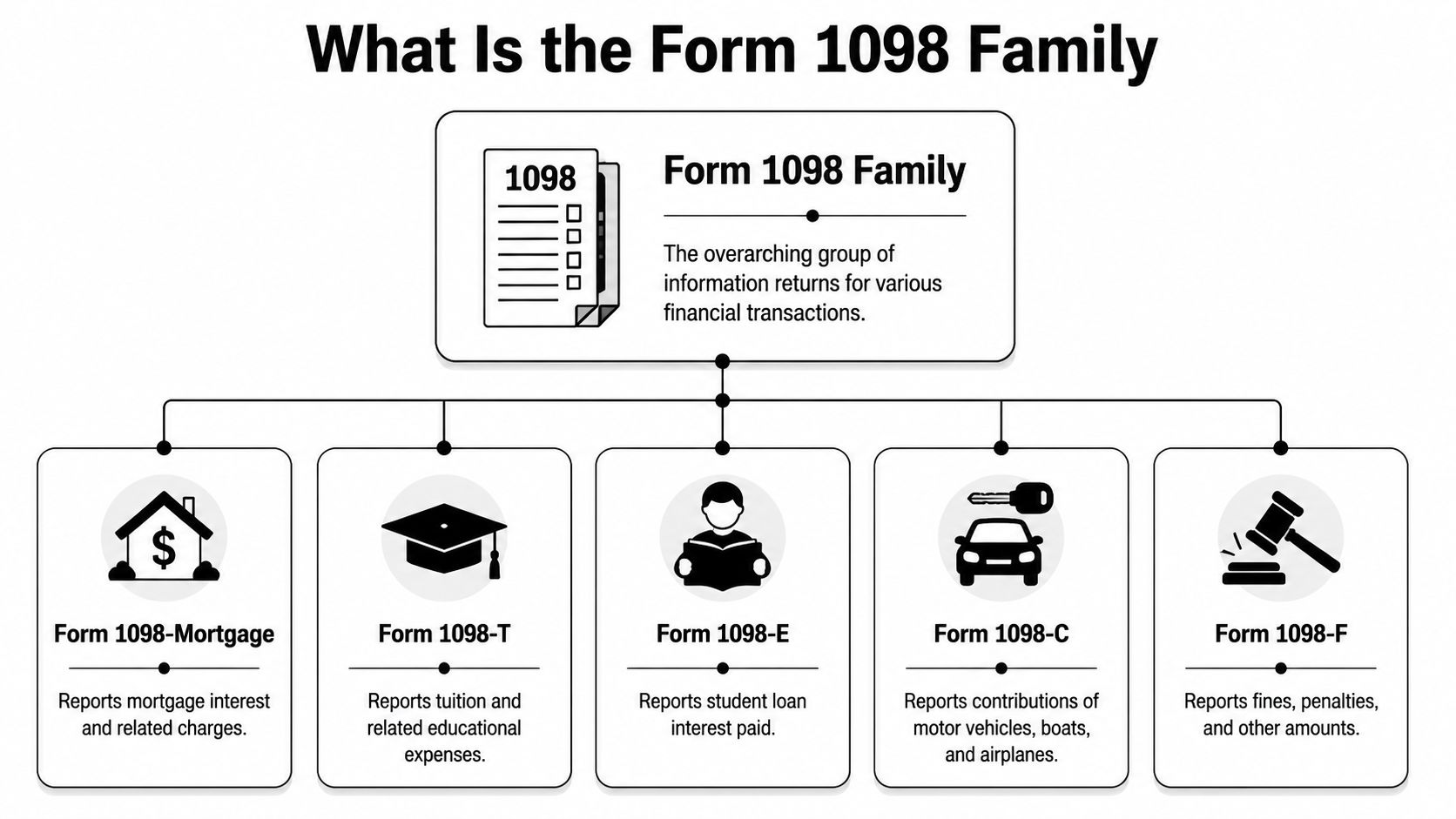
Form 1098 is not one form. It's a family of information returns used to report specific tax-relevant payments and transactions.
A useful way to think about the 1098 family is this: it's like a receipt that gets copied to the IRS. The lender, school, or other issuer sends you a version, but its primary purpose is third-party reporting. That lets the IRS compare what was reported about you with what you claimed on your return.
Why these forms exist
The government relies heavily on information returns because they create an independent paper trail. If a taxpayer claims mortgage interest, education credits, or student loan interest, the IRS can compare that claim against a corresponding 1098.
That reporting function is why these forms matter even when they seem routine. They are not tax bills. They are not refunds. They are not final proof that a deduction or credit is allowed. They are matching documents.
The common members of the family
Most individual taxpayers run into a small group of 1098 forms over and over:
| Form | What it generally reports | Who usually issues it |
|---|---|---|
| Form 1098 | Mortgage interest and related information | Mortgage lenders |
| Form 1098-E | Student loan interest paid | Student loan servicers or lenders |
| Form 1098-T | Qualified tuition and related education reporting | Eligible educational institutions |
| Form 1098-C | Certain vehicle, boat, and airplane donation reporting | Donee organizations |
| Form 1098-F | Certain fines, penalties, and other amounts | Governmental entities |
For most clients, the practical work centers on the first three. Those are the forms most likely to affect annual filing positions for deductions and credits.
The IRS sees a 1098 as third-party reporting. You should see it as one piece of substantiation.
That mindset becomes even more important once the form leaves the mailbox and starts affecting a live tax return.
Decoding the Most Common 1098 Forms
A client receives a 1098, sees a number in a box, and assumes the return is basically done. That is where avoidable problems start. These forms are useful, but each one reports a limited slice of the facts. The filing position still has to match what the tax law allows and what the taxpayer can prove if the IRS asks questions later.
Form 1098 for mortgage interest
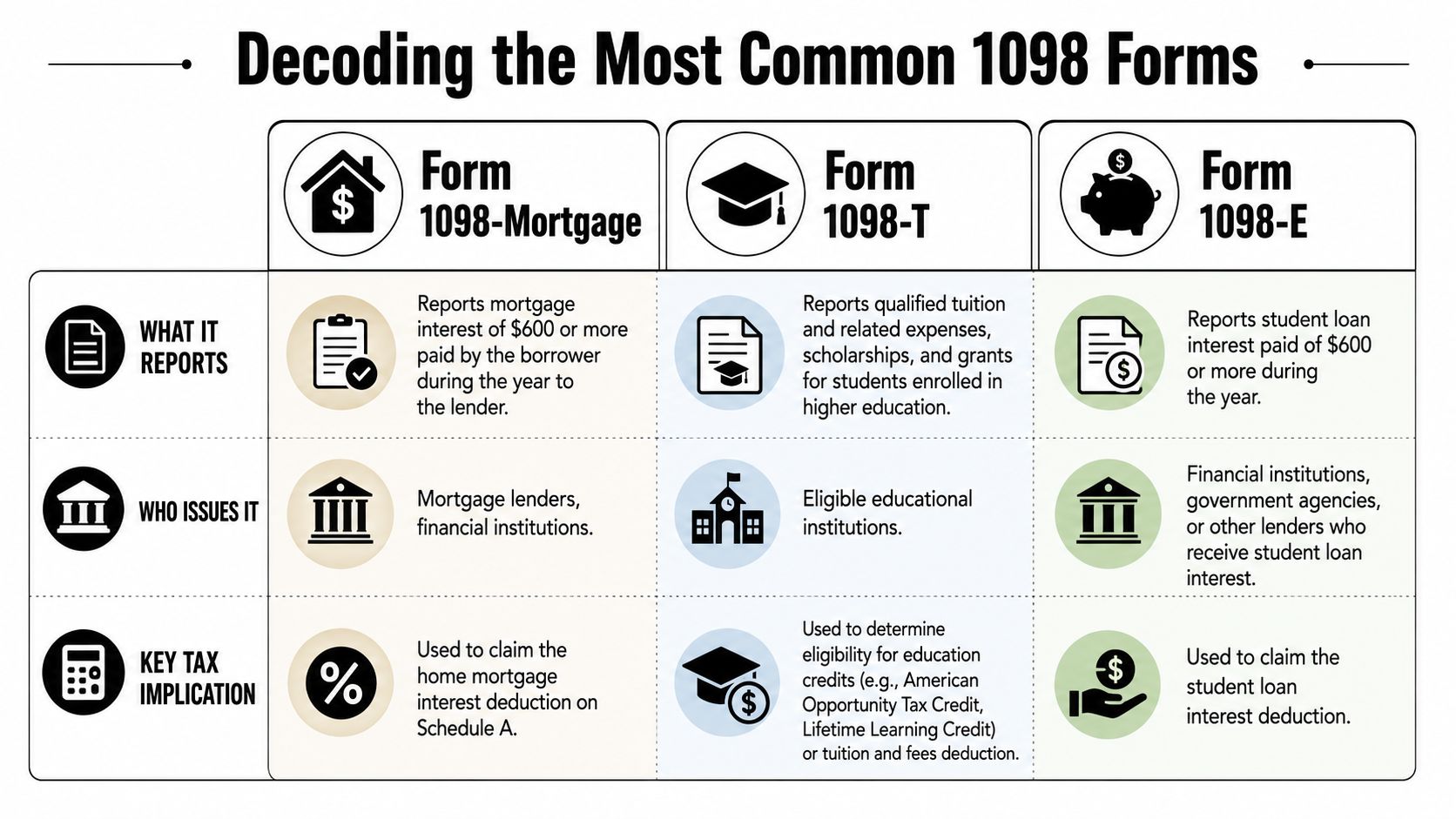
The standard Form 1098 reports mortgage interest received by the lender. The IRS describes the filing requirement and the basic reporting rules in its Form 1098 guidance. For the taxpayer, the practical issue is narrower. The form helps identify what the lender reported under your name and loan. It does not settle whether the full amount is deductible on Schedule A.
That distinction matters in ordinary situations, not just unusual ones. A servicing transfer, refinance, loan payoff, home equity borrowing, or mixed personal and rental use can break the easy assumption that the form amount equals the deduction. I often tell clients to treat the 1098 as the first draft of the mortgage interest analysis.
Use the form this way:
- Start with the reported figure, then compare it to the lender's year-end statement and monthly payment history.
- Confirm the loan and property information matches the return, especially after a refinance or servicing transfer.
- Check whether all interest shown is deductible under the mortgage interest rules that apply to your use of the property and the purpose of the debt.
Problems usually come from overreliance on the form, not from the form existing at all. If the lender posted payments across two servicers, issued a corrected form late, or reported interest connected to a loan that was partly used for a non-deductible purpose, the taxpayer needs records beyond the 1098. If the return was already filed using the wrong figure, the fix may involve amending a tax return to correct reported mortgage interest or related deductions.
Form 1098-E for student loan interest
Form 1098-E reports student loan interest received by a lender or servicer. The IRS explains the form and its reporting role in its Form 1098-E overview. Taxpayers often read the form as a green light for the deduction. It is better viewed as supporting evidence that still has to be checked against the borrower's facts.
The trade-off here is simple. This form is usually cleaner than a 1098-T, but it still produces errors in practice. Consolidations, servicer changes, and online account gaps can leave borrowers with incomplete year-end records. A missing form does not automatically mean no review is needed, and an issued form does not automatically mean the deduction will survive scrutiny.
Review points that matter:
- Match the form to the correct borrower and tax year.
- Compare the reported interest to account history, especially if the loan was transferred or consolidated.
- Keep payment records and statements if the amount on the form looks incomplete or inconsistent.
Form 1098-T for tuition reporting
Form 1098-T causes the most confusion because schools report educational information that does not always line up neatly with what the taxpayer can claim. The IRS explains how educational institutions use the form and how it relates to education benefits in its Form 1098-T instructions and overview. That relationship is important, but it is not automatic.
A 1098-T can support an education credit analysis. It does not answer the full question of qualified expenses paid during the year, how scholarships were applied, or whether the student and taxpayer otherwise qualify for the credit. Schools frequently report data on a calendar-year basis while academic billing operates on a semester schedule. That timing mismatch is one reason taxpayers get into trouble by copying box amounts into software without reconciling the school account.
This is the form where the gap between reporting and legal entitlement shows up most clearly.
A taxpayer may have a 1098-T and still overclaim a credit. A taxpayer may also have a flawed or incomplete 1098-T and still be entitled to a credit if billing statements, account ledgers, scholarship records, and proof of payment support the position. That is why box-by-box explanations only get you part of the way there.
A 1098-T often starts the education credit file. It rarely finishes it.
A practical comparison
| Form | What it reports | What still has to be proven |
|---|---|---|
| 1098 | Mortgage interest received by the lender | Whether the interest is deductible and in what amount |
| 1098-E | Student loan interest received by the servicer or lender | Whether the borrower can claim the deduction based on the actual account and return facts |
| 1098-T | Tuition-related reporting from the school | What qualified expenses were paid, how scholarships apply, and whether the credit is legally allowed |
For 1098 form taxes, the key point is not what the form says by itself. The key point is whether the taxpayer can connect that form to the underlying records and defend the amount claimed on the return.
From Form to Tax Return How 1098s Impact Your Filing
A client brings in a stack of tax documents, sees a 1098, and assumes the return is mostly done. That assumption causes problems. A 1098 is a reporting form. The return still has to reflect what the tax law allows, and those two numbers are not always the same.

Mortgage interest workflow
For mortgage interest, Form 1098 is one input in the itemized deduction analysis. The taxpayer still has to confirm that the loan relates to a qualified residence, that the interest was paid in the tax year, and that the deduction rules apply to that specific debt. If the loan was transferred, refinanced, or partially paid through escrow adjustments, the form may need to be reconciled to year-end statements and payoff records.
I tell clients the same thing every filing season. The lender reports what it received. The return reports what the taxpayer can legally deduct.
That distinction matters when servicing changes midyear or when points, insurance, or property taxes appear on statements and get confused with deductible interest.
Student loan interest workflow
Form 1098-E is narrower, but it still should not be treated as auto-pilot. The reported amount feeds the student loan interest deduction analysis, yet the taxpayer must confirm that the interest belongs to the correct borrower, was paid in the correct year, and fits the rules that apply on that return.
Imported tax software data often creates false confidence. If the servicer reported the wrong amount or tied the payment history to the wrong account, the taxpayer is still the one signing the return. A quick check of annual account history can prevent a mismatch that later has to be explained.
Education credit workflow
Form 1098-T requires the most judgment. Schools issue it to report tuition-related information, but the form does not by itself establish the amount of an education credit. The actual credit is calculated on Form 8863, and that calculation depends on qualified expenses, scholarships and grants, timing of payments, and the taxpayer's eligibility facts. The IRS instructions for Form 8863 make that clear.
In practice, it is often during this process that many otherwise careful returns go off course. A school may report charges and payments in a way that does not line up neatly with the credit year. Scholarships may reduce the expenses that count for the credit. Course materials may matter in one credit analysis and not in another. The 1098-T helps start the calculation, but account ledgers, billing statements, scholarship notices, and proof of payment usually determine whether the claimed credit will hold up.
A 1098-T can support a credit claim. It does not complete the legal analysis.
If a mismatch is found after filing, the next step is to determine whether the original return overstated or understated the deduction or credit and whether a correction is warranted. A practical guide on how to amend a tax return can help with the process. The key work is assembling the facts, reconciling the form to the underlying records, and deciding what amount can be defended if the IRS asks questions later.
Missing or Incorrect 1098s What to Do Next
By the time taxpayers realize a 1098 is missing or wrong, they're often close to filing deadlines and tempted to guess. That's the wrong move.
A missing or incorrect form doesn't automatically destroy a valid deduction or credit. It does raise the stakes. Once your return differs from what a third party reported, or from what the IRS expected to receive, you should assume the discrepancy may need to be explained later.
Start with expectation, not frustration
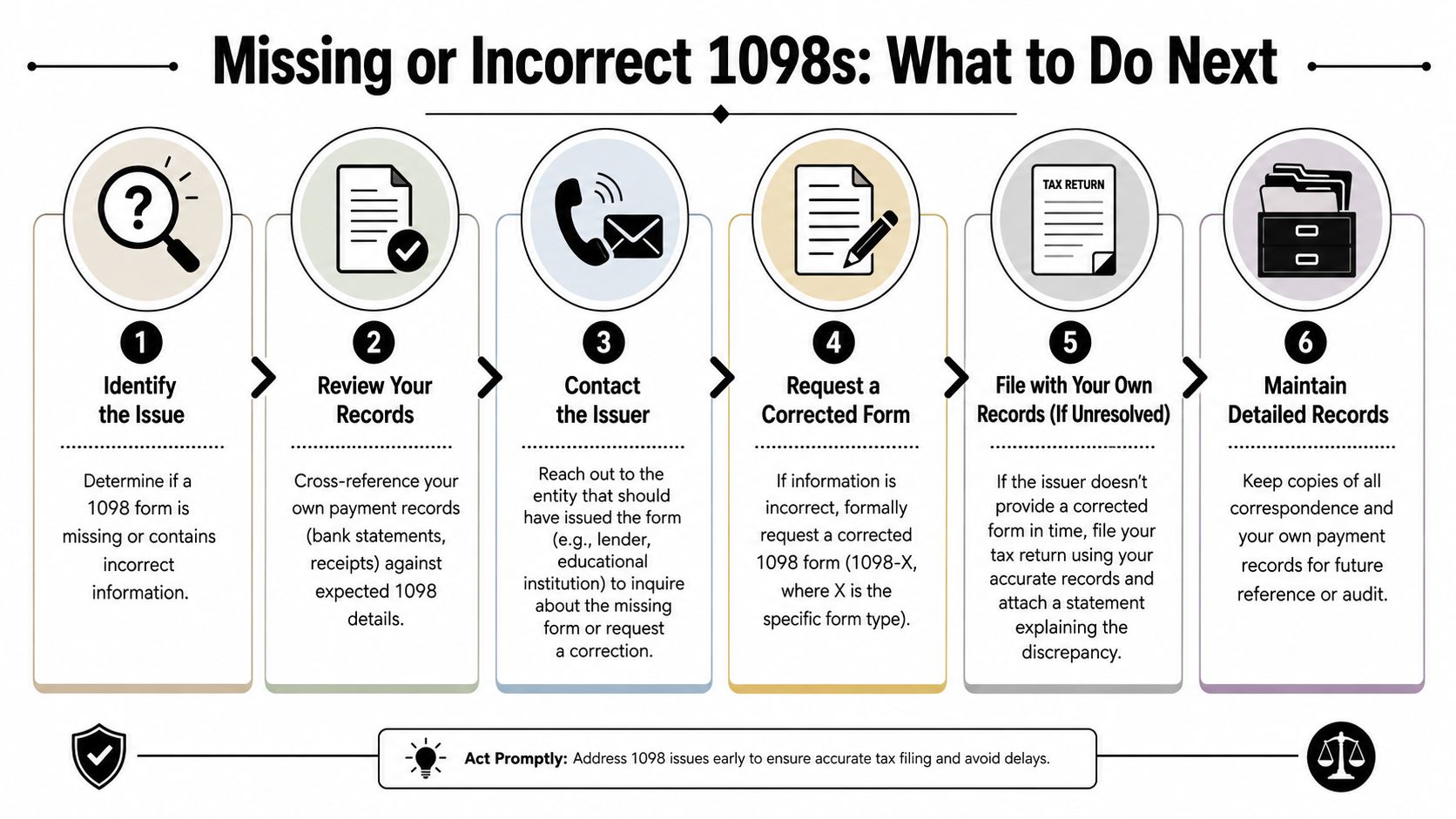
Before calling anyone, determine whether you expected a form.
For mortgage interest and student loan interest, one useful threshold question is whether the reporting trigger was likely met. For education, determine whether the school was an eligible educational institution and whether reportable transactions existed. If the answer is unclear, your own statements usually tell the story faster than a customer service line will.
Build your own reconciliation file
There's often a mismatch between what taxpayers think a 1098 proves and what it legally proves. In the education context especially, school guidance commonly notes that a 1098-T may not reflect the full amount of qualified expenses paid, and taxpayers must reconcile the form with their own records. Discrepancies between a 1098 and a return can trigger automated IRS notices, so documentation matters (ECSI FAQ discussing what a 1098-T does and does not prove).
That means your first file should include:
- Payment proof such as bank records, canceled checks, or card statements
- Issuer statements showing transaction history
- Account correspondence including portal messages or emails requesting correction
- A timeline showing what was paid, when, and how it was applied
Contact the issuer with a specific request
General complaints rarely help. A targeted correction request does.
Use a short written request that identifies the form, the tax year, the specific error, and the supporting records you have. Ask for a corrected form or written confirmation of the account history. If you call, document the date, representative name, and substance of the conversation.
What tends to work:
- Pinpoint the exact issue rather than saying the form is “wrong.”
- Send supporting documents in an organized packet.
- Request written follow-up so you have a paper trail.
What tends to fail:
- Relying on phone assurances alone
- Waiting until after filing season pressure peaks
- Filing a return with unexplained estimates
Keep every communication. In a controversy, your correction request history often matters almost as much as the numbers.
If you discover the issue after filing, timing becomes important. A practical question then is how long the correction window remains open, and how far back you can amend taxes is often part of that analysis.
The Taxpayer Documentation Checklist
The safest way to handle 1098 form taxes is to create a defense file before anyone asks for one. Most tax disputes become harder, not because the taxpayer was wrong, but because the taxpayer didn't keep the right records in one place.
What to keep by category
For mortgage interest, keep the 1098, annual loan statements, payoff records if the loan changed, and closing documents if the issue involves points or other loan charges.
For student loan interest, keep the 1098-E, servicer account histories, payment confirmations, and any notices showing transfers between servicers.
For education credits, keep more than the 1098-T. Hold onto school billing statements, ledger detail, scholarship and grant notices, and proof of payment. If the school portal changes or access disappears after graduation, save copies early.
What the file should answer
Your records should let you answer these questions quickly:
- Who reported it and under what account
- What was paid
- When it was paid
- Why the amount claimed on the return is correct
- What explains any mismatch
That same record discipline helps across other deduction categories too. If you're already organizing tax support, the documentation habits used for 1098 issues overlap with other substantiation-heavy areas such as home office deduction requirements.
A practical issue people overlook is retention. Tax records shouldn't live forever in random drawers, but they also shouldn't be discarded too early. If you need a simple framework for when to dispose of old records, use one and apply it consistently.
When a 1098 Problem Needs a Tax Attorney
A client usually calls at the same point. The return has already been filed, the IRS has sent a notice, and the taxpayer is holding a 1098 that does not fully support what was claimed, or flatly reports the wrong amount.
That is the point where a routine reporting issue can become a legal one.
A tax attorney is worth bringing in when the problem is no longer just collecting records. Common examples include an IRS notice disallowing mortgage interest, a challenge to an education credit because the 1098-T does not match the school account history, or a loan servicer that will not fix a material error on a 1098-E or 1098. The underlying issue is not the form by itself. The issue is whether the taxpayer can prove the deduction or credit under the tax law, even if the form is incomplete, delayed, or wrong.
That gap matters. A 1098 is a starting point, not a safe harbor. I often tell clients and referring CPAs the same thing: the return must be defensible based on the underlying facts, not just explainable by pointing to a box on an information return. Once the IRS questions the claim, the case turns on payment records, account histories, closing documents, school ledgers, and how those records fit the statute and regulations.
Legal help also makes sense when the dollar amount is large enough that interest and penalties could turn a correctable reporting problem into a serious liability. It makes sense when there is a pattern issue across multiple years. It also makes sense when the taxpayer needs someone to frame the response carefully, preserve arguments, and avoid handing the IRS a sloppy record that creates new problems.
A tax attorney does more than answer the notice. Counsel can evaluate whether the issuer's reporting error changes the tax result, identify what documents will carry the issue if the form is never corrected, and present the position in a way that fits the procedural stage of the case. If you are weighing that decision, this guide on when to hire a tax attorney is a useful place to start.
If a 1098 issue has turned into an IRS notice, an audit risk, or a dispute you cannot resolve with the issuer, Attorney Stephen A Weisberg offers a practical next step. He starts with a FREE Tax Debt Analysis to determine whether he can help and what the right path looks like before charging for representation.


